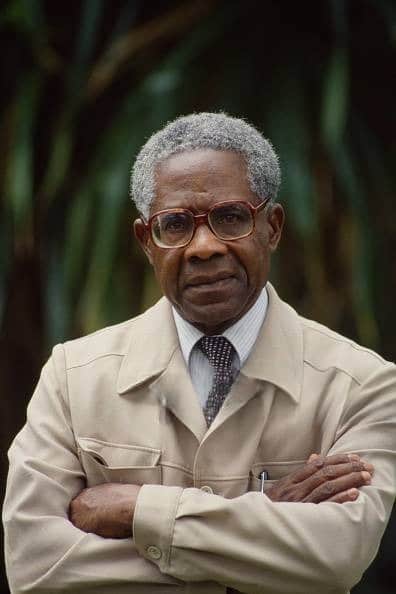
Aimé Césaire remains one of the most structuring intellectual and political figures in contemporary Caribbean history. A major poet of French-language literature, a key anti-colonial thinker and a central figure in Martinique’s public life for over half a century, he had a profound impact on the cultural and political consciousness of the 20th century.
Today, his work and commitment continue to inform debates on identity, memory, social justice and the place of the Caribbean in the world.
Excellent training at the heart of anti-colonial awareness
Aimé Césaire was born into a modest family in Basse-Pointe, Martinique, on June 26, 1913. A brilliant student at the Lycée Schœlcher in Fort-de-France, he won a scholarship to study in Paris. He entered the lycée Louis-le-Grand, then the École normale supérieure in 1935, where he specialized in literature.
In Paris, he met Léopold Sédar Senghor and Léon-Gontran Damas. Together, they took part in the intellectual adventure of The Black Student in 1934. It was in this context that the notion of Negritude of which Aimé Césaire became one of the main theorists. Its aim was to assert black identity in the face of colonial assimilation and restore a long-denied historical and cultural dignity.
Aimé Césaire’s Négritude is more than an assertion of identity. It is a profound reflection on history, memory and the place of colonized peoples in modernity.

Cahier d'un retour au pays natal: a seminal work
First published in 1939, Cahier d’un retour au pays natal is considered one of the major texts of twentieth-century French literature.
In this long poem, he questions the colonial condition, cultural dispossession and the need to reclaim the self. The work is distinguished by a poetic language of rare power, combining striking images, incantatory rhythm and political reflection.
This text marks a break in literary history: it proposes a new way of telling the world from the perspective of the Caribbean, fully embracing the complexity of its history. Cahier d’un retour au pays natal quickly became a reference text for many writers and thinkers in the French-speaking world.

Discourse on colonialism: a radical critique of the colonial system
Published in 1950, Discourse on Colonialism is one of the most important essays in anti-colonial thought.
In it, Aimé Césaire dismantles the ideological foundations of European colonialism and criticizes the notion of a “civilizing mission”. He shows how colonialism produces widespread dehumanization and contributes to trivializing violence. The essay became a reference text for the decolonization movements and many twentieth-century intellectuals.
Even today, Discourse on Colonialism is still studied in universities, and continues to fuel reflections on colonial legacies and their contemporary extensions.

A theatrical work at the heart of historical issues
Aimé Césaire’s dramatic work is an extension of his intellectual commitment.
With The Tragedy of King Christophehe explores the political and social tensions of post-independence Haiti. A Season in the Congo traces the fate of Patrice Lumumba and the challenges facing newly independent African states. A Tempesta free adaptation of Shakespeare, offers a critical reading of colonial relations through the prism of theater.
These works reflect on the power, freedom and responsibilities of societies born of colonization. They bear witness to Aimé Césaire’s determination to place the Caribbean and Africa at the heart of global historical debates.
A lasting political commitment in Martinique
Aimé Césaire’s political action is inseparable from his literary work.
Elected mayor of Fort-de-France in 1945, he held this position until 2001, making a lasting mark on the development and cultural life of the Martinique capital. In 1946, he became deputy for Martinique in the French National Assembly, a position he held until 1993.
He played a decisive role in the adoption of the Departmentalization Act of 1946, which transformed Martinique, Guadeloupe, French Guiana and Reunion into French departments. This reform was seen as a lever for social and legal equality for these territories.
In 1956, he left the French Communist Party and founded the Martinique Progressive Party. He progressively defended a vision of Martinican autonomy within the Republic, seeking to reconcile local development, social justice and cultural recognition.

Tropiques: a Caribbean intellectual laboratory
In 1941, Aimé Césaire co-founded the magazine Tropiques in Martinique. The publication quickly became an essential forum for cultural and political reflection.
Tropiques contributes to the valorization of Martinican and Caribbean culture, while opening up a dialogue with international intellectual currents. The magazine plays a major role in structuring an autonomous Caribbean way of thinking, capable of asserting itself in the face of dominant models.
A lasting intellectual and cultural legacy
Aimé Césaire died on April 17, 2008 in Fort-de-France. His national funeral testifies to the recognition of his historic role. Martinique’s international airport now bears his name, symbolizing a legacy deeply rooted in the Caribbean landscape.
His influence extends far beyond Martinique. His work has influenced generations of writers, artists and thinkers, from the Caribbean to Africa and the Americas. It continues to fuel contemporary reflections on identity, memory and power relations.

A key figure in understanding the contemporary Caribbean
To understand the contemporary Caribbean, Aimé Césaire’s trajectory remains essential. He showed that an intellectual from a colonized territory could produce universal thought without renouncing his roots.
His career illustrates the possibility of combining literary creation, political action and historical reflection. He has contributed to making the Caribbean a major area of intellectual production, capable of dialogue with the world while asserting its singularity.
Aimé Césaire’s work and commitment continue to provide essential insights into the cultural and political dynamics of the contemporary world.
Aimé Césaire was a Martinican poet, playwright, essayist and politician who was born in 1913 and died in 2008. Co-founder of Négritude, he had a profound impact on anti-colonial thought and political life in Martinique.
Aimé Césaire was one of the main founders and theorists of Négritude in the 1930s. This intellectual movement affirmed black cultural identity and criticized colonial assimilation.
Aimé Césaire helped redefine the cultural and political dignity of the Caribbean territories. His literary work and institutional commitment have had a lasting influence on contemporary Caribbean thought.