We’ve reached the halfway point of the series “Stories of Caribbean Cinema.” The first four episodes have spanned nearly three decades of cinema, from Cuba in the 1960s to productions from Martinique and Curaçao in the 1980s. This fifth installment moves into the 1990s with two films set in very different worlds. Euzhan Palcy’s *Siméon* delves into a Caribbean imagination where music, ghosts, and magical realism converge. Raoul Peck’s *The Man on the Quay* revisits François Duvalier’s dictatorship in Haiti through the eyes of a child.
You are now reading the fifth episode in a series of ten. Four episodes have already been published on Richès Karayib, and five more will follow in this series through 2025.
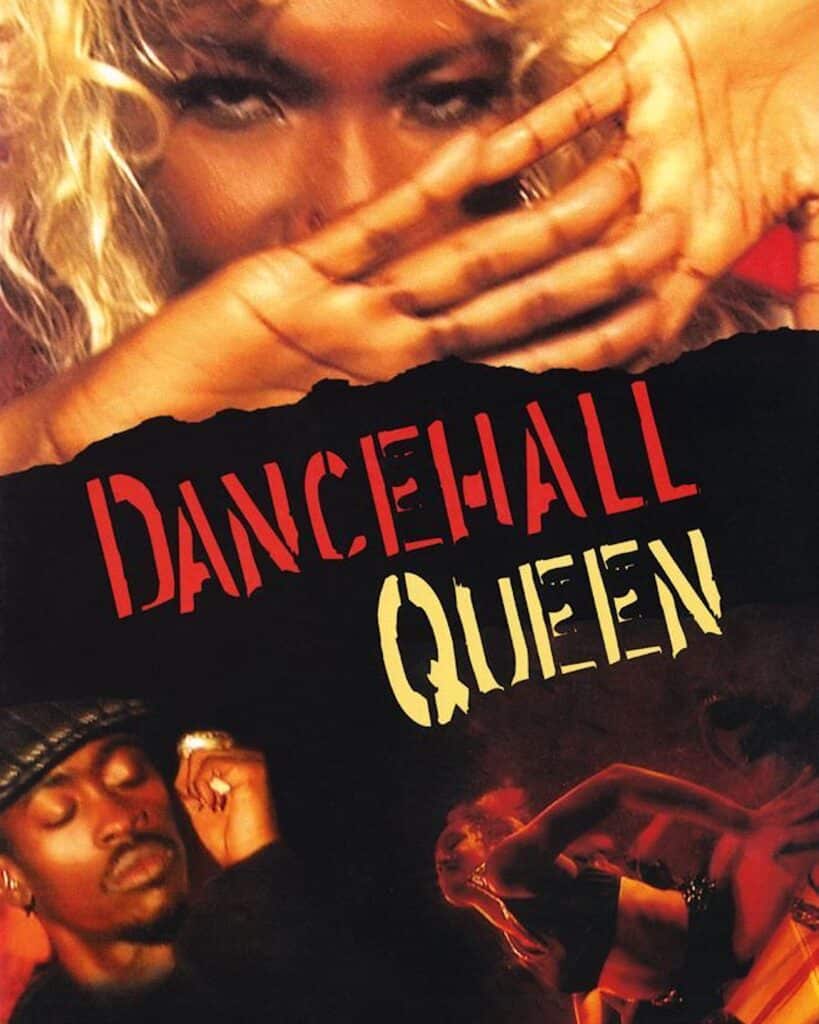
1997: JAMAICA - "DANCEHALL QUEEN" BY RICK ELGOOD & DON LETTS
Dancehall Queen is one of many Jamaican films that follow the formula established by *The Harder They Come* (Perry Henzell, 1972): Jamaican music (reggae or dancehall), known internationally; sexualized dance (as seen in the closing credits of Henzell’s film, with a close-up of a woman’s hips as she dances, like an invitation to what comes next); violence in the ghetto, and sporadic police interventions.
This is true of some major films in this genre, including *Rockers* (1978) by Greek director Theodoros Bafaloukos, considered by some to be the film that best captured the rebellious spirit of reggae and Rastafarian philosophy (a community presence that plays a central role in *Countryman* by Dickie Jobson in 1982), and which sparked a riot during its screening at the Cannes Film Festival in 1979; or, more recently, *Better Mus’Come* by Storm Saulter (2011), which takes on a more overtly political dimension by drawing inspiration from actual riots that occurred during an election period.
So, *Dancehall Queen* opens with a “music video”-style sequence featuring the famous Beenie Man, who plays a supporting role, singing—just as in the film’s final act, several performances take place on stage during a dance competition. However, one major difference stands out: the main character is a woman. Marcia is a street vendor who decides to enter a dance competition as a way to break free.
At the same time, one of his daughters is being hit on by her uncle Larry, who provides financial support to the family. When she tells her mother about this, her mother downplays her own brother’s behavior and points to her financial difficulties. As she gradually realizes the true nature of her brother Larry—who, in the meantime, has slept with his own niece—she manipulates one of his henchmen to turn against him.
The issue of violence against women is a recurring theme in English-language Caribbean cinema, particularly in the semi-professional productions of Mathurine Emmanuel (St. Lucia) and Anderson Quarless (Grenada), whereas this subject remains taboo in Guadeloupean and Martinican cinema, with a few rare exceptions. The directness with which the issue of rape—and, more specifically, incest—is addressed sets *Dancehall Queen*.
2000: MARTINIQUE - "PASSAGE DU MILIEU" BY GUY DESLAURIERS
To mark the turn of the 21st century, director Guy Deslauriers and his screenwriter Patrick Chamoiseau (winner of the 1992 Prix Goncourt for his famous novel Texaco) invite us to relive the Atlantic crossing aboard a slave ship, which during the era of slavery was known as the “ Middle Passage ” (meaning the “Middle Passage”), as a necessary act of remembrance.
Three-quarters of the film takes place in the hold, among the slaves torn from Africa. Several flashbacks “take us back” to that continent—to the villages, rivers, and vast plains—all accompanied by the voice-over of an anonymous slave whose face constantly changes (often looking directly at the camera) throughout the film, as if he were representing each and every one of them.
This lost Africa is, quite clearly, embodied by a woman who stares directly into our eyes—the eyes of the audience—while the voice-over says: “Woman, you are the earth, violated twice. You are the mother from whom her children are snatched. Of all our Africas, you are the most real. ” In the first feature film directed by Deslauriers and Chamoiseau, *The Exile of King Béhanzin* (1996), the film depicted the imprisonment (a historically verified event) of King Ahydjéré of the Kingdom of Dahomey (present-day Benin), in Martinique, following his defeat at the hands of Alfred Dodds’ French troops: a way for Caribbean cinema to reestablish a connection with the “Pays d’avant” (the “Land of Before”), to borrow an expression from the poet and philosopher Édouard Glissant.
A few years after *Amistad* by Steven Spielberg (1997), *Passage du milieu* was widely acclaimed for its meticulous portrayal of this chapter of colonial history. As a result, it won an award at the renowned Sundance Film Festival and was broadcast and later released on DVD by HBO in the United States.

2000: CUBA – WAITING LIST (LISTA DE ESPERA), BY JUAN CARLOS TABÍO
A close friend of Tomás Gutiérrez Alea, Juan Carlos Tabío co-directed with him the last two films by the famous director, known in Cuba as “El Titón” (“The Titan”), namely Strawberry and Chocolate / Fresa y Chocolate (1993) and Guantanamera (1995). The first is a comedy about the lives of gay people and the state’s control over them in Cuba, based on a screenplay co–written by Senel Paz, an author who has frequently addressed the place of homosexuality in Cuban society in his various writings, and who was honored with an Oscar nomination for Best Foreign Language Film—a first for a Cuban film.
The second is a fast-paced, offbeat road movie that, like *Strawberry and Chocolate*, does not shy away from casting a critical eye on the Cuban regime and stands as Alea’s true cinematic testament. As for Juan Carlos Tabío, this is by no means his first attempt, since his debut feature film, *Se permuta*, dates back to 1985. In the satirical vein of Alea’s films, Waiting List follows the journey of a group of characters waiting for a bus—sometimes bound for Havana, sometimes for Santiago—at an isolated bus stop.
Between the buses that never show up and those that are so worn out they break down, the station manager repairs a battered bus himself in the absence of spare parts—parts that cannot come from either the communist regime of the former USSR, which has collapsed, nor from the United States, which has imposed an economic embargo on the island—waiting passengers will have to learn to live together and overcome all the current difficulties, including finding food…
In addition to being a film that offers a critical view of Cuba, this bittersweet comedy with multiple plot twists, carried by an exceptional cast that highlights the immense professionalism of Cuban cinema, is a subtle reflection on the difficulty of overcoming individualism and coming together as one—that is, of functioning in a communist manner. The final section, blurring the lines between dream and reality, establishes a beautiful political utopia with infectious cheerfulness. A pinnacle of Cuban cultural refinement.

About the Author
Guillaume Robillard holds a Ph.D. in film studies; he is a professor and researcher, a documentary filmmaker, and a specialist in Caribbean cinema and artistic production. He is the author of two books: *Conquest of Space and Time: Caribbean Cinema (Éditions Jannink, “Hypothèses d’Art,” 2023) and Decolonial Cinema: Characters in Caribbean Cinema (Presses Universitaires des Antilles, “Arts et Esthétique,” 2024).
The release of *Magma*, a film by French director Cyprien Vial heavily inspired by the 1976 eruption of La Soufrière, which raised fears that the capital city of Basse-Terre (Guadeloupe) would be destroyed, followed by two films directed by Guadeloupeans: *Fanon* (Jean-Claude Barny), about the famous anti-colonialist intellectual during his time in Algeria, and *Zion*, in less than a month, succeeded in drawing the attention of the French media (Le Monde, Libération, etc.) to the potential of Caribbean cinema and, more broadly, of films dealing with the French overseas territories.