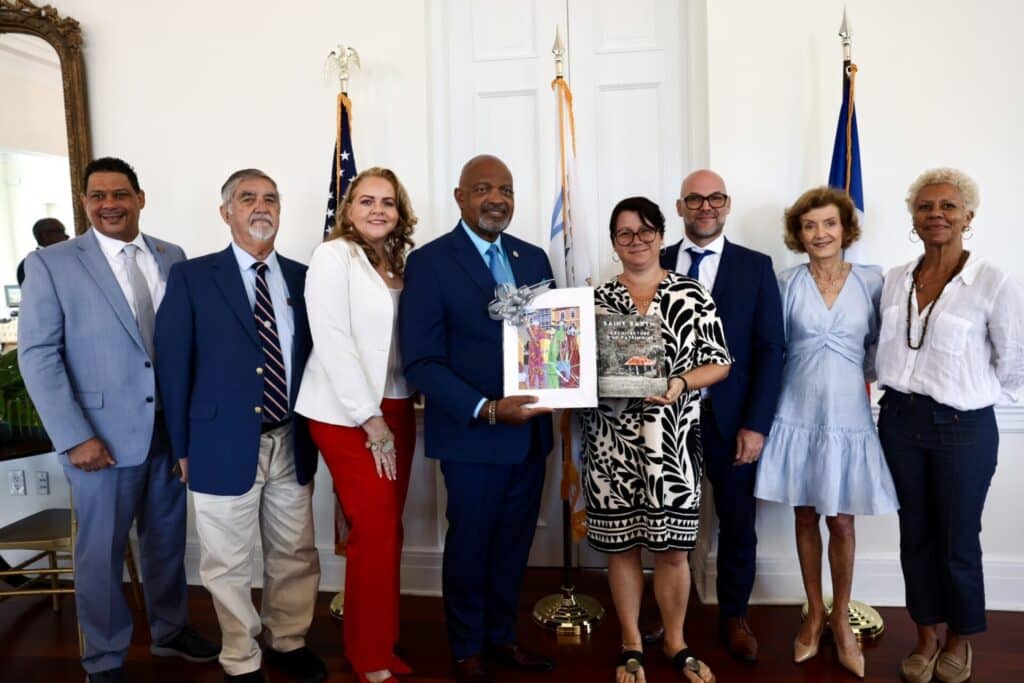
The twinning of Saint-Barth and Saint-Thomas marks a new stage in relations between two neighboring territories whose human, cultural and historical ties have long transcended administrative boundaries. Tuesday, March 10, 2026, Xavier Lédée, President of the Territorial Council of Saint-Barthélemy, and Albert Bryan Jr, Governor of the U.S. Virgin Islands, officially signed the twinning agreement between the two islands. The signing provides a concrete framework for a long-standing regional relationship, and lays the foundations for cooperation that is set to expand in a number of areas, including culture, education, sport and institutional exchanges.
In the Caribbean, where neighboring territories often share common histories, families and economic flows, this type of agreement takes on a special dimension. The twinning arrangement between Saint-Barth and Saint-Thomas illustrates this regional reality: that of close islands that are now choosing to structure their relations more closely in order to build joint projects and strengthen their dialogue.
An official signature supported by committed players
The signing of the twinning agreement between Saint-Barth and Saint-Thomas took place in the presence of a delegation representing the institutional and associative life of Saint-Barthélemy. Around the President Xavier Lédée, several personalities involved in the cultural and associative life of the region were present: Bettina Cointre, president of the culture commission, Cécile Coudreau, president of AJOE, Vianney Blanchard, president of the “Jumelage Saint-Barth et Saint-Thomas” association, and Jean-Yann Bouchau, thead of the culture and communications department.
This composition underlines the ambition of the project. The twinning between Saint-Barth and Saint-Thomas is not limited to a relationship between institutions. It also relies on cultural, associative and educational players who will play an essential role in transforming this agreement into concrete initiatives. The first working meetings should rapidly identify projects capable of giving real visibility to this rapprochement between the two territories.
Two neighbouring islands linked by a regional history
The proximity between Saint-Barth and Saint-Thomas is not new. Located just a few dozen kilometers from each other, the two islands have maintained regular human, economic and cultural exchanges over the decades. In the Caribbean, movement between neighboring islands has always shaped daily life. Families, migrations, commercial activities and cultural exchanges have all contributed to the creation of a regional space where administrative borders do not always reflect the reality of human links.
The twinning of Saint-Barth and Saint-Thomas is a logical step in this direction. It formalizes a proximity that is already well established in the region, and opens up the possibility of translating it into structured, sustainable projects.
A project several months in the making
The signing of the agreement in March 2026 is the culmination of a process initiated by the local authorities. As early as 2025, the idea of a twinning arrangement between Saint-Barth and Saint-Thomas had been mooted as a way of strengthening relations between the two territories and developing joint initiatives. Discussions held at the time had already identified several possible areas of cooperation: cultural events, educational exchanges, sporting events and institutional collaboration. The official signature now gives a formal framework to this desire for closer ties, and paves the way for the implementation phase.

Culture, youth and sport: the first areas of cooperation
One of the main aims of the twinning between Saint-Barth and Saint-Thomas is to encourage exchanges between the inhabitants of the two territories.
Cultural initiatives to promote Caribbean heritage
Culture is naturally one of the first areas of cooperation. Exhibitions, artistic encounters, exchanges between associations and heritage initiatives could all help to raise the profile of cultural links between the two islands. In a region marked by linguistic diversity and the legacy of several historical influences, these cultural exchanges also help to enhance local identities while strengthening regional bridges.
Educational exchanges for young people
The jumelage between Saint-Barth and Saint-Thomas also opens up prospects for the younger generation. School or language exchange programs could enable students to learn more about the cultural and social realities of their Caribbean neighbors. In a region where several languages coexist: French, English, Spanish and Creole, these initiatives also represent an opportunity for openness and learning.
Sport as a means of bringing people together
Sport is another important lever for cooperation. Sports meetings between young people, clubs or associations often provide a simple and effective framework for strengthening ties between neighboring territories. These events not only encourage exchanges between residents, but also give concrete visibility to the twinning between Saint-Barth and Saint-Thomas among the general public.
Saint-Thomas and the region's francophone memory
The rapprochement between the two territories is also part of a broader cultural context. St. Thomas has a history marked by the presence of communities from various Caribbean territories, including the neighboring French-speaking islands. This cultural dimension was recently brought to the fore when the authorities of the US Virgin Islands proclaimed a French Heritage Week recognizing the lasting influence of French-speaking communities in the region, particularly those linked to Saint-Barth, Guadeloupe and Saint-Martin.
In this context, the jumelage between Saint-Barth and Saint-Thomas takes on a special resonance. It helps to shed light on a shared history and to strengthen exchanges between territories whose cultural relations go back several generations.
A rapprochement revealing Caribbean dynamics
The twinning between Saint-Barth and Saint-Thomas reflects a wider dynamic in the Caribbean. The region’s territories are increasingly seeking to strengthen their direct cooperation in order to meet common cultural, economic and educational challenges. These partnerships between neighboring islands are helping to build a more connected regional space, where local initiatives can foster exchanges and encourage greater mutual understanding.
From this perspective, the rapprochement between Saint-Barth and Saint-Thomas is a concrete example of how Caribbean territories can transform their historical ties into future projects.

Cooperation set to take shape
The signing of the twinning agreement between Saint-Barth and Saint-Thomas marks the start of a new phase: that of implementing the projects that will bring this agreement to life. Future initiatives will enable us to measure the extent of this cooperation and observe how the two territories choose to develop their exchanges. In a Caribbean where relations between neighboring islands play an essential role in the circulation of cultures, ideas and initiatives, this twinning could become an example of regional cooperation built on already solid human and historical links.
The twinning between Saint-Barth and Saint-Thomas is an official agreement signed on March 10, 2026 between the Collectivité de Saint-Barthélemy and the government of the US Virgin Islands. It aims to strengthen exchanges between the two territories in a number of areas, including culture, education, sport and institutional relations.
This partnership formalizes a long-standing relationship between two neighboring Caribbean islands, enabling the development of joint projects. It also helps strengthen cultural and human links between the region’s French- and English-speaking territories.
The first avenues to be explored include cultural events, school exchanges, sporting events and institutional collaboration, designed to foster relations between residents, associations and institutions in both areas.
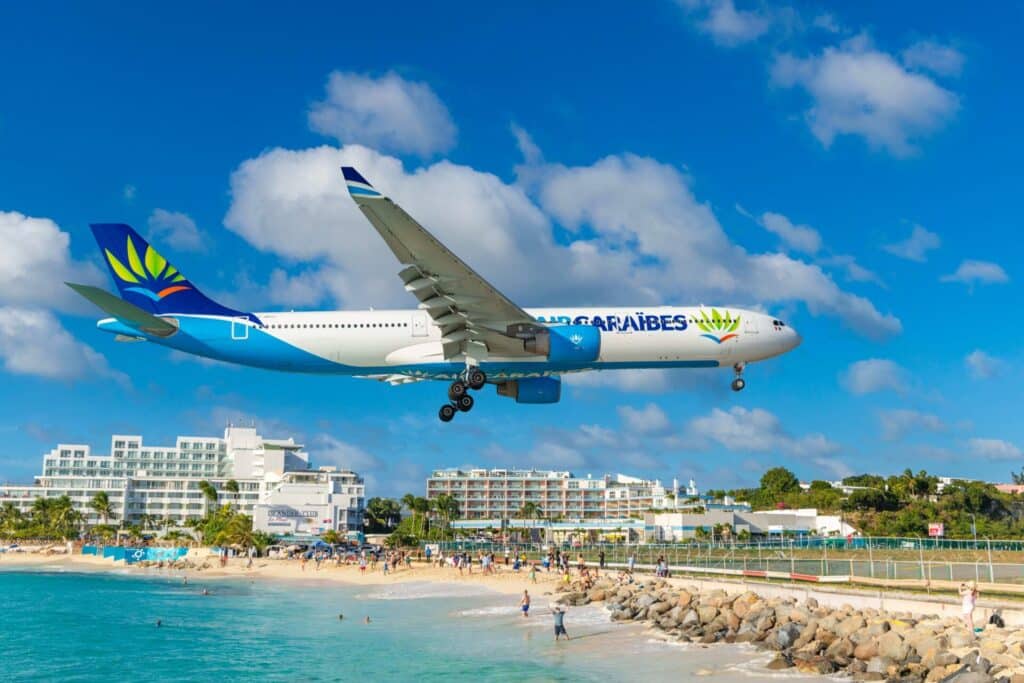
Appointed Deputy CEO in January 2026, Karen Virapin becomes the first woman from the French overseas territories to reach this level of governance within Air Caraïbes. A major development for the airline, but also a strong signal for the Caribbean air transport sector. Beyond the symbolism, this appointment raises a central question: what concrete impact could it have on governance, social dialogue, the regional network and service quality?
An appointment that reflects continuity, but not stasis
Having been with the company for fourteen years, Karen Virapin is no parachute. A former Director of Human Resources, Karen Virapin has been involved in all the company’s structural transformations: organizational changes, workforce growth, adaptation to the economic and social constraints of the airline industry. Her appointment to the position of Managing Director is therefore a logical step in the company’s continuity.
But continuity does not mean standstill. In a sector as exposed as air travel, marked by a fragile balance between costs, social demands, quality of service and local expectations, governance plays a decisive role. And it is precisely at this level that this appointment takes on its full meaning.

First woman from the French overseas territories to reach this level: a signal for Caribbean aviation
Air transport has historically been a very male-dominated sector, particularly in the executive ranks. The arrival of Karen Virapin as Managing Director is therefore a strong marker, both for the representation of women and for that of talent from the French overseas territories.
This signal goes beyond the company’s internal framework. It refers to a broader reality: the ability of companies operating in the Caribbean to recognize locally-built career paths, rooted in a detailed knowledge of the region, and not solely the result of external trajectories. This recognition is not just symbolic; it can influence the way strategic decisions are made, prioritized and implemented.
Social dialogue: a strategic lever, not a slogan
In the airline industry, social dialogue is never a secondary issue. Working conditions, organization of schedules, changes in professions, operational pressures: every decision has a direct impact on the stability of the company and the customer experience.
The fact that the new Managing Director comes from a human resources background is not insignificant. This does not guarantee the absence of tensions or consensual decisions, but it does imply a method. A method based on an understanding of internal balances, the expectations of both flight and ground crews, and the constraints specific to Caribbean services.
In the medium term, the impact will be measured less by rhetoric than by concrete indicators: social climate, ability to anticipate conflicts, continuity of service in sensitive periods.
Caribbean-Guyana regional network: local governance put to the test
Based in Pointe-à-Pitre, Karen Virapin embodies a form of governance rooted in the territories served. This geographic positioning is not neutral. It puts management as close as possible to the realities of the Antilles-Guyane regional network, which is often faced with specific challenges: flight regularity, connections, territorial continuity, and the expectations of residents and tourism professionals alike.
It’s not just a question of maintaining individual lines, but of ensuring their overall coherence. How can we link regional and transatlantic networks? How can we guarantee a clear and reliable offer in a context of increased competition and pressure on costs? Here again, future decisions will enable us to assess the real scope of this so-called “local” governance.

Service quality: maintaining high standards in a context of transformation
One of the major challenges for any airline lies in its ability to transform itself without degrading the quality perceived by passengers. Fleet modernization, internal reorganization, operational adjustments: each change entails a risk for the customer experience.
Against this backdrop, the new Executive Vice President’s career path will be closely scrutinized for consistency between internal transformation and the service promise. Punctuality, regularity, quality of welcome and management of disruptions are all concrete markers for passengers and for the regions that depend on air connectivity.
What territories can expect to see in the coming months
For the French West Indies and Guyana, the stakes go far beyond internal governance. It affects mobility, tourism, economic attractiveness and daily life. The concrete impact of this appointment can be assessed through a number of weak but revealing signals: social stability, legibility of the regional offer, continuity of services, capacity to adapt to unforeseen events. It’s not a question of waiting for spectacular ruptures, but of observing whether the promise of an anchored leadership, attentive to Caribbean realities, is translated into reality.
An appointment observed far beyond the company
Karen Virapin’s appointment to the position of Chief Operating Officer is more than just a new face inAir Caraïbes governance. She also embodies a broader evolution in the relationship between companies, territories and leadership in the French Caribbean. It’s an evolution that’s still fragile, but one that’s full of structural challenges. The next few months will tell whether Karen Virapin’s appointment marks a mere symbolic milestone, or a lasting step forward in the way we think about the governance of Caribbean air transport.
Karen Virapin is a French executive originally from Guadeloupe, appointed Chief Operating Officer of Air Caraïbes in January 2026. She has been with the company for fourteen years, and for over a decade held the position of Director of Human Resources.
Her career has been built up both in France and in the West Indies, with solid experience of organizational management and social dialogue in a demanding air transport sector. Her appointment makes her first woman from the French overseas territories to reach this level of governance within the company.
The Managing Director holds a executive position governance. She works in close coordination with General Management and is directly involved in the company’s strategic, operational and organizational decisions.
- – supervision of internal organization,
- – managing structural transformations,
- – social dialogue with teams,
- – consistency between business strategy, operational constraints and service quality.
Air Caraïbes plays a central role in air connectivity in the French West Indies and French Guiana. The company provides both:
- – essential transatlantic links with France,
- – a structuring regional network for intra-Caribbean mobility.
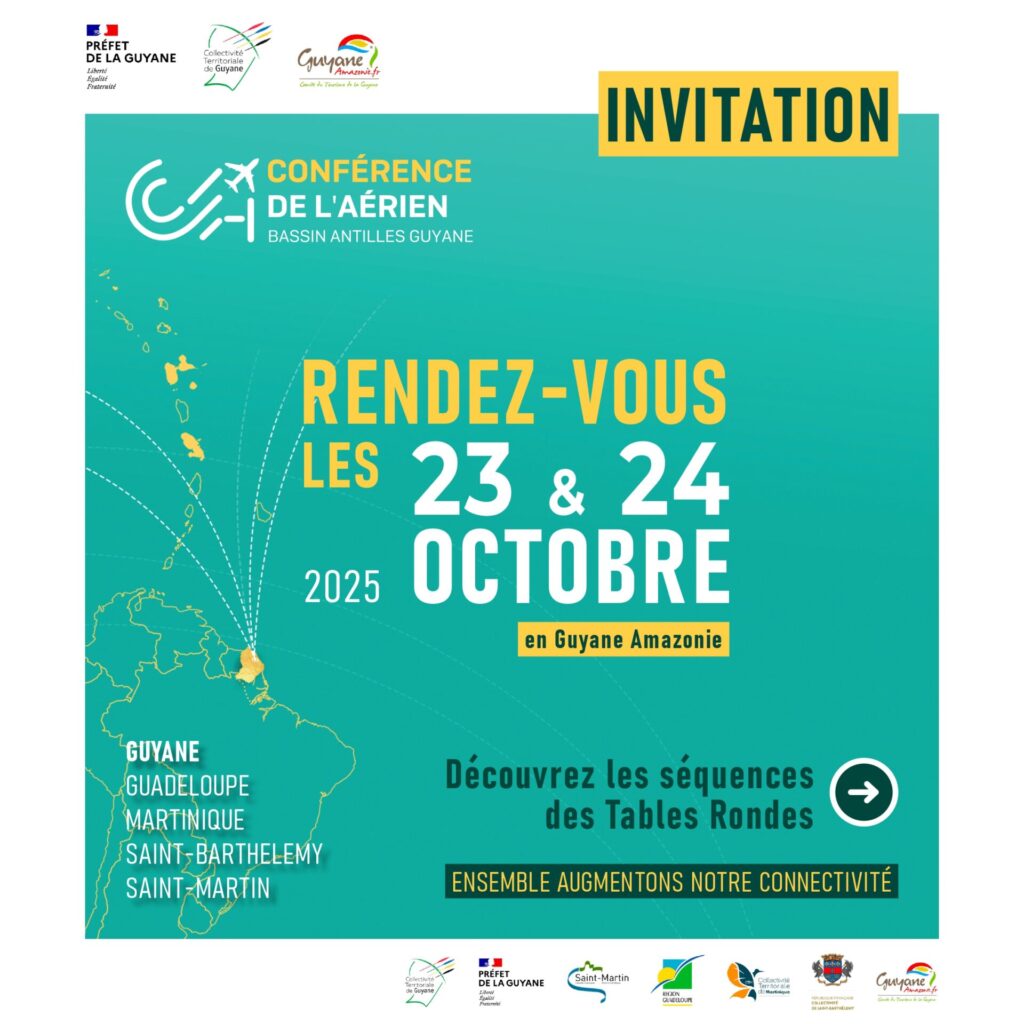
The Airline Conference 2025 will take place in Cayenne, French Guiana, on October 23 and 24. This event confirms the commitment made during the first edition in 2024 in Martinique: to give French Guiana the responsibility of hosting the sequel.
This second edition takes place against a backdrop marked by the need to strengthen regional connectivity, accelerate the ecological transition and prepare for the future of space. The Airline Conference 2025 promises to be a strategic event for the entire Antilles-Guyane region.
Six preparatory workshops to lay the foundations for the conference
In September, six preparatory workshops brought together airports, airlines, aviation authorities, local authorities, space experts and economic players. These working sessions enabled us to draw up a diagnosis and outline the main lines that will structure the Airline Conference 2025.
1. Multiscale connectivity and emerging companies
The arrival of new operators such as Caribbean Airlines, the growth of St-Barth Executive and the opening of specific routes (to Cap-Haïtien, by Sunrise) were among the highlights of the discussions. However, participants emphasized the weight of the European regulatory framework, which is stricter than that of other Caribbean countries, and recalled that airlines are now demanding risk-sharing with the territories.
2. Airport governance and performance
A comparative overview highlighted the diversity of management models: concessions in Martinique, Guadeloupe and French Guiana, local authority management in Saint-Barthélemy and Saint-Martin, and a state-owned company model in Barbados with a PPP project. Discussions converged on the need to create a regional body that would be more technical than political, in order to strengthen cooperation between platforms.
3. Aerospace skills and synergies
Preparations for the Antilles-Guyane Air Transport Conference also highlighted the urgent need to structure a common frame of reference for aerospace professions. Maintenance, remote piloting of drones, space engineering: the needs are numerous and strategic. The creation of a Caribbean aerospace cluster was chosen as a priority tool for federating rectorats, universities, CNES and ENAC.
4. Ecological transition and sustainable air travel
The prospect of COP30 in Brazil set the tone for the discussions, with the reduction of carbon footprints taking center stage. Air France-KLM detailed its strategy (fleet modernization, 10% sustainable fuels by 2030), while SARA presented its plans for local biofuel production. The region’s airports emphasized their climate resilience and renewable energy initiatives.
The creation of an SAF group purchasing platform and joint lobbying of the European Union to adapt the ETS system have been identified as priorities.
5. Freight, logistics and regional integration
The findings are clear: freight is structurally lagging behind, particularly in Cayenne. The EFTI4All project was highlighted as a lever for digitizing and simplifying customs procedures. Participants stressed the importance of supporting SMEs to avoid a digital divide, and of exploiting the potential of free trade zones to boost exports.
6. Financing and innovation
The workshop highlighted the difficulties of financing strategic projects such as Flying Whales in French Guiana, and proposed the creation of a regional investment fund. Financial institutions (AFD, BPI, SEM patrimoniale, Caribbean banks) were identified as essential partners. All players agreed on the priority of formalizing the air and space cluster at the Airline Conference 2025.

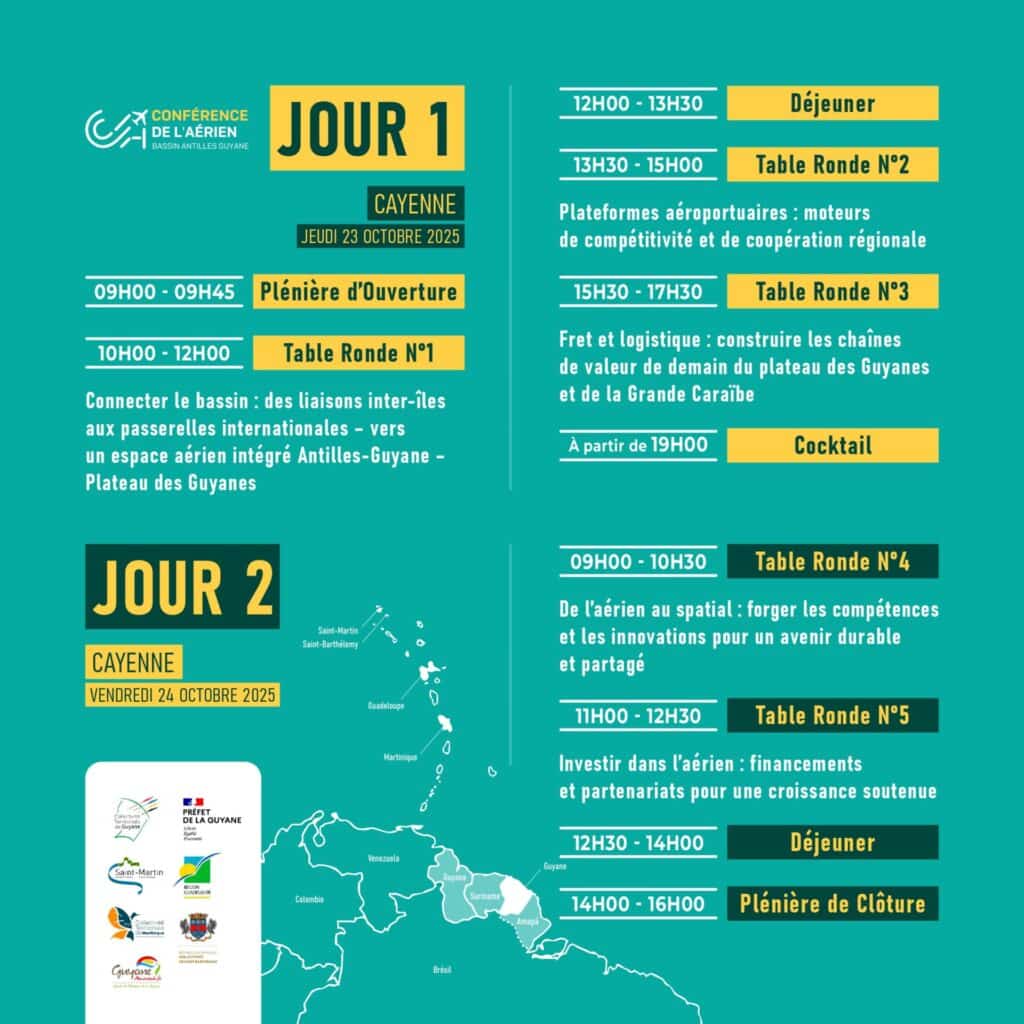
The official program for October 23 and 24, 2025
The round tables and plenary sessions announced will provide a concrete framework for the priorities emerging from the preparatory workshops. The two-day format will enable the Airline 2025 Conference to move from strategic reflection to operational commitments.
Day 1 – Thursday, October 23, 2025, Cayenne
- 🕐 12:30 pm – 2:00 pm : Inaugural lunch.
- 🕐 2:00 pm – 4:00 pm : Opening plenary – Connecting the basin: from inter-island links to international gateways – towards an integrated Antilles-Guyane airspace – Plateau des Guyanes.
- 🕐 16h00 – 18h00 : Round Table 1 – From air to space: forging skills and innovations for a sustainable, shared future.
- 🕐 7:00 pm: Welcome cocktail.
Day 2 – Friday, October 24, 2025
- 🕐 09h00 – 09h45 : Opening plenary.
- 🕐 10h00 – 12h00 : Round Table 2 – Airport hubs: drivers of competitiveness and regional cooperation..
- 🕐 12h00 – 13h30 : Lunch.
- 🕐 1:30 pm – 3:00 pm : Round Table 3 – Freight and logistics: building tomorrow’s value chains in the Guiana Shield and Greater Caribbean..
- 🕐 3:30 pm – 5:30 pm : Round Table 4 – Investing in air travel: financing and partnerships for sustained growth.
- 🕐 17:30 – 18:00: Closing plenary.
Strategic challenges for the region
The Airline Conference 2025 aims to provide clear answers to several major challenges. The Airline Conference 2025 aims to ensure the continuity of inter-island links, strengthen training, accelerate the ecological transition and modernize freight. It will also lay the foundations for a regional fund, by formalizing public-private partnerships.

An assertive political dimension
The Airline Conference 2025 goes beyond the technical framework: it symbolizes a strong political will. After Martinique in 2024, French Guiana is keeping its promise to organize this second edition, and asserting its strategic position in Caribbean cooperation.
On October 23 and 24, Cayenne will become the focal point for the region’s aviation and space ambitions. The Airline 2025 Conference will mark a new stage in regional cooperation.
The port of Saint Barthélemy is currently the focus of much attention. Faced with growing saturation, the local authority has launched an expansion project, essential to guaranteeing the smooth flow of trade and the island’s prosperity. Here are the issues, challenges and future of this essential infrastructure.
The port of Saint Barthelemy : the island's backbone
An irreplaceable economic role
The port of Saint Barthélemy is more than just a quay where ships dock. It is the logistical heart of the island, through which cement, vehicles, foodstuffs, fuel and various parcels pass every day. For Saint Barthelemy, where almost everything is imported, the port is synonymous with economic survival and social stability. Without it, business and daily life would come to a standstill.
An ever-increasing variety of goods flows
Every year, the port of Saint Barthélemy sees an impressive variety of goods pass through its doors. Containers of fresh produce, building materials, cars, fuel and even equipment for luxury hotels and villas pass through its quays. This diversity of flows underlines the port’s strategic importance for the entire community.

Saturation threatens logistical balance
Unprecedented traffic growth
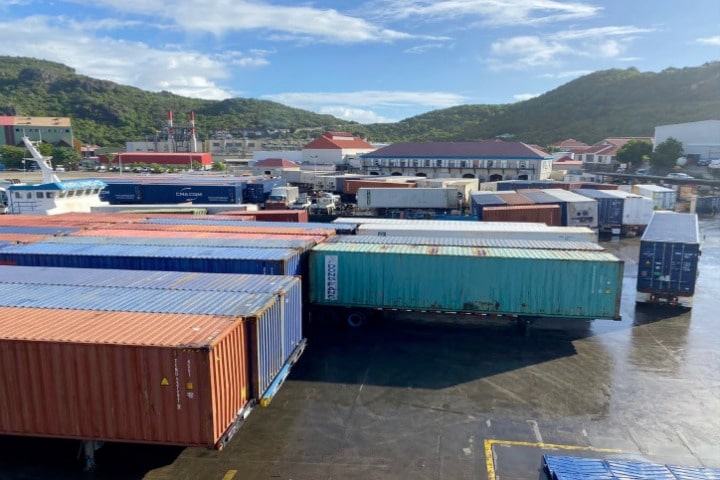
For the past ten years, traffic at the port of Saint Barthelemy has been growing steadily. After Hurricane Irma and the economic recovery, the island saw a doubling in the number of containers imported. In 2023, nearly 8,500 containers and over 7 million liters of fuel were unloaded. This exponential growth is putting a strain on existing infrastructures.
Practical consequences in everyday life
Lack of space leads to major difficulties. Maneuvering areas are narrow, containers, barges and tankers are difficult to accommodate, and operations are sometimes confused. On some days, it’s almost impossible to simultaneously manage the unloading of a tanker and the arrival of general cargo, which slows down the supply of goods to the island and creates tensions among professionals in the sector.
A necessary expansion project
An investment of 10 million euros
Faced with this saturation point, the local authorities have decided to invest 10 million euros to expand the port of Saint Barthélemy. The project, entirely financed locally, aims to create 2,200 m² of additional quay space, representing an increase of more than 20% in operational surface area. The work, which will take five months to complete, is expected to improve traffic flow and operational safety.
Planning for the future
The expansion is not just about adding space. It also involves reorganizing flows, separating unloading areas, creating dedicated spaces for refrigerated containers and reinforcing security around sensitive installations, such as the drinking water production plant. The inner dock will be filled in to provide a new storage and handling area to meet the island’s growing needs.
The challenges of port management in Saint Barthelemy
Coexistence of different types of traffic
One of the main challenges remains the simultaneous management of different types of traffic. Containers, fuel, unloading barges: each activity has its own constraints. Expansion must be accompanied by more rigorous organization to avoid conflicts of use and guarantee the safety of all those involved.
Regulate to avoid further saturation
Expanding the port also means running the risk of further traffic growth. To avoid further saturation, the local authority is considering modulating the port tax according to the length of stay of goods, in order to encourage regular rotation and limit quay congestion. This regulation will be essential to maintain the port’s efficiency over the long term.

The port of Saint Barthelemy, a pillar of public finances
Quay dues: a major resource
A 5% wharfage charge is levied on all goods unloaded. This tax, which replaces VAT on the island, brings in almost 23 million euros a year for the local authority, making the port the second-largest source of public revenue after property transfer taxes. This simple, effective tax system enables the island to finance its infrastructure without resorting to debt.
A direct impact on island life
Revenues generated by the port account for almost a quarter of the community’s budget. They are used to finance investment in schools, health, roads and safety. The smooth running of the port therefore determines not only the supply of goods to the island, but also the quality of life of its inhabitants and the community’s ability to invest in the future.
Expanding the port is much more than a simple infrastructure project. It’s a concrete response to current saturation and a gamble on the island’s economic future. Thanks to this investment, the port of Saint Barthelemy will be able to continue playing its role as the backbone of the island’s supply, security and prosperity for years to come.