
Haiti – “Vèvè Vodou Haïti”: a fundamental work on the sacred symbols of Haitian spirituality

Vèvè Vodou Haïti

The book Vèvè Vodou Haiti by Roxane Ledan – Taino-L is an essential contribution to the documentation and understanding of Haitian vodou. The fruit of over twenty years’ research, this publication sheds light on the world of vèvè, the sacred drawings traced on the ground during vodou rituals, revealing their spiritual depth and artistic value.

A work born of long fieldwork

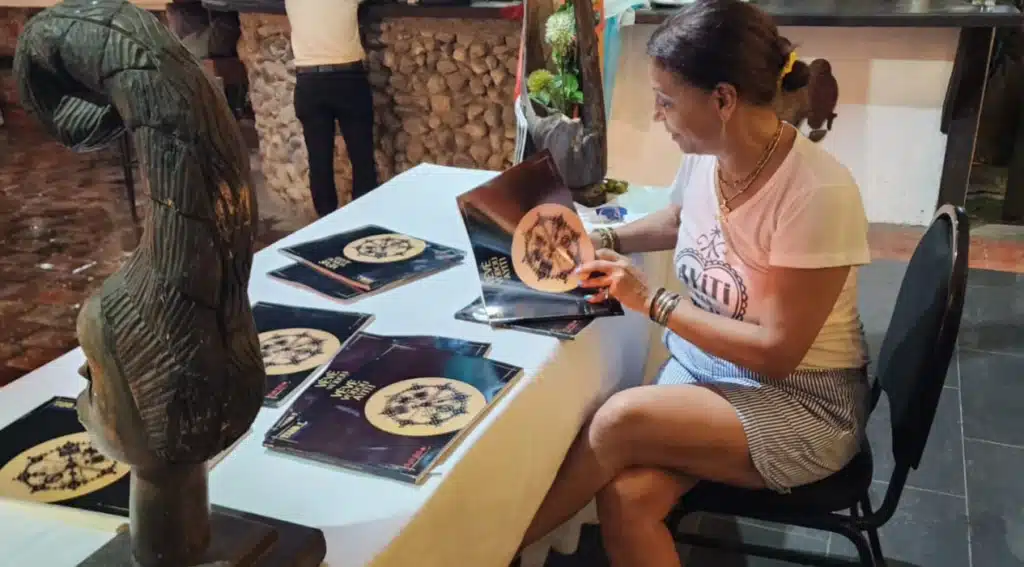
Published in August 2023 by AYITI BÈL, Vèvè Vodou Haïti was presented to the Haitian public in Cap-Haïtien, then at the Hostellerie du Roy Christophe. Led by Roxane Ledan, the project documents the vèvè through 81 previously unpublished photographs, 38 of which were taken by researcher Milo Rigaud. The book comprises 104 pages of visual and symbolic analysis, supported by a sharp photographic eye.

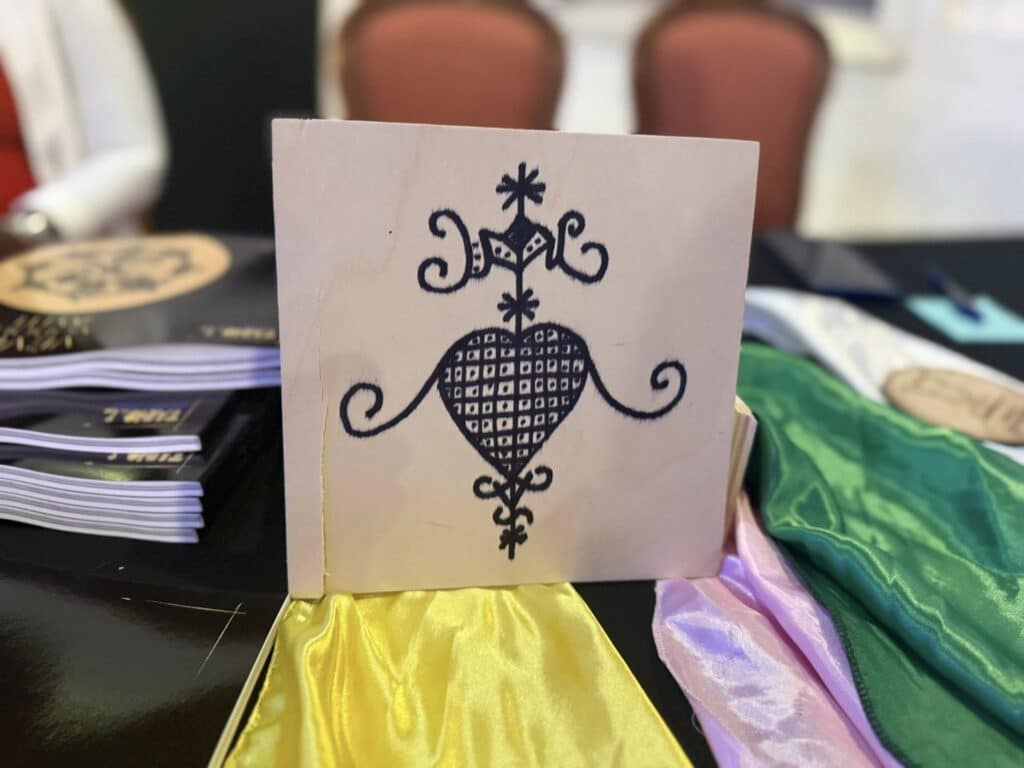
Each image precisely reproduces the ephemeral lines created on the ground with corn flour, ash or coffee grounds. These representations are linked to lwa – the divinities of the Vodou pantheon – and constitute a codified ritual language passed down from generation to generation.

Vèvè Vodou Haïti

The career of a committed artist

Born in Les Cayes, Roxane Ledan – also known as Taino-L – claims a strong Caribbean identity, in reference to indigenous peoples. A photographer, documentary filmmaker and human rights activist, she trained at the Centre d’études photographiques in Port-au-Prince before perfecting her skills at the Nikon School in Fort Lauderdale. She is currently pursuing graduate studies at Concordia University in Montreal.

This transnational background feeds an artistic reflection rooted in Haitian culture and open to international dialogue. His participation in exhibitions in the United States, Canada and France, notably at the Salon du livre haïtien de Paris, is testimony to this.

Cayes
Cayes
Vèvè Vodou Haïti
Vèvè Vodou Haïti

The documentary scope of Vèvè Vodou Haïti

With Vèvè Vodou Haïti, the artist offers much more than a collection of photographs: she questions the meaning, history and uses of vèvè. The book thus becomes a tool for cultural transmission, a rare visual archive that places Haitian vodou in a historical and aesthetic perspective.

By incorporating drawings by Milo Rigaud, author of Vévè, diagramme rituel du voudoo, Roxane Ledan pays tribute to one of the pioneers of religious anthropology in Haiti. This inter-generational dialogue lends density to the project and legitimizes its academic dimension.

Vèvè Vodou Haïti
©juno7

A controlled symbolic hierarchy

In certain regions of Haiti, such as Artibonite, only initiates who have attained a high rank, sometimes higher than ougan or manbo, are authorized to draw vèvè. This ritual mastery underlines the central place of these symbols in Vodou cosmology. Vèvè Vodou Haïti aptly illustrates this spiritual codification, showing the precision of the gestures and the depth of meaning that each line conveys.

Roxane Ledan manages to capture the fleeting nature of these creations – which disappear after the ceremony – and to perpetuate them in a high-quality editorial form. The sharpness of the shots, the meticulous composition and the thematic organization of the pages all contribute to making this book a work of reference.

Vèvè Vodou Haïti
©Garry Assad

From intimate to collective: the cultural impact of the book

Far from being folklorized, Vèvè Vodou Haïti takes a rigorous approach that restores dignity to a tradition that is often caricatured. Through her eyes, Roxane Ledan deconstructs preconceived ideas about vodou and invites us to consider it as a philosophical, religious and artistic system in its own right.

Since the publication of Vèvè Vodou Haïti, the artist has been asked to exhibit in the United States, notably in Louisiana, as part of an exhibition dedicated to the cultural links between Haiti and New Orleans. This international influence is accompanied by a clear desire to have vodou creations recognized as intangible heritage of major importance.

Vodou as a visual and theological system

What Vèvè Vodou Haïti shows is that vèvè are not decorative elements, but bearers of theological meaning. Each figure corresponds to a divinity, a prayer, an interaction between the human and spirit worlds. The potomitan – the central pillar in a hounfor (Vodou temple) – thus becomes the axis around which the symbols revolve.

By capturing these moments of spirituality in action, Roxane Ledan reveals the complexity of a cosmogony where the visible and invisible cohabit. The vèvè are the vectors of this cohabitation, symbolic portals that cross spiritual planes. Vèvè Vodou Haïti restores the sacred power of these figures.

A project for the transmission of knowledge

Through its methodical approach and artistic commitment, Vèvè Vodou Haïti helps to safeguard a fragile body of knowledge, often transmitted orally. The book is also a silent plea for greater recognition of Afro-descendant religions and the preservation of endangered cultural practices.

In the words of linguist Robert Berrouët-Oriol, the book is an “exceptional pictorial journey”, both rigorous and inspired. This intellectual recognition validates the importance of this work in both academic and artistic circles.

A contemporary reference on Haitian vodou

With Vèvè Vodou Haïti, Roxane Ledan sets a milestone in the history of Caribbean religious iconography. Through her photography, she documents, interprets and transmits a living memory, rooted in the daily life of communities and imbued with a strong sense of the sacred.

Far from a rigid ethnographic approach, this book combines documentary accuracy with aesthetic finesse. It contributes to renewing our view of Vodou, not as a relic of the past, but as an active, inventive and meaningful culture.

Vèvè Vodou Haïti
©rezonodwes.com

Leave a Reply

Your email address will not be published. Required fields are marked *

More articles from RK

Eric Williams
HISTORY & HERITAGE
Tolotra

Trinidad & Tobago – Eric Williams, the historian who led Trinidad and Tobago to independence

In Port of Spain, history was never just a matter of archives. It was also told in public squares, in schools, in family conversations, where a colonial society was looking for the words to think differently about itself. Eric Williams understood the power of storytelling very early on. Before becoming head of government, he made history an instrument of collective lucidity. A historian before the head of government Born in Port of Spain on September 25, 1911, Eric Williams grew up in a Trinidad still part of the British colonial order. His schooling took him to Queen’s Royal College, then to Oxford University, where he obtained his doctorate in 1938. This passage through one of the great institutions of the imperial world gives his work a special significance: he knows the codes of British academia, but uses them to interrogate the history of empire from the perspective of the Caribbean.

Read More »
Sa sa pé foutew
HISTORY & HERITAGE
Tolotra

Martinique – “Sa sa pé foutew”: the Creole formula powered by Netflix carried by Bandi

With Bandi, a 2026 Netflix series set in Martinique, eight episodes have taken a Martinican Creole expression far beyond its native territory. “Sa sa pé foutew” means much more than “What’s it to you? It’s a way of setting a limit, sometimes with humor, sometimes with firmness, but always with an element of identity. Three words, one border Three Creole words, one question, and one attitude. When the Bandi series arrived on Netflix in 2026, it brought with it a phrase that many Martiniquais recognize: “sa sa pé foutew”. For some, it’s pride. For others, it’s a silent victory. For all those who know what these words mean in a conversation, it’s a moment that counts. Literally, the phrase can be translated as “what’s it to you?” or “what’s it got to do with you?”. But the translation always gives us away. In reality, “sa sa pé foutew” functions like

Read More »
Michael Jackson
FILM & VIDEO
Tolotra

Michael Jackson biopic: Kingston 1975, the legend’s other scene

Michael Jackson biopic arrives with the weight of great Hollywood narratives: a global figure, a famous family, a body of work that continues to fill cinemas and push songs up the charts. Directed by Antoine Fuqua, the film stars Michael Jackson’s nephew Jaafar Jackson in the lead role, with a release date announced on April 24, 2026 on the film’s official website. But behind this much-talked-about news item, there’s another image worth rereading from the Caribbean: Bob Marley on stage at Kingston’s National Stadium on March 8, 1975, during a Jackson Five concert. A box-office success The film not only awakened curiosity about Michael Jackson. It also created a major commercial event. According to the Associated Press, Michael took in $97 million on its opening weekend in the U.S. and Canada, setting a new box-office record for a musical biopic. Internationally, the film added another $120.4 million, for an estimated

Read More »

conTACT RK

we'd love to have your feedback on your experience so far

Join The List

Join our Richès Karayib community!  Sign up for our newsletter.

Want To Maximize Your Business Presence On Riches Karayib?

Complete the form to start the application