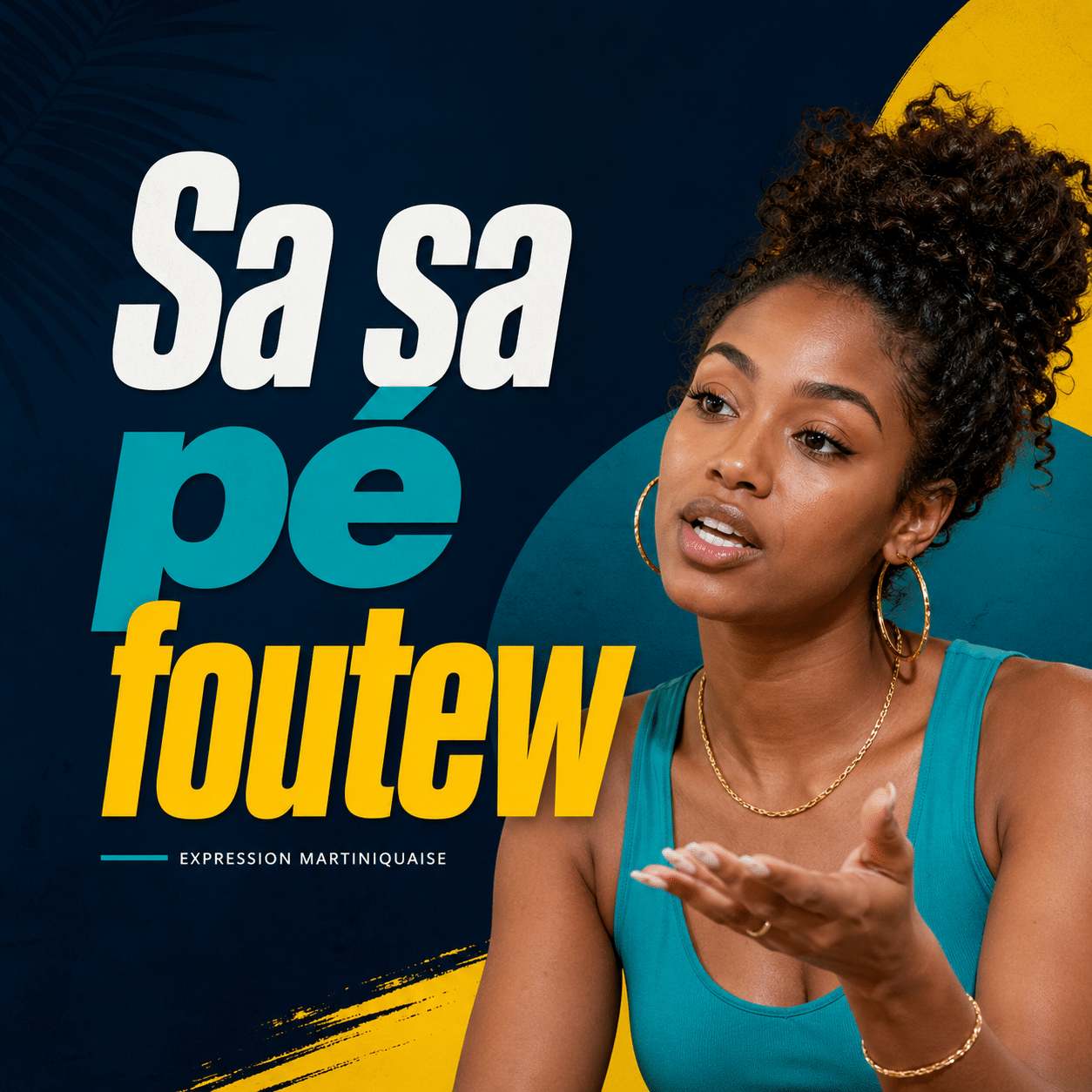
With Bandi, a 2026 Netflix series set in Martinique, eight episodes have taken a Martinican Creole expression far beyond its native territory. “Sa sa pé foutew” means much more than “What’s it to you? It’s a way of setting a limit, sometimes with humor, sometimes with firmness, but always with an element of identity.
Three words, one border
Three Creole words, one question, and one attitude. When the Bandi series arrived on Netflix in 2026, it brought with it a phrase that many Martiniquais recognize: “sa sa pé foutew”. For some, it’s pride. For others, it’s a silent victory. For all those who know what these words mean in a conversation, it’s a moment that counts.
Literally, the phrase can be translated as “what’s it to you?” or “what’s it got to do with you?”. But the translation always gives us away. In reality, “sa sa pé foutew” functions like an air bubble between self and other. It means: you have no authority over my life, what I do is none of your business, I don’t expect your validation. It’s a boundary, not an aggression.

A short formula, many emotions
And it’s precisely this dual dimension – defense and tenderness – that makes the formula so special. Depending on the context, the tone and the face, “sa sa pé foutew” can be a burst of laughter between friends, an icy clarification, or a resigned sigh. The Creole language excels in these short formulas that carry several emotions at once.
Martinique Creole is rich in such expressions. According to the Atlas of Pidgin and Creole Language Structures, it is spoken by around 400,000 people in Martinique, with an equally large diaspora. But numbers don’t tell the whole story. A language doesn’t live by the number of speakers alone. It lives on through intonation, usage, everyday situations, the retorts that circulate in families, neighborhoods, markets, songs or conversations between relatives.
In “sa sa pé foutew”, there’s more than just a phrase. There’s a posture. That of a person who refuses to be intruded upon. It’s a popular voice that knows how to say no without making a speech. This is also why the expression remains difficult to translate properly. In French, it sounds abrupt. In Martinique Creole, it can be funny, dry, affectionate or sharp, depending on the mouth that utters it.
When Martinique Creole arrives on Netflix
The arrival of the formula on Netflix marks something. For a long time, Martinique’s Creole language circulated mainly in local cultural spaces, whether musical, theatrical, family or militant. Seeing it installed in a series broadcast on an international platform changes perception. What was local becomes audible elsewhere. What was familiar to some becomes a subject of curiosity for others.
This does not automatically transform the expression into a global phenomenon. We must not exaggerate. But it does give voice to a language in an area where it is still rare. And, for a regional language often reduced to orality or intimacy, this visibility has weight. It shows that Martinique Creole can carry a plot, a tension, an emotion and a strong line without being decorative.

A Caribbean resonance, without erasing differences
This upsurge in Martinique Creole does not stand alone. It is part of a wider movement to recognize Creole languages in the Caribbean. In Dominica, the country’s official profile mentions English and French Patois, also known as “Kwéyòl”. In Saint Lucia, Kwéyòl pride is expressed every October around Jounen Kwéyòl, linked to International Creole Day on October 28. In Haiti, the 1987 Constitution recognizes Creole and French as the official languages of the Republic.
In Guadeloupe, there are also sister formulas. “Ki sa ou ka chèché?” carries a similar intensity, even if it doesn’t say exactly the same thing. But each island has its own music. Guadeloupe Creole is not Martinique Creole. Saint Lucian kwéyòl is not Haitian Creole. They are related languages, not a single language.


A popular phrase, a demand for autonomy
What makes “sa sa pé foutew” singular in the Martinican context is its social significance. The phrase expresses a relationship with authority, whether familial, social or institutional, and a demand for autonomy that runs through part of popular culture. In zouk songs, in comic theater, in carnival, we find this posture: I hold my place, I don’t ask permission.
When a formula like this leaves its home territory and reaches the ears of viewers who don’t necessarily have a direct link with Martinique, it doesn’t become universal. It becomes curious. And curiosity, for a language long kept at a distance from the major cultural circuits, is already a form of victory.
Next week, we cross the sea to Trinidad to find the equivalent. What expression over there will say the same thing differently?
“Sa sa pé foutew” can be translated as “what’s it got to do with you” or “what’s it got to do with you? In Martinican Creole, the expression is often used to set a limit, with humor, firmness or distance, depending on the context.
The expression is brought back into the spotlight by the Bandi series, broadcast on Netflix and set in Martinique. Its presence in an international production gives new visibility to Martinique Creole and its popular formulas.
“Sa sa pé foutew” is not just a literal translation. The expression conveys an attitude, a way of refusing intrusion and asserting autonomy. It demonstrates the expressive power of Martinique Creole in everyday life.