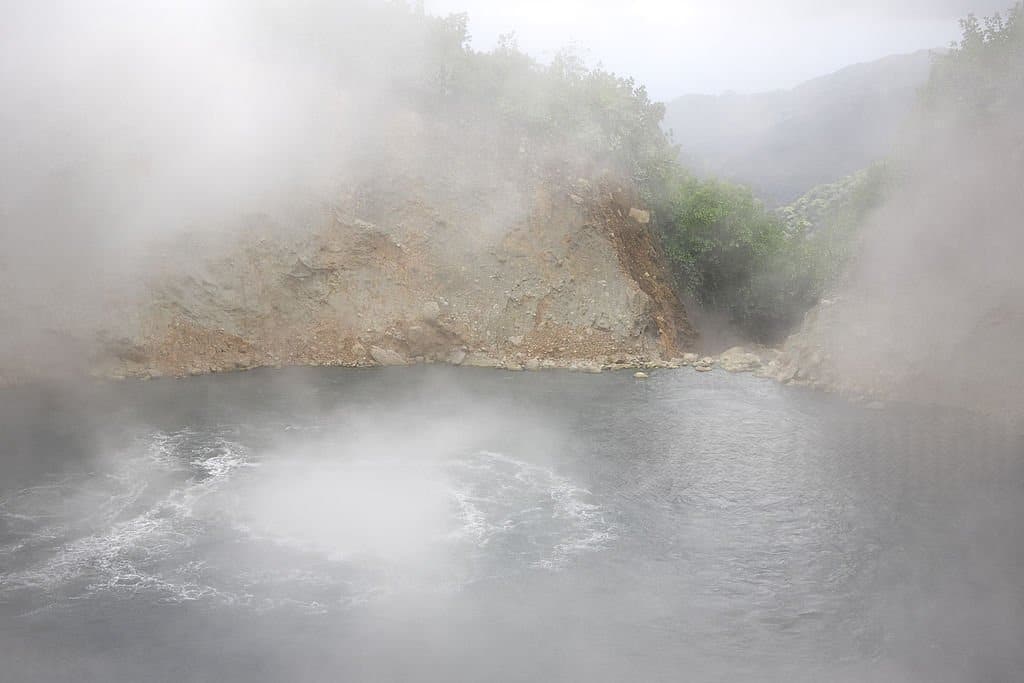
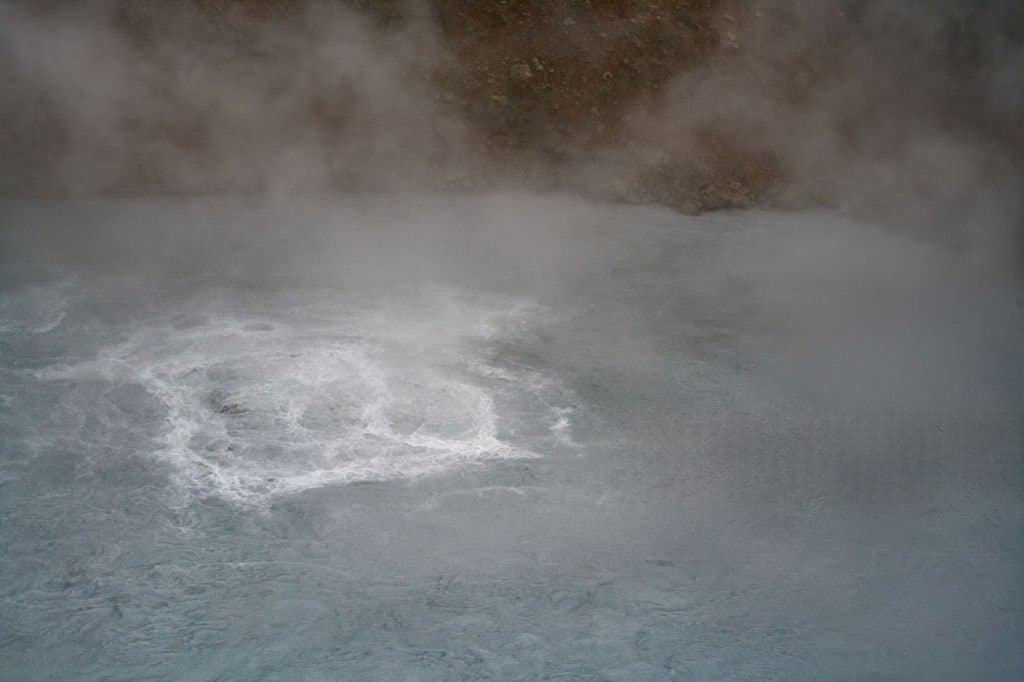
Boiling Lake: 92 °C, 63 m wide, the 2nd largest bubbling lake in the world

Boiling Lake

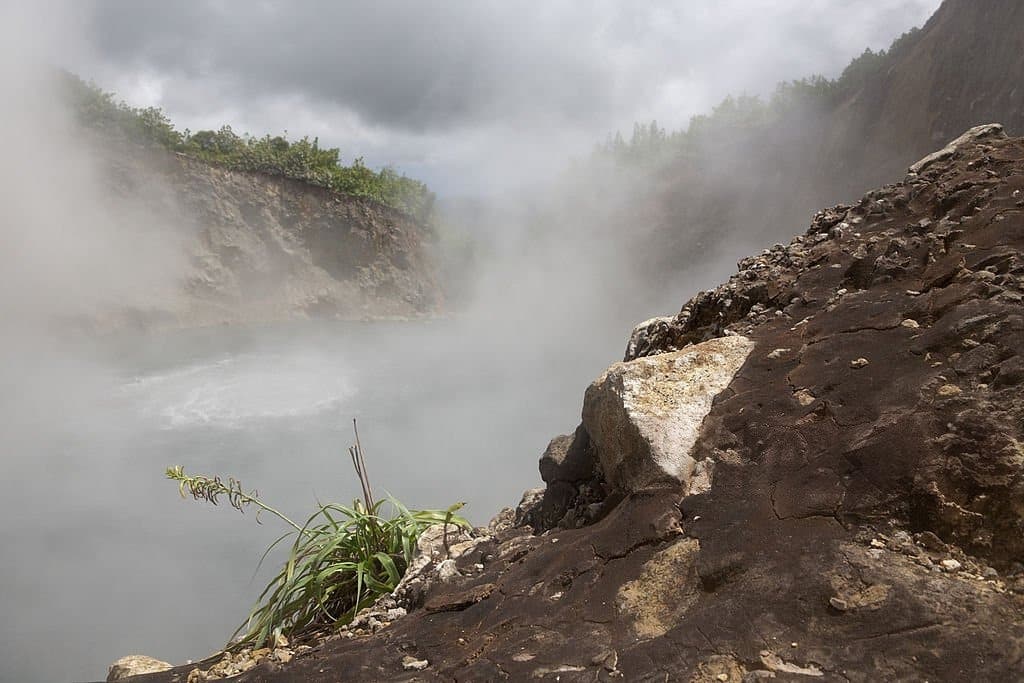
Just 8 kilometers east of Roseau, the capital of Dominica, it’s a three-hour walk from Laudat to Boiling Lake. Three hours of humid forest, desolate valley, soil-heated rocks and sulfurous fumes. At the end of the path, a 63-metre-wide pool. Inside, the water bubbles almost continuously, with temperatures measured up to 91.6°C at the edges. It’s the second largest bubbling lake in the world.

A rare phenomenon in a UNESCO park

The world’s first is Frying Pan Lake in New Zealand’s Waimangu Valley. But the Dominican Boiling Lake is in a class of its own. Firstly, because it can only be reached on foot, after a demanding hike. Secondly, because it is part of a national park that has been a UNESCO World Heritage Site since 1997: Morne Trois Pitons National Park. This makes it one of the most singular geothermal phenomena protected in a world-renowned natural site.

Boiling Lake
Boiling Lake

A flooded, rain-fed fumarole

Geologically, Boiling Lake is what scientists call a flooded fumarole – an opening in the Earth’s crust that lets out volcanic steam and gases. The heat comes directly from the volcanic activity below. The lake is fed by rainfall, nearby slopes and small streams. Its exact depth is difficult to determine: the first measurements in 1875 indicated a depth of over 59 metres, but recent data vary according to sources and the state of the lake.

Boiling Lake

An unstable lake since the 19th century

The lake was first observed in 1875 by Edmund Watt and Dr Henry Alford Nicholls, two Englishmen working in the colony, accompanied by their guides. Since then, lake levels and temperatures have fluctuated dramatically. In 1880, a phreatic eruption in the Valley of Desolation had a profound effect on the area. There have also been several episodes of significant drops in water levels, notably in 1988 and between December 2004 and April 2005. The UWI Seismic Research Centre, based in Trinidad, monitors the lake’s activity as part of its volcanic monitoring program in Dominica.

Boiling Lake

Dominica, an island of visible geology

Dominica’s absolute uniqueness lies in a particular alignment. The island – around 750 km², with a population of almost 70,000 – boasts a geological and ecological density that is rare in the Caribbean: several potentially active volcanic centers, 365 rivers according to the country’s tourism communication, a tropical forest that is still very much present, and the last pre-Columbian Kalinago population in the eastern Caribbean. Boiling Lake is one of the jewels in the crown.

Boiling Lake
Boiling Lake

A human memory around a natural site

For the Kalinago people, Dominica’s land, landscapes and natural spaces bear an ancient memory. During the colonial period, the island’s mountains and forests also served as refuges for Maroon populations fleeing the plantations. This dual indigenous and African memory gives the territory a historical depth that few geological curiosities can claim. Boiling Lake is not just a natural curiosity. It’s part of an island of memory.

A demanding hike, not a simple excursion

The hike to the lake is a demanding one. The official trail starts from Ti Tou Gorge, near the village of Laudat, and takes about three hours to get there, then the same to get back. The route passes through the Valley of Desolation, where steam comes out everywhere, sulfur deposits stain the rocks, you can sometimes cook an egg in the cracks in the ground, and the smell of sulfur marks the air. The authorities strongly recommend that you set off with a certified guide, don’t start hiking after 10 a.m., wear suitable footwear and check the weather forecast before setting off.

Boiling Lake
Boiling Lake

What Boiling Lake has to say about Caribbean tourism

At a time when the Caribbean is seeking to position itself as a destination for experiential tourism, Dominica offers a clear answer. No all-inclusive beaches. No over-the-top resorts. A hike of several hours to see a lake boil. And UNESCO status to protect it all. Boiling Lake tells the story of another Caribbean: a Caribbean of volcanoes, forests, rivers, trails, memories and landscapes that don’t come without effort. Perhaps that’s where its strength lies. Dominica doesn’t just sell scenery. It’s a reminder that Caribbean nature can still command respect.

Boiling Lake is located in Dominica’s Morne Trois Pitons National Park, a UNESCO World Heritage Site since 1997. The hike usually starts from the Laudat area, near Ti Tou Gorge. It takes around three hours’ walk each way to reach this bubbling lake, set in a volcanically active environment of rainforest, hot springs, sulphur deposits and the Valley of Desolation.

Boiling Lake is famous for being the second largest bubbling lake in the world, after New Zealand’s Frying Pan Lake. Its basin is around 63 metres wide and its water reaches temperatures close to 92°C at the edges. This rare natural phenomenon provides an insight into the volcanic power of Dominica, an island where geology remains visible through fumaroles, hot springs and volcanic landforms.

We strongly recommend that you visit Boiling Lake with a certified guide. The hike is long, physical and sometimes challenging, especially due to the heat, humidity, slippery rocks, sulfurous fumes and rapid weather changes. The trail passes through geothermally active areas, notably the Valley of Desolation. A guide helps to make the route safe, explain the site and avoid mistakes in an impressive but potentially dangerous natural area.

Leave a Reply

Your email address will not be published. Required fields are marked *

More articles from RK

Boiling Lake
TOURISM
Tolotra

Boiling Lake: 92 °C, 63 m wide, the 2nd largest bubbling lake in the world

Just 8 kilometers east of Roseau, the capital of Dominica, it’s a three-hour walk from Laudat to Boiling Lake. Three hours of humid forest, desolate valley, soil-heated rocks and sulfurous fumes. At the end of the path, a 63-metre-wide pool. Inside, the water bubbles almost continuously, with temperatures measured up to 91.6°C at the edges. It’s the second largest bubbling lake in the world. A rare phenomenon in a UNESCO park The world’s first is Frying Pan Lake in New Zealand’s Waimangu Valley. But the Dominican Boiling Lake is in a class of its own. Firstly, because it can only be reached on foot, after a demanding hike. Secondly, because it is part of a national park that has been a UNESCO World Heritage Site since 1997: Morne Trois Pitons National Park. This makes it one of the most singular geothermal phenomena protected in a world-renowned natural site. A flooded,

Read More »
Tourisme 3.0
TOURISM
Tolotra

Tourism 3.0: Jamaica wants to keep its tourist wealth

At the Montego Bay Convention Centre, the image speaks for itself. Local entrepreneurs showcase their products, hotel representatives circulate, meetings follow one another. Behind these rapid exchanges, one question weighs heavily: when tourism makes money, how much really stays in Jamaica? This is at the heart of Tourism 3.0, the new direction championed by Jamaica’s Minister of Tourism, Edmund Bartlett. At the Tourism Enhancement Fund’s 11th Speed Networking Event, he set out a clear ambition: to make tourism a more direct driver for Jamaican producers, artisans, manufacturers and suppliers. Tourism that no longer just wants to attract Jamaica knows how to welcome visitors. But the challenge is no longer just to fill hotels or increase arrivals. The real challenge is to retain more value in the territory. Edmund Bartlett has recognized a structural weakness: a large proportion of the goods and services consumed by the tourism industry are still imported.

Read More »
Edwidge Danticat
LITERATURE
Tolotra

Haiti – Edwidge Danticat: the voice that put Haiti on the world literary map

When Edwidge Danticat arrived in Brooklyn at the age of twelve, in 1981, English was not her language. She wore Haitian clothes, spoke Creole as her mother tongue, and had a family history already marked by separation. Forty-five years later, she is one of the most respected living Haitian-American writers, a MacArthur Fellow and professor at Columbia University, where she holds the Wun Tsun Tam Mellon Professor of the Humanities. But above all, she has done something that few writers of her generation have achieved on this scale: she has placed Haiti at the heart of contemporary world literature. A childhood between Port-au-Prince and waiting Edwidge Danticat was born on January 19, 1969 in Port-au-Prince, under the dictatorship of François Duvalier. Her father left for the United States when she was still very young, and her mother joined him a few years later. She was brought up in Haiti by

Read More »

conTACT RK

we'd love to have your feedback on your experience so far

Join The List

Join our Richès Karayib community!  Sign up for our newsletter.

Want To Maximize Your Business Presence On Riches Karayib?

Complete the form to start the application