St. George’s Cathedral in Georgetown, Guyana, is approximately 43.5 meters tall and is built of wood. Consecrated on November 8, 1894, it replaced a brick cathedral, completed in 1842, whose tower was deemed too heavy for its foundations. Its history is that of a building made of greenheart, a hardwood native to Guyana, which the diocese must continue to protect.
In January 2015, Dean Paul Andrew Carto, rector of St. George’s Cathedral in Georgetown, Guyana, warned that the building’s problems would not be solved by barbecues and bake sales. That statement sums up the challenge facing this landmark. In Georgetown, St. George’s Anglican Church is a large, 43.5-meter-tall wooden structure, and wood requires constant maintenance.
St. George's Cathedral, a 43.5-meter-tall wooden structure in Georgetown
St. George’s Cathedral in Georgetown, the capital of Guyana, stands on Church Street and is approximately 43.5 meters, or 143 feet, tall. The UNESCO Tentative List lists the height as 43.59 meters and specifies that the building is made of wood, with the exception of the low masonry foundations. The primary wood used is greenheart, a hard and durable local timber. Pitch pine imported from North America was also used for the ceiling.
Guyana has been protecting St. George’s Cathedral in Georgetown since April 2001, when it was designated a national monument. On November 15, 1995, the country also inscribed it on its tentative list for UNESCO World Heritage status, under criterion (i), that of a masterpiece of human creative genius.
When the brick gave way
Anglican services began in Georgetown in 1796. On the site of the present-day St. George’s Church, the first chapel was built in the early 19th century. It was succeeded by a brick cathedral, completed in 1842, the year the Diocese of Guyana was established. Bishop William Piercy Austin, the diocese’s first bishop, consecrated it. Its west tower was deemed too heavy for its foundations. The brick cathedral in Georgetown was subsequently dismantled following a structural failure. The exact year of this demolition is unknown. In 1877, the parish of St. George’s moved into a temporary church, the pro-cathedral, on the lawns of the Deanery in Georgetown.
Blomfield, the architect who never came
The plans for the new St. George’s Cathedral in Georgetown came from England. Their designer, Sir Arthur Blomfield, never visited British Guiana. His designs proved impractical, and the church, built between 1889 and 1892, took on a Gothic style, with arches, clustered columns and flying buttresses, and was constructed primarily of greenheart wood.
The cornerstone of St. George’s Cathedral in Georgetown was laid on November 21, 1889. The building opened for worship on August 24, 1892, while still unfinished. Bishop William Proctor Swaby consecrated it on November 8, 1894. Some Guyanese publications cite 1899 as the year of completion, a date not confirmed by official sources. The title of “tallest wooden building” remains disputed. Claims range from “tallest wooden building in the Western Hemisphere” to “tallest in the world” to “largest wooden church in the world.” These claims do not overlap, and the Georgetown building does not need them to remain unique.
St. George's Cathedral: A Restoration Project and a Roof Still Awaiting Work
In 2015, Dean Paul Andrew Carto determined that St. George’s Church required a complete renovation after 121 years of existence and repairs. That same year, the dean also reported that flooding during the rainy season was threatening the church’s foundations. An architectural firm from Grenada, TVA Consultancy, had assessed the building, and its structure had been deemed sound.
The restoration of St. George’s Cathedral in Georgetown was launched on April 26, 2015, under Bishop Cornell Moss. Work began in 2017. The exterior and interior walls, the basement, and the ceiling were restored, and the electrical system was upgraded. The main phase was completed on October 17, 2020. The replacement greenheart wood came from the Iwokrama Forest in central Guyana. The project cost more than 200 million, of which 177 million came from the Diocese of Guyana and Suriname, according to Bishop Charles Davidson in 2020. The currency is not specified here.
Upon completion of the work, Carlton Joao, an executive at Banks DIH, the company supporting the project, said he was “a proud Guyanese today.” Columnist Ian McDonald, who has known the building for 65 years, wrote that it “shines for God and for man.” The main roof of St. George’s Cathedral, however, was not included. In November 2020, Bishop Davidson estimated the cost at approximately 150 million and was hoping for donations, while the National Trust of Guyana was waiting for the 2021 national budget to determine its contribution.
In Georgetown, the question raised by Dean Carto in 2015 continues to linger. Who will provide the funding, year after year, to keep these 43.5 meters of greenheart standing?
Frequently Asked Questions About St. George's Cathedral
St. George’s Cathedral in Georgetown is approximately 43.5 meters, or 143 feet, tall. The UNESCO Tentative List lists its height as 43.59 meters. It is a wooden structure built on low masonry foundations.
Bishop William Proctor Swaby consecrated St. George’s Cathedral in Georgetown on November 8, 1894. The building had opened for worship on August 24, 1892, while still unfinished.
La Brea Pitch Lake is a natural asphalt lake located in La Brea, southwest of Trinidad (Trinidad and Tobago). It covers approximately 41 hectares and is reported to reach a depth of 76 meters at its center, according to the country’s submission to UNESCO. Walter Raleigh visited it in 1595, and the site has been on the World Heritage Tentative List since 2011, though it has not yet been inscribed.
In January 2020, certified guide Garvin Charles, who was born and raised in La Brea, described his visit to La Brea’s Pitch Lake to the daily newspaper Newsday. At the time, he had eighteen years of experience leading tours of the approximately forty-five-minute hike. In this account, the surface is described using two guide terms. “Elephant skin” refers to the solid, wrinkled crust. “Mother of the Lake” refers to the spot where molten asphalt still oozes. In some places, the asphalt is soft enough for visitors to walk on it barefoot.
The key facts about this site can be summed up in a few figures. According to the dossier submitted by Trinidad and Tobago to UNESCO, La Brea Pitch Lake covers approximately 41 hectares. Its depth is estimated at 76 meters (250 feet) at the center, and it is believed to contain approximately 10 million metric tons of bitumen. Measurements vary by source, ranging from 40 to 47 hectares in area.
The black surface of La Brea Pitch Lake, in La Brea (Trinidad).
La Brea Pitch Lake, an asphalt lake formed by intersecting faults
La Brea Pitch Lake is located in La Brea, in southwestern Trinidad. The name is Spanish and means “pitch.” According to the UNESCO dossier, the asphalt rose up along major intersecting faults during geological movements in the Pliocene epoch. The dossier describes the lake as an emulsion of water, gas, bitumen, and mineral matter, containing a mixture of methane, carbon dioxide, and hydrogen sulfide.
The lake moves slowly, with visible flow lines. The report notes that prehistoric trees and other objects have already appeared, disappeared, and then reappeared there. Trinidad and Tobago presents La Brea Pitch Lake as the world’s largest and most significant asphalt lake, a claim made by the government.
Water and asphalt crust on La Brea Asphalt Lake in Trinidad.
From Raleigh Pitch to a State-Owned Enterprise
Native Americans were the first to use this asphalt, according to the official history of the company that operates the site today. In 1595, Walter Raleigh visited La Brea Pitch Lake. In his account published in 1596, he wrote that he had tried this pitch to maintain his ships. He described it as “most excellent good” and stated that it “melteth not with the sun as the pitch of Norway,” meaning that it does not melt in the sun like Norwegian pitch.
Commercial operations began in 1888, with a concession granted to A.L. Barber. Lake Asphalt of Trinidad and Tobago (1978) Limited, a state-owned company based in Brighton, La Brea, was established in 1978. It has just over 200 employees, 90% of whom live nearby. According to its own figures, approximately 90% of its lake asphalt sales are for export.
La Brea Tar Pits, viewed from the surrounding area.
Wood carvings and sacred hummingbirds: what La Brea's Pitch Lake holds
In 2017, researchers including Ostapkowicz, Brock, and Wiedenhoeft published a study of ten wood carvings and a skull found in the asphalt of La Brea’s Pitch Lake. Radiocarbon dates range from approximately 3200 BCE to approximately 700 CE. The authors describe them as the oldest known wood carvings from the Caribbean.
These objects were recovered during commercial mining operations, without any archaeological context, which limits the conclusions that can be drawn from them. However, one weaving tool bears a strontium signature that is unlikely to have originated in Trinidad, suggesting connections to the South American continent. The artifacts are housed primarily at the National Museum and Art Gallery of Trinidad and Tobago. The UNESCO dossier also recounts a Native American legend. A village is said to have cooked sacred hummingbirds, which were believed to carry the souls of ancestors. The earth opened up, and a lake of pitch engulfed the village.
Thick, viscous asphalt at La Brea Pitch Lake.
Reddish water at La Brea's Pitch Lake in Trinidad.
La Brea Tar Pits and the Wait for UNESCO Since 2011
On August 17, 2011, Trinidad and Tobago submitted La Brea’s Pitch Lake to the indicative list World Heritage sites, including Banwari Trace and the Tobago Main Ridge Forest Reserve. This list is a preliminary step, not an inscription. As of October 2, 2026, the country has no inscribed properties. The nomination cites two natural criteria, (vii) and (viii). On the ground, Newsday reported in 2020 that there were seven certified guides and five tours per day during peak season, compared to twenty when Garvin Charles first started. If inscription ever happens, what will we want to protect about a lake that spits out what it swallows?
On the ground, Newsday reported in 2020 that there were seven certified guides and five tours per day during peak season, compared to twenty when Garvin Charles first started. If the site is ever listed, what exactly will we want to protect about a lake that spits out what it swallows?
A black vulture on the asphalt of La Brea's Pitch Lake.
La Brea Pitch Lake is located in La Brea, in the southwestern part of the island of Trinidad, in Trinidad and Tobago. According to the dossier submitted to UNESCO, it is located about 1.1 kilometers from the sea.
According to Trinidad and Tobago’s submission to UNESCO, La Brea’s Pitch Lake covers approximately 41 hectares, with an estimated depth of 76 meters at its center and approximately 10 million metric tons of bitumen. Other sources estimate its surface area to be between 40 and 47 hectares.
No. La Brea Pitch Lake has been on Trinidad and Tobago’s Tentative List since August 17, 2011, which is a preliminary step. As of October 2, 2026, the country has no properties inscribed on the World Heritage List.
On Sint Eustatius, a Dutch-speaking island in the Caribbean, the Quill crater is 760 meters in diameter and plunges to a depth of more than 300 meters. This volcano, which has been dormant for about 1,600 years, is large enough to harbor an entire tropical forest at its base, invisible from the sea.
The main trail on the Quill, maintained by the STENAPA Foundation (St. Eustatius National Parks Foundation), climbs for 1.6 kilometers before reaching the crater’s rim. The round-trip takes between one and two hours, depending on the route you choose. In this southeastern part of the island of Sint Eustatius, the vegetation changes in just a few meters. The dry scrub that covers most of the island gives way to a volcanic cliff face and then, at the summit, to the entrance of a rainforest found nowhere else on the island.
The Quill crater rises to an elevation of 601 meters, with a diameter of 760 meters and a depth of more than 300 meters, according to the Smithsonian Institution’s Global Volcanism Program. This andesitic volcano formed approximately 22,000 to 32,000 years ago and has not erupted for about 1,600 years, an event radiocarbon-dated to around the year 250 CE, with a margin of error of 150 years.
The Quill Crater, an andesitic volcano that has been dormant for 1,600 years
The Quill Crater is located at the southeastern tip of Sint Eustatius, a Dutch-speaking island in the Caribbean covering approximately 21 square kilometers. Unlike the classic image of a volcano topped by a cinder cone, the Quill features a wide and deep crater, with no visible lava or active fumaroles on the surface today. The Smithsonian Institution’s Global Volcanism Program It dates its last known eruption to approximately 1,600 years ago, with pyroclastic flows radiocarbon-dated to around the year 250 CE. The volcano itself formed between 22,000 and 32,000 years ago, according to the same source.
The neighboring island of Saba is home to Mount Scenery, the highest peak in the entire Kingdom of the Netherlands at 887 meters. Mount Quill, at 601 meters, is lower, but its crater is significantly wider and deeper than that of its neighbor.
From the heights of Mount Quill, the neighboring island of Saba can be seen on the horizon in the Dutch Caribbean.
A tropical rainforest invisible from the sea
At the bottom of the Quill Crater lies a rainforest that stands in stark contrast to the dry vegetation found elsewhere on Sint Eustatius. STENAPA, the national park’s managing agency, has identified at least 17 varieties of orchids there, alongside mahogany, breadfruit, banana, fig, and tree ferns. Iguanas, anoles, snakes, and several species of birds also live there. Along the main trail, hikers pass by one of the largest trees in the entire Kingdom of the Netherlands, according to STENAPA. This high humidity, concentrated within a closed crater—while the rest of the island of Sint Eustatius remains dry for much of the year—explains why this forest is unlike any other on the island.
The Quill Crater rises to 601 meters and is home to a tropical forest at its base, on the island of Sint Eustatius.
A national park on Sint Eustatius that has been protected since 1997
Quill/Boven National Park, on Sint Eustatius, was established in 1997. It was subsequently recognized in 1998 as the first official national park in the Netherlands Antilles, according to the management plan published by the Dutch Caribbean Nature Alliance (DCNA), the regional organization that supports STENAPA. The park is still managed today by STENAPA, the foundation responsible for Sint Eustatius’s protected natural areas. Yet the history of the island of Sint Eustatius is quite distinct from that of its volcano. In the 18th century, Sint Eustatius was a free port so prosperous that it was nicknamed the Golden Rock, before falling into obscurity—a fate that, paradoxically, protected its natural heritage from mass tourism development.
The Quill/Boven National Park protects dense tropical vegetation on Sint Eustatius.
A volcano off the beaten path
The Quill Crater continues to attract hikers rather than crowds on the island of Sint Eustatius, which has never sought to compete with its neighbors in the Dutch Caribbean. With a population of 3,348 as of January 1, 2026, Sint Eustatius remains one of the least populated islands in the Dutch Caribbean. It remains to be seen how long this volcano—which has remained largely off the beaten path of the Caribbean’s major tourist circuits—will retain its status as a well-kept secret.
The Quill Crater is located at the southeastern tip of the island of Sint Eustatius, in the Dutch Caribbean, a few kilometers from the capital, Oranjestad.
Yes. Several trails marked by STENAPA, the national park’s managing agency, lead to the summit or down to the forested crater floor, taking one to two hours depending on the route.
The Quill/Boven National Park on Sint Eustatius was established in 1997 and recognized in 1998 as the first official national park in the Netherlands Antilles, according to the Dutch Caribbean Nature Alliance (DCNA).
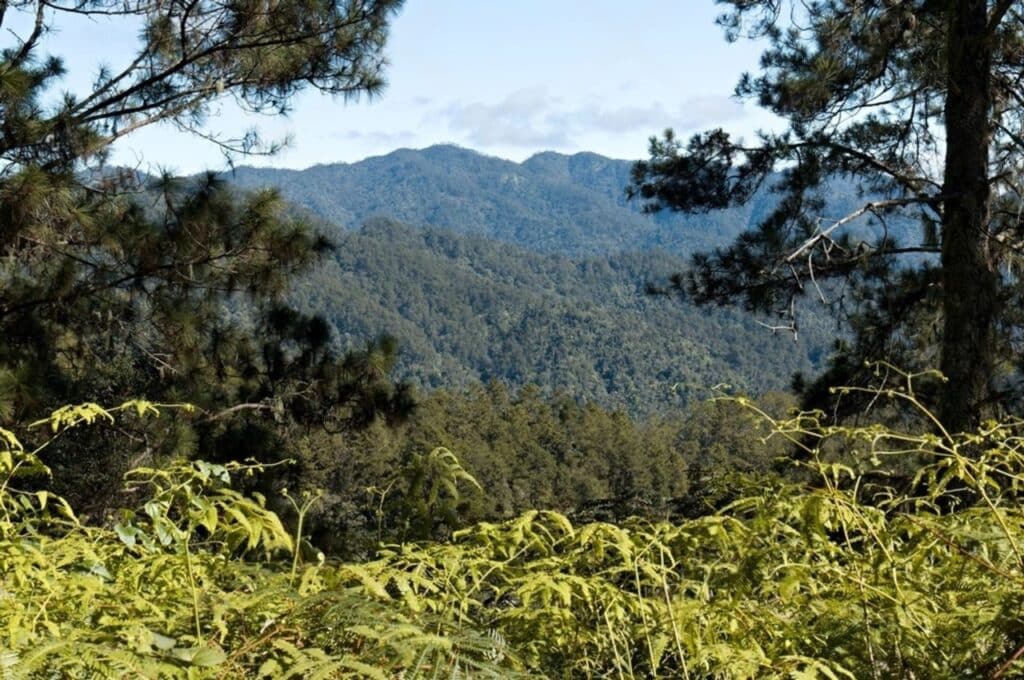
Early in the morning in La Ciénaga, in the Central Cordillera of the Dominican Republic, hikers load up their mules before heading deep into the forest. The trail climbs steeply. The vegetation changes with altitude, from tropical foliage to pine trees, then to cloud forest, until nights arrive when the cold takes you by surprise right in the middle of the Caribbean. After two or three days of hiking—sometimes longer, depending on the hikers’ fitness levels and the weather—Pico Duarte comes into view, the highest peak in the entire Caribbean.
Pico Duarte, in the Dominican Republic, stands at 3,101.1 meters according to a precise GPS survey conducted in 2021 —a few meters higher than the 3,087-meter figure long cited by the Dominican tourism board. In either case, no other peak in the Caribbean—whether in Cuba, Haiti, Jamaica, or Puerto Rico—is higher. A mountain peak, not a beach, offering a different perspective on the Dominican Republic.
The cloud forest crossed during the ascent, before reaching the summit
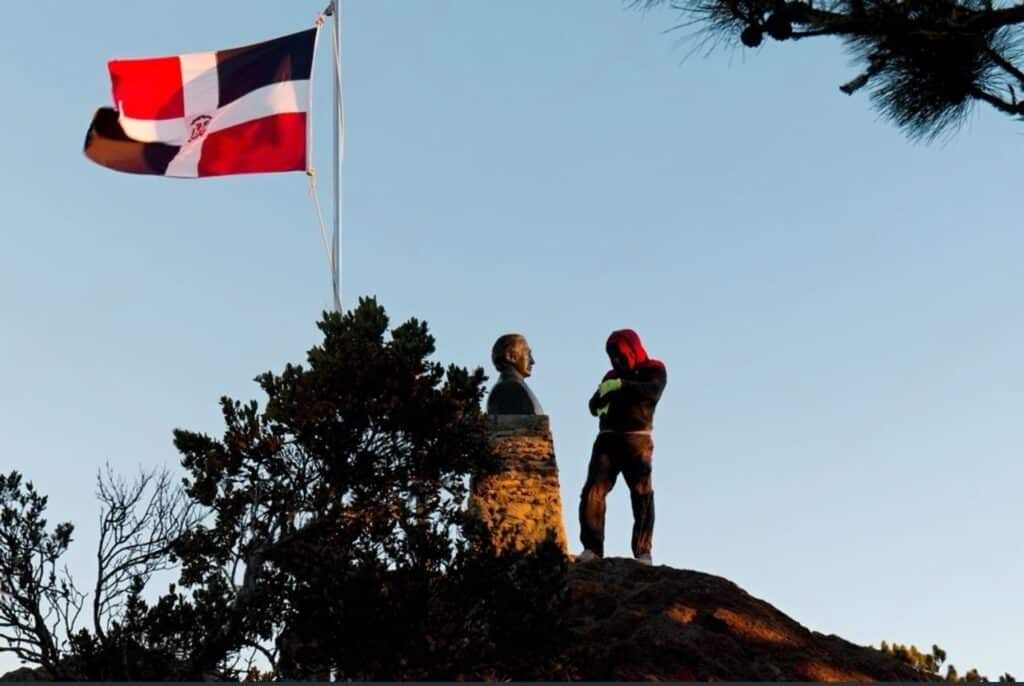
The Dominican flag and the bust of Juan Pablo Duarte mark the summit of Pico Duarte
Pico Duarte, the highest peak in the Central Cordillera
Pico Duarte straddles two national parks— Armando Bermúdez National Park and José del Carmen Ramírez National Park—in the Cordillera Central, the mountain range that runs through the center of the island of Hispaniola. These two parks protect most of the country’s mid- and high-altitude forests, a mountain range that Dominicans sometimes refer to as their “tropical Alps.” Some of the pine trees covering the slopes of Pico Duarte belong to a species found nowhere else in the world: the pino criollo (Pinus occidentalis), which is endemic to the island.
The ascent passes through several vegetation zones—tropical rainforest, pine forest, and then cloud forest—before reaching a summit where nighttime temperatures sometimes drop close to zero degrees, a far cry from the most common image of the Dominican Republic as a tropical destination. This same Central Cordillera is the source of the Yaque del Norte, the country’s longest river at 386 kilometers, which originates on its slopes before flowing across the entire northern part of the island.
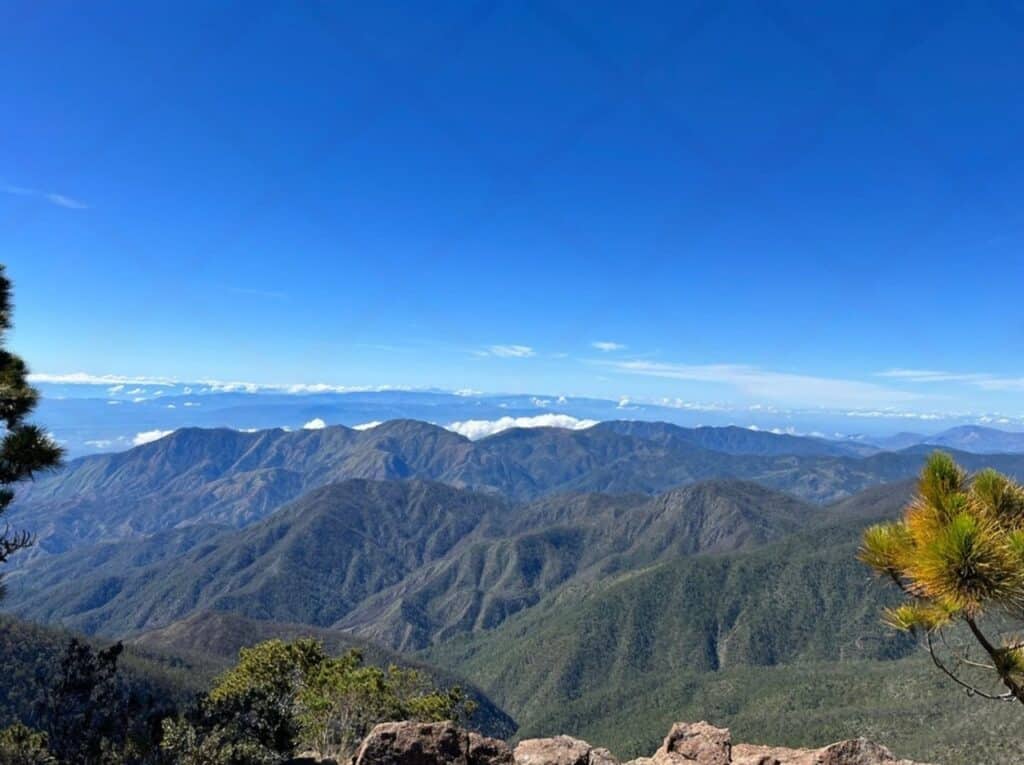
View of the Central Cordillera from the summit of Pico Duarte
A summit that changed its name three times
Pico Duarte has not always been known by that name. In 1851, the German-British explorer Robert Hermann Schomburgk made the first recorded ascent of the peak and named it Monte Tina. Later, the Swedish botanist Erik Leonard Ekman, who spent a great deal of time exploring the island’s mountains in the early twentieth century, distinguished between its two highest points, naming them Pelona Grande and Pelona Chica.
Under Rafael Trujillo’s dictatorship, the mountain became known as Pico Trujillo, a name the regime imposed on several of the country’s iconic landmarks during those years. After the dictator’s death in 1961, it was renamed Pico Duarte, in honor of Juan Pablo Duarte, one of the founding fathers of the Dominican Republic and a leading figure in the country’s independence, which was proclaimed in 1844. The name of the country’s highest peak thus embodies, in and of itself, a part of its political history.
The bust of Juan Pablo Duarte, who gave the summit its name in 1961
A three-day hike to reach the summit
The hike up Pico Duarte usually starts from La Ciénaga, via Manabao, before reaching the camps at Compartición or Valle de Lilís. Allow two to three days of hiking, depending on the route chosen and the group’s physical condition. A guide and mules to carry the gear are required; these can be arranged through hotels in Jarabacoa or directly at the La Ciénaga outpost.
Jarabacoa, nicknamed the “City of Eternal Spring” for its mountain climate—with temperatures ranging from 16 to 25 degrees year-round—serves as the gateway to the summit. This industry supports an entire local economy of guides and muleteers around Pico Duarte, which is very different from the coastal hotels or the resorts in Punta Cana.
Pico Duarte remains relatively unvisited compared to the beaches in the north or east of the Dominican Republic, despite its status as the highest peak in the entire Caribbean. But its elevation continues to be measured and remeasured—as the 2021 survey once again demonstrated—proving that a peak, even the region’s highest, is never fully understood. Three names in a century and a half—Monte Tina, Pico Trujillo, and then Pico Duarte—also tell the story of a country that long sought a name for itself before choosing to honor one of its founding fathers rather than a dictator. Does the Dominican Republic tell its story best from a beach, or from a mountaintop where it’s almost cold?
A hiker on the trail leading to the summit of Pico Duarte
Pico Duarte, in the Dominican Republic, stands at 3,101 meters according to the 2021 survey. No peak in Cuba, Haiti, Jamaica, or Puerto Rico is higher than it.
It was first named Monte Tina after its first ascent in 1851, then Pico Trujillo during the dictatorship of Rafael Trujillo, before being renamed Pico Duarte in 1961 in honor of Juan Pablo Duarte.
Allow two to three days of hiking from La Ciénaga; a guide and mules are required to carry the equipment.
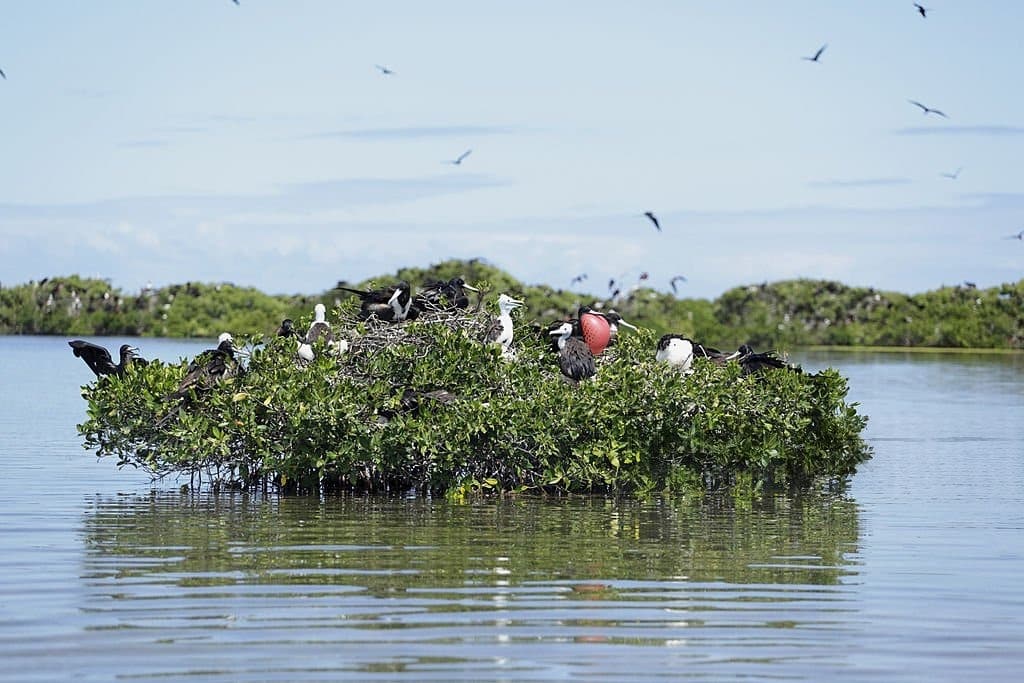
In Barbuda, the show begins even before you spot the birds. There is no road leading to the Codrington Lagoon sanctuary. You have to board a boat, travel across the water through the mangroves, and then watch as the black silhouettes of the magnificent frigatebirds (Fregata magnificens) come into view—their colony is one of the largest in the Caribbean.
This fact alone is enough to reveal another side of Barbuda. Beyond its pink beaches, the island is home to a lagoon where more than 5,000 of these birds have been recorded, in a colony where a scientific survey counted 1,743 nests. Here, you discover the destination by looking up and understanding the role this lagoon plays in the balance of the entire island.
A Ramsar-designated lagoon, nestled between mangroves and reefs
The Codrington Lagoon covers 3,600 hectares and has been recognized as a wetland of international importance under the Ramsar Convention since 2005. It borders Codrington, the only village on Barbuda, from which it takes its name and whose residents are among the sanctuary’s closest neighbors. Mangroves, seagrass beds, sandbars, and reefs form an ecosystem where hawksbill and leatherback sea turtles also nest. Around the lagoon, spiny lobster fishing and nature-based tourism provide a livelihood for some of Barbuda’s families, in a balance that local guides are committed to preserving.
The magnificent frigate, symbol of Barbuda
In Barbuda, the bird is more than just a curiosity. It has become one of the territory’s most recognizable symbols. The male attracts everyone’s attention during courtship, when he inflates a scarlet red pouch under his beak to attract passing females. The species’ wingspan can exceed two meters. Despite its webbed feet, it almost never lands on the water, as its feathers are not waterproof. It therefore spends most of its life gliding, carried by air currents over the sea, and sometimes supplements its diet by chasing other seabirds until they let go—a well-documented behavior in this species.
When Irma Hit the Colony
The importance of the sanctuary became even clearer in September 2017. Hurricane Irma struck Barbuda, forcing the evacuation of the entire island to Antigua. A scientific study published in 2023 showed that the sandbar protecting the lagoon—which had remained intact for 250 years—broke in two places under the force of the storm, a breach that remained open four years later. The lagoon also lost some of its mangroves, prompting a local organization, the MEPA Trust, to begin replanting them with the help of volunteers.
Twenty-eight days after the storm, Barbadian ecologist Shanna Challenger took part in the sanctuary’s first census since the disaster. She found only 300 frigatebirds. “There was a significant drop compared to the usual numbers,” she told the Antigua Observer at the time. No one knows yet whether the birds—like the residents—will return.
The return did not make up for the losses, but it demonstrated the colony’s ability to resume its life cycle in a disrupted environment. Today, the sanctuary is once again home to more than 5,000 frigatebirds. In 2025, a specialized media outlet described it as one of the most thriving colonies in the world, managed by a community council rather than a distant agency, with guides who pass this knowledge down from generation to generation.
More than just a postcard-perfect setting
What makes this sanctuary unique is not just the size of the colony. It is the proximity between a major natural phenomenon and a small island whose entire identity is tied to this landscape. The next time Barbuda appears as nothing more than a postcard of pink sand, just look toward Codrington Lagoon. Behind the beach lies another story—that of an island that has become one of the great refuges for the magnificent frigatebird in this part of the world. What if Barbuda’s true wealth were best seen in what it chooses to preserve for the future?
More than 5,000 magnificent frigatebirds live in the Codrington Lagoon sanctuary, a colony where a scientific census counted 1,743 nests—one of the largest in the Caribbean.
In Codrington Lagoon, on the west coast of Barbuda. The site has been designated a Wetland of International Importance under the Ramsar Convention since 2005.
Yes, but the population has been greatly reduced. A census conducted 28 days after Irma in 2017 found only 300 frigatebirds, compared with more than 5,000 today.
In Saint-Laurent-du-Maroni, the journey to the Voltaire Falls begins well before the first waterfall. From the town, the Paul Isnard Trail leads into the forest for about 70 kilometers. After being closed to the public for several years, the site has just reopened following a restoration program led by the Territorial Collectivity of French Guiana. The goal is threefold: to make the trail safer, to better accommodate visitors, and to showcase this natural site all without losing what gives this place its unique character.
70 kilometers before the trailhead
The figure illustrates the scale. The “Cascades et crique Voltaire” ZNIEFF, listed in the National Natural Heritage Inventory, begins at the end of the Paul Isnard trail, 70 kilometers south of Saint-Laurent-du-Maroni. The French Guiana Regional Nature Park also notes that you must take this road from the town before it turns into a dirt track.
Once you arrive, the journey continues on foot. The Chutes Voltaire trail is listed as 5.3 kilometers long and takes about three hours to walk. While this distance doesn’t make the place inaccessible, it does remind us of something obvious: here, the journey begins long before you reach the water. The trail, the forest, and the path are all part of the experience.
A Reopening Focused on Safety
The closure had brought the issue of access to the forefront. The renovation therefore had to address several areas. A comprehensive signage system has been installed starting from the town of Saint-Laurent-du-Maroni, particularly along the Paul Isnard Trail. A new visitor area now includes a parking lot, a parking space for people with disabilities, an access gate, and an information sign.
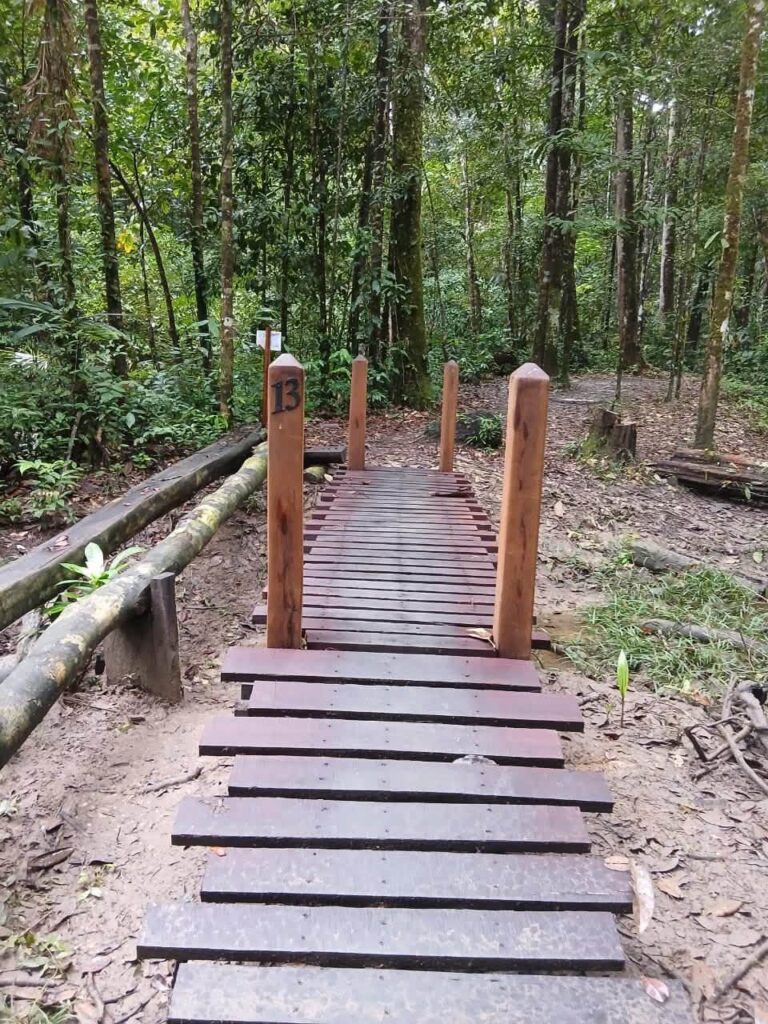
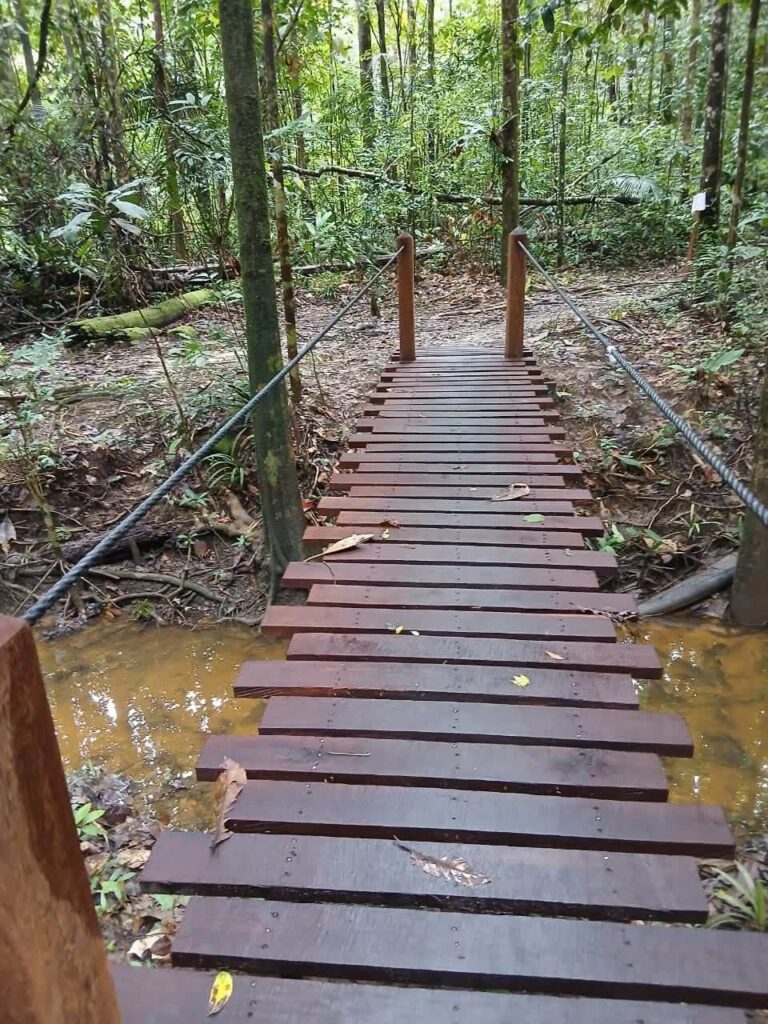
The most noticeable change is the reconstruction of the main footbridge. Approximately 21 meters long, it spans the Voltaire Creek. It was designed to better withstand flooding. The trail has also been restored, with several structures built to allow hikers to cross wetlands. According to information provided at the reopening, all of these improvements have received the necessary regulatory and technical approvals.
Voltaire Falls: A Landscape Unlike Any Other in French Guiana
The Voltaire Falls are not only notable for their remote location. It is a particularly rugged area, where the creek cuts through hard rock before reaching the waterfall zone. Over a distance of approximately 200 meters, the Voltaire Falls have a vertical drop of 35 meters, described in this official documentation as unparalleled in French Guiana. The site combines waterfalls, cascades, rocky thresholds, rapids, and forested areas. The area is recognized for its scenic, geomorphological, ecological, floristic, and faunistic features.
A multidisciplinary survey conducted in 2011 examined, among other things, the flora, fish, reptiles, amphibians, and non-flying mammals. This rich biodiversity serves as a reminder that opening the area to the public must also take into account a sensitive natural environment. The Voltaire Creek is part of the Maroni watershed and originates in a small mountain range east of the Sparouine Mountains. It flows for approximately 30 kilometers. In its upper reaches, the valley narrows and becomes winding: this is where the waterfalls are located. The terrain thus explains the spectacular appearance of the Voltaire Falls today.
At the foot of the waterfalls, a new kind of hospitality
The restoration doesn’t stop at the trail. At the base of the Voltaire Falls, visitors now have access to a large shelter, a fire pit, hammock shelters, and picnic tables with benches. These facilities are designed to provide a more comfortable rest stop after the hike. The reopening may also boost the appeal of western French Guiana as a tourist destination. The inn located at the site’s entrance is one of the local businesses likely to benefit from the return of visitors. This connection between natural heritage and the local economy adds another dimension to the work that has been done.
But the challenge won’t just be attracting more visitors. It will also be necessary to maintain a balance between visitor numbers, safety, and respect for the environment. At the Voltaire Falls, distance remains a key factor: 70 kilometers of road before the trail begins, followed by the forest and the creek leading to the waterfalls. The renovation makes the route safer and more comfortable. It doesn’t change the fact that it’s remote. And that may be precisely what makes the Voltaire Falls a unique destination in western French Guiana.
The Voltaire Falls are located in western French Guiana, south of Saint-Laurent-du-Maroni. They can be reached via the Paul Isnard trail, traveling about 70 kilometers before reaching the trailhead.
From Saint-Laurent-du-Maroni, take the road and then the Paul Isnard trail for about 70 kilometers. Once there, the journey continues on foot along a trail that is expected to take about three hours to complete.
The renovation of the Voltaire Falls is primarily aimed at making the trail safer and improving the visitor experience. The work includes new signage, visitor facilities, trail restoration, and a main footbridge approximately 21 meters long that spans the Voltaire Creek.
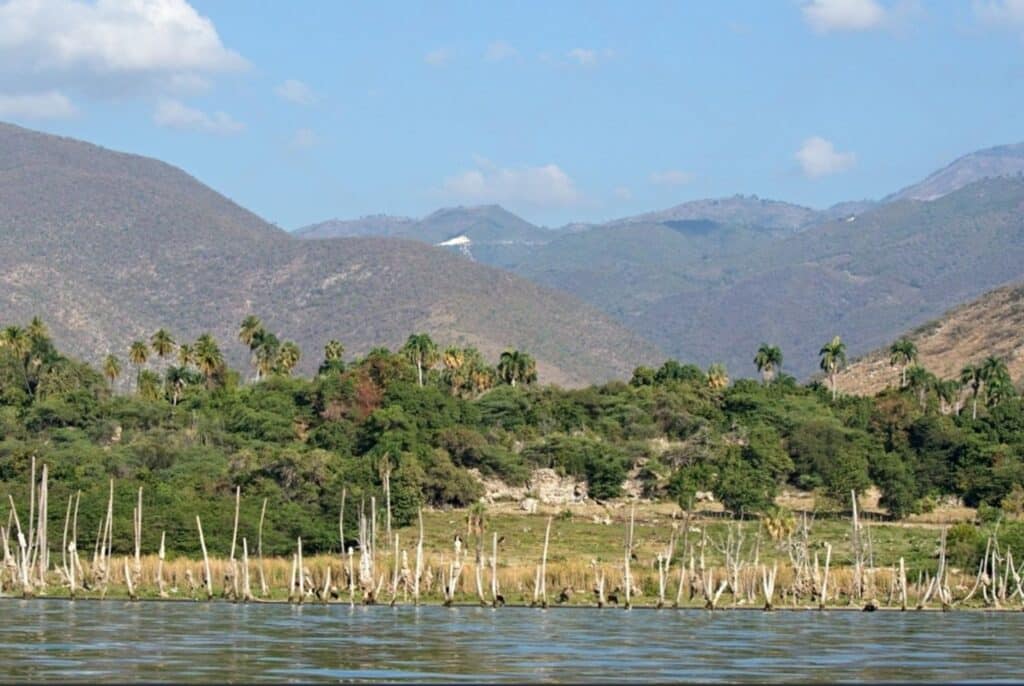
In the southwestern part of the Dominican Republic, the landscape seems to defy geography. Lake Enriquillo, said to be the largest lake in the Caribbean, lies in a depression whose surface is 40 meters below sea level. It is a vast saltwater lake with no outlet to the ocean, home to American crocodiles and iguanas. Behind this very concrete scene lies a much broader question: how did such a unique lake come to be here, and what does it reveal about the territory that surrounds it?
Lake Enriquillo, a lake with no outlet to the sea
One of the keys lies in the very shape of the basin. The United States Geological Survey (USGS), a government research agency specializing in Earth sciences, describes Lake Enriquillo and the neighboring Lake Azuéi in Haiti as two salt lakes located in the Hispaniola rift valley. Both occupy a closed basin: their waters have no natural outlet to the sea.
This lack of an outlet changes everything. The lake’s water level depends heavily on rainfall, runoff, and evaporation. When water enters the basin, it is not drained into the ocean. Evaporation therefore plays a major role in the system’s balance, while salts remain concentrated in the water. This is one of the reasons why USGS researchers classify the lake as hypersaline.
The landscape is therefore never completely static. Landsat images analyzed by the USGS show dramatic changes over the decades. Between 2002 and 2016, a sharp rise in water levels submerged farmland and displaced thousands of families. In Lake Enriquillo, this geographical reality is also evident in the daily lives of the riverside communities.
A Shelter for Reptiles
Another unique feature of Lake Enriquillo can be seen along the water’s edge. The Dominican Republic’s population of American crocodiles is confined to this geographical area. In this dry, salty landscape, the presence of this large reptile gives the lake a particularly strong ecological identity.
Iguanas are also part of the scenery. Two species are found in this region, including Ricord’s iguana, a species with a very limited range on Hispaniola. Isla Cabritos, one of the recommended stops in the national park, is an iconic spot for observing this wildlife and understanding the site’s biological richness.
This biodiversity also explains the level of protection afforded to the territory. Lake Enriquillo has been listed since 2002 as a Wetland of International Importance under the Ramsar Convention. The lake is also part of the Jaragua-Bahoruco-Enriquillo Biosphere Reserve, designated in the Dominican Republic in 2002 and, since 2017, integrated into a transboundary biosphere reserve with La Selle, in Haiti, under the auspices of UNESCO.
When Lake Enriquillo Also Tells Us About the Climate
The lake is also of interest to scientists for a less obvious reason: its sediments preserve information about the climate of the past. In 2019, the USGS team retrieved several sediment cores from the lake, some of which were about five meters long. Their goal was to reconstruct the history of precipitation and droughts in the Caribbean during the recent Holocene.
Lake Enriquillo is thus more than just a geographical curiosity. Its sediment layers, fluctuating water level, and salinity form a natural archive that allows scientists to study the balance between rainfall and evaporation. What we see on the surface today can therefore help researchers better understand climate variations that have occurred over thousands of years.
About 40 meters that change the way you see things
What ultimately makes Lake Enriquillo so memorable is an apparent contradiction: the largest lake in the Caribbean is located in one of the driest regions of the Dominican Republic, below sea level, yet it is home to remarkable wildlife and preserves part of the Caribbean’s climate history in its depths.
The figure of about 40 meters catches the eye. But above all, it opens a door to a region where geology, climate, biodiversity, and human lives remain intimately intertwined. What if some of the Caribbean’s most fascinating destinations were precisely those whose landscapes first force us to rethink what we thought we knew?
Lake Enriquillo has no natural outlet to the sea. The water that flows into the lake evaporates, leaving the salts concentrated, which explains its hypersaline nature.
Lake Enriquillo is said to be the largest lake in the Caribbean. Located below sea level, it is home to American crocodiles and iguanas, among other species, and its sediments preserve evidence of the region’s past climate.
Four artists, four regions, four journeys. On September 19, 2026, the National Academy for the Performing Arts in Port of Spain will host a ceremony at which Patra, Calypso Rose, Alan Cavé, and Shyne will each receive a special award. The 2026 Caribbean Music Awards will bring them together on the same stage, but their journeys tell different stories about Caribbean music and its ability to transcend borders.
One Scene, Four Legacies
The announcement made by the Caribbean Music Awards highlights four distinct honors. Patra will receive the Lifetime Achievement Award. Calypso Rose will be honored with the Elite Calypso Honors. Alan Cavé will receive the Elite Konpa Honors, while Shyne will be awarded the Global Ambassador Award.
This selection almost maps out the region’s musical landscape. Jamaica, Trinidad and Tobago, Haiti, and Belize are thus represented by artists whose careers have taken very different paths. More than just a list of winners, this selection offers a glimpse into the cultural diversity of the Caribbean.
Patra, a leading figure in Jamaican dancehall
With Patra, the 2026 Caribbean Music Awards are honoring an artist associated with a significant period in the globalization of Jamaican dancehall. Her style, visual identity, and positioning have helped bring to the forefront a strong female presence in a musical world often dominated by male figures.
The Lifetime Achievement Award highlights this aspect of longevity and influence. It is not merely a matter of recalling past successes, but of recognizing an artist whose image remains closely tied to a pivotal moment in the spread of dancehall beyond Jamaica.
@Queen Patra
Calypso Rose, the Living Legend of Calypso
Calypso Rose represents a different story. A native of Tobago, she has for decades embodied the narrative power of calypso, a genre that reflects society, comments on its times, and transforms the stage into a space for expression.
The Elite Calypso Honors, therefore, highlight more than just an individual career. Through her, it also celebrates a musical tradition deeply rooted in Trinidad and Tobago. Her presence in Port of Spain will give this honor a special significance: that of an artist being honored in the very heart of the land to which her musical history remains intimately tied.
With Alan Cavé, Haitian konpa also takes its place in this regional landscape. The singer is one of those artists whose career has unfolded across Haiti, the diaspora, and audiences located far beyond his homeland.
His *Elite Konpa Honors* serves as a reminder that Caribbean music isn’t limited to the genres that enjoy high visibility in English-speaking markets. Konpa has its own networks, communities, and collective memory. Alan Cavé’s recognition brings this history back to the forefront of a scene designed to celebrate the sounds of the entire Caribbean.
@Alan Cavé
Shyne: An Influence That Goes Beyond Music
Shyne’s career offers a fourth perspective. A native of Belize, he was honored with a Global Ambassador Award—a category that goes beyond musical performance alone. His public career has gradually combined music with representing and promoting his country on the international stage. This award thus broadens the very definition of cultural influence. Promoting the Caribbean can be achieved through a song, a musical genre, or an artistic career, but also through the ability to project a region’s image beyond its borders.
@Shyne
Four Ways to Experience the Caribbean
Bringing together Patra, Calypso Rose, Alan Cavé, and Shyne ultimately reveals what the 2026 Caribbean Music Awards aim to celebrate this year: not a single Caribbean musical identity, but multiple heritages capable of coexisting. Dancehall, calypso, konpa, and cultural representation don’t all tell the same story. Yet each demonstrates how a region can produce a voice that travels, transforms, and reaches new audiences.
In this context, their differences will thus become the true common thread: four distinct legacies, four different relationships with the world, and a shared ability to integrate Caribbean creations into international and sustainable cultural networks. On September 19, these four paths will converge in Port of Spain. And perhaps that is where the strength of this edition lies: in reminding us that the Caribbean shines precisely because it never speaks with a single voice.
Patra will receive the Lifetime Achievement Award, Calypso Rose will receive the Elite Calypso Honors, Alan Cavé will receive the Elite Konpa Honors, and Shyne will receive the Global Ambassador Award.
The 2026 Caribbean Music Awards ceremony will take place on September 19, 2026 at the National Academy for the Performing Arts in Port of Spain, Trinidad and Tobago.
In Barahona, in the southwestern part of the Dominican Republic, a blue stone bridges geology, craftsmanship, and national identity. Larimar is not only prized for its color: its history is tied to a specific region, to those who mine it, and to those who craft it. From the Sierra de Bahoruco to the jewelry workshops, its journey illustrates how a local resource can become cultural heritage, a symbol, and a cause for conservation.
In Barahona, a stone begins its journey
In 1974, Dominican artisan Miguel Méndez became interested in a blue stone known in the Barahona region. Together with geologist Norman Rilling, he helped identify its deposit and develop its use in jewelry. Méndez also gave it its name: “Larimar,” a combination of “Larissa,” his daughter’s first name, and “mar,” the Spanish word for “sea.” Behind this name, which has become familiar in the Dominican Republic, lies a history deeply rooted in a region, a family, and a tradition of craftsmanship.
Larimar: Why Is This Stone So Unique?
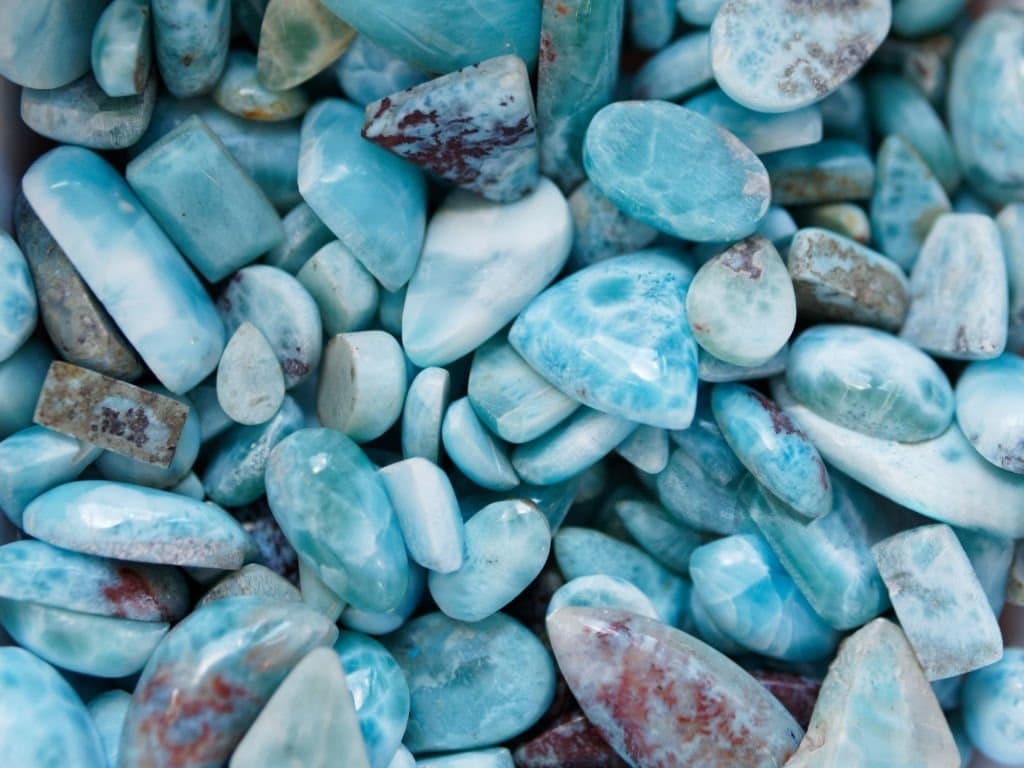
Larimar is a blue variety of pectolite that Dominican authorities claim is unique to the country. Its deposit is located in the Sierra de Bahoruco, in the southwestern part of the Dominican Republic, specifically in the communities of Los Checheses and La Filipina, in the province of Barahona. Its color, which ranges from light blue to deeper shades, gives it an instantly recognizable visual identity.
But its uniqueness lies not only in its appearance. It stems above all from its geographical origin: Barahona is not merely a backdrop for the stone; it is the place that gives it its history. This geographical context changes the way we view it: behind every crafted piece lies the concept of a heritage that the country intends to preserve.
When stone passes through the hands of artisans
Extracting this stone is just the beginning. Once it’s out of the ground, the material must be sorted, cut, polished, and then transformed. That’s where artisans play a vital role. Jewelry, pendants, rings, and decorative pieces give the stone a second life and transform a mineral resource into a cultural artifact. In December 2025, Dominican authorities reported that at least half of the extracted material remained in the country to be processed locally, particularly in the fields of handicrafts and jewelry.
This transformation represents a significant challenge: retaining more value within the region rather than simply exporting raw materials. It also helps maintain a visible connection between the stone’s origin and the processes that give it its final form before it enters the international market.
How did Larimar become a Dominican symbol?
This relationship between the stone, the region, and the craftsmanship has gradually transcended commercial boundaries. On November 4, 2011, Law 296-11 designated Larimar as the “National Stone” of the Dominican Republic. Since the passage of another law in 2018, November 22 has also been designated as National Larimar Day.
These recognitions lend an institutional dimension to what the artisans and communities of Barahona have been building for decades. Choosing this stone, then, is no longer simply a matter of selecting a blue stone. The stone evokes a place, a history of transformation, and an identity that the country has chosen to officially recognize.
Protecting the name “Larimar Barahona”
The next question was almost inevitable: How can this designation of origin be protected when the stone is exported? The answer today lies in the “Larimar Barahona” designation of origin. Its international registration under the World Intellectual Property Organization’s Lisbon System allows the name to be legally linked to the territory from which it originates.
In June 2026, the Dominican Ministry of Energy and Mines reported that this designation was protected in 28 countries. The goal goes beyond combating the misuse of the name. It also aims to improve traceability and encourage cutting, polishing, and jewelry making in the Dominican Republic.
From Barahona to the World: The True Story of Larimar
The story of this stone ultimately tells of much more than just a geological curiosity. A material buried in the Sierra de Bahoruco became a resource, then a craft, a national symbol, and now a heritage that the Dominican Republic seeks to protect beyond its borders. In this story, Barahona remains, even today, both the starting point and the central thread.
Perhaps this is where the true heritage value of this stone lies. Its uniqueness stems not only from its rarity, but also from the connection between a place, people, and the processes that transform the stone. Protecting this connection also raises a broader question: in the Caribbean, a region rich in traditions deeply rooted in their territories, how many other forms of craftsmanship could, in turn, become cultural heritage that is better recognized, better passed down, and better protected?
Larimar is a blue variety of pectolite associated with the Dominican Republic. Its deposit is located in the Sierra de Bahoruco, in the province of Barahona.
Larimar has become a national symbol associated with Dominican identity, craftsmanship, and expertise. It was designated the national gemstone of the Dominican Republic in 2011.
The “Larimar Barahona” designation of origin protects the connection between the stone and its region of origin. In particular, it aims to preserve the stone’s traceability, authenticity, and the value created locally through its processing.
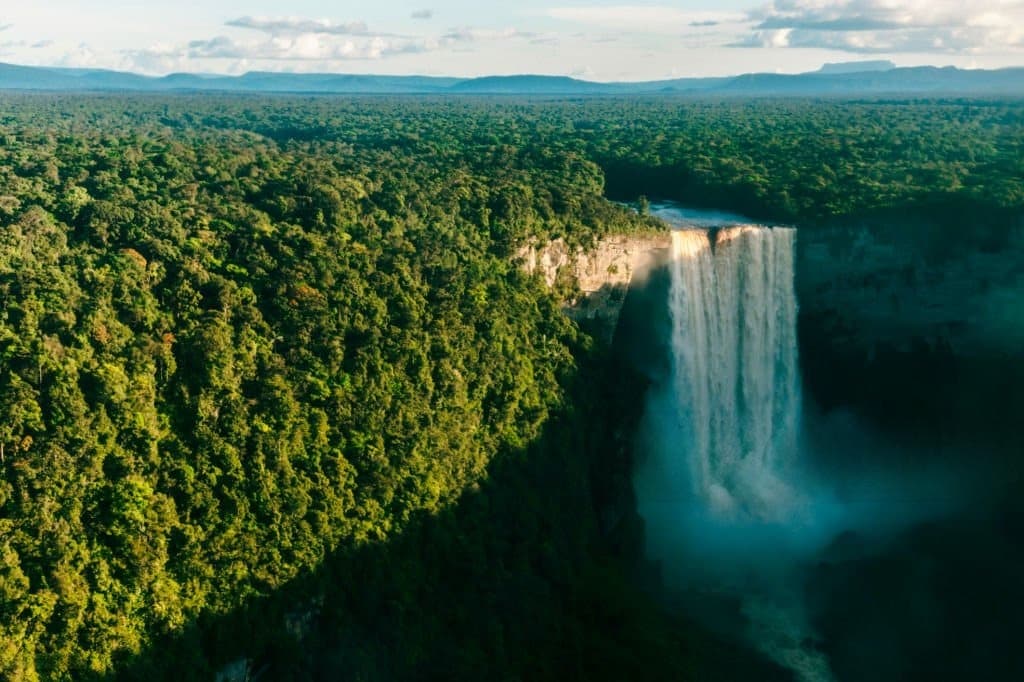
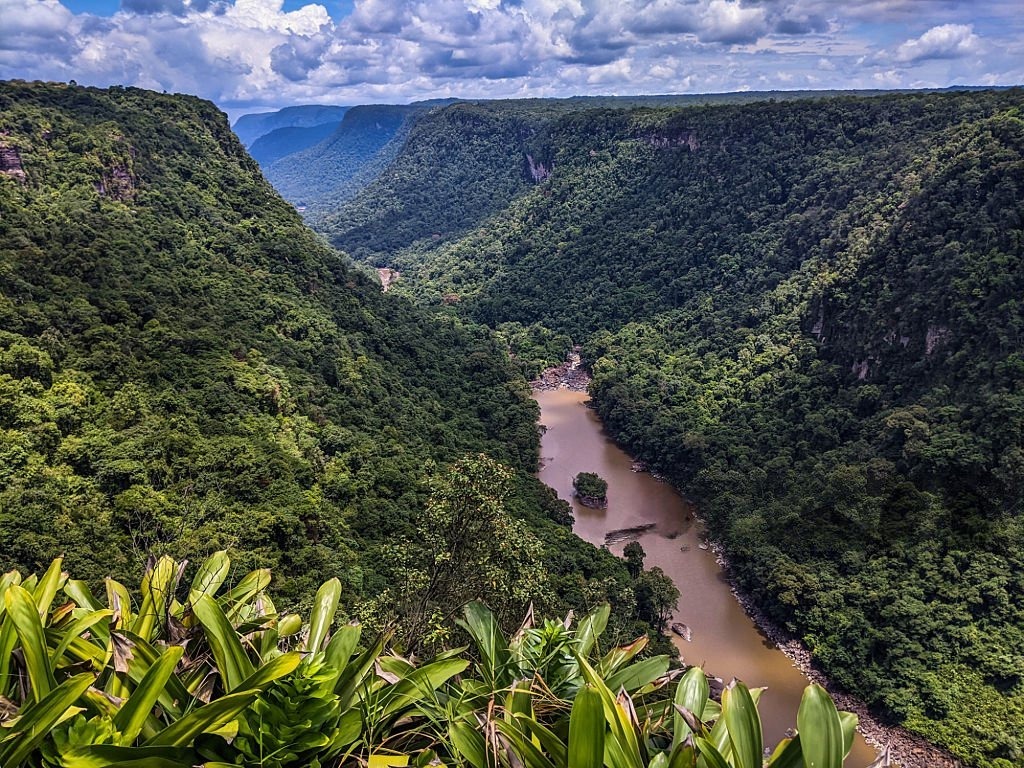
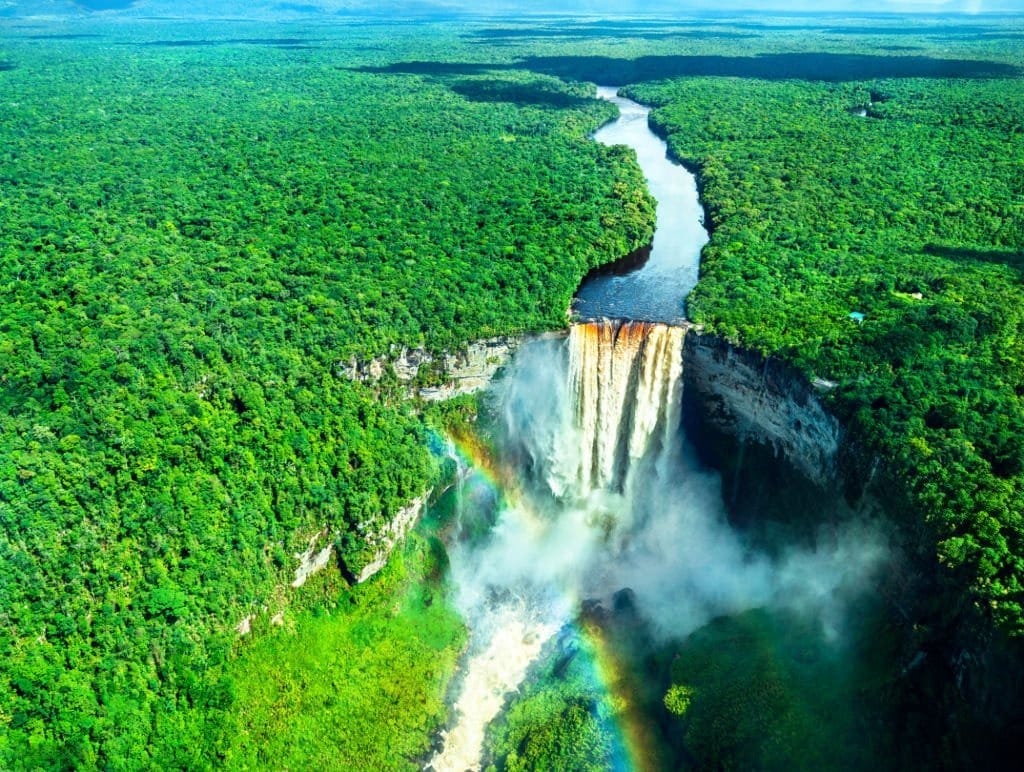
As the plane leaves Georgetown, the roads fade from view, the houses become tiny, and the forest eventually fills almost the entire horizon. Then, suddenly, a white break appears in this vast expanse of green. These are the Kaieteur Falls, where the Potaro River plunges 226 meters in a single drop. The sight is impressive not only for its height but especially for its surroundings: almost no man-made structures, just rock, forest, water, and open space.
Kaieteur Falls: 226 meters that put things into perspective
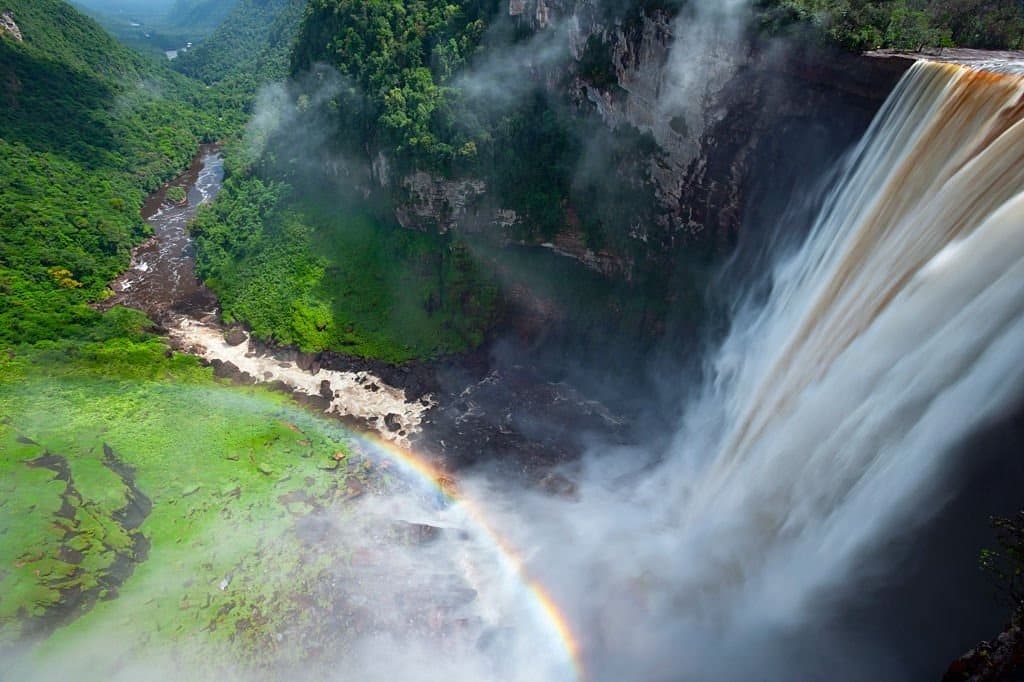
At 226 meters, or 741 feet, Kaieteur Falls is more than four times as high as Niagara Falls. Its uniqueness also lies in the combination of this height and the volume of water plunging from the plateau. Here, the Potaro River does not cascade down in a series of waterfalls. It flows through the landscape, suddenly reaches the escarpment, and then vanishes into a curtain of water, spray, and roaring sound.
This power gives the place a feeling that is difficult to capture in a photograph. From the viewing points, the eye is not drawn solely to the waterfall. It also takes in the rock faces, the mist rising from the pool, and the expanse of forest that seems to stretch on endlessly.
A waterfall in the heart of a landscape billions of years old
Kaieteur Falls are located in the Potaro-Siparuni region, within Kaieteur National Park. Established in 1929, the park now covers approximately 62,700 hectares. It lies on the Guiana Shield, a geological formation whose rocks are over two billion years old in some places.
This geological depth adds another dimension to the site. Kaieteur is not just a spectacular destination—it’s also a window into one of the oldest landscapes on the South American continent. In this part of Guyana, the tourist experience relies less on a series of activities than on coming face-to-face with the sheer scale of the landscape.
A place filled with stories
Long before the first Western accounts, Kaieteur Falls were known to the region’s Indigenous peoples, particularly the Patamona. Several oral traditions are associated with their name. One tells of a chief who chose to cross the falls in a canoe to protect his people. Another tells of an old man who was swept away by the waters. These stories should not be confused with established historical facts. Their significance lies elsewhere: they serve as a reminder that the place is also part of a cultural memory, and not just part of the history of tourism or exploration.
On April 29, 1870, British geologist Charles Barrington Brown reached the falls during an expedition. This date marks its entry into Western exploration history, but not its “discovery” in the strictest sense: local communities had known about Kaieteur for much longer.
A Living World to Explore Up Close
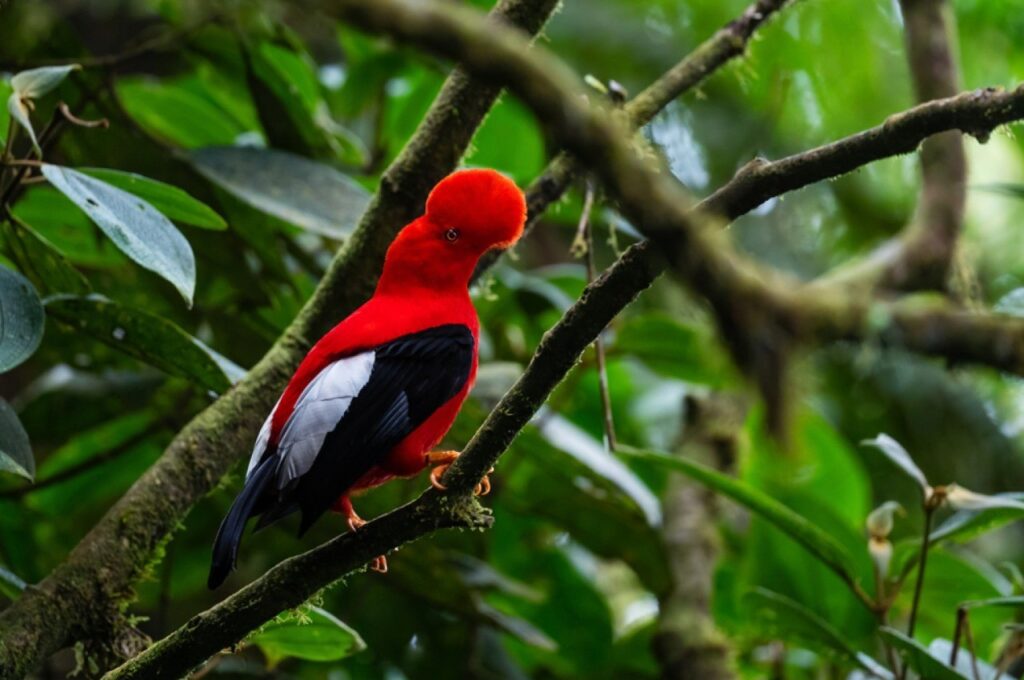
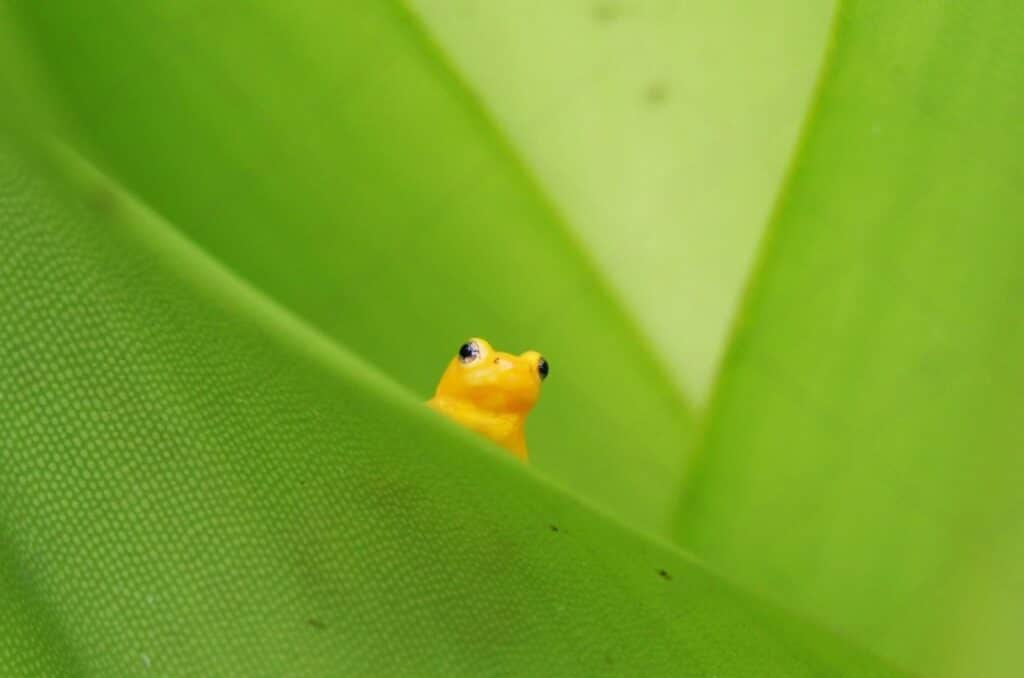
Around Kaieteur Falls, the spectacular can be found in just a few centimeters. The park is home to Anomaloglossus beebei, a small golden frog endemic to the area. It lives in close association with large bromeliads, whose leaves retain small reserves of water used for the development of tadpoles. Visitors can also spot the orange rock cock and Kaieteur swifts, which nest in the cliffs near the waterfall. This biodiversity serves as a reminder that the waterfall is not just an isolated attraction: it is the most visible part of a much larger ecosystem.
The experience of seeing Kaieteur Falls begins even before you arrive
For many visitors, the journey to Kaieteur Falls is part of the experience. Flights from Ogle Airport in Georgetown take about an hour. From the small planes, the urban landscape gradually gives way to rivers, then to the forest. Upon arrival, guided trails lead to several viewing points, including Rainbow View, Boy Scout View, and Johnson View. Each offers a different perspective: from one vantage point, the falls appear massive; from another, they seem almost suspended above the valley.
Perhaps that is where Kaieteur’s true strength lies. Its 226 meters are impressive, but they tell only part of the story. Kaieteur also reveals a Guyana that is forested, ancient, indigenous, and deeply connected to its wild landscapes. It is a destination that demands not only to be admired, but to be understood within the context of the land that gives it its full power.
Kaieteur Falls are located in Guyana, in the Potaro-Siparuni region, in the heart of Kaieteur National Park. They are formed by the Potaro River, in a vast tropical rainforest setting.
Kaieteur Falls is approximately 226 meters, or 741 feet, during their main jump. The Potaro River plunges almost straight down from the plateau, creating the impressive waterfall that can be seen today.
Kaieteur Falls are notable for their combination of height, powerful flow, and secluded forest setting. The site also has significant cultural importance, linked to indigenous traditions, and is home to remarkable biodiversity.
To provide the best experiences, we use technologies like cookies to store and/or access device information. Consenting to these technologies will allow us to process data such as browsing behavior or unique IDs on this site. Not consenting or withdrawing consent, may adversely affect certain features and functions.
Functional
Always active
The technical storage or access is strictly necessary for the legitimate purpose of enabling the use of a specific service explicitly requested by the subscriber or user, or for the sole purpose of carrying out the transmission of a communication over an electronic communications network.
Preferences
The technical storage or access is necessary for the legitimate purpose of storing preferences that are not requested by the subscriber or user.
Statistics
The technical storage or access that is used exclusively for statistical purposes.The technical storage or access that is used exclusively for anonymous statistical purposes. Without a subpoena, voluntary compliance on the part of your Internet Service Provider, or additional records from a third party, information stored or retrieved for this purpose alone cannot usually be used to identify you.
Marketing
The technical storage or access is required to create user profiles to send advertising, or to track the user on a website or across several websites for similar marketing purposes.