The vodou is entering a new phase in its international history. The joint candidacy of Haiti and Benin for inscription on the Representative List of the Intangible Cultural Heritage of Humanity places centuries of memory, transmission and creation at the heart of a global heritage debate. The deadline set by UNESCO for applications to be examined in 2027, and submitted before March 31, 2026, places this initiative within a precise and structured institutional calendar, but the stakes go far beyond the administrative procedure.
For the Caribbean, and Haiti in particular, this candidacy is no mere cultural formality. It’s about recognizing a living heritage, often misunderstood, sometimes caricatured, but deeply rooted in the country’s social, artistic and spiritual history. Vodou is not a fixed folklore; it is a cultural matrix, a way of organizing the link between generations, communities and the sacred. To place it within an international heritage dynamic is to recognize its complexity, depth and vitality.
A candidacy that redefines the way we look at vodou
The strength of this initiative lies in its ambition to go beyond simplistic representations. Too often confined to spectacular or distorted images, Vodou appears here as a complete cultural system, articulating beliefs, social practices, arts, rituals and modes of transmission. The official documentation associated with the Benin project reminds us that Vodou has its roots in West Africa, and that it spread to territories marked by the transatlantic slave trade. This historical continuity sheds light on the deep bond between Benin and Haiti, not as a diplomatic juxtaposition, but as a shared history.
This repositioning is essential. Registering Vodou as intangible cultural heritage means recognizing that it is not an isolated object, but a body of knowledge, gestures, rhythms and stories transmitted within living communities. Heritage recognition does not freeze tradition; it underlines its capacity to adapt and evolve. It affirms that the value of vodou lies as much in its spiritual dimension as in its social and artistic role.
Haiti, vodou territory in the Caribbean
A structuring presence in Haitian society
In Haiti, vodou permeates the deepest layers of society. It shapes not only rituals, but also forms of sociability, symbolic calendars, relationships with ancestors and ways of interpreting the world. It is not only expressed in ceremonies; it also permeates everyday gestures, family stories and community relations. To understand Vodou in Haiti, we need to look beyond the boundary between religion and culture: it’s a universe of meaning where spirituality, aesthetics and social organization are in constant dialogue.
This reality explains why the candidacy takes on a special dimension for the country. Haiti has more than just a historical legacy; it is a vital part of a heritage that continues to shape contemporary identities and practices. In a context where Haiti’s international image is often dominated by narratives of crisis, highlighting Vodou as a living heritage is part of a more balanced and fairer rewriting of the national narrative.

An artistic and creative matrix
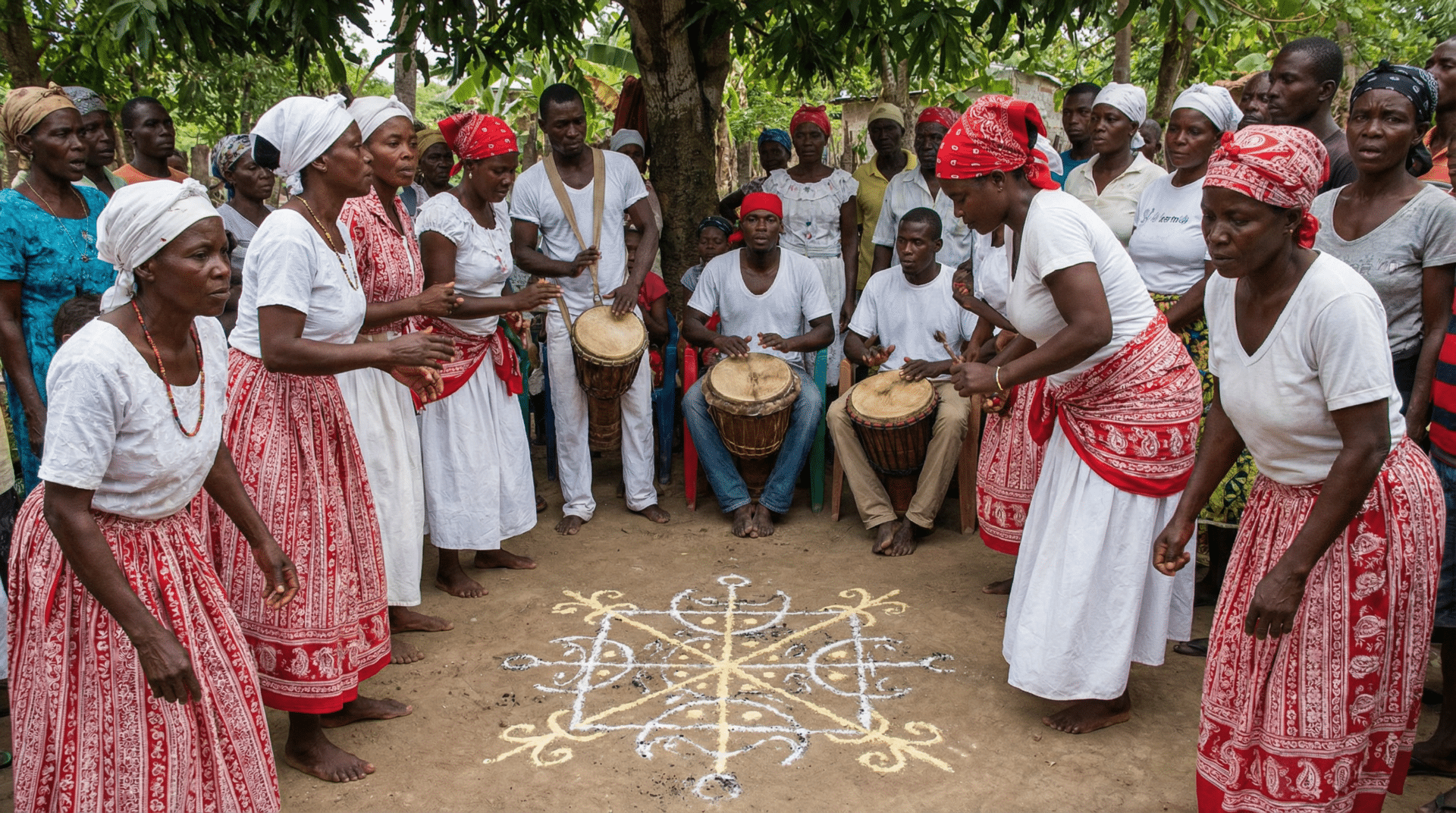
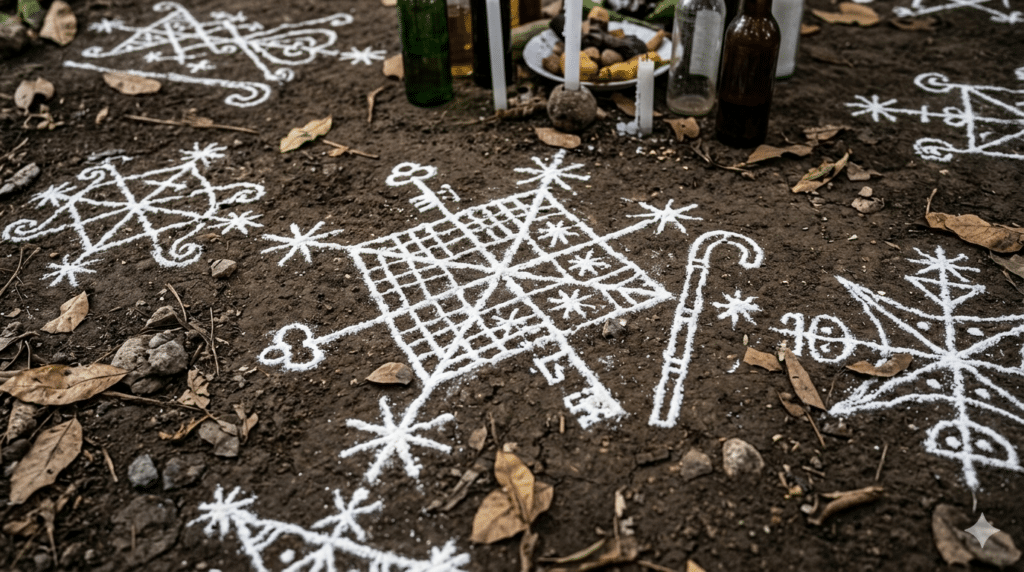
It has long nourished Haitian artistic expression. The percussive rhythms, responsorial songs, codified dances and symbols traced on the ground make up a remarkably rich aesthetic language. The vèvè, symbolic drawings associated with the spirits, bear witness to a graphic sophistication that has influenced generations of artists. Textiles, embroidery and contemporary creations inspired by the vodou imagination illustrate how tradition continues to dialogue with modernity.
This artistic dimension is not secondary; it lies at the heart of the application. It shows that vodou is not just a belief system, but also a creative space where body, voice and matter become vectors of memory and transmission. For readers in the Caribbean, this perspective will help them better understand why it occupies a singular place in the region’s cultural ecosystem.

From the Gulf of Benin to Haiti: transatlantic historical continuity
A history shaped by the Atlantic slave trade
The link between Benin and Haiti is part of the long history of the transatlantic slave trade. Beliefs and practices originating in the ancient kingdoms of the Gulf of Benin region crossed the ocean with enslaved people. When they arrived in the Caribbean, they were transformed, adapted and enriched by contact with other traditions and the colonial context. Haitian vodou is not a simple reproduction; it is the result of a process of cultural re-creation in the face of the violence of uprooting.
Acknowledging this continuity means recognizing the ability of displaced peoples to preserve essential elements of their worldview. The joint candidacy highlights this complex trajectory, where African memory and Caribbean experience come together in a shared heritage.
Cultural diplomacy aimed at recognition
Beyond history, this initiative is part of active cultural diplomacy. Together, Benin and Haiti are asserting the value of a shared heritage, as part of a dynamic of intercultural dialogue. This cooperation underscores the fact that intangible heritage can become an arena for rapprochement and mutual recognition, far removed from the logic of symbolic competition.
The challenges for Haiti: recognition, transmission and international image
A heritage already present on the UNESCO stage
Haiti has recently distinguished itself with the inscription of several cultural elements on UNESCO’s Representative List, including joumou soup in 2021, cassave bread knowledge in 2024 and compas in 2025. This trajectory confirms the country’s determination to promote its living traditions. In this continuity, it appears as a fundamental pillar, whose recognition would reinforce the coherence of this heritage policy.
An opportunity to rebalance representations
International recognition of vodou would have a powerful symbolic impact. It would help to deconstruct sensationalist visions and place the tradition in its historical and social context. For Haiti, the stakes are also educational: offering younger generations a more structured reading of their heritage and encouraging documentation, education and safeguarding programs.


Heritage recognition as a lever for the future
Inscription on the Representative List would not be an end in itself. It would open up a space for reflection on how to preserve a living heritage without freezing it. It would encourage the active participation of communities and strengthen transmission mechanisms. Above all, it would affirm that Vodou fully belongs to the world’s cultural heritage, not as an exotic curiosity, but as a complex system of knowledge and artistic expression.
At the crossroads of Africa and the Caribbean, it tells a story of continuity despite rupture, of creation despite constraint, of memory despite erasure. For Haiti, this candidacy represents a significant step in the recognition of a heritage that continues to structure its cultural identity and international influence.
No. Vodou is the subject of a joint nomination by Haiti and Benin for inscription on the Representative List of the Intangible Cultural Heritage of Humanity. The final decision is expected during a forthcoming evaluation cycle by the intergovernmental committee.
In Haiti, vodou is a living heritage that structures collective memory, social practices, artistic expression and intergenerational transmission. It plays a central role in Haitian cultural identity.
Vodou originated in West Africa, particularly in the Gulf of Benin region. Following the transatlantic slave trade, these beliefs and practices were transmitted to the Caribbean, where they were adapted and transformed in Haiti, while retaining common roots.