

From February 24 to 27, 2026 the Heads of Government of CARICOM will meet in Basseterre, à Saint Kitts and Nevis, for the 50th Regular Meeting of the Conference of Heads of Government. A highly symbolic, but above all strategic event, at a time when the Caribbean region is facing an accumulation of economic, climatic, security and geopolitical challenges. The chosen theme, “Beyond Words: Action Today for a Thriving, Sustainable CARICOMclearly announces the ambition: to move beyond declarations of intent into a phase of concrete implementation.
Chaired by the Prime Minister of Saint Kitts and Nevis, Dr Terrance Drew current President for the first half of 2026, this conference marks an important milestone in the history of the regional organization, created to strengthen integration, cooperation and solidarity between its member states.

An opening under the banner of political responsibility
The opening ceremony, scheduled for February 24th at the Marriott Dome in Frigate Bay, will set the political tone for the summit. The expected speeches will put into perspective the commitments made by CARICOM over the past decades, but also the persistent gaps between adopted decisions and actual implementation. The speech by outgoing Chairman, Jamaican Prime Minister Andrew Holness, is expected to take critical stock of the previous cycle, while Secretary General, Dr Carla Barnett, will remind us of regional priorities in an unstable international context.
The challenge is clear: to demonstrate that CARICOM remains a relevant framework for responding collectively to contemporary crises.
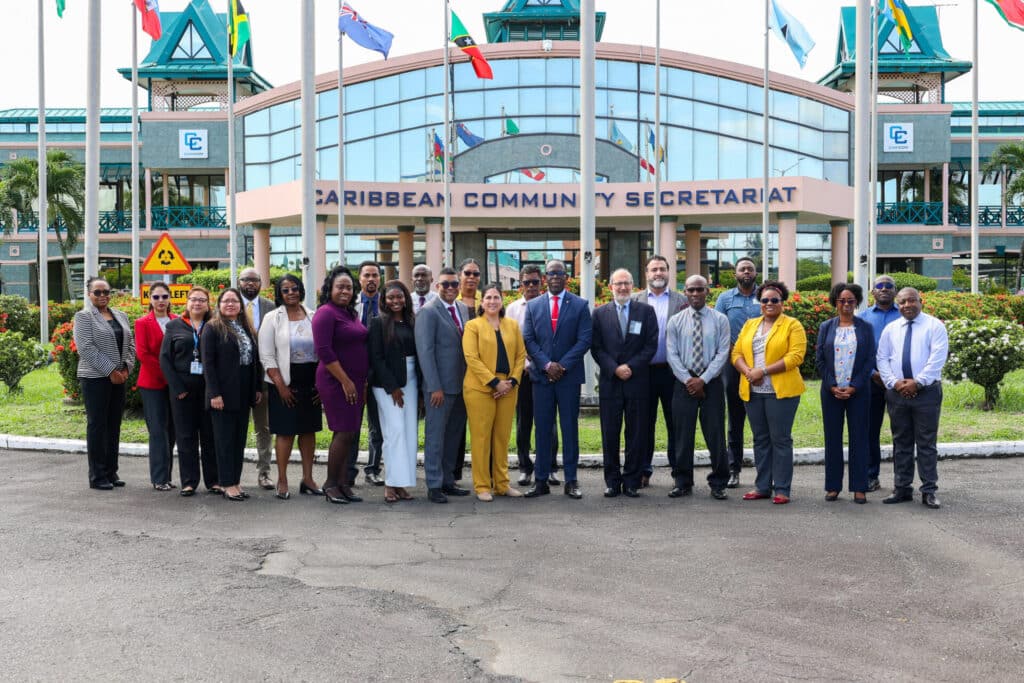
The Caribbean single market still at the center of debate
Among the structuring dossiers on the agenda is the CARICOM Single Market and Economy (CSME). More than thirty years after its launch, the single market remains incomplete. Discussions will focus in particular on the free movement of qualified people, the recognition of skills, the removal of non-tariff barriers and the harmonization of economic policies.
For many member states, the credibility of the organization today depends on its ability to make the CSME fully operational, to the benefit of citizens and regional businesses alike.

Climate and financing: an existential emergency
The climate issue will be central to the discussions. For the CARICOM states, climate change is not a future projection, but a daily reality: rising sea levels, intensifying hurricanes, pressure on natural resources. The heads of government will discuss access to climate financing, reform of vulnerability criteria and international recognition of the specific situation of small island states.
The organization should reaffirm a strong collective position in favor of climate justice and better access to international financial mechanisms.
Food security and regional resilience
Another strategic priority is food and nutritional security. The region’s high dependence on imports exposes CARICOM countries to external shocks, whether economic, health-related or logistical. Discussions will focus on strengthening regional agricultural production, local processing and supply chain resilience.
Beyond agriculture, a broader reflection on Caribbean food sovereignty is expected.


Regional security and transnational crime
Security was also a major theme at the summit. Organized crime, arms trafficking, urban violence and illicit flows are common challenges for CARICOM member states. Leaders will examine existing cooperation mechanisms and ways of strengthening collective action, particularly in terms of information sharing and operational coordination.
Safety is now seen as an essential condition for the region’s economic and social development.
Transport and connectivity: a structural brake on integration
Intra-regional transport remains a sensitive issue. High costs, limited connections and dependence on external hubs hamper the mobility of citizens and the movement of goods within CARICOM. Heads of government should reassess existing options for improving air and sea connectivity, a key element of regional integration.

Reparations and international relations
The issue of reparations for slavery and colonialism will remain on the agenda, following on from the work of the CARICOM Reparations Commission. At the same time, foreign relations will be the subject of in-depth exchanges, illustrated by the presence of international partners, notably from Saudi Arabia and Africa, a sign of our commitment to diplomatic and economic diversification.
A summit under pressure
The conference closes on February 27 by a final press conference at the St Kitts Marriott. Beyond the official communiqués, this 50ᵉ summit will be judged by its ability to produce clear, measurable directions that are followed by action.
The stakes are high: to prove that regional integration can still be a concrete lever for development, resilience and sovereignty in a changing world.
The 50ᵉ Regular Meeting of the Conference of Heads of Government is an official meeting bringing together the leaders of CARICOM member states to set the political, economic and diplomatic direction of the Caribbean region.
Discussions include the Caribbean Single Market (CSME), climate financing, food security, regional security, intra-Caribbean transport, reparations and international relations.
This summit marks a symbolic and strategic milestone, with high expectations of concrete results. It takes place against a backdrop of economic, climatic and geopolitical pressures that call for coordinated, effective regional action.



One Response