January 28, 2026 marks a defining moment in relations between Martinique and its regional environment. On that day, the French Senate adopted the bill authorizing Martinique’s accession to the CARICOM as an associate member. A widely supported vote, seen as a strong political signal in favor of a Caribbean anchorage that has long remained partial for the French territories of America.
This decision is part of a process that began several months earlier, with the official signing of the accession agreement in February 2025. It does not, however, represent the definitive culmination of the institutional process, as the text still has to be examined by the French National Assembly to complete the French legislative procedure.
CARICOM, a framework for Caribbean cooperation
Created in 1973 by the Treaty of Chaguaramas, CARICOM is today one of the Caribbean’s leading forums for political, economic and sectoral cooperation. It brings together sovereign states and several non-independent territories around common priorities: economic integration, mobility, climate resilience, public health, education and cultural cooperation.
For the French territories in the region, relations with CARICOM have long been indirect, limited to one-off partnerships or technical cooperation without any real institutional framework. Martinique’s accession as an associate member is intended to fill this gap.
February 2025: a founding signature
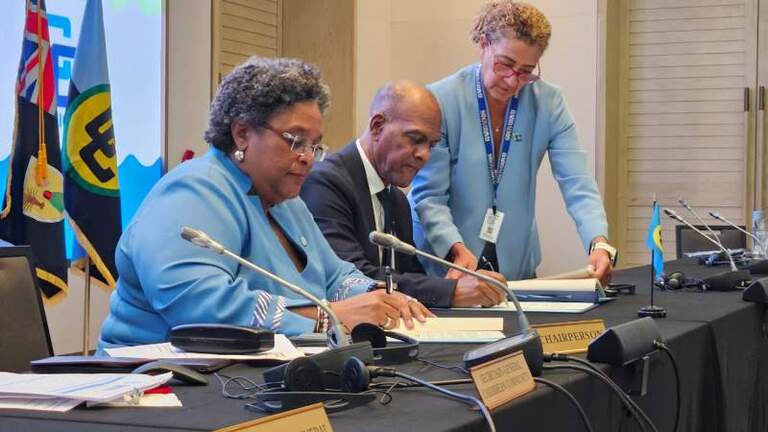
It was in February 2025, at a CARICOM summit held in Bridgetown, that Martinique officially signed the accession agreement granting it associate member status. The signing of this agreement, with the backing of French diplomacy, laid the political foundations for the territory’s integration into the regional organization.
Associate membership, provided for under the Treaty of Chaguaramas, is reserved for non-sovereign territories. It enables active participation in CARICOM’s work and programs, but excludes sovereign powers such as foreign policy or the right to vote on decisions binding on member states.

Senate vote: a key legal step
On January 28, 2026, French senators passed a bill authorizing France to accede to a protocol granting Martinique the status of associate member. This text provides the necessary legal framework for the exercise of CARICOM representatives on French territory, and for Martinique’s institutional participation in regional bodies.
This vote comes after several years of debate on the place of the French overseas territories in their immediate geographical environment. The parliamentary debates have highlighted a shared observation: despite belonging fully to the Caribbean in geographical and cultural terms, the French territories remain insufficiently integrated into regional dynamics.
The bill must now be examined by the French National Assembly, the last stage before the scheme comes into full effect.
A status compatible with French and European law
Martinique’s accession in no way alters its institutional status. The territory remains a French collectivity governed by the Code général des collectivités territoriales, and fully retains its status as an outermost region of the European Union.
The French legal framework authorizes local authorities to join regional organizations, subject to the agreement of the State. This does not involve any transfer of competence, or any questioning of French or European sovereignty.
This clarification is central: membership is part of a regional cooperation rationale, not an institutional redefinition.

A response to a regional integration deficit
Parliamentary debates have highlighted the limits of a model in which the French territories of the Americas evolve on the bangs of the major regional areas to which they naturally belong. This gap has long hampered economic, academic, cultural and health cooperation, all of which are essential in a Caribbean context marked by shared vulnerabilities.
By joining CARICOM, Martinique intends to become an identified player, capable of participating in collective responses to climate change, health crises and economic development challenges.
Concrete prospects for the region
Membership opens up a wide range of opportunities for Martinique. On the economic front, it facilitates dialogue with the Caribbean states and encourages the emergence of regional partnerships. In terms of training and research, it strengthens student and university mobility in a linguistically and culturally diverse area.
Cultural cooperation is also an important lever in a region where creative industries are playing a growing role. Finally, integration into CARICOM’s regional programs enables us to collectively address environmental and climate issues, which are particularly sensitive in the Caribbean arc.

A new phase to materialize
The Senate’s vote on January 28, 2026 opens a new phase for Martinique within CARICOM. The challenge now is to transform this institutional framework into tangible projects and useful cooperation for the territory and its stakeholders. Membership is not a symbolic achievement, but the starting point for a regional participation that will be translated into action, in the service of Martinique’s development and integration into the Caribbean.
Martinique signed an accession agreement in February 2025, giving it associate membership status. associate member. The French Senate validated the legal framework on January 28, 2026, and the text still has to be examined by the National Assembly to complete the process.
Associate membership enables Martinique to participate in CARICOM’s work and sectoral programs, without voting rights on decisions binding on sovereign states. It does not imply any transfer of sovereignty or diplomatic competence.
Membership opens up prospects for economic cooperation, student and professional mobility, cultural projects and joint responses to the climate and environmental challenges shared by the Caribbean.