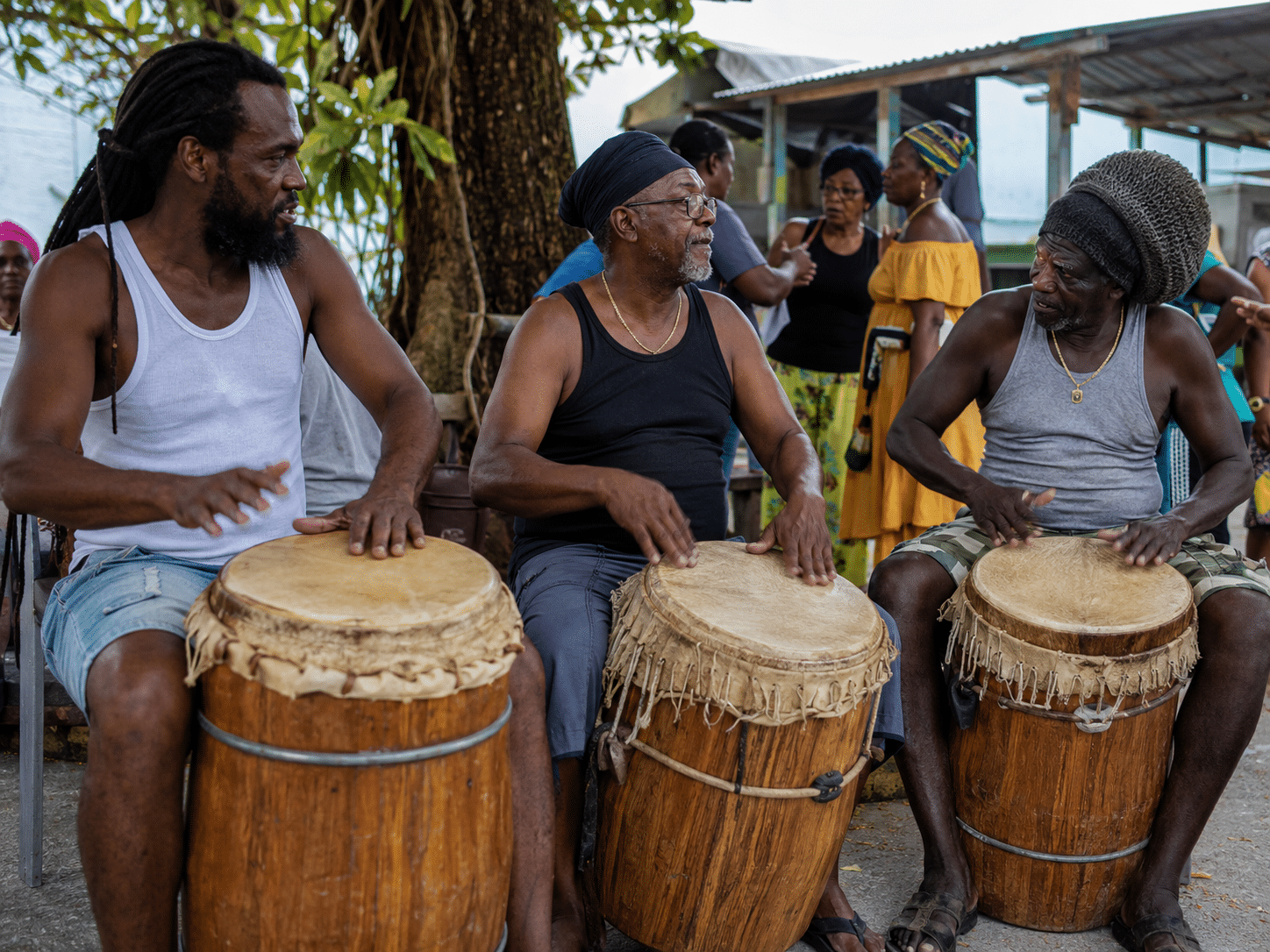
In a yard, at the edge of a field or near a house in need of repair, someone calls out. You don’t just lend your arms. They come with their presence, their voice, sometimes a drum, often a dish to share. In Haiti, Konbit doesn’t just mean one-off help. The word tells of a way of living together. It is this force that still runs through the living word today.
To say “fè yon konbit”, in Haitian Creole, is to announce that work is being carried out by several people. The simplest translation would be “collective work” or “mutual aid”. But that’s too short a translation. A Konbit implies a call, a response, a reciprocity. Today we help a neighbor prepare his field, tomorrow that neighbor will come and help in turn. Effort circulates. Debt is not accounting. It is social.
Working together, but never cold
The word is strongly associated with rural Haiti. In many descriptions, the Konbit is used to prepare the land, plant, harvest, clean up a space or carry out a task impossible to accomplish alone. So it’s not an abstract gathering. It’s a concrete gesture. Hands coordinate. A plot of land moves forward. A family breathes. A community remembers that it can produce strength without waiting for an institution.
What makes the Konbit unique is the alliance between work and social ties. The field is not just a place of production. It becomes a space for speech, rhythm, meals and mutual recognition. Some forms combine singing, music or drumming. Rhythm helps the body to hold on. The meal is a reminder that shared effort also opens up a time of hospitality. However, we must avoid turning this practice into a fixed folkloric image. Not all Konbits are alike. Depending on place, time and need, the practice can be agricultural, communal, familial or symbolic.


African roots recomposed in Haiti
Its roots are often traced back to African forms of collective work. Researchers have linked Haitian coumbite to the dokpwe of Dahomey. It is better to speak of a probable and documented filiation, rather than a single and direct origin. Haitian history has always recomposed heritages. The Konbit thus carries the memory of Africa, the plantation experience, survival after slavery and the peasant creativity of a people who had to organize to stand on their own feet.
This strength explains why the word now extends beyond the agricultural field. It can be found in educational, social, cultural and diasporic initiatives. It is used to name collectives, projects and solidarity initiatives. In these contemporary uses, Konbit retains its central idea: several people pooling their resources to achieve what none could achieve alone. The word has not lost its weight. It has just changed scale.


Kinship on the island, a lesson for the Caribbean
The relationship with the neighboring Dominican Republic also needs to be approached with caution. In certain contexts, the Spanish term convite also refers to a form of community work or mobilization. This proximity reminds us that both parts of the island share rural histories, circulations and African heritages.
Konbit is important because it gives a name to a collective Caribbean intelligence. It rejects the idea that work is necessarily solitary, cold or silent. It shows that a community can transform a necessity into a bonding moment. In a region marked by natural disasters, migration, economic fragility and the strength of extended families, this idea still speaks. It reminds us that grassroots organization is not a last-minute emergency. It’s a culture. It’s not just a Haitian tradition. It’s a social lesson: when arms multiply, the load becomes lighter.
Konbit is more than just a method. It’s a trust in one’s neighbor, a memory of gestures passed down, and a very Haitian response to a universal question: how do you move forward when no one, alone, has enough hands? The answer begins with a common call to action. What if the next Caribbean word took us to Jamaica, to irie, that way of saying that all is well, but with more than just well-being?

Konbit refers to a form of collective work in Haiti. The word refers to neighbors, families or community members helping each other to accomplish a task that requires several hands. This may involve preparing a field, harvesting, repairing a house or supporting a joint initiative. But Konbit doesn’t just mean “working together”. The word also conveys the idea of reciprocity, social ties, shared meals, sometimes music and festivities.
The Konbit is important because it shows how Haitian society has long organized everyday solidarity. In rural areas, it enabled people to carry out difficult tasks without depending solely on money or institutions. It is also a reminder that work can be a moment of cohesion, a time for talking and mutual recognition. Through this word, Haiti conveys a social philosophy: when a load is too heavy for a single person, the community can carry it together.
Yes, Konbit remains a strong reference in Haiti, even if its forms have evolved. It remains associated with the rural world, but today the word is also used to refer to community projects, social initiatives, associations, collectives or solidarity initiatives in the diaspora. Its meaning has broadened: it no longer refers only to collective agricultural work, but to any action where several people pool their forces to advance a cause, a neighborhood or a community.