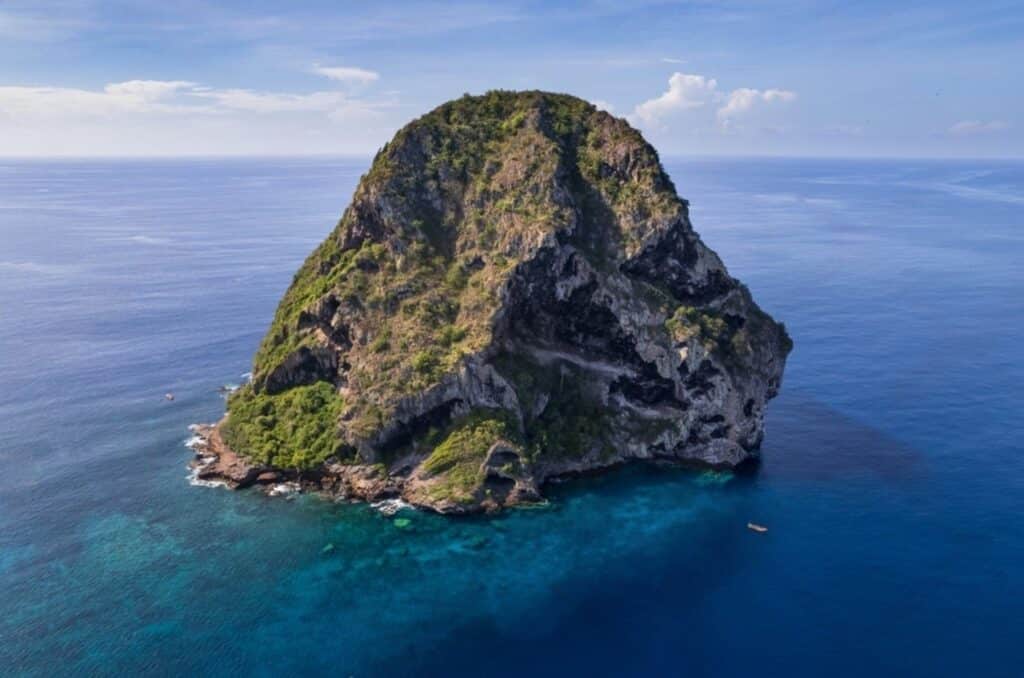
Diamond Rock, a 176-meter-high volcanic islet off the coast of Diamant, Martinique, was registered on February 3, 1804, as a small warship of the Royal Navy under the name HMS Diamond Rock. A French division commanded by Captain Julien Cosmao recaptured it on June 2, 1805. More than two centuries later, landing there is prohibited.
About 1,800 meters off the coast of the town of Le Diamant, in southern Martinique, lies a small islet that the British Navy occupied beginning in 1804. In January, Commodore Samuel Hood decided to turn it into a fortified position. Lieutenant James Wilkes Maurice landed there with a detachment from the HMS Centaur. Just a few weeks later, the Royal Navy added the islet to its list of vessels.
The Rocher du Diamant, 176 meters high, facing the Diamant
The Rocher du Diamant rises to a height of 176 meters and has a diameter of approximately 300 meters. This islet is a massive dome of dacite, a volcanic rock, formed about 0.97 million years ago, according to geologists’ measurements. In 1804, this landmark became a strategic military position. The British Navy occupied it and, from this outpost, controlled the Passage des Fours.
January 1804: The Royal Navy fortified the islet
In January 1804, the HMS Centaur, a 74-gun ship commanded by Commodore Samuel Hood, anchored at the foot of the rock. First Lieutenant James Wilkes Maurice went ashore with sailors and marines. He and his men were tasked with fortifying an uninhabited islet that was difficult to climb. The cannons were first brought in by sea. A cable stretched from the mainmast of the HMS Centaur was used to hoist them up the cliff face. Five guns were initially installed—three 24-pounders and two 18-pounders—from the water’s edge to the summit.
On February 3, 1804, the islet was registered as a small warship of the Royal Navy under the name HMS Diamond Rock. James Wilkes Maurice was placed in command, with a garrison of about 120 men.

May 31–June 2, 1805: The recapture by Julien Cosmao’s division
In mid-May 1805, Admiral Pierre de Villeneuve arrived in Fort-de-France with a Franco-Spanish fleet. One division was tasked with recapturing the rock. It was placed under the command of Captain Julien Cosmao, who commanded the ship Pluton. The division also included the ship Berwick, the frigate Sirène, and French and Spanish vessels. The ships Pluton and Berwick each carried 74 guns. The division set sail on May 29, 1805.
The attack began on May 31, 1805. The ships’ cannons destroyed the islet’s lower batteries, then the troops landed, while James Wilkes Maurice withdrew his men to the upper levels. Running low on water and ammunition, James Wilkes Maurice surrendered on June 2, 1805, with 107 men. The garrison left the islet on June 3 with the honors of war. On the British side, losses were limited to two dead and one wounded. James Wilkes Maurice was tried by a court-martial in Barbados and acquitted.
Today, the Rocher du Diamant is closed to visitors
Since the biotope protection order of March 1, 1994, access to the rock from the shore has been prohibited. The islet is part of a designated protected area, established by decree on April 4, 2001, which covers approximately 1,429 hectares between the municipalities of Anses-d’Arlet and Le Diamant, both on land and at sea. The rock has belonged to the Conservatoire du littoral since 1994. Thirteen bird species were observed there in 2004, including the brown noddy, the bridled tern, the white-rumped tropicbird, the brown booby, and the magnificent frigatebird.

What the Rocher du Diamant Brings to Martinique
The Rocher du Diamant gives its name to the town of Le Diamant and remains a landmark visible from the southern part of Martinique. It still bears traces of a military conflict that took place off the island’s coast in 1804 and 1805. It also serves as a refuge for seabirds, located within a 1,429-hectare protected area. Its value lies in this threefold heritage—geological, historical, and natural—which we preserve by no longer visiting it.
More than two centuries after it was commissioned as a small Royal Navy warship, no one boards it anymore. One question remains for those who gaze at it from the Diamant coast: What story does a rock—one that can no longer be touched—tell in Martinique?

Frequently Asked Questions About the Diamond Rock
Off the coast of the town of Le Diamant, in southern Martinique, about 1,800 meters from the shore. It rises to a height of 176 meters.
The Royal Navy commissioned it in January 1804 and registered it as a sloop on February 3, 1804, under the name HMS Diamond Rock. Julien Cosmao’s division captured it on June 2, 1805.
No. Access to the shore has been prohibited since the biotope protection order of March 1, 1994.