
One-One Coco Full Basket: In Jamaica, every little effort counts

One-one coco full basket

In Jamaica, sometimes just a few words are enough to remind us that even a small gesture is never truly insignificant. “One-one coco full basket” is one of those expressions that sticks in your mind: a simple image—a basket filling up little by little—and behind it, an idea of patience, perseverance, and progress.

One-one coco full basket has even spread far beyond everyday conversation. In 2013, it lent its name to a fundraising campaign aimed at supporting the relocation to Canada of a group of Maroons from Charles Town, Jamaica. This choice perfectly captured the spirit of the proverb: even a small contribution can be part of something greater.

What does “One-one coco full basket” mean?

The expression can be understood this way: one coconut at a time, the basket eventually fills up. But its meaning obviously goes beyond the basket. It reminds us that an important goal can be achieved gradually, through the accumulation of small efforts. What seems modest on its own takes on a whole new dimension when added to what has already been accomplished.

One-one coco full basket

That is the true strength of this approach. It doesn’t promise any shortcuts. It doesn’t claim that results will come immediately. Rather, it’s about building something over time, piece by piece. One-by-one. Just a few words are enough to transform an abstract idea—patience, consistency, progress—into a scene that everyone can visualize: a basket that’s still empty, then less and less empty.

One-one coco full basket

But what exactly is a “coco”?

For a reader outside Jamaica, the word “coco” may immediately bring to mind the coconut. However, in Jamaican culinary vocabulary, the term also refers to a tuber. The Jamaican Ministry of Agriculture notes, in particular, that dasheen, also known as taro, may be called “coco”. In Jamaican Food: History, Biology, Culture, historian B. W. Higman devotes an entire section to coco among the roots, while the coconut is discussed separately among the fruits.

This detail immediately gives the proverb a whole new meaning. It’s no longer just a nice saying about perseverance. The image becomes concrete: something is added to the basket, then something else, then yet another thing. No single item is enough on its own to fill it. Yet each one counts. And suddenly, the message becomes almost visible.

One-one coco full basket

A proverb to help you get through tough times

Perhaps that is precisely what explains the appeal of “One-one coco full basket”. The image is very concrete, but its message isn’t confined to a basket. Saving little by little. Learning step by step. Building a project. Contributing to a collective effort. Continuing to work even when the results aren’t yet visible.

One-one coco full basket

In all these situations, the principle remains the same: don’t underestimate what seems small simply because the final result isn’t there yet. The proverb, therefore, does not celebrate a spectacular feat. Rather, it draws attention to all those intermediate steps that are less easily noticed. The basket remains the same. What each person decides to put in it may change. And it is precisely this simplicity that allows the expression to continue to make sense far beyond its initial meaning.

One-one coco full basket

Small actions, big results

In French, one might be tempted to compare “One-one coco full basket” with “little by little, the bird builds its nest.” The general idea is similar: something important is built gradually. But translating an expression isn’t just about finding an equivalent. The Jamaican saying has its own rhythm, its own words, and above all, its own imagery. Where the French expression evokes a bird and its nest, the Jamaican proverb presents us with a basket that is filling up. Two expressions can convey a similar idea without telling the same story.

That’s also what makes proverbs so valuable. In just a few words, they convey advice, experience, or a particular way of capturing everyday life. They also show how a language can give a local expression to an almost universal idea. In Jamaica, this progression is described “one-one”. One thing at a time. One effort at a time. Until the moment you look at the basket again and realize it’s no longer empty. One-one, a basket full of coconuts. What seemed like very little, taken separately, ended up making a difference.

One-one coco full basket

“One-one coco full basket” is a Jamaican proverb that means that small efforts, when accumulated over time, can eventually produce a significant result.

In Jamaica, “coco” can refer to a tuber. In the proverb, the image is that of a basket gradually filling up, one item at a time.

This expression is similar to “little by little, the bird builds its nest.” Both convey the idea that a significant result can be achieved through a series of small, successive efforts.

Leave a Reply

Your email address will not be published. Required fields are marked *

More articles from RK

Silver Magellan Award 2026 logo awarded to Martinique for its culinary heritage
CULINARY ART
Tolotra

2026 Silver Magellan Award: Martinique Showcases Its Cuisine on the International Stage

Martinique has just won a 2026 Silver Magellan Award for its culinary heritage. Presented by Travel Weekly, this award honors the Martinique Tourism Board in the category of Caribbean culinary destinations. This international recognition highlights the island’s flavors, its culinary expertise, and a growing ambition: to make Martinican cuisine a true travel experience. 2026 Silver Magellan Award: An Accolade for Martinican Cuisine The results of the 2026 Travel Weekly Magellan Awards are now available on the competition’s official website. Martinique is among the winners, having received a silver medal in the “Caribbean – Overall Destinations – Culinary Destination” category. The Martinique Tourism Committee’s (CMT) entry, titled “Martinique: Where Culinary Heritage Comes to Life,” highlights a destination where culinary heritage continues to thrive and be passed down through the generations. Organized by the U.S. trade publication Travel Weekly, the Magellan Awards recognize achievements in various areas of international tourism. Entries are
Read More »
St. George's Cathedral in Georgetown, Guyana, a wooden Anglican church
TOURISM
Tolotra

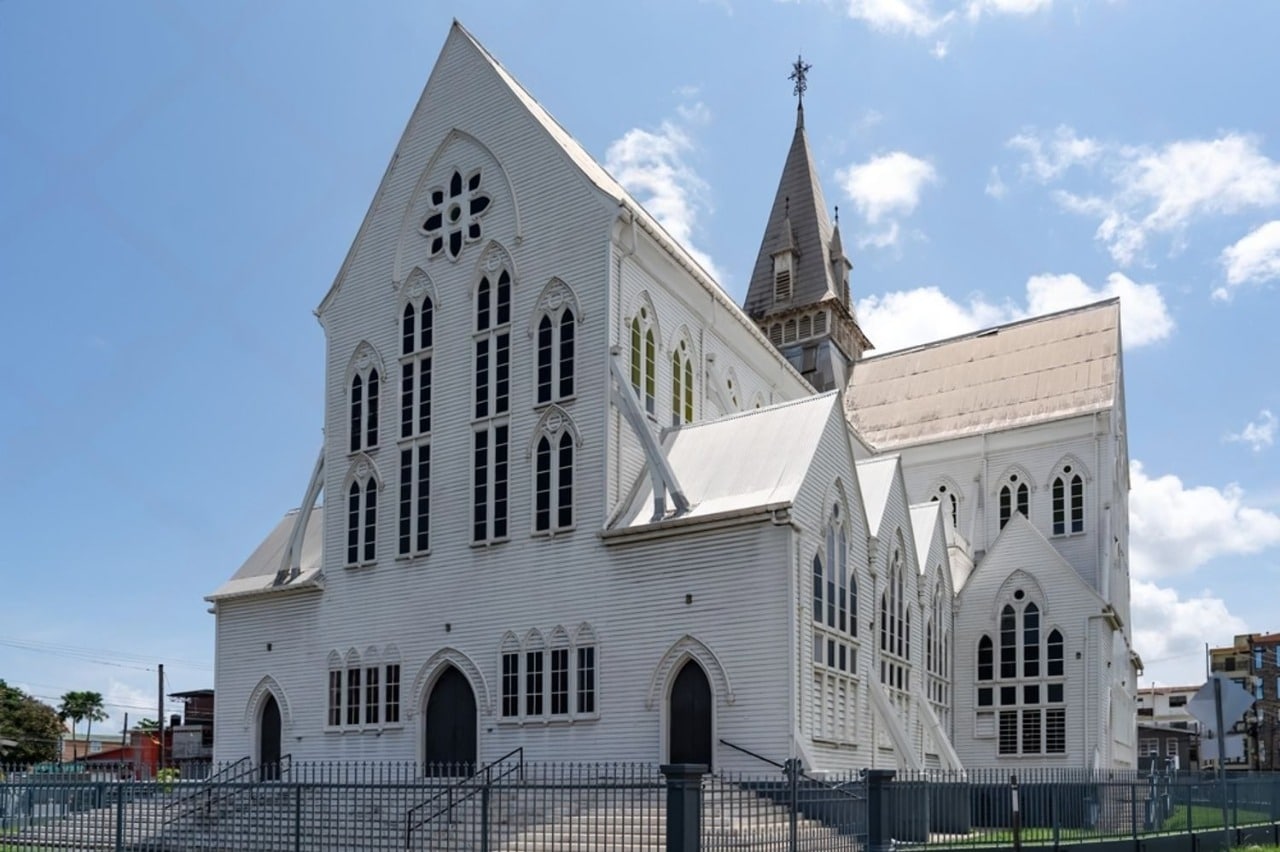
St. George’s Cathedral in Georgetown: 43.5 meters of wood after the brick

St. George’s Cathedral in Georgetown, Guyana, is approximately 43.5 meters tall and is built of wood. Consecrated on November 8, 1894, it replaced a brick cathedral, completed in 1842, whose tower was deemed too heavy for its foundations. Its history is that of a building made of greenheart, a hardwood native to Guyana, which the diocese must continue to protect. In January 2015, Dean Paul Andrew Carto, rector of St. George’s Cathedral in Georgetown, Guyana, warned that the building’s problems would not be solved by barbecues and bake sales. That statement sums up the challenge facing this landmark. In Georgetown, St. George’s Anglican Church is a large, 43.5-meter-tall wooden structure, and wood requires constant maintenance. St. George’s Cathedral, a 43.5-meter-tall wooden structure in Georgetown St. George’s Cathedral in Georgetown, the capital of Guyana, stands on Church Street and is approximately 43.5 meters, or 143 feet, tall. The UNESCO Tentative List
Read More »
cinémas caribéens
FILM & VIDEO
Tolotra

S6/10 – Stories of Caribbean Cinema, Dancehall, Memory, and Cuban Satire. Texts by Guillaume Robillard. Ciclic, 2026.

We’ve reached the halfway point of the series “Stories of Caribbean Cinema.” The first four episodes have spanned nearly three decades of cinema, from Cuba in the 1960s to productions from Martinique and Curaçao in the 1980s. This fifth installment moves into the 1990s with two films set in very different worlds. Euzhan Palcy’s *Siméon* delves into a Caribbean imagination where music, ghosts, and magical realism converge. Raoul Peck’s *The Man on the Quay* revisits François Duvalier’s dictatorship in Haiti through the eyes of a child. You are now reading the fifth episode in a series of ten. Four episodes have already been published on Richès Karayib, and five more will follow in this series through 2025. 1997: JAMAICA – “DANCEHALL QUEEN” BY RICK ELGOOD & DON LETTS Dancehall Queen is one of many Jamaican films that follow the formula established by *The Harder They Come* (Perry Henzell, 1972): Jamaican

Read More »

conTACT RK

we'd love to have your feedback on your experience so far

Join The List

Join our Richès Karayib community!  Sign up for our newsletter.

Want To Maximize Your Business Presence On Riches Karayib?

Complete the form to start the application