
Ser’i Neger, 231 years after the Battle of Tula.

Ser’i Neger

In Curaçao, Ser’i Neger today bears witness to the history of the former Fontein plantation. On August 25, 1795, this landscape became one of the main theaters of the revolt led by Tula against slavery. Two hundred thirty-one years later, the story of this battle has returned to the forefront, along with an urgent heritage issue. How can we preserve a site where a crucial chapter in Curaçao’s struggle for freedom was written?

On August 17, 1795, it all began in Kenepa

Eight days before the Battle of Ser’i Neger, the revolt began at the Kenepa plantation, now also known as Knip. On August 17, enslaved people, led by Tula, refused to return to work and demanded their freedom. The official website of Curaçao describes this event as the beginning of the most significant resistance to slavery in the island’s history.

The movement was not limited to Kenepa. The insurgents spread to other plantations, freed prisoners, and sought out weapons and food. According to a historical account preserved by the Digitale Bibliotheek voor de Nederlandse Letteren, the group grew rapidly. In Portomarí, colonial forces attempted to regain control, but an attack launched on August 19 was repelled. The revolt then took on a scale that the authorities could no longer consider an isolated incident.

Ser’i Neger

Ser’i Neger, the site of a decisive battle

After further clashes, the fighters regrouped on the hill known as Ser’i Neger, in the Fontein region. The terrain provided them with a position from which they could resist the forces sent against them. Attempts at negotiation took place. An offer of amnesty was made on the condition that the insurgents return to work. It was rejected. Their demand remains the same: freedom.

On August 25, 1795, colonial forces launched a new attack on Ser’i Neger. The clash was violent. The Antilliaans Dagblad reported that more than 100 enslaved people lost their lives there. Faced with better-armed and more numerous troops, the resistance fighters eventually abandoned the high ground and retreated toward the Mount Christoffel region. The battle did not immediately put an end to the revolt. The resistance continued for several more weeks before its main leaders were gradually arrested. Tula was eventually captured and then executed along with other fighters.

Ser’i Neger
dav

Ser’i Neger: A Landscape That Has Become a Heritage Site

Ser’i Neger is therefore not just a name associated with Tula. The site preserves the physical traces of a pivotal episode in Curaçao’s history. That is precisely what gives it its heritage value today. Unlike a museum or a monument built to commemorate an event, the heritage here is the land itself, a hill, a landscape, a place where men and women resisted, fought, and lost their lives.

This aspect explains the repeated calls for protection. As early as 2006, several heritage organizations called for formal recognition of the site. In 2018, part of the hillside was damaged, resulting, according to the *Antilliaans Dagblad*, in a loss of cultural and archaeological value. The Monumentenraad now hopes that Ser’i Neger will be recognized as a true “Place of Memory,” dedicated to education, the transmission of knowledge, and the commemoration of the history of slavery.

From Tula to the Collective Memory

Tula’s place in official history has itself evolved. In 2010, Curaçao recognized Tula and the other fighters of 1795 as heroes of the resistance. In 2023, the Dutch government also granted Tula official rehabilitation. These recognitions lend particular significance to the current debate. Honoring a historical figure is one step. Preserving the sites where his struggle took place is another.

In August 2026, the Monumentenraad once again called on the government to move forward with the acquisition and protection of Ser’i Neger. Questions were also raised in the Curaçao Parliament regarding its recognition as a site of remembrance. Two hundred thirty-one years after the battle, Ser’i Neger thus connects history, territory, and the passing down of heritage. Preserving this hill means preserving more than just a landscape. It means enabling future generations to know where, in 1795, men and women turned a demand for freedom into resistance. And why this place continues today to challenge Curaçao to reflect on what it chooses to pass on to tomorrow.

Ser’i Neger
Tula Museum, Landhuis Knip Crédit photo, Kattiel / Wikimedia Commons, CC BY-SA 4.0

Ser’i Neger is associated with the 1795 revolt led by Tula against slavery in Curaçao. On August 25, 1795, the site was the scene of a major clash between the insurgents and colonial forces.

The battle resulted in heavy casualties and stands as one of the defining moments of the revolt led by Tula.

The preservation of Ser’i Neger aims to safeguard a site directly linked to the history of slavery and resistance on Curaçao. Heritage advocates, in particular, hope to turn it into a space for remembrance, education, and the passing down of knowledge.

Leave a Reply

Your email address will not be published. Required fields are marked *

More articles from RK

Silver Magellan Award 2026 logo awarded to Martinique for its culinary heritage
CULINARY ART
Tolotra

2026 Silver Magellan Award: Martinique Showcases Its Cuisine on the International Stage

Martinique has just won a 2026 Silver Magellan Award for its culinary heritage. Presented by Travel Weekly, this award honors the Martinique Tourism Board in the category of Caribbean culinary destinations. This international recognition highlights the island’s flavors, its culinary expertise, and a growing ambition: to make Martinican cuisine a true travel experience. 2026 Silver Magellan Award: An Accolade for Martinican Cuisine The results of the 2026 Travel Weekly Magellan Awards are now available on the competition’s official website. Martinique is among the winners, having received a silver medal in the “Caribbean – Overall Destinations – Culinary Destination” category. The Martinique Tourism Committee’s (CMT) entry, titled “Martinique: Where Culinary Heritage Comes to Life,” highlights a destination where culinary heritage continues to thrive and be passed down through the generations. Organized by the U.S. trade publication Travel Weekly, the Magellan Awards recognize achievements in various areas of international tourism. Entries are
Read More »
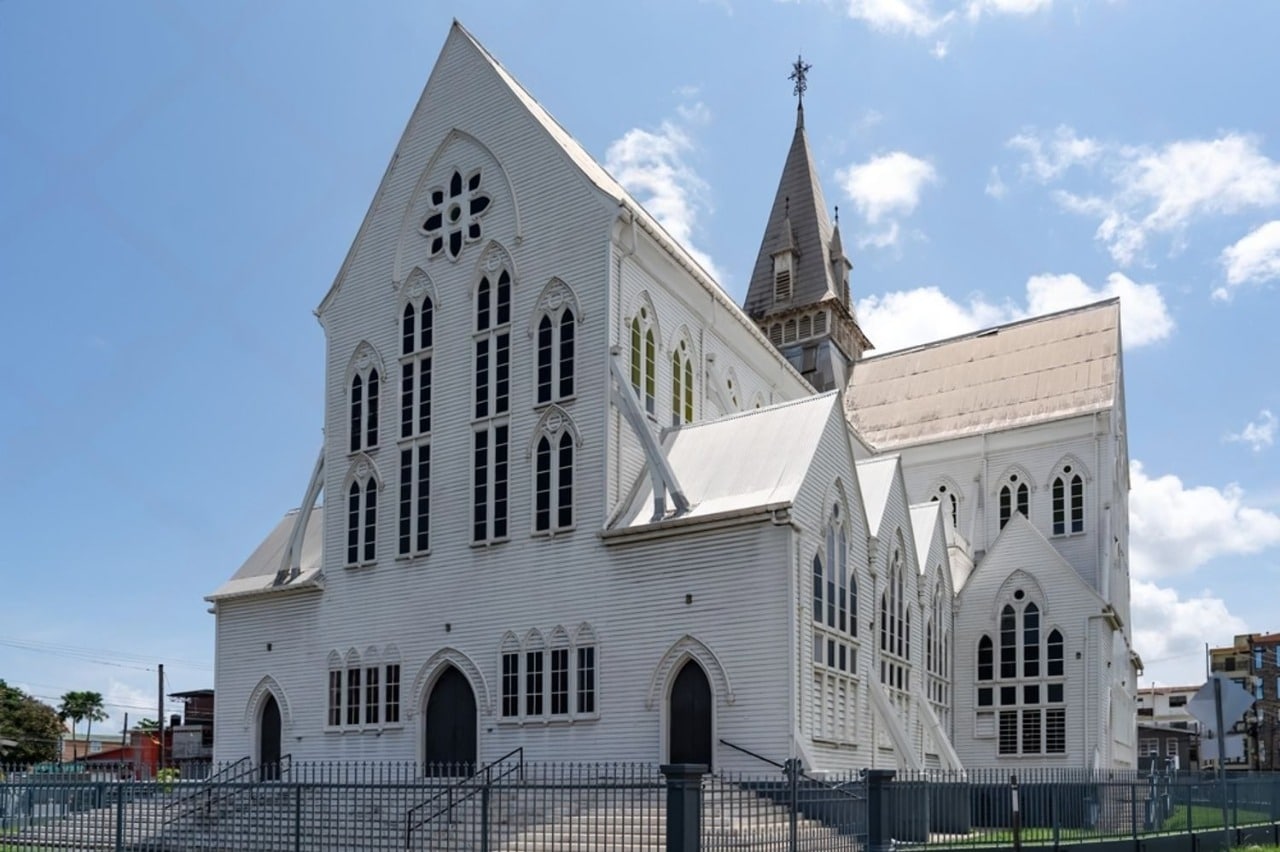
St. George's Cathedral in Georgetown, Guyana, a wooden Anglican church
TOURISM
Tolotra

St. George’s Cathedral in Georgetown: 43.5 meters of wood after the brick

St. George’s Cathedral in Georgetown, Guyana, is approximately 43.5 meters tall and is built of wood. Consecrated on November 8, 1894, it replaced a brick cathedral, completed in 1842, whose tower was deemed too heavy for its foundations. Its history is that of a building made of greenheart, a hardwood native to Guyana, which the diocese must continue to protect. In January 2015, Dean Paul Andrew Carto, rector of St. George’s Cathedral in Georgetown, Guyana, warned that the building’s problems would not be solved by barbecues and bake sales. That statement sums up the challenge facing this landmark. In Georgetown, St. George’s Anglican Church is a large, 43.5-meter-tall wooden structure, and wood requires constant maintenance. St. George’s Cathedral, a 43.5-meter-tall wooden structure in Georgetown St. George’s Cathedral in Georgetown, the capital of Guyana, stands on Church Street and is approximately 43.5 meters, or 143 feet, tall. The UNESCO Tentative List

Read More »
cinémas caribéens
FILM & VIDEO
Tolotra

S6/10 – Stories of Caribbean Cinema, Dancehall, Memory, and Cuban Satire. Texts by Guillaume Robillard. Ciclic, 2026.

We’ve reached the halfway point of the series “Stories of Caribbean Cinema.” The first four episodes have spanned nearly three decades of cinema, from Cuba in the 1960s to productions from Martinique and Curaçao in the 1980s. This fifth installment moves into the 1990s with two films set in very different worlds. Euzhan Palcy’s *Siméon* delves into a Caribbean imagination where music, ghosts, and magical realism converge. Raoul Peck’s *The Man on the Quay* revisits François Duvalier’s dictatorship in Haiti through the eyes of a child. You are now reading the fifth episode in a series of ten. Four episodes have already been published on Richès Karayib, and five more will follow in this series through 2025. 1997: JAMAICA – “DANCEHALL QUEEN” BY RICK ELGOOD & DON LETTS Dancehall Queen is one of many Jamaican films that follow the formula established by *The Harder They Come* (Perry Henzell, 1972): Jamaican

Read More »

conTACT RK

we'd love to have your feedback on your experience so far

Join The List

Join our Richès Karayib community!  Sign up for our newsletter.

Want To Maximize Your Business Presence On Riches Karayib?

Complete the form to start the application