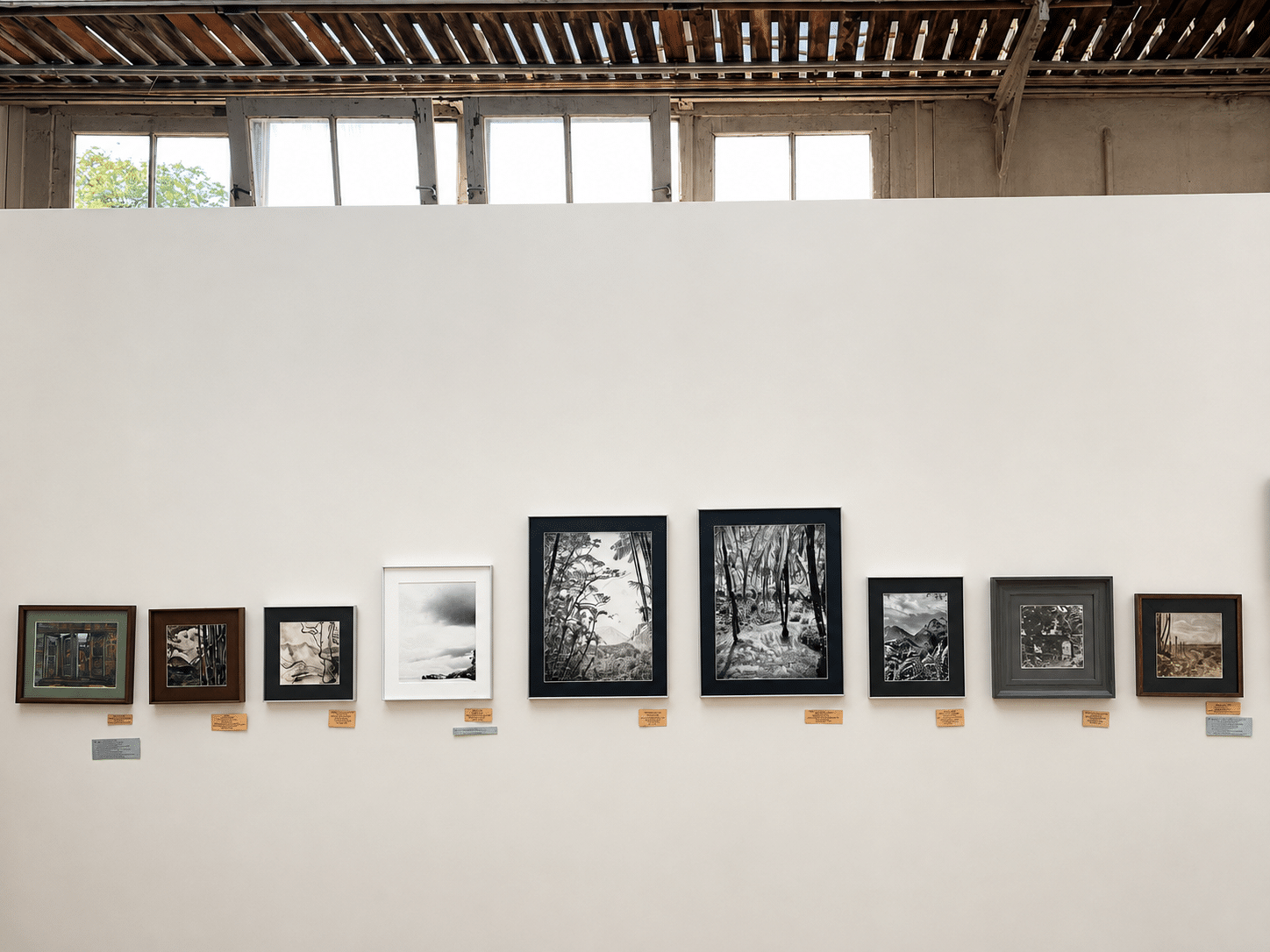
At the Curaçao Museum, faces seem to speak to one another. Some are familiar; others evoke families, trades, stories, and expressions passed down through the generations. Since August 20, 2026, the exhibition “Rumbo i Raís” has brought together more than 100 works: portraits, mixed-media pieces, and three-dimensional creations. Through this collection, David Paulus reflects on his native island, its people, and the memories that continue to shape Curaçao.
The exhibition serves as a meeting point for various aspects of her career. Fashion, visual arts, performance, teaching, and family history all intersect here. Behind the works, a single question keeps recurring: Where do we come from, who shapes us, and what do we choose to pass on?

First Aid in Curaçao
Born in 1986 and raised in Curaçao, David Paulus says he discovered the joy of creating at an early age. As a child, he helped his mother make dolls to sell and watched his grandmother sew her own dresses. He also remembers small fashion shows held in the garden. Today, these domestic activities take on a new significance. They place creativity at the heart of a family tradition, even before it became a profession. Based in the Netherlands since 2003, the artist has built a world in which clothing, imagery, and staging interact.

Fashion as a Testing Ground
David Paulus identifies as an Afro-Caribbean artist and works at the intersection of several disciplines. In fashion, he develops what he calls “Art Couture.” His creations do more than simply clothe; they construct characters, atmospheres, and narratives.
This approach has led him to participate in various events, including Fashion Weeks in Amsterdam, London, Paris, and Curaçao. He also conceives his presentations as performances, with a focus on the models, music, set design, and choreography. This freedom allows him to gradually move beyond the traditional framework of clothing. For him, fashion becomes one language among many, capable of conveying a memory or questioning an identity.
When Roots Become the Subject
In April 2025, the “Paga Tera” clearly pointed in this direction. Presented in Amsterdam, it brought together fashion, identity, family narratives, and Curaçao’s heritage. David Paulus explained at the time that his work also serves to honor the stories of his ancestors and the Afro-Caribbean diaspora. Clothing is therefore no longer merely a form of spectacle. It becomes a medium for looking back, questioning what has been passed down, and bringing to light cultural references that are sometimes absent from mainstream fashion circles.
This research also ties in with his interest in arts education. After largely teaching himself, he began training in the Netherlands to become a teacher of visual arts and design. During a stay in Curaçao in 2023, he focused in particular on new ways to integrate creativity into the local education system.
More than a hundred works, a collective memory
With “Rumbo i Raís”, David Paulus takes this reflection a step further. The Curaçao Museum presents the exhibition as a dialogue between historical legacies, contemporary voices, personal memories, and collective history. The people depicted do not claim to represent the entirety of Curaçaoan society. They constitute an artistic selection shaped by the artist’s research, encounters, and perspective.
This choice is essential. It prevents the exhibition from becoming an official inventory of Curaçao. Instead, the portraits serve as gateways to broader stories—those of families, generations, and cultural references that continue to resonate today.

David Paulus: Between Leadership and His Roots
The title “Rumbo i Raís” can be understood as an encounter between direction and roots. These two ideas also sum up David Paulus’s journey. His work evolves, changes form, and spans multiple disciplines, yet it regularly returns to Curaçao. Perhaps that is where his uniqueness lies. He does not choose between fashion and art, between personal creation and transmission. He uses each medium to ask the same question in a different form.
Today, more than a hundred works invite the public to recognize a face, a story, or a part of themselves. But behind this recognition lies a deeper question. If our roots help define our path, what will we, in turn, choose to leave for future generations? Discover David Paulus, an artist from Curaçao, his journey through Art Couture, memory, and identity, and his exhibition *Rumbo i Raís* at the Curaçao Museum in 2026.
David Paulus is an Afro-Caribbean artist born and raised in Curaçao. His work spans fashion, Art Couture, and the visual arts, with a particular focus on identity, roots, and cultural transmission.
Rumbo i Raís is an exhibition by David Paulus on view at the Curaçao Museum since August 20, 2026. It features more than 100 works, including portraits, mixed-media pieces, and three-dimensional works exploring the themes of memory and Curaçao’s roots.
Curaçao’s roots run deep throughout David Paulus’s artistic journey. His works explore family histories, ancestors, Afro-Caribbean identity, and what each generation chooses to pass on to the next.