After Cuba, Jamaica, Trinidad and Tobago, Haiti, Guadeloupe, and Martinique, our serieson the history of Caribbean cinema continues its exploration of Caribbean cinema in the early 21st century. This seventh episode takes us from Antigua and Barbuda to Martinique.
On one hand, Howard and Mitzi Allen are helping to build a local movie theater in a small island nation. On the other, Guy Deslauriers and Patrick Chamoiseau are depicting the origins of the biguine in 19th-century Saint-Pierre. You are watching the seventh episode of ten. Six episodes are already available on Richès Karayib, and three more will follow.
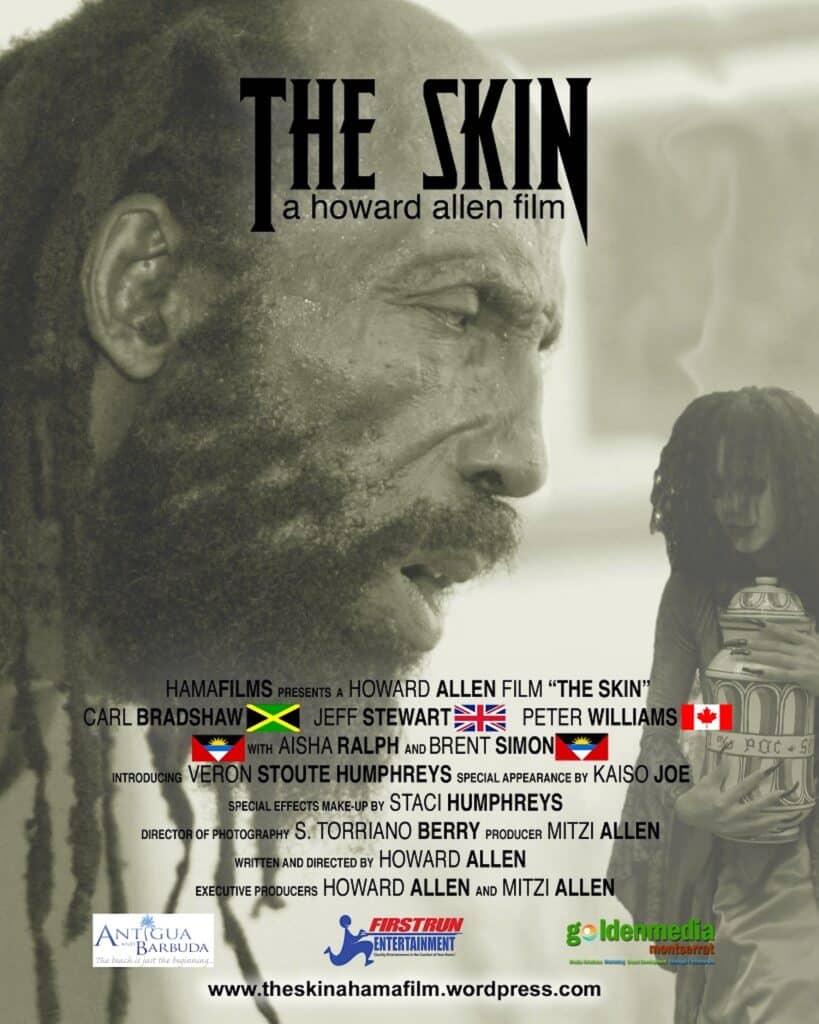
2001: ANTIGUA AND BARBUDA – “THE SWEETEST MANGO, THE SKIN” BY HOWARD ALLEN
The Skin is the second feature film by the Allen couple—Howard directing and Mitzi producing. In 2001, they directed *The Sweetest Mango* (2001) so that their country would have its first “local” feature film to mark the dawn of the 21st century. The film is clearly inspired by their own love story: Lovelyanne “Luv ” Davies, returning after several years living in Canada, struggles to readjust to her home country, given the small size of the archipelago (440 km²) and the limited professional opportunities, while one of her colleagues woos her and eventually marries her.
Based on a classic plot, this film—which was, unfortunately, technically flawed (shot with first-generation digital cameras)—already stood out in several ways: it lacked any social or historical dimension, unlike other Caribbean films, a title referencing mango season (from April through the end of summer), which created a temporal marker firmly rooted in the landscape; and the assertion that even small spaces can be the setting for grand stories (of love, among others).
For The Skin, this ambitious couple—struggling to make a film on an island with fewer than 100,000 residents—received support from a technical crew from the prestigious African American university Howard University as well as an international cast that included the famous Jamaican actor Carl Bradshaw and British comedian Jeff Stewart.
While catering to a tourist-oriented vision of the island (aerial shots of the coastline, pleasure boats, sensuous dances and accompanying music, etc.), this film is firmly rooted in Caribbean magical-religious folklore through the story of a cursed vase linked to the era of slavery and features some particularly unsettling nighttime sequences in the woods, where the Creole language mischievously blends with English. An effective film with lofty ambitions.
2004: MARTINIQUE – BIGUINE, BY GUY DESLAURIERS
The third feature film from the Chamoiseau-Deslauriers duo, a unique collaboration between Caribbean literature and Caribbean cinema To date, this musical (or, more precisely, musical drama) about the invention of the famous “biguine” music in the city of Saint-Pierre (at the time the world capital of sugar and rum) in Martinique during the second half of the 19th century serves as an opportunity to portray the process of creolization, an accelerated and unpredictable cultural fusion (as proposed by the author Édouard Glissant), through musical creation. Hermansia (Micheline Mona, daughter of the famous Eugène Mona, a specialist in the “flûte des mornes”) and Tiquitaque (Max Télèphe), coming from the countryside, settle in the city, where they will live for nearly 30 years.
The music they play, of African origin, held no appeal for bourgeois dance halls. It was then, upon coming into contact with European music, ballets (Saint-Pierre had an opera house, a streetcar, and gas lighting) or mazurkas, and European instruments, which were largely unfamiliar to them, they began to blend different musical styles. In particular, Hermansia made a major decision by giving her partner a clarinet.
The clash between rhythms of African origin (music from the Martinican countryside) and European instruments (clarinet, violin, piano, etc.) gave rise to the biguine, much like so many other forms of Caribbean music, from reggae to steel bands to compas. In this film, the Caribbean woman is thus at the heart of the process of cultural creolization: Biguine complements the various aspects of “femifocality”, that is, the importance of women in Caribbean cinema. Finally, in addition to the numerous musical sequences featuring legendary biguine songs with strong political undertones, the film concludes with a depiction of the famous 1902 eruption of Mount Pelée, which leveled the city of Saint-Pierre and claimed nearly 30,000 lives.

About the Author
Guillaume Robillard holds a Ph.D. in film studies; he is a professor and researcher, a documentary filmmaker, and a specialist in Caribbean cinema and artistic production. He is the author of two books: *Conquest of Space and Time: Caribbean Cinema (Éditions Jannink, “Hypothèses d’Art,” 2023) and Decolonial Cinema: Characters in Caribbean Cinema (Presses Universitaires des Antilles, “Arts et Esthétique,” 2024).