We’ve reached the halfway point of the “Stories of Caribbean Cinema” series. The first four episodes have covered nearly three decades of cinema, from Cuba in the 1960s to productions from Martinique and Curaçao in the 1980s. This fifth installment moves into the 1990s with two films set in very different worlds. Euzhan Palcy’s “Siméon” delves into a Caribbean imagination where music, ghosts, and magical realism converge. Raoul Peck’s “The Man on the Quay” looks back at François Duvalier’s dictatorship in Haiti through the eyes of a child.
You are now reading the fifth episode in a series of ten. Four episodes have already been published on Richès Karayib, and five more will follow through 2025.
1992: MARTINIQUE/GUADELOUPE - SIMÉON, BY EUZHAN PALCY
Following his early work in Hollywood, Euzhan Palcy returned to the Caribbean with a film rooted in Caribbean magical-religious folklore, told in the style of a fairy tale and shot in Guadeloupe. In the first twenty minutes, music teacher Siméon, majestically portrayed by Jean-Claude Duverger, passes away. Unable to ascend to heaven, Siméon’s ghost (known as “the spirit of music”) remains with his friends, who have formed a band called “Jacaranda”, whose members are played by the real-life band Kassav’ (led by Jacob Desvarieux and Jocelyne Béroard), who invented zouk.
He’ll help them promote their music to producers in Paris. Partly narrated by the young Orélie (Lucinda Messager), the film’s plot presents the French capital (recreated in studios) as imagined by a young woman from Guadeloupe, in the style of an Épinal print, as a “shift” in perspective: it is now the French mainland (and no longer the overseas territories) that is to be seen as a “postcard.”
Above all, this film cinematographically develops a marvelous realism, a sort of Caribbean fantasy in which supernatural events are experienced without surprise and in which the characters interact quite naturally with a ghost they cannot see (unlike in most ghost movies) but can hear (in a clear celebration of oral tradition). A few years later, *Nord-Plage* (2004), the only film to date directed by a Béké from the French Antilles (a descendant of a slave-owning family), based on a screenplay by Patrick Chamoiseau (1992 Goncourt Prize winner), would brilliantly continue this tradition, which has been tentatively emerging since the earliest films of Caribbean cinema. Siméon, a blend of joy and originality!
1993: HAITI – "The Man on the Quay", by Raoul Peck
Defining Haitian cinema is no easy task. Indeed, unlike other Caribbean film industries that are more “structured,” such as in Cuba or Jamaica, for example, or those with limited production, like Antigua and Barbuda, in Haiti, many films are made, sometimes under precarious technical conditions, and are highly popular with the public despite their semi-professional nature.
One might think, in particular, of films such as Does the President Have AIDS? (2006), starring the famous Jimmy Jean-Louis, who played “the Haitian” in the American series Heroes (2006–2010), and A Zombie’s Love (2010) by Arnold Antonin, starring the future director of Freda (2021), Gessica Généus, a must-see filmmaker best known for his documentaries and his relentless commitment to chronicling everyday life in Haiti.
One date is often mentioned: the release of the medium-length film Anita by Rassoul Labuchin in 1980. As for feature-length fiction films, “L’Homme sur les quais” is a must-see, if only for its international cast and Raoul Peck’s career: among other works, the fictional film “Lumumba” (2000), and the documentaries “I Am Not Your Negro” (2016) about the intellectual James Baldwin, and Orwell: 2+2 = 5 (2025) or the documentary series Exterminate All These Brutes (2021), not to mention his tenure as director of the prestigious FÉMIS film school (2010–2019).
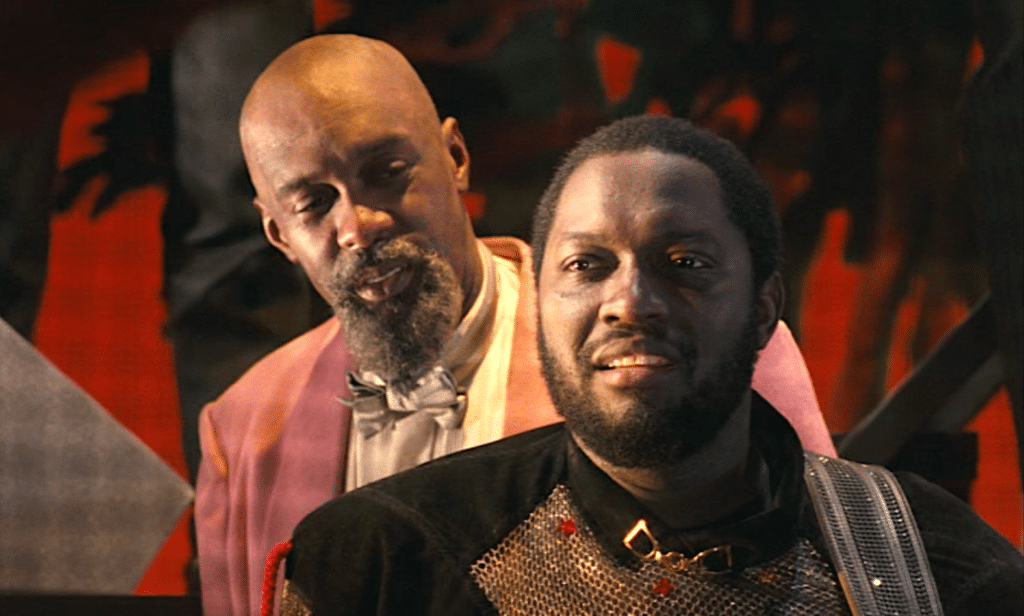
Selected for the official competition at the Cannes Film Festival, “The Man on the Docks” is a rare film in Caribbean cinema due to its reliance on numerous slow-motion effects, achieved through the actors’ performances and frequent camera movements (starting with the very first sequence), which capture the constant tension that existed during the dictatorship of François Duvalier (1957–1971), a tension that, at times, erupts without warning within a consistently understated visual style.
Seen through the eyes of a young girl whose father opposes the regime, and who is staunchly defended by her grandmother, played with dignity by the famous singer Toto Bissainthe (who passed away shortly after the film was released), the film’s plot concludes with the child’s voice-over: “even as my story ceases to be just my own and becomes everyone’s…” A major film about dictatorship.

About the Author
Guillaume Robillard holds a Ph.D. in film studies; he is a professor and researcher, a documentary filmmaker, and a specialist in Caribbean cinema and artistic production. He is the author of two books: *Conquest of Space and Time: Caribbean Cinema (Éditions Jannink, “Hypothèses d’Art,” 2023) and Decolonial Cinema: Characters in Caribbean Cinema (Presses Universitaires des Antilles, “Arts et Esthétique,” 2024).
The release of Magma, a film by French director Cyprien Vial heavily inspired by the 1976 eruption of La Soufrière, which raised fears that the capital city of Basse-Terre (Guadeloupe) would be destroyed, followed by two films directed by Guadeloupeans, namely Fanon (Jean-Claude Barny), about the famous anti-colonialist intellectual during his time in Algeria, and *Zion*, in less than a month, succeeded in drawing the attention of the French media (Le Monde, Libération, etc.) to the potential of Caribbean cinema and, more broadly, of films dealing with the French overseas territories.