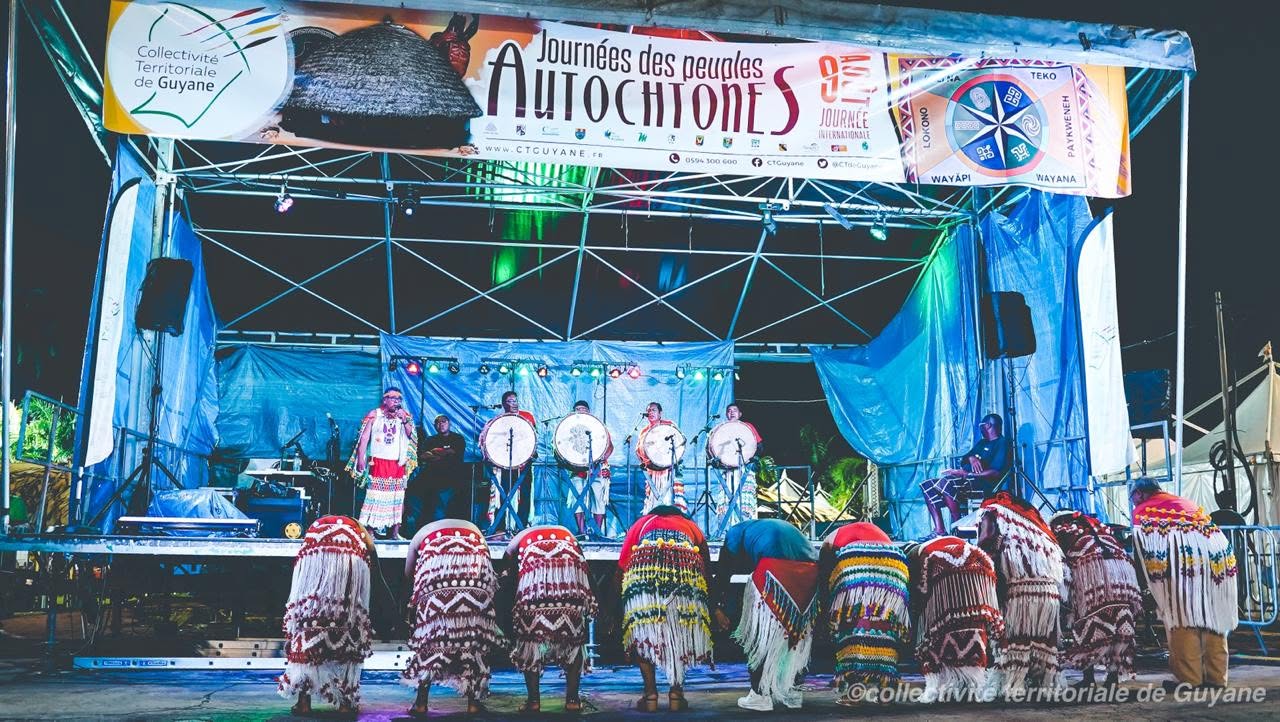
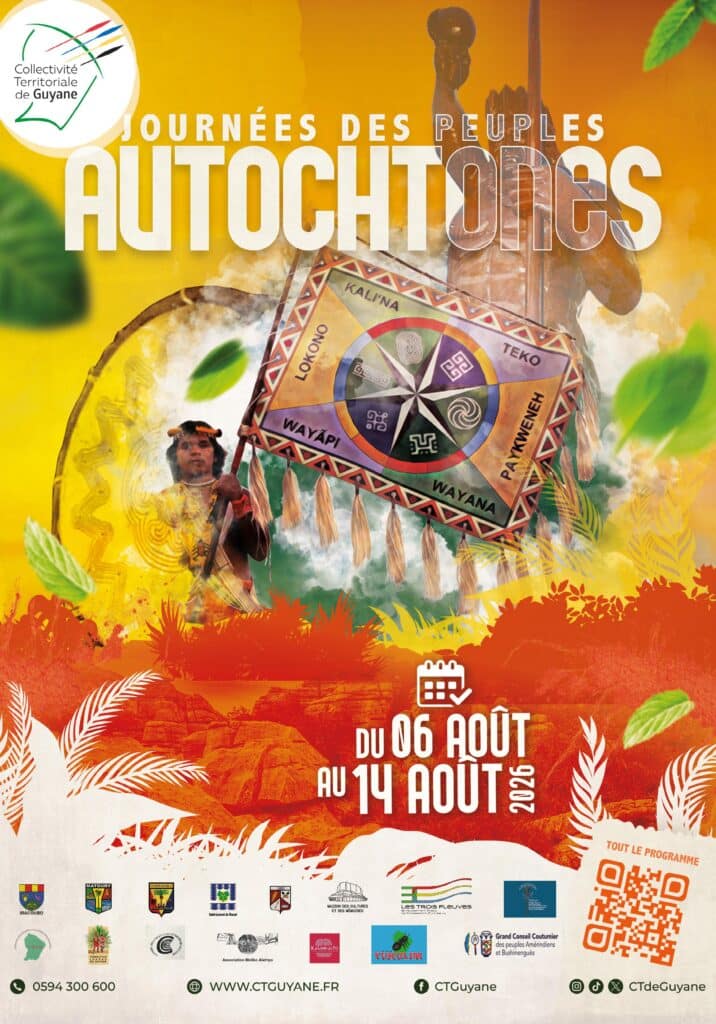
From August 6 to 14, 2026, French Guiana will host the 2026 Indigenous Peoples’ Days, featuring conferences, ceremonies, workshops, exhibitions, gatherings, and film screenings in several municipalities. Behind this program lies a key objective: to enable Indigenous peoples to pass on their memories, languages, traditional knowledge, and connection to the land in their own way.
A program led by Indigenous voices
In Rémire-Montjoly, the first events will focus on life stories, spirituality, and literary creation. The conference dedicated to Alwin Manewamo-Karwofodi will be led by his daughter, Mikke Manewamo, alongside several other speakers. The following day, authors, organizations, and community leaders will present books and resources dedicated to the Indigenous cultures of French Guiana. This choice matters. It avoids discussing Indigenous peoples solely from an outside perspective. Instead, the 2026 Indigenous Peoples’ Days highlight those who are currently creating, passing on, teaching, and defending their cultural heritage. Literature, personal accounts, and debate thus become tools for cultural continuity.
Communicating Through Gestures
In Matoury, the artisan village will offer a hands-on approach to learning these traditional crafts. Beadwork, pottery, basket weaving, cotton spinning, gourd carving, jewelry making, and arrow making: each workshop reveals a deep understanding of materials, forms, and uses. These actions are not merely decorative. They embody a memory, a vocabulary, a way of learning, and a relationship with natural resources. Observing the roof of a hut, weaving a fiber, or crafting an object helps us understand that living heritage depends first and foremost on people who are able to practice it and pass it on.
This aspect gives the Indigenous Peoples’ Days a special significance. The public doesn’t just come to watch. They can listen, ask questions, try out certain techniques, and gauge how long it takes to master them. The experience thus becomes more meaningful than the fleeting consumption of a cultural image.


Memory, Land, and Gratitude
The program also addresses more sensitive topics. In Iracoubo, a ceremony will pay tribute to the people who were put on display in 1882 and 1892 at the Jardin d’Acclimatation in Paris. In Rémire-Montjoly, several lectures will address land, biodiversity, the Indigenous economy, and language transmission.
These themes serve as a reminder that cultural preservation cannot be separated from the concrete conditions of life. Preserving a language requires that it be spoken, taught, and heard. Preserving a craft requires access to materials, territories, and the people who know its rules. Celebrating a culture therefore also means recognizing the rights, historical wounds, and contemporary challenges of those who carry it forward.

A region connected by several events
The 2026 Indigenous Peoples’ Days will not be concentrated in a single location. They will take place in Rémire-Montjoly, Saint-Laurent-du-Maroni, Iracoubo, Matoury, Cayenne, and Kourou. This itinerary highlights the diversity of communities, organizations, and ways of passing on traditions found in French Guiana. Museum exhibits, a day dedicated to Kali’na traditions, dances, food tastings, a flag-raising ceremony, and a film preview come together to form a multifaceted experience. Everyone can find a way to learn here: through words, objects, taste, movement, images, or encounters.
The cinema will continue this initiative on August 14 with the preview screening of “Piiyai Emali – The Story of a Piiyai,” dedicated to the memory of Alwin Manewamo-Karwofodi. This screening demonstrates how images can preserve a narrative without replacing the presence of families and communities. It also serves as a reminder that the 2026 Indigenous Peoples’ Days create a legacy that can endure beyond the event and the locations involved.


Indigenous Peoples' Days 2026: More Than Just a Celebration
Ultimately, the value of this edition lies in its ability to link discovery with responsibility. The 2026 Indigenous Peoples’ Days invite the public not only to learn more about living cultures, but also to reflect on the conditions under which they are passed down.
The true success of these events will therefore not be measured solely by the number of visitors. It will depend on what remains after August 14: greater attention to languages, histories, artists, artisans, and Indigenous voices. For heritage remains alive only when it continues to be practiced, respected, and passed on.
Practical information
📅 Dates: August 6–14, 2026
📍 Territory: several locations in French Guiana
👥 Audience: Most sessions are open to everyone
🎟️ Prices: Many activities are free, but some workshops require a fee
📝 Registration: required for several workshops and for the event organized at the Kalawachi Center
🔎 Full program: available from the Collectivité Territoriale de Guyane
Indigenous Peoples’ Days will take place from August 6 to 14, 2026, in several municipalities across French Guiana.
The itinerary will include stops in Rémire-Montjoly, Saint-Laurent-du-Maroni, Iracoubo, Matoury, Cayenne, and Kourou, among other places.
Many lectures, ceremonies, exhibitions, and activities are free. Some craft workshops require a fee and advance registration.