“¿Qué lo que?” Three words, three letters, one identity

¿Qué lo que?

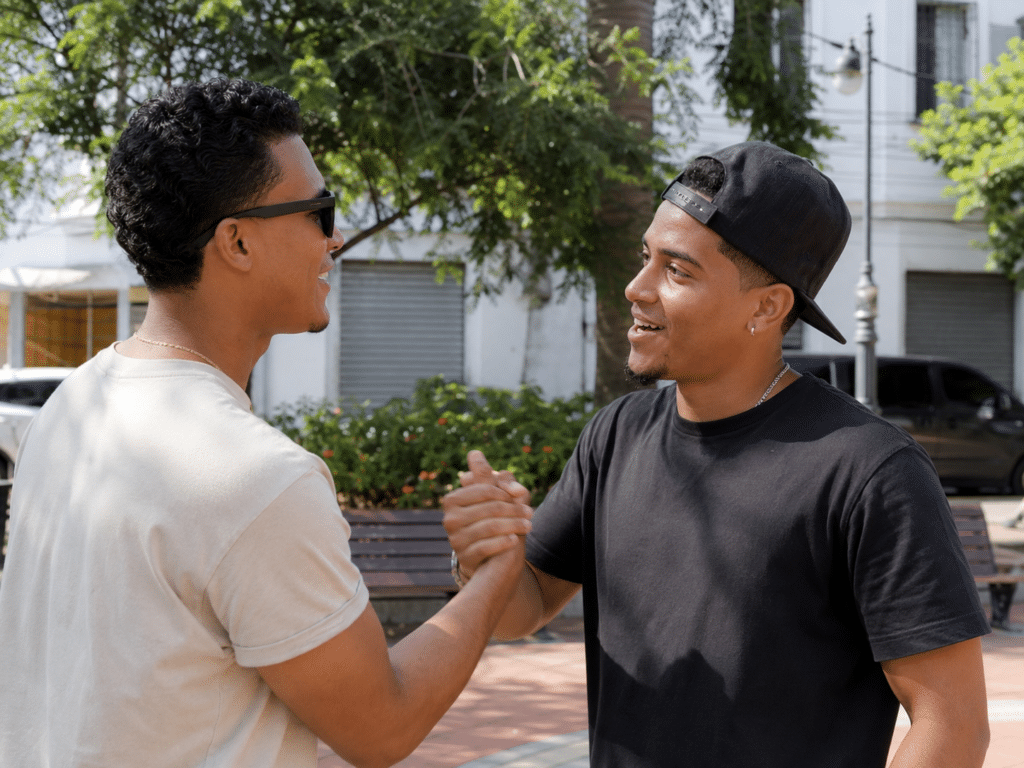
In the Dominican Republic, an encounter can begin with three words that might baffle anyone who translates Spanish literally. A friend arrives, a message pops up, a conversation begins, and out comes this familiar phrase: “¿Qué lo que?” It doesn’t require a complicated explanation. Above all, it establishes a connection. Behind this phrase lies a social convention, a way of speaking, and, now, three very recognizable letters: KLK.

What does "¿Qué lo que?" really mean?

The closest equivalent would be “what’s new?”, “what’s going on?”, or, in English, “what’s up?”. SpanishDictionary classifies the expression as a regionalism used in Dominican Republic and as a greeting. In other words, a literal translation isn’t very helpful. In conversation, “¿Qué lo que?” primarily serves as a casual opening. The response, therefore, doesn’t need to be a detailed account of one’s day. Like many greetings, the expression can simply establish a sense of closeness between two people. Context, tone, and the nature of the relationship matter just as much as the words themselves. This is where local speech eludes overly literal translations.

¿Qué lo que?

A phrase that depends on tone and context

Saying “¿Qué lo que?” is not the same as using a neutral phrase in every situation. It’s informal in tone. Its power lies in everyday conversations among family, friends, or people who share the same cultural codes. An expression is never just a definition. It also indicates who is speaking, to whom, in what situation, and with what degree of closeness. Vocabulary thus becomes an indicator of social life. In the Dominican Republic, this phrase is one of the elements associated with a local way of speaking.

¿Qué lo que?
¿Qué lo que?

From “¿Qué lo que?” to KLK

The story becomes more interesting when it moves from speech to the screen. In written exchanges, the phrase is commonly shortened to three letters: KLK. This abbreviation preserves the sound and intent of the greeting while adapting to the speed of digital messaging. The phenomenon is prominent enough to be addressed in institutional discussions about Dominican speech. In 2022, a meeting organized by the Academia Dominicana de la Lengua on the way people speak in Santo Domingo was titled “¿KLK ciudad? ¿Cómo habla la ciudad de Santo Domingo?” .” The choice of KLK in this title shows just how effectively these three letters can function as an immediately recognizable linguistic sign in the Dominican context.

¿Qué lo que?
¿Qué lo que?

When Three Letters Become a Symbol of Identity

The connection between “¿Qué lo que?” and Dominican identity also extends beyond the island’s borders. A study presented in 2024 at the Hispanic Linguistics Symposium examined several elements of the Dominican lexicon among 25 residents of Long Island, New York. In particular, the researchers observed that “que lo qué” was associated with Dominican identity by the participants. The expression was also strongly linked to perceptions of friendliness. The study thus demonstrates how certain words travel with communities and continue to evoke social associations far from the territory where they are used.

This finding does not mean that all Dominicans use “¿Qué lo que?” in the same way, nor that the expression alone sums up Dominican Spanish. The Academia Dominicana de la Lengua points out that speech patterns vary by region, with each area having its own rhythms, sounds, and words. It is precisely this diversity that makes it unique.

¿Qué lo que?

A short phrase, a bigger story

With “¿Qué lo que? ”, three words are all it takes to start a conversation. With KLK, three letters are now all it takes to convey that same sense of complicity on a screen. Oral tradition, digital writing, and the diaspora—this formula reminds us that a language also evolves through everyday usage. Perhaps that’s what makes these expressions so valuable. They don’t just exist in dictionaries. They circulate among people, change form, and sometimes become identifying markers. After “KLK,” what other Caribbean expression deserves to be decoded to understand what a region reveals through its way of speaking?

¿Qué lo que?

“¿Qué lo que?” is a colloquial Dominican expression used as a greeting. Depending on the context, it can be similar to “what’s new?”, “what’s going on?”, or the English phrase “what’s up?”

KLK is the abbreviation for “¿Qué lo que?” and is used primarily in written and digital communication. These three letters help preserve the spirit of this Dominican greeting in messages and on social media.

“¿Qué lo que?” is strongly associated with Dominican linguistic usage. Beyond its meaning, the expression can serve as a marker of closeness and identity, even within Dominican communities living outside the country.

Leave a Reply

Your email address will not be published. Required fields are marked *

More articles from RK

Joheirry Mola, institutrice dominicaine sacrée Miss Monde 2026, lors de son couronnement à Nha Trang, au Vietnam
NEWS
Tolotra

Joheirry Mola, the schoolteacher crowned Miss World after 44 years

In a classroom in the Distrito Nacional in Santo Domingo, she taught Spanish and social studies to elementary school students. On the stage in Nha Trang, Vietnam, Joheirry Mola was crowned Miss World 2026, bringing the crown back to the Dominican Republic 44 years after the country’s first victory, achieved by Mariasela Álvarez in 1982. This is the story of a teacher who made her classroom and a global pageant one and the same cause. Joheirry Mola, a schoolteacher from the National District Joheirry Mola Domínguez is 24 years old and comes from the Distrito Nacional, the institutional heart of Santo Domingo, which she had already represented in the national pageant that led her to Miss World. A graduate of the Ibero-American University (Unibe) with a degree in business administration, she teaches Spanish and social studies to elementary school students. She is also a correspondent for the show “Ventana a

Read More »
HISTORY & HERITAGE
Tolotra

“Dèyè mòn, gen mòn,” the proverb that inspired Paul Farmer

In Haiti’s Central Plateau, a mountain trail leads to Morne Michel, one of the most remote villages served by Zanmi Lasante, the health organization co-founded by American physician and anthropologist Paul Farmer. It is by taking this path, amid ridges that seem to go on forever, that writer Tracy Kidder comes to understand why an old Creole saying so aptly describes this place: “Dèyè mòn, gen mòn.” Behind the mountain, there is another mountain. Kidder would use this as the title of a book that would introduce Haiti to millions of readers around the world, far beyond the Caribbean. What does “Dèyè mòn, gen mòn” mean? “Dèyè mòn, gen mòn” literally translates to “beyond the mountains, more mountains.” The true meaning of the proverb goes beyond a simple geographical observation: in life, once one problem is overcome, another almost always arises. It’s a way of saying that life is a

Read More »
Le Umana Yana, monument circulaire en bois et palmes à Georgetown, au Guyana
Tolotra

Umana Yana, the Guyanese monument built in 80 days by the Wai-Wai

The Umana Yana is a national monument in Georgetown, Guyana, built in 1972 in just 80 days by about 60 Wai-Wai artisans. This circular building, carved from wood and palm fronds, hosted the first conference of non-aligned nations held in the Western Hemisphere. Destroyed by a fire in 2014, the Umana Yana was rebuilt and remains today an exhibition space in the heart of the Guyanese capital. The Umana Yana, an 80-day project led by the Wai-Wai In 1972, in Georgetown, Guyana, about sixty Wai-Wai artisans arrived from the interior of the country for an unusual project. The Wai-Wai people normally live in the far south of the Rupununi savanna, hundreds of kilometers from the capital, far from the narrow coastal strip where the majority of Guyana’s population is concentrated. These artisans climbed smooth poles with an agility that witnesses at the time considered remarkable. The project was led by

Read More »

conTACT RK

we'd love to have your feedback on your experience so far

Join The List

Join our Richès Karayib community!  Sign up for our newsletter.

Want To Maximize Your Business Presence On Riches Karayib?

Complete the form to start the application