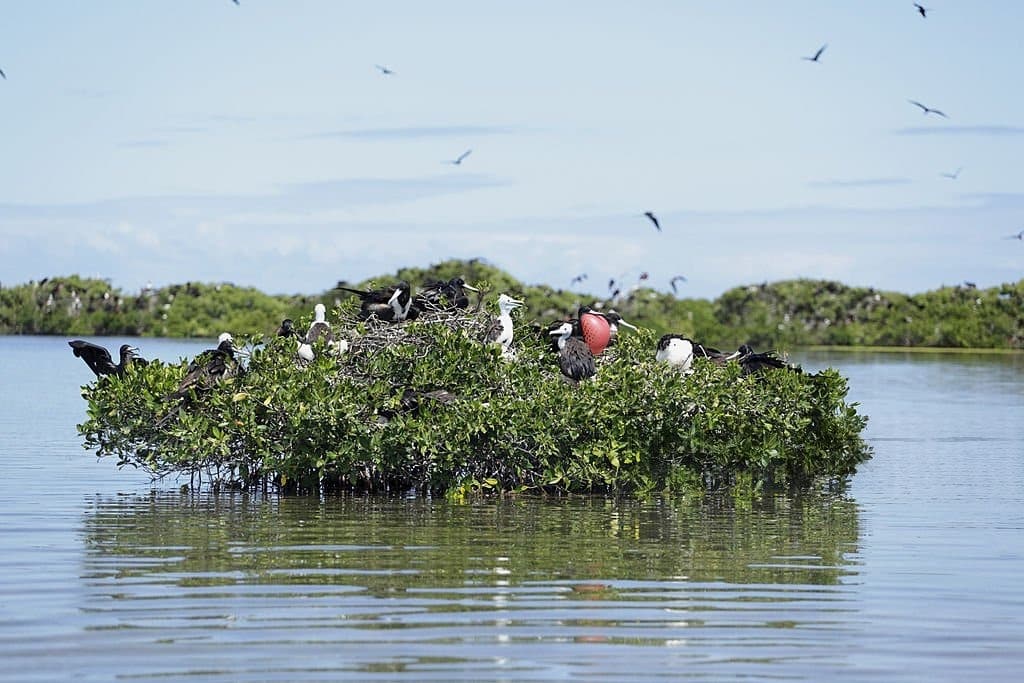
In Barbuda, the show begins even before you spot the birds. There is no road leading to the Codrington Lagoon sanctuary. You have to board a boat, travel across the water through the mangroves, and then watch as the black silhouettes of the magnificent frigatebirds (Fregata magnificens) come into view—their colony is one of the largest in the Caribbean.
This fact alone is enough to reveal another side of Barbuda. Beyond its pink beaches, the island is home to a lagoon where more than 5,000 of these birds have been recorded, in a colony where a scientific survey counted 1,743 nests. Here, you discover the destination by looking up and understanding the role this lagoon plays in the balance of the entire island.
A Ramsar-designated lagoon, nestled between mangroves and reefs
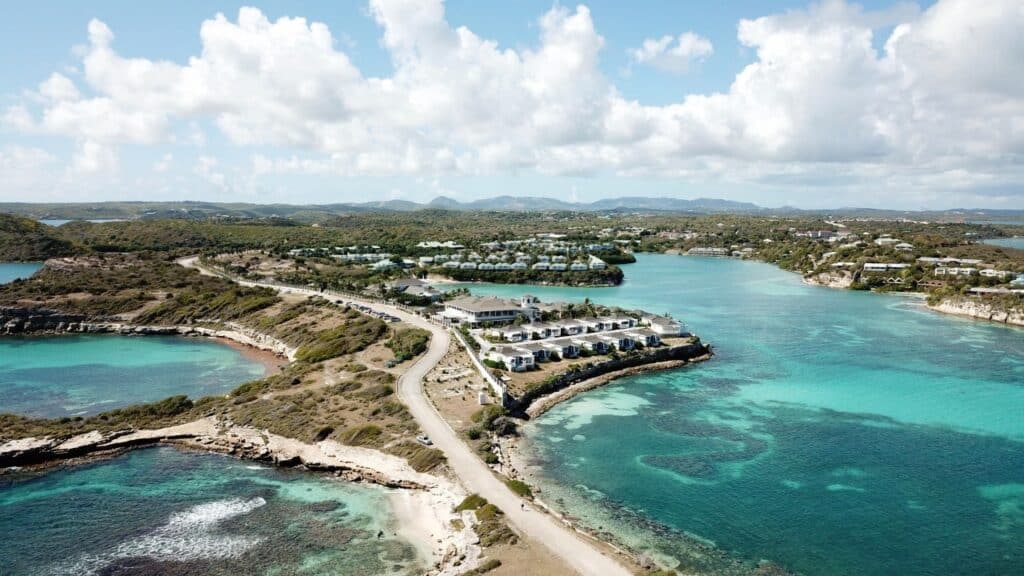
The Codrington Lagoon covers 3,600 hectares and has been recognized as a wetland of international importance under the Ramsar Convention since 2005. It borders Codrington, the only village on Barbuda, from which it takes its name and whose residents are among the sanctuary’s closest neighbors. Mangroves, seagrass beds, sandbars, and reefs form an ecosystem where hawksbill and leatherback sea turtles also nest. Around the lagoon, spiny lobster fishing and nature-based tourism provide a livelihood for some of Barbuda’s families, in a balance that local guides are committed to preserving.
The magnificent frigate, symbol of Barbuda
In Barbuda, the bird is more than just a curiosity. It has become one of the territory’s most recognizable symbols. The male attracts everyone’s attention during courtship, when he inflates a scarlet red pouch under his beak to attract passing females. The species’ wingspan can exceed two meters. Despite its webbed feet, it almost never lands on the water, as its feathers are not waterproof. It therefore spends most of its life gliding, carried by air currents over the sea, and sometimes supplements its diet by chasing other seabirds until they let go—a well-documented behavior in this species.
When Irma Hit the Colony
The importance of the sanctuary became even clearer in September 2017. Hurricane Irma struck Barbuda, forcing the evacuation of the entire island to Antigua. A scientific study published in 2023 showed that the sandbar protecting the lagoon—which had remained intact for 250 years—broke in two places under the force of the storm, a breach that remained open four years later. The lagoon also lost some of its mangroves, prompting a local organization, the MEPA Trust, to begin replanting them with the help of volunteers.
Twenty-eight days after the storm, Barbadian ecologist Shanna Challenger took part in the sanctuary’s first census since the disaster. She found only 300 frigatebirds. “There was a significant drop compared to the usual numbers,” she told the Antigua Observer at the time. No one knows yet whether the birds—like the residents—will return.
The return did not make up for the losses, but it demonstrated the colony’s ability to resume its life cycle in a disrupted environment. Today, the sanctuary is once again home to more than 5,000 frigatebirds. In 2025, a specialized media outlet described it as one of the most thriving colonies in the world, managed by a community council rather than a distant agency, with guides who pass this knowledge down from generation to generation.
More than just a postcard-perfect setting
What makes this sanctuary unique is not just the size of the colony. It is the proximity between a major natural phenomenon and a small island whose entire identity is tied to this landscape. The next time Barbuda appears as nothing more than a postcard of pink sand, just look toward Codrington Lagoon. Behind the beach lies another story—that of an island that has become one of the great refuges for the magnificent frigatebird in this part of the world. What if Barbuda’s true wealth were best seen in what it chooses to preserve for the future?
More than 5,000 magnificent frigatebirds live in the Codrington Lagoon sanctuary, a colony where a scientific census counted 1,743 nests—one of the largest in the Caribbean.
In Codrington Lagoon, on the west coast of Barbuda. The site has been designated a Wetland of International Importance under the Ramsar Convention since 2005.
Yes, but the population has been greatly reduced. A census conducted 28 days after Irma in 2017 found only 300 frigatebirds, compared with more than 5,000 today.
2024 was a pivotal year for connectivity in the Caribbean, marked by a series of initiatives that transformed the region’s aviation landscape. Airlines expanded their operations, introducing new routes and improving existing services. This review examines the advances made, the challenges encountered and the economic implications of these changes for the region.
New flights and connections
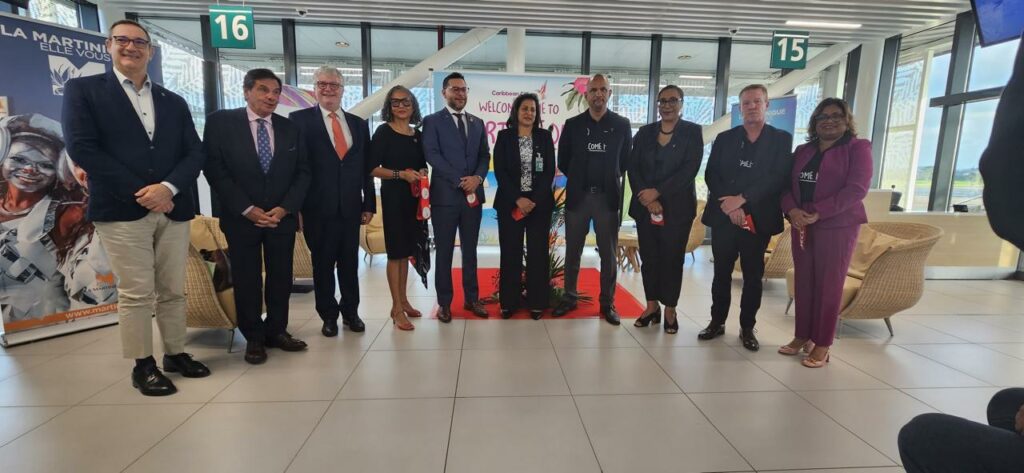
One of the most remarkable features of 2024 was the launch of several new flights, strengthening connectivity between the islands. These include Caribbean Airlines inaugurated direct services to Martinique, facilitating travel between the English- and French-speaking islands. Likewise LIAT Airlines has re-established routes to the British Virgin Islands, offering travelers additional options for exploring the region.
This expansion of the air network has met the growing demand for inter-island travel, stimulating tourism and trade. Passengers now enjoy greater choice, flexibility and convenience.
LIAT Airlines
Événement de bienvenue de Caribbean Airlines en Martinique Source : Caribbean Airlines
Economic impact
Increased connectivity has had a significant impact on the Caribbean economy. By making it easier for tourists to travel, airlines have helped to boost the hotel and restaurant sectors. For example, the increase in visitor numbers to Martinique and the Virgin Islands led to an increase in hotel bookings and restaurant spending, benefiting local businesses.
Statistics show that passenger numbers were up 15% on the previous year, testifying to the effectiveness of the new routes. Local governments have also benefited from this dynamic through increased tax revenues linked to the tourism sector.
Sustainability and Social Responsibility
Another important aspect of the 2024 review was the airlines’ commitment to sustainable practices. Royal Caribbean for example, has taken significant steps to reduce its carbon footprint. By using biofuels and investing in green technologies, airlines are striving to address environmental concerns while continuing to grow.
In addition, airlines have introduced social responsibility programs, supporting local communities and promoting sustainable development initiatives. This has helped to strengthen the relationship between the companies and the communities they serve.
Regional collaboration
Improved connectivity has also encouraged greater collaboration between countries and islands in the region. Governments have recognized the importance of working together to maximize the benefits of tourism. Initiatives such as the Caribbean Tourism Organization have been strengthened, enabling an exchange of ideas and best practices between industry players.
This cooperation has been essential in promoting events and festivals that attract visitors throughout the year, contributing to a more uniform and sustainable tourist season.
Challenges to overcome
Despite the progress made, connectivity in the Caribbean is not without its challenges. Airlines face issues such as increasing competition, fluctuating fuel prices and the need to modernize airport infrastructure. Continued investment is needed to ensure that the region’s airports can accommodate the growing volume of passengers.
Future prospects
Looking ahead, it’s clear that connectivity in the Caribbean will continue to evolve. Airlines plan to open new routes and improve existing services. Governments and local businesses must work together to ensure that this growth is sustainable and beneficial to all.
The overall picture of connectivity in the Caribbean in 2024 is positive. Thanks to initiatives to expand air links and promote sustainable practices, the region is well positioned for continued economic growth. By overcoming challenges and strengthening collaboration, the Caribbean can assert itself as a key destination on the global tourism scene.
To provide the best experiences, we use technologies like cookies to store and/or access device information. Consenting to these technologies will allow us to process data such as browsing behavior or unique IDs on this site. Not consenting or withdrawing consent, may adversely affect certain features and functions.
Functional
Always active
The technical storage or access is strictly necessary for the legitimate purpose of enabling the use of a specific service explicitly requested by the subscriber or user, or for the sole purpose of carrying out the transmission of a communication over an electronic communications network.
Preferences
The technical storage or access is necessary for the legitimate purpose of storing preferences that are not requested by the subscriber or user.
Statistics
The technical storage or access that is used exclusively for statistical purposes.The technical storage or access that is used exclusively for anonymous statistical purposes. Without a subpoena, voluntary compliance on the part of your Internet Service Provider, or additional records from a third party, information stored or retrieved for this purpose alone cannot usually be used to identify you.
Marketing
The technical storage or access is required to create user profiles to send advertising, or to track the user on a website or across several websites for similar marketing purposes.