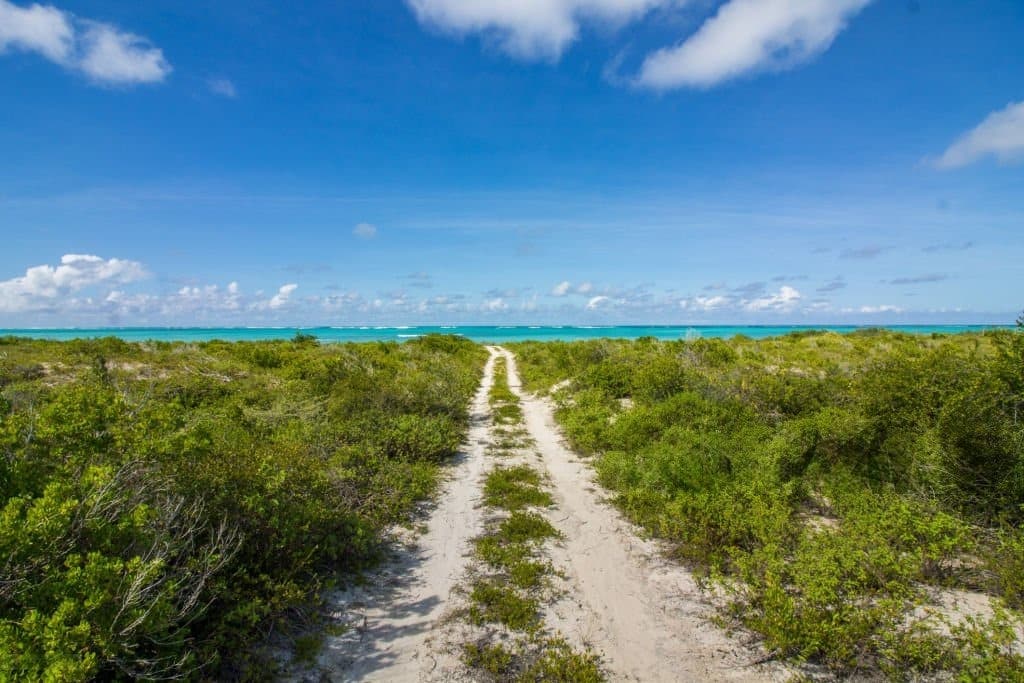
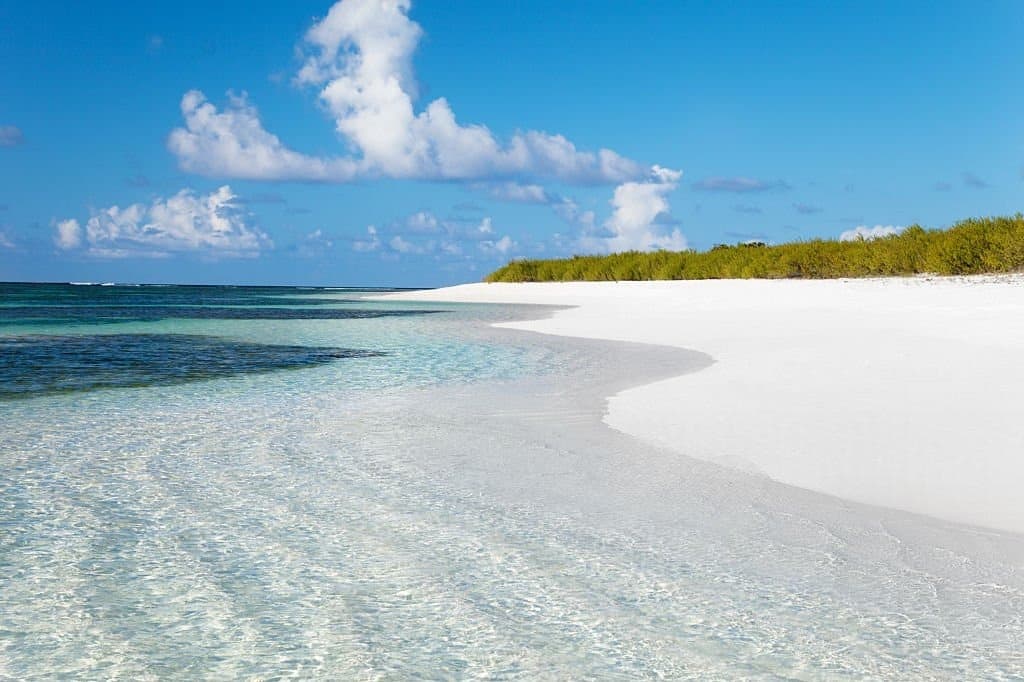
In Anegada, 28 feet is enough to tell the story of an entire island. In the British Virgin Islands, this low-lying land is measured not by its peaks, but by its permanent proximity to the sea. Around it, Horseshoe Reef stretches 18 miles of coral: a protection, a trap, and the great natural story of this territory. These two figures immediately give the scale: an island almost at water’s edge, defended by one of the region’s most remarkable reef systems. They also speak of a way of living, sailing and protecting a place where every metre counts.
An island that the sea watches closely
Anegada lives up to its name. The word comes from the Spanish language and conjures up the idea of a drowned land. This image is not a formula. The island reaches only 28 feet, or about 8.5 meters, at its highest point. That’s less than a small three-storey building. In an archipelago where Tortola, Virgin Gorda and Jost Van Dyke are marked by volcanic reliefs, Anegada imposes another reading of the landscape.
Here, you don’t look up at the hills. It glides towards beaches, salt ponds, shallows and passes. This horizontality changes everything. It explains the caution of sailors, the place of the reef, the presence of birds, but also the way tourism has developed: less around spectacular scenery than around a fragile natural balance.
18 miles of reefs, between refuge and danger
Horseshoe Reef is the number that gives thickness to Anegada. This barrier reef measures around 29 kilometers, or 18 miles. It is billed by the BVI government as the largest barrier reef in the Caribbean, and the fourth largest in the world. For an island that doesn’t exceed 28 feet, this coral belt functions as a living rampart.
But this rampart also has a dark memory. The reef has long made maritime approaches difficult. Inaccurate charts, shallow waters and coral formations have trapped many a ship. The HMS Astraea in 1808, the Donna Paula in 1819 and the MS Rocus in 1929 are among the wrecks cited in local history. Anegada is a reminder of a simple truth: the maritime beauty of the Caribbean has often been inextricably linked with risk.
A rare geological difference in the archipelago
Anegada’s strength also lies in its composition. It is the only coral island in the Virgin Islands volcanic chain. Made of coral and limestone, it stands out clearly from its neighbors. This geological detail explains its almost flat relief, long white beaches, underwater caves, clear springs and salt ponds.
This difference avoids the cliché of the interchangeable island. Anegada doesn’t sell the same imaginary world as the other territories of the BVI. It tells of a lower, more exposed Caribbean, more attentive to invisible thresholds: depth, navigation, reef protection, access to natural areas. And this is precisely where RK Facts finds its value: a figure opens up a complete understanding of the territory.
Flamingos, salt ponds and tourism responsibility
To the west of the island, the salt ponds add another dimension. They have long been home to Caribbean flamingos. Authorities report that these birds were present in their thousands in the 1830s, before disappearing locally around 1950 as a result of hunting for food and feathers. Their reintroduction today gives Anegada a strong ecological significance.
The island is not just a place of beaches and reefs. It raises a question of management: how to receive visitors without damaging what makes the place so unique? In fact, the government states that anchoring is forbidden on Horseshoe Reef in order to protect the reef. This detail lends depth to the subject: Anegada attracts visitors because it remains fragile.
At 28 feet high and 18 miles of reef, Anegada turns two numbers into a Caribbean lesson. The island doesn’t dominate the sea; it negotiates with it. And in this tension, it reminds us that a territory can be immense in its vulnerability, its memory and its way of standing up to the water, all year round.
Anegada is located in the British Virgin Islands, in the northeast of the archipelago. It stands out from its neighbors for its low relief and coral formation. Unlike many of the BVI’s more mountainous and volcanic islands, Anegada is a flat island of coral and limestone. It’s this geographical singularity that makes its landscape so special.
Anegada is known for its maximum height of 28 feet, or around 8.5 meters above sea level. This figure tells us a lot more than just a relief: it explains its name, its direct relationship with the sea, its environmental fragility and its identity in the British Virgin Islands. Anegada impresses not with its mountains, but with its constant proximity to the water.
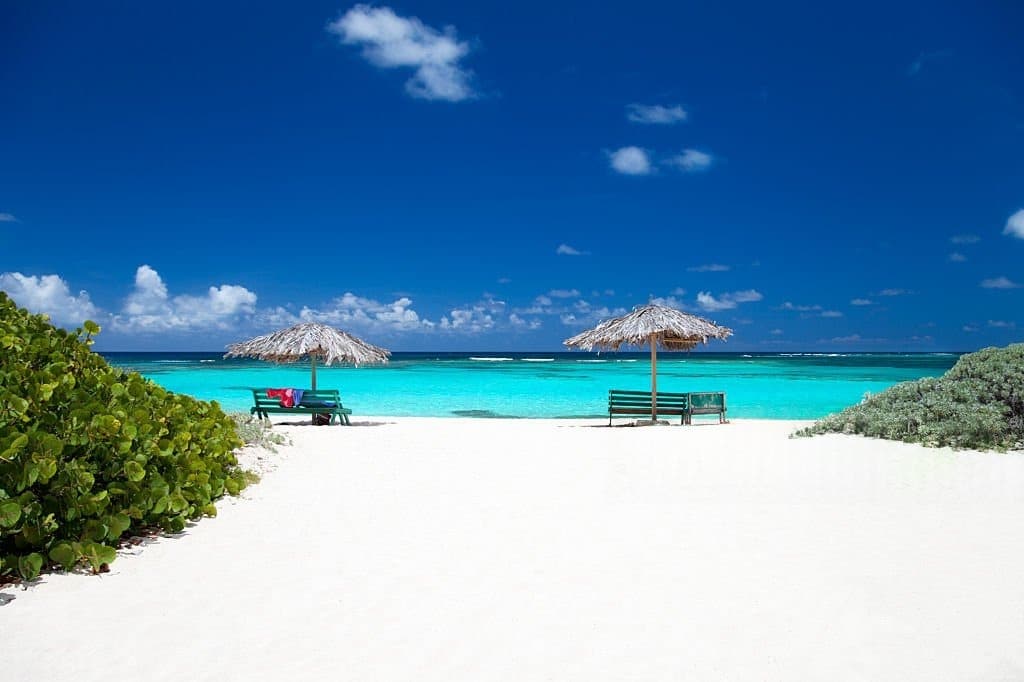
Horseshoe Reef is essential to understanding Anegada. This reef stretches for some 18 miles around the island, and plays a role of natural protection, marine heritage and maritime memory. It has contributed to the ecological richness of the area, but it has also made navigation difficult for a long time, with several shipwrecks recorded in local history. This is one of the elements that gives Anegada its narrative power.
British Virgin Islands start 2025 at the top of the international rankings, named “Best Destination of the Year” at the Luxury Travel Awardsby Modern Luxurythe largest American media group specializing in high-end lifestyle.
This recognition comes against a backdrop of strategic repositioning for the archipelago, which successfully combines hotel excellence, environmental preservation and cultural authenticity. For connoisseurs and travellers alike, curious to understand what truly distinguishes a prestigious destination, the British Virgin Islands offer an inspiring model.
An award based on standards, not notoriety
Unlike other awards, which are sometimes driven by media visibility, the Luxury Travel Awards are based on clear, rigorous criteria: innovation, quality of accommodation, personalized service, sustainable management of the territory and coherence of the tourism offering.
Outperforming established destinations such as the Bahamas, St Vincent and the Grenadines and the Maldives, the British Virgin Islands have demonstrated that a strategy based on long-term quality can win out over short-term communication campaigns. Far from mass tourism, the archipelago today attracts an international public in search of differentiated, sober and elegant experiences.
A constant presence in the benchmark rankings
The year 2025 confirms a trend observed as early as 2024: the British Virgin Islands are consistently ranked among the world’s top destinations. They feature in the “52 Places to Go in 2025” by New York Times as well as in the “World’s Best Awards” of the magazine Travel + Leisure.
This recognition is based on concrete elements: renovated infrastructures, an accommodation offer in line with contemporary luxury expectations, and a local fabric involved in tourism development. Virgin Gorda, Jost Van Dyke and Tortola are no longer just exotic names: today, they represent benchmarks for discerning travellers.
The reopening of the Peter Island Resort: a strategic turning point
The reopening of the Peter Island Resort, after years of renovation, marks a turning point. This iconic resort, located on one of the archipelago’s largest private islands, now offers suites and villas designed for guests seeking tranquillity, refinement and controlled isolation.
The experience is based on discretion, individualized service and a preserved natural environment. The Peter Island Resort illustrates British Virgin Islands to combine modern comfort with respect for the island’s heritage, breaking away from the impersonal standards found in some of the larger hotel chains.
Necker and Moskito Island: the exclusive face of private islands
The British Virgin Islands are also home to two emblematic sites of extreme luxury: Necker Island and Moskito Island, owned by Sir Richard Branson. These private islands embody a vision of travel based on intimacy, autonomy and integration with nature. Guests stay in highly personalized villas, with direct access to unspoilt beaches, tailor-made water sports and dedicated staff.
Beyond their prestige, these two islands illustrate a strong trend in luxury tourism: the search for a space of one’s own, far from the gaze of others, in an ethical and controlled setting. They reinforce the selective and responsible image of British Virgin Islands.
Quintessa Villa: a benchmark for private accommodation in the Caribbean
Located in Oil Nut Bay, on the island of Virgin Gorda, Quintessa Villa has been voted “Best Private Villa in the Caribbean”. With five spacious bedrooms, a honeymoon suite designed as a cocoon of intimacy, and exceptional panoramic views over the North Sound, this property exemplifies the harmony between contemporary architecture and island landscape.
The seamless flow between interior and exterior, the sustainable energy management and the high quality finish of the materials used make the Quintessa a showcase for tomorrow’s hospitality. Once again British Virgin Islands don’t just follow luxury trends: they define them.
Sundara Spa: well-being, innovation and marine identity
In 2025, Quintessa Villa strengthened its offering with the opening of Sundara Spa, the first floating spa in the British Virgin Islands. Designed to blend into the seascape, this center offers treatments inspired by Caribbean traditions and the natural properties of the sea.
Customers can access it directly from their villa or yacht, for a moment of absolute relaxation. This innovation underlines the archipelago’s commitment to developing a tourism offering in keeping with its environment and cultural identity. Far from being a fashion statement, the Sundara Spa bears witness to a genuine reflection on the meaning of the customer experience.
Hospitality based on people and local know-how
At the heart of the British Virgin Islands British Virgin Islands is the quality of human relations. Service is never intrusive, but always present. The hotel teams are trained locally, with a constant concern for detail and personalization.
Clive McCoy, Director of Tourism, insists on this dimension: “The strength of the British Virgin IslandsIt’s their ability to create links, to offer each visitor a meaningful experience. It’s this level of attention, far removed from industrial automation, that sets the archipelago apart in the long term.
Recreational boating and preserved beaches: a rare balance
World-renowned as a boating paradise, the British Virgin Islands British Virgin Islands offer yachtsmen calm waters, protected itineraries and unspoiled natural surroundings. The archipelago thus combines nautical excellence with ecological preservation, avoiding overexploitation of sensitive sites.
Whether you choose to stay on a catamaran, in a private villa or in a small, charming hotel, the experience is always based on the same logic: that of respectful immersion in a fragile yet living territory.
The British Virgin Islands as a model of sustainability and excellence
Far from being just a passing fad, the British Virgin Islands have established themselves as a veritable laboratory for responsible luxury tourism. They show that it is possible to achieve a very high level of quality without denying local identity or compromising ecological balance.
For both discerning travelers and those wishing to understand the mechanics of demanding tourism, they are an exemplary destination. In 2025, they don’t just seduce: they inspire.