
To the northwest of Saint Kitts, the walls of Brimstone Hill Fortress overlook the coast from a volcanic hill nearly 240 meters high. Behind the panoramic view lies a more complex history: that of a fortress designed by the British, built and maintained by enslaved Africans, and designated a UNESCO World Heritage Site in 1999.
Brimstone Hill Fortress, a citadel perched atop a volcano
As you climb Brimstone Hill, the sea comes into view between the steep slopes and the dark stone ramparts. From this natural vantage point, soldiers could observe the western coast of Saint Kitts and keep watch for the possible arrival of enemy ships. The location was far from insignificant. This volcanic hill, nearly 800 feet high, had steep, hard-to-access slopes. It thus offered a prime vantage point and a defensive refuge in the event of a naval attack. Nevertheless, the builders had to adapt their techniques to the particularly challenging terrain.
The walls were built primarily from volcanic rock quarried from the hill. The mortar was made on site from limestone found on the hill’s middle and lower slopes. The fortress thus seems to be an extension of the landscape on which it stands.
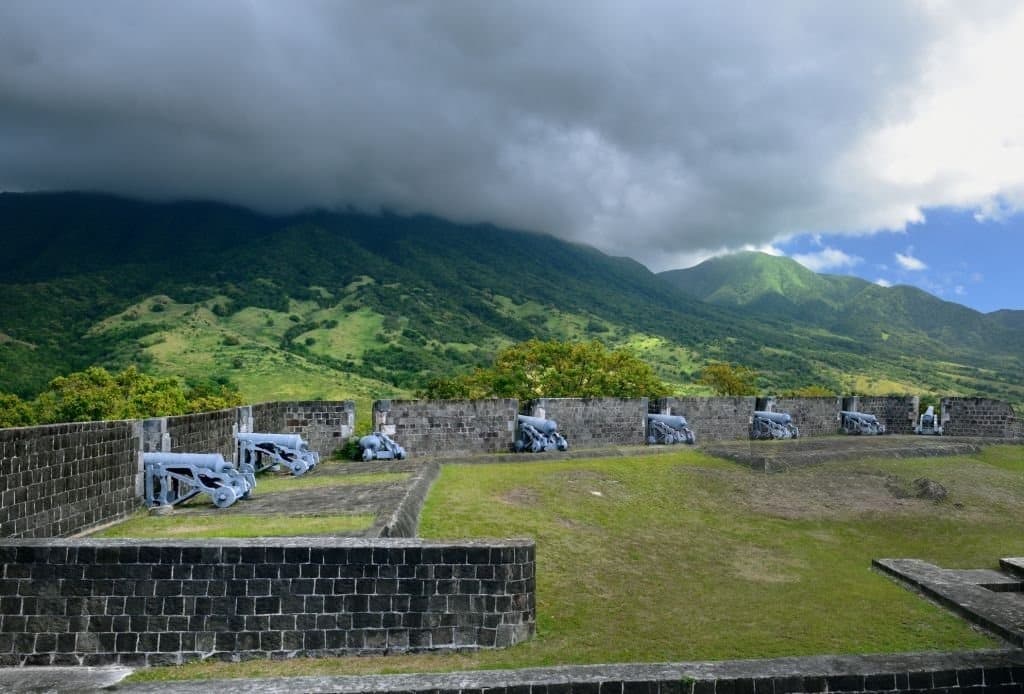
1690: The Start of a Project That Would Last More Than a Century
The construction of Brimstone Hill Fortress began in 1690. That year, the British set up cannons on the hilltop in order to recapture Fort Charles from the French. The site was then gradually expanded, in successive phases, until the 1790s. This construction project, spanning more than a century, attests to the strategic importance of Saint-Christophe, now known as Saint Kitts. The English and French established a permanent presence on the island in the 17th century and shared control of it between 1627 and 1713. Saint Kitts thus became one of the first footholds for their colonial ambitions in the region.
At that time, the Caribbean territories were generating considerable wealth for the European powers. The ports, plantations, and shipping routes had to be protected. Given its scale, Brimstone Hill was a testament both to British military power and to the economic value placed on the island.
British architecture, a project imposed on Africans
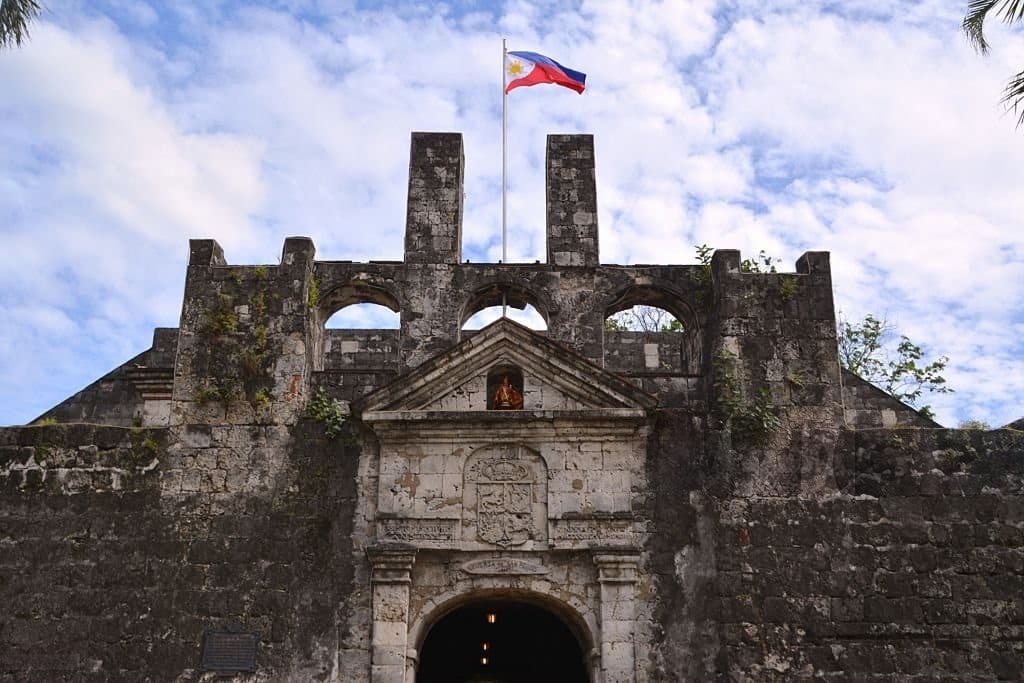
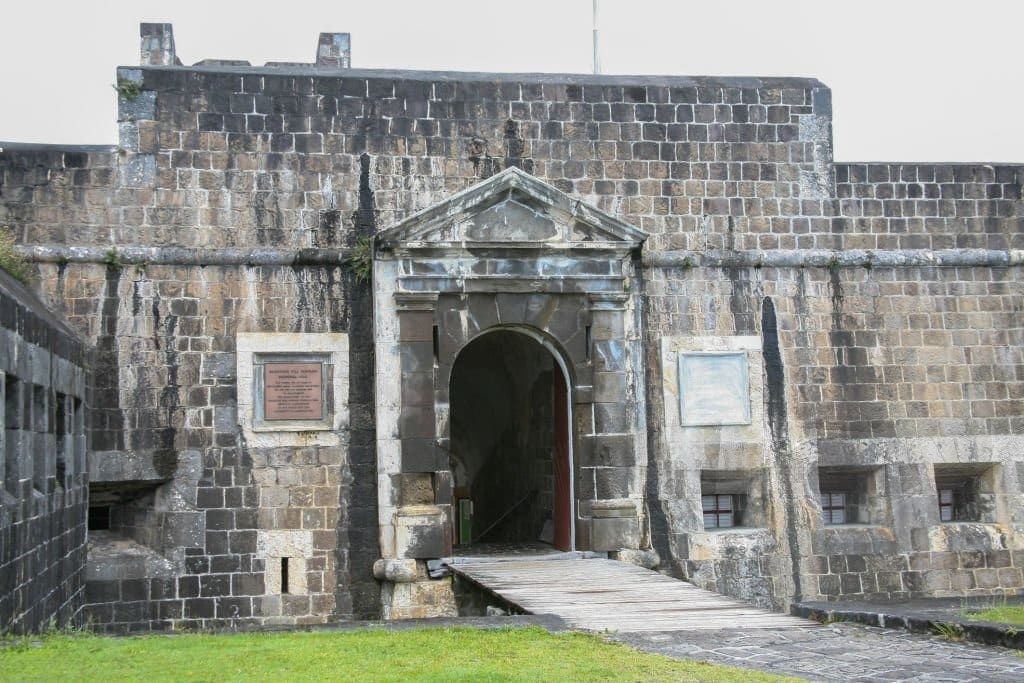
The fortress’s architecture met the requirements of British military engineers. Yet the people who transported the materials, quarried the rock, and built the walls were primarily enslaved Africans. This reality lies at the heart of the historical value recognized by UNESCO. Brimstone Hill Fortress It is not only a remarkable example of 17th- and 18th-century military architecture; it also bears witness to European colonial expansion, the transatlantic slave trade, and the emergence of new societies in the Caribbean.
To present the site as merely a British feat would therefore overlook an essential part of its history. Its architecture is also the result of the strength, skill, and endurance of enslaved workers, who were subjected to particularly harsh conditions on the steep slopes.

Fort George, the defensive heart of the fortress
At the summit stands Fort George, the monumental heart of the complex. Built on one of the two highest points, it comprised barracks, storage areas, artillery positions, and spaces arranged around a central courtyard. Fort George is one of the oldest surviving British examples of a so-called “polygonal” fortification system. Unlike forts dominated by large, projecting bastions, this design better conformed to the terrain and provided multiple defensive angles. Several restored rooms now house a museum dedicated to the site’s history.
A large cistern built beneath one of the rooms was used to collect and store water. According to the ICOMOS assessment, it was still being used as the park’s main water source at the time of the UNESCO nomination review.

From Military Use to World Heritage Site
After several generations of occupation, British troops left the fortress in 1853. The complex gradually lost its military function, and several buildings fell into ruin. A restoration movement took shape in the 20th century. The Society for the Restoration of Brimstone Hill was founded in 1965. Now known as the Brimstone Hill Fortress National Park Society, it manages the park on behalf of the government and the people of Saint Kitts and Nevis.
In 1999, UNESCO inscribed the site on the World Heritage List under criteria III and IV. The protected area covers 15.37 hectares and remains one of the best-preserved historic fortified complexes in the Americas.

Brimstone Hill Fortress: A Memory to Face Head-On
From the ramparts, the landscape can make you forget, for a moment, the violence of history. Yet every wall serves as a reminder of colonial conflicts, rivalry between empires, and the forced labor that made the site’s construction possible. Preserve Brimstone Hill Fortress…it means preserving much more than just a former military outpost. It means passing on a heritage that showcases, all at once, the architectural ingenuity, the European ambitions, and the experiences of the Africans who built the fortress. This leaves one crucial question: How can we admire such a monument without separating its beauty from the lives sacrificed to build it?
Brimstone Hill Fortress is located in the northwest of the island of Saint Kitts, in the country of Saint Kitts and Nevis. The fortress overlooks the coast from a steep volcanic hill.
Brimstone Hill Fortress has been a UNESCO World Heritage Site since 1999. The site is recognized for its remarkable British military architecture and for its role in documenting colonization, the transatlantic slave trade, and the labor of enslaved Africans.
Brimstone Hill Fortress was designed by British military engineers. Its construction and maintenance relied primarily on forced labor provided by enslaved Africans between the late 17th century and the 18th century.
This week, Basseterre is gearing up. From June 25 to 27, 2026, the capital of Saint Kitts and Nevis will host the 28th edition of the Saint Kitts Music Festival 2026. For three nights, Warner Park Stadium will bring together international, regional, and St. Kitts-based artists for a lineup ranging from R&B to reggae, soca to dancehall. Thirty years after its inception, the festival will continue to face the same challenge: attracting big names without overshadowing the local scene.
Saint Kitts Music Festival 2026: Three Nights at Warner Park
The lineup announced for this year’s festival features Fantasia, Beres Hammond, Machel Montano, Mavado, Tarrus Riley, Steel Pulse, Luciano, Aidonia, Masicka, Kranium, Valiant, Voice, and Kehlani. It also features several artists and groups with ties to Saint Kitts and Nevis, including Nu Vybes Band International, Shelly & Signal Band, Rucas H.E., Rodney Tattat, Gharlic & The Upper Level Band, and Zu. This coexistence between well-known stars and local artists is part of the festival’s original vision. From the very beginning, the organizers wanted to showcase Kittiti talent and give them the opportunity to meet artists, promoters, and visitors from outside the region.
Tourism Minister Marsha Henderson described the event as “the beating heart of our tourism industry.” Behind the rhetoric, the goal remains practical: to make the festival a gateway to the island, its heritage, its cuisine, and its communities—beyond the three nights of concerts.

A multi-genre identity established in 1996
The Saint Kitts Music Festival 2026 was launched in 1996. The project was initially conceived as a jazz-focused event, but that direction quickly evolved. The very first edition already featured evenings dedicated to soca, calypso, reggae, jazz, and gospel. This diversity has become the festival’s hallmark. The official website describes it as a “potpourri of musical delights”—a mix of musical pleasures. Over the years, the stage has hosted Lionel Richie, Kenny Rogers, Fantasia, K. Michelle, Chris Brown, the Goo Goo Dolls, Chaka Khan, John Legend, Kassav’, Calypso Rose, and Machel Montano.
The 2026 Saint Kitts Music Festival will build on this approach without confining each evening to a single genre. Caribbean music will share the stage with North American R&B and soul. The program will not seek to impose a dominant aesthetic, but rather to bring together audiences who do not always frequent the same venues.
A streamlined format at the federation level
Saint Kitts and Nevis covers 261 km² and has a population of approximately 47,000. This scale will give the festival a unique format. The program will be concentrated over three nights at Warner Park in the capital, rather than being spread out over a long period or across multiple cities. This concentration will contribute to the festival’s identity. In a single location, the audience will be able to enjoy international artists, Caribbean figures, and St. Kitts-based bands. The festival will leverage the size of the territory to create a compact, distinctive event directly associated with Basseterre.
Thirty years after its launch, this continuity is already a notable achievement. The 2026 event will mark the 28th edition. It will retain its place on the national cultural calendar while revamping its lineup and formats centered around the main venue.


The 2026 Saint Kitts Music Festival: A Blend of Culture and Tourism
The creation of the 2026 Saint Kitts Music Festival was also a response to a specific economic challenge. In 1996, St. Kitts was experiencing low hotel occupancy and a slowdown in activity during that time of year. The event was intended to attract visitors, support hotels, boost local businesses, and enhance the destination’s international visibility. This purpose remains relevant today. The concerts will be accompanied by festival-related activities, culinary events, and side events. The goal will be to extend visitors’ stay beyond Warner Park and integrate music into a broader experience of the region.
The dates of the 2026 Saint Kitts Music Festival will also coincide with the end of Caribbean American Heritage Month, which is celebrated every June in the United States. For some members of the diaspora, the festival will thus take place during a period already dedicated to Caribbean cultures and heritage, though this alone does not fully capture the diversity of its audience.


What role do Kittitian artists play?
The 2026 lineup confirms the participation of several local bands and performers. This visibility will remain essential for an event built around major headliners. It will prevent Saint Kitts from being reduced to merely a backdrop for stars from elsewhere. However, the same question arises with each new edition: How can we ensure a strong local presence when competition among festivals is increasing and international performance fees are straining budgets? How can we measure what these stage appearances will ultimately yield for Kittitian artists in terms of collaborations, contracts, or regional exposure?

The schedule will bring the two events even closer together. Vincy Mas 2026 will begin on June 26 in Saint Vincent and the Grenadines, while the Saint Kitts festival will continue through June 27. The two events will therefore overlap for two days, highlighting the density of the Caribbean cultural calendar at the start of summer. On Thursday, June 25, music will return to Warner Park. But beyond the headliners, the goal of the 2026 Saint Kitts Music Festival will also be to demonstrate the lasting impact an international event can have on the territory’s artists, businesses, and residents.
The 2026 Saint Kitts Music Festival will take place from Thursday, June 25, through Saturday, June 27, at Warner Park Stadium in Basseterre, the capital of Saint Kitts and Nevis. This 28th edition will feature three nights of concerts showcasing international, Caribbean, and St. Kittsian artists. The festival will also include side events, culinary experiences, and entertainment, allowing visitors to extend their experience on the island.
The announced lineup for the 2026 Saint Kitts Music Festival includes Fantasia, Beres Hammond, Machel Montano, Mavado, Tarrus Riley, Steel Pulse, Luciano, Aidonia, Masicka, Kranium, Valiant, Voice, and Kehlani. Several artists and groups with ties to Saint Kitts and Nevis will also be performing, including Nu Vybes Band International, Shelly & Signal Band, Rodney Tattat, Zu, and Gharlic & The Upper Level Band. The lineup will thus bring together R&B, reggae, soca, dancehall, and soul over the course of three evenings.
The 2026 Saint Kitts Music Festival will contribute to the cultural, tourism, and musical profile of Saint Kitts and Nevis. Established in 1996, the festival allows local talent from Saint Kitts to share the stage with renowned artists from the Caribbean and the international scene. It also attracts visitors to Basseterre, supports local businesses and tourism, while providing international visibility to a nation of approximately 47,000 residents.
Direct flight between Saint Kitts and Nigeria is part of a more profound evolution in relations between the Caribbean and the African continent. On March 21, 2026, a charter flight left Robert L. Bradshaw International Airport with over 100 passengers from eight Caribbean territories. The aircraft landed the next day in Abuja, Nigeria, marking a concrete break with traditional travel routes. This journey is more than just a logistical feat. It embodies a political will: to reduce dependence on European and North American hubs, and to structure direct connections between two regions that have historically been linked, but are still poorly connected in practice.
A break with imposed routes
Until now, travelling to Africa from the Caribbean involved long and costly detours. Multiple stopovers, long journey times, administrative complexity: these constraints limited exchanges, particularly economic ones. This direct flight between St. Kitts and Nigeria changes all that. It doesn’t just reduce travel time. It redefines the conditions of access. By eliminating geographical intermediaries, it opens up the possibility of a more direct, fluid and potentially more frequent relationship.
This is a strategic development. In a region where connectivity determines opportunities, each new air route can change the dynamics of trade, tourism and institutions.
An assertive lever for economic diplomacy
The composition of the delegation spoke volumes about their intentions. Alongside political representatives were entrepreneurs, investors and cultural players. This choice confirms that the objective goes beyond the institutional framework. The trip took place against the backdrop of the Afri-Caribbean Investment Summit (AACIS) in Abuja. Discussions focused on sectors identified as priorities: agriculture, blue economy, cross-investment and cultural industries.
The direct flight between St. Kitts and Nigeria thus becomes a tool. It facilitates meetings, speeds up negotiations and lends operational credibility to projects that are often mentioned but rarely put into practice. The ambition is clear: to create a trade corridor between the Caribbean and West Africa. This notion, still theoretical, takes tangible form here.
A political reading of the Africa-Caribbean rapprochement
Beyond the economic stakes, the initiative is part of a broader reading of international relations. It reflects a desire to strengthen ties between theOrganization of Eastern Caribbean States (OECS) and the Economic Community of West African States (ECOWAS). This positioning marks an evolution. The Caribbean no longer seeks solely to consolidate relations with its traditional partners. It is exploring alternative avenues, in line with a logic of South-South cooperation. In this context, the direct flight between Saint Kitts and Nigeria sends out a signal. It shows that links between regional blocs are possible, provided they are supported by concrete infrastructures.
"Reverse Middle Passage": a reinvested symbol
The initiative is accompanied by a strong symbolic dimension, through the expression “Reverse Middle Passage”. It refers back to transatlantic history, but reverses its meaning. It is no longer an imposed crossing, but a chosen journey, organized around economic and strategic interests. This change of perspective is not insignificant. It is part of a re-reading of relations between Africa and the Caribbean, based on cooperation rather than memory alone. In this context, the direct flight between Saint Kitts and Nigeria goes beyond air transport. It is part of an attempt at political and economic repositioning.
Real but conditional opportunities
The prospects opened up by this link are numerous. They include
- – bilateral investments,
- – Caribbean exports,
- – collaborations in the blue economy,
- – the circulation of cultural and creative players.
But these opportunities remain conditional. A one-off flight is not enough to structure a lasting relationship. Continuity will be decisive: economic agreements, financing mechanisms, regularity of connections, diplomatic follow-up. The direct flight between Saint Kitts and Nigeria is a starting point, not an end point.

A new geography of trade under construction
This move raises a fundamental question: is the Caribbean in the process of redesigning its connecting axes? By bypassing the routes dominated by the North, this initiative proposes a different reading of the Atlantic. It brings together two areas which, despite their shared history, are still far apart in contemporary exchanges. The direct flight between St. Kitts and Nigeria will not immediately transform regional balances. But it does introduce a concrete possibility: that of a direct, structured and assumed relationship between the Caribbean and Africa. In a context where mobility directly influences economic opportunities, this development deserves particular attention.
The direct flight between St. Kitts and Nigeria is profoundly changing mobility conditions between the Caribbean and Africa. Until now, travel between the two regions required stopovers in Europe or North America, which added considerably to journey times and costs. This new link reduces these constraints and facilitates travel for decision-makers, entrepreneurs and investors. In the medium term, this can accelerate trade, encourage economic partnerships and strengthen the Caribbean’s presence in African markets.
This flight is strategic, because it’s not just about air travel, but a tool for regional cooperation. It is part of a process of rapprochement between the Organization of Eastern Caribbean States (OECS) and ECOWAS. The direct flight between Saint Kitts and Nigeria creates an operational link between two regional blocs, facilitating economic meetings, negotiations and joint projects. It also helps to reposition the Caribbean as an active player in South-South dynamics.
At this stage, it’s a charter flight organized as part of a major economic event. For a scheduled service to become a reality, a number of conditions will have to be met: sufficient demand, solid bilateral agreements, a viable business model for the airlines and a lasting political commitment. The direct flight between St. Kitts and Nigeria is therefore a first step, but its transformation into a scheduled service will depend on the concrete benefits of this initiative.
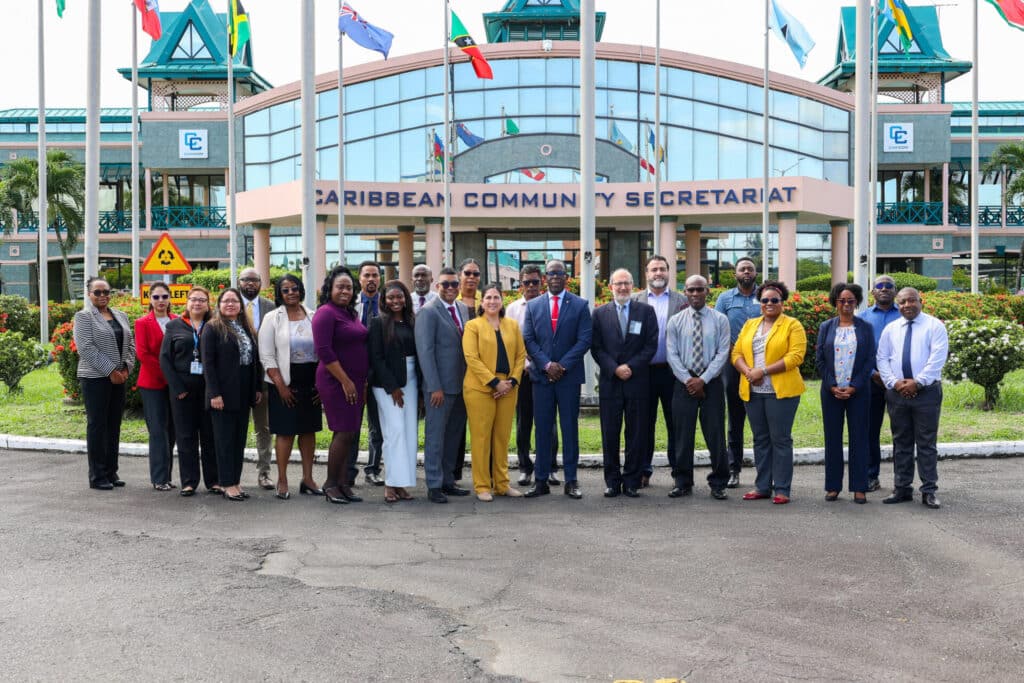
From February 24 to 27, 2026 the Heads of Government of CARICOM will meet in Basseterre, à Saint Kitts and Nevis, for the 50th Regular Meeting of the Conference of Heads of Government. A highly symbolic, but above all strategic event, at a time when the Caribbean region is facing an accumulation of economic, climatic, security and geopolitical challenges. The chosen theme, “Beyond Words: Action Today for a Thriving, Sustainable CARICOMclearly announces the ambition: to move beyond declarations of intent into a phase of concrete implementation.
Chaired by the Prime Minister of Saint Kitts and Nevis, Dr Terrance Drew current President for the first half of 2026, this conference marks an important milestone in the history of the regional organization, created to strengthen integration, cooperation and solidarity between its member states.

An opening under the banner of political responsibility
The opening ceremony, scheduled for February 24th at the Marriott Dome in Frigate Bay, will set the political tone for the summit. The expected speeches will put into perspective the commitments made by CARICOM over the past decades, but also the persistent gaps between adopted decisions and actual implementation. The speech by outgoing Chairman, Jamaican Prime Minister Andrew Holness, is expected to take critical stock of the previous cycle, while Secretary General, Dr Carla Barnett, will remind us of regional priorities in an unstable international context.
The challenge is clear: to demonstrate that CARICOM remains a relevant framework for responding collectively to contemporary crises.
The Caribbean single market still at the center of debate
Among the structuring dossiers on the agenda is the CARICOM Single Market and Economy (CSME). More than thirty years after its launch, the single market remains incomplete. Discussions will focus in particular on the free movement of qualified people, the recognition of skills, the removal of non-tariff barriers and the harmonization of economic policies.
For many member states, the credibility of the organization today depends on its ability to make the CSME fully operational, to the benefit of citizens and regional businesses alike.

Climate and financing: an existential emergency
The climate issue will be central to the discussions. For the CARICOM states, climate change is not a future projection, but a daily reality: rising sea levels, intensifying hurricanes, pressure on natural resources. The heads of government will discuss access to climate financing, reform of vulnerability criteria and international recognition of the specific situation of small island states.
The organization should reaffirm a strong collective position in favor of climate justice and better access to international financial mechanisms.
Food security and regional resilience
Another strategic priority is food and nutritional security. The region’s high dependence on imports exposes CARICOM countries to external shocks, whether economic, health-related or logistical. Discussions will focus on strengthening regional agricultural production, local processing and supply chain resilience.
Beyond agriculture, a broader reflection on Caribbean food sovereignty is expected.


Regional security and transnational crime
Security was also a major theme at the summit. Organized crime, arms trafficking, urban violence and illicit flows are common challenges for CARICOM member states. Leaders will examine existing cooperation mechanisms and ways of strengthening collective action, particularly in terms of information sharing and operational coordination.
Safety is now seen as an essential condition for the region’s economic and social development.
Transport and connectivity: a structural brake on integration
Intra-regional transport remains a sensitive issue. High costs, limited connections and dependence on external hubs hamper the mobility of citizens and the movement of goods within CARICOM. Heads of government should reassess existing options for improving air and sea connectivity, a key element of regional integration.

Reparations and international relations
The issue of reparations for slavery and colonialism will remain on the agenda, following on from the work of the CARICOM Reparations Commission. At the same time, foreign relations will be the subject of in-depth exchanges, illustrated by the presence of international partners, notably from Saudi Arabia and Africa, a sign of our commitment to diplomatic and economic diversification.
A summit under pressure
The conference closes on February 27 by a final press conference at the St Kitts Marriott. Beyond the official communiqués, this 50ᵉ summit will be judged by its ability to produce clear, measurable directions that are followed by action.
The stakes are high: to prove that regional integration can still be a concrete lever for development, resilience and sovereignty in a changing world.
The 50ᵉ Regular Meeting of the Conference of Heads of Government is an official meeting bringing together the leaders of CARICOM member states to set the political, economic and diplomatic direction of the Caribbean region.
Discussions include the Caribbean Single Market (CSME), climate financing, food security, regional security, intra-Caribbean transport, reparations and international relations.
This summit marks a symbolic and strategic milestone, with high expectations of concrete results. It takes place against a backdrop of economic, climatic and geopolitical pressures that call for coordinated, effective regional action.
In the Eastern Caribbean, St Kitts occupies a unique position. Main island of the state of St Kitts and NevisIt’s the only island to boast a large part of the region’s British colonial history, a remarkable built heritage and a volcanic geography that still shapes local life. Here, the territory is easy to read: a compact island, a central volcano, coastal villages and a capital facing the sea.
A founding island in Caribbean history
St Kitts is one of the first islands in the Eastern Caribbean to be colonized by the British in the XVIIᵉ century. It quickly became a strategic center for English colonial expansion in the region. This history can still be seen today in the organization of the territory, in the architecture and in the former sugar estates scattered across the island.
The capital, Basseterre, the city’s urban layout, with its structured streets, administrative buildings, churches and former port warehouses, is a legacy of this period. For visitors, the city offers a straightforward reading of Caribbean history, without excessive staging.


Brimstone Hill, a symbol of heritage
It’s impossible to mention St Kitts without mentioning Brimstone Hill Fortress a UNESCO World Heritage site. This monumental fortress, built by the British between the XVIIᵉ and XVIIIᵉ centuries, dominates the island’s northwest coast. It illustrates both European colonial rivalries and the island’s strategic importance in the Caribbean.
The remarkably well-preserved site provides an insight into the military organization of the period, and offers unobstructed views of the Caribbean Sea and the nearby island of Nieves. For visitors, Brimstone Hill is a major historical landmark.


A structuring volcanic relief
The island’s landscape is dominated by Mount Liamuiga a volcano rising to an altitude of over 1,100 metres. Visible from most of the island, it influences climate, vegetation and human occupation. The fertile slopes have long been used for sugarcane cultivation, while the higher areas remain covered by tropical forests.
This relief gives the island a diversity of landscapes that is rare in such a small territory: coastal plains, green hills, volcanic craters and contrasting coastlines. For travelers, this variety means they can alternate between the sea, landscape observation and discovering the island’s interior.


A variety of beaches, from light sand to volcanic sand
The island’s coastline alternates between light sandy beaches and darker sandy beaches of volcanic origin. This diversity is a direct reflection of the island’s geology. Some beaches are developed and easily accessible, while others are more discreet, lined with vegetation and frequented mainly by locals.
The sea is generally calm on the Caribbean coast, making for pleasant swimming and supervised water sports. Most of the coastline remains open, with no systematic privatization, fostering a natural cohabitation between visitors and the local population.


An island focused on tourism, with no break with local life
St Kitts has been welcoming international visitors for several decades, notably via cruises and regional flights. This has led to the development of a solid tourism infrastructure: hotels, restaurants and transport services. However, tourism has not erased local life.
Villages, markets, cultural events and everyday practices remain visible and accessible. This continuity between tourist activity and island life gives the island a legible character, appreciated by travelers seeking a balance between comfort and territorial anchorage.


A complete Caribbean destination
Highlighting this destination means presenting an island that combines several essential dimensions of the Caribbean:
– a central colonial history,
– an internationally recognized heritage,
– a structuring volcanic relief,
– a controlled opening up to tourism.
For visitors, the island offers a clear and coherent approach to the Caribbean territory. It shows how history, geography and tourism coexist in a small space, without obscuring local realities.
📸 ©My St. Kitts / Facebook page
It is located in the eastern Caribbean and, together with Niévès, forms an independent state to the southeast of Puerto Rico.
The island played a central role in the British colonization of the Caribbean and is home to Brimstone Hill, one of the region’s most important fortified sites.
Yes, the island has a well-developed tourist infrastructure, while retaining an active local life and a well-preserved heritage.
