
Haiti – Joseph Laroche: The Titanic’s only black passenger, a story of hope, courage and oblivion

Joseph Laroche

The name Joseph Laroche resonates today as a powerful symbol, that of a Haitian man, talented engineer, family man and, above all, the only known black passenger aboard the Titanic. Yet for decades, his story was overshadowed, forgotten or ignored in official accounts of the legendary sinking. A look back at an extraordinary destiny, which sheds light not only on the history of the Titanic, but also that of Haiti, the little-known jewel of the Caribbean and the silent struggle against racism in the early 20th century.

A Haitian childhood between heritage and ambition

Joseph Philippe Lemercier Laroche was born in 1886 in Cap-Haïtien, a historic city in northern Haiti, the cradle of the Haitian revolution and a powerful symbol of the Caribbean. Born into a middle-class family, he carried with him a prestigious heritage: his grandfather was a bootmaker to King Henri Christophe, the emblematic figure of Haitian independence. His mother, a shrewd businesswoman, prospered in the coffee, cocoa, sugarcane and cotton trades. She invested everything in her only son’s education, convinced that knowledge was the key to success.

At the age of 15, Joseph Philippe left Haiti for France, his chosen destination for higher education. His departure marked the beginning of a journey that combines hope, determination and confrontation with the realities of a racialized world.

Studying in France: engineers face invisible barriers

In Beauvais, Joseph Laroche obtained his baccalaureate and then a diploma in agricultural engineering. He married Juliette Lafargue, a young French woman, a rare and courageous union for the time, defying racial and social prejudice. Together, they started a family with two daughters, Simone and Louise, and were expecting a third child. Despite his skills, Joseph encounters insidious racism in France.

His diploma was not enough to open every door. He worked on the construction of line 12 of the Paris metro, linking Porte de la Chapelle to Porte de Versailles, a major project of which he was proud. But opportunities are few and far between, and stable jobs are nowhere to be found. Republican France, despite its ideals of equality, is often closed to talent from former colonies.

Joseph Laroche
The Laroche family, Joseph with his wife Juliette and their daughters Simone and Louise. Source : Domaine public

The return to Haiti: a hope supported by the family

Faced with these difficulties, Joseph Laroche and Juliette decided to return to Haiti, where Joseph’s uncle by marriage, Cincinnatus Leconte, had just been elected President of the Republic. This family link opens up new prospects: Joseph is promised a job as a mathematics teacher, a welcome professional and social recognition.

Returning to their native land becomes a family project, a dream of a better future for their children, far from European discrimination.

Choosing the Titanic: a voyage of hope and constraint

Joseph Laroche’s family first to book first-class tickets on the liner Francea symbol of elegance and social status. But the ship’s policy forbids children to dine with their parents, an unbearable affront for Joseph and Juliette. They cancel their reservation and choose to travel second class aboard the Titanic, a brand-new ship reputed to be unsinkable, which accepts children at the table.

On April 10, 1912, they set sail from Cherbourg, hoping to reach New York and then Haiti. The voyage begins under the best of auspices: luxury, comfort, the children’s wonderment. Juliette wrote a letter describing their happiness, still unaware of the tragedy that lay ahead.

Joseph Laroche
RMS Titanic, Southampton, southern England, April 10, 1912.

The shipwreck: a sacrifice and a painful separation

On the night of April 14-15, 1912, the Titanic struck an iceberg. Panic gripped the ship. Women and children are given priority for the lifeboats. Joseph Laroche sees to it that Juliette and their daughters board safely. He entrusts little Louise to his wife and daughter Simone, promising to join them soon. This will be their final farewell.

Joseph disappears into the icy waters of the North Atlantic, his body never found. Juliette and her daughters are rescued by the Carpathia, but the trauma is immense. Juliette gives birth to their third child, a boy named Joseph, in honor of his lost father.

Haiti, the Caribbean and rediscovered memory

Joseph Laroche’s story is also that of Haiti, the founding country of the first independent black republic, often marginalized in global historical narratives. His story illustrates the challenges faced by a black man from the Caribbean, confronted with discrimination in Europe, but with a strong cultural and political heritage.

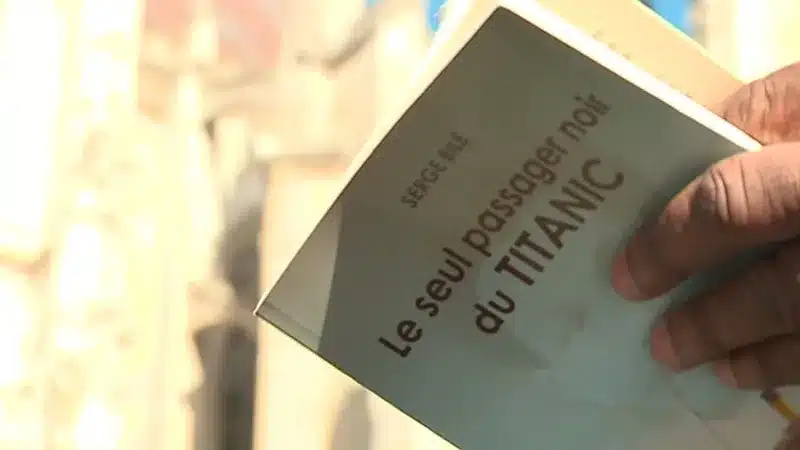
For a long time, his name was erased, forgotten in the Titanic archives. This silence bears witness to the racial bias and wilful neglect of history. It was only thanks to the research of journalist and author Serge Bilé in his book: ” TITANIC’S ONLY BLACK PASSENGER” that the memory of Joseph Laroche has been revived, offering a new, more inclusive and human perspective on the Titanic tragedy.

Joseph Laroche
Journalist and author Serge Bilé. Source: Conrad Vitasse
Joseph Laroche
Book cover: “Le seul passager noir du TITANIC” (The only black passenger on board the TITANIC)

Joseph Laroche embodies the strength of a man who, despite the odds, pursued his dreams and protected his family to the point of ultimate sacrifice. His story invites us to rethink historical narratives, to recognize forgotten voices, and to celebrate the richness of Caribbean heritages in the larger global story.

Leave a Reply

Your email address will not be published. Required fields are marked *

More articles from RK

Marcus Garvey
HISTORY & HERITAGE
Tolotra

Jamaica – Marcus Garvey, Jamaican hero of international renown

Marcus Garvey remains one of the most influential figures to emerge from the Caribbean. Born in Jamaica at the end of the 19th century, he transformed a local experience into a political and cultural project of international scope. At a time when black populations faced deeply rooted systems of exclusion, Marcus Garvey proposed a structured vision based on dignity, organization and autonomy. Recognized today as a national hero in Jamaica, he is much more than a historical symbol. His story helps us understand how the Caribbean helped shape major intellectual and political movements on a global scale. His name continues to circulate in contemporary debates on identity, memory and the development of societies born out of colonial history. From Jamaican origins to the formation of a committed conscience He was born on August 17, 1887 in St. Ann’s Bay, Jamaica, into a modest family. Very early on, he developed a

Read More »
BlueSeas Festival
EVENT MANAGEMENT
Tolotra

BlueSeas Festival: in Curaçao, Pietermaai becomes the epicenter of Caribbean blues in 2026

From April 2 to 4, 2026, Curaçao hosts another edition of the BlueSeas Festival a musical event that is gradually establishing itself as one of the most unique cultural events in the Caribbean. Free, open and rooted in the urban space, the festival goes far beyond simple musical programming to become a genuine territorial experience. Right from the opening night, Thursday April 2 at Kura Hulanda Village, the mood is set: the blues settle into a heritage setting, before taking full possession of the Pietermaai district on April 3 and 4. This two-stage format structures an immersive experience in which music, architecture and local life are seamlessly interwoven. A free festival that transforms the city into an open-air stage The BlueSeas Festival is based on the principle of offering free concerts in public spaces. This choice is not insignificant. It widens access to live music, while creating direct interaction between

Read More »
Le vodou : Haïti au cœur d’une candidature patrimoniale majeure avec le Bénin
COOPERATION
Tolotra

Vodou: Haiti at the heart of a major heritage bid with Benin

The vodou is entering a new phase in its international history. The joint candidacy of Haiti and Benin for inscription on the Representative List of the Intangible Cultural Heritage of Humanity places centuries of memory, transmission and creation at the heart of a global heritage debate. The deadline set by UNESCO for applications to be examined in 2027, and submitted before March 31, 2026, places this initiative within a precise and structured institutional calendar, but the stakes go far beyond the administrative procedure. For the Caribbean, and Haiti in particular, this candidacy is no mere cultural formality. It’s about recognizing a living heritage, often misunderstood, sometimes caricatured, but deeply rooted in the country’s social, artistic and spiritual history. Vodou is not a fixed folklore; it is a cultural matrix, a way of organizing the link between generations, communities and the sacred. To place it within an international heritage dynamic is

Read More »

conTACT RK

we'd love to have your feedback on your experience so far

Join The List

Join our Richès Karayib community!  Sign up for our newsletter.

Want To Maximize Your Business Presence On Riches Karayib?

Complete the form to start the application