
An essential Jamaican author

Opal Palmer Adisa is recognized as a major figure in Caribbean literature. A native of Kingston, she has led a transnational career, moving between Jamaica, the United States and the wider region. Professor and writer, Opal Palmer Adisa taught for over twenty years in California and helped found the Creative Writing Program, California College of the Arts. Returning to the Caribbean, she directed the Institute for Gender and Development Studies at the University of the West Indies, while publishing over twenty-five books.
Tracks such as It Begins with Tears, Painting Away Regrets or 4-Headed Womanare read as benchmarks in the exploration of identity, gender and historical heritage. Through her magazine Interviewing the Caribbeana, she has also created a space to give a voice to the region’s writers, artists and intellectuals.
A writing workshop rooted in the senses and memory

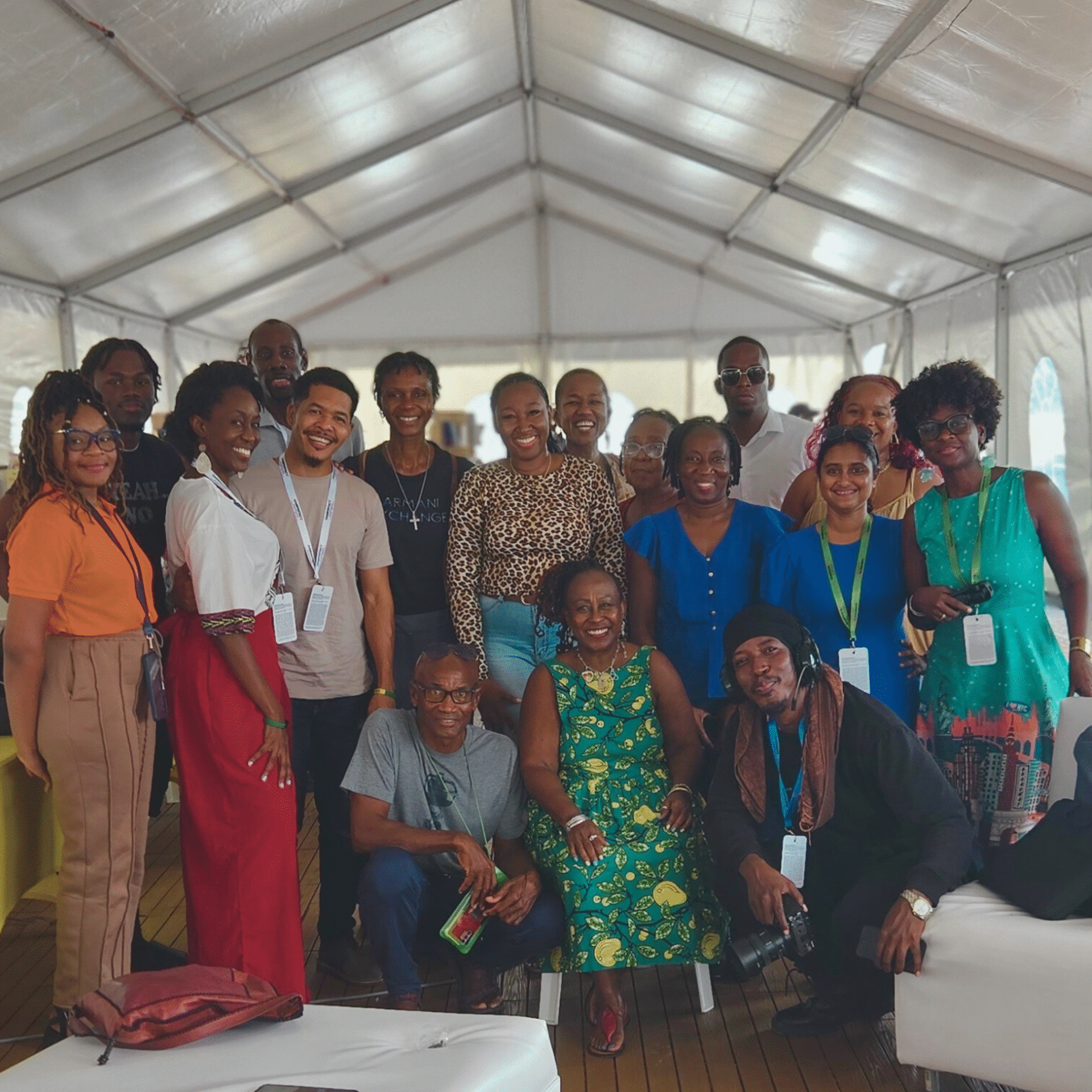
During CARIFESTA XV in Barbados, Opal Palmer Adisa led a workshop as part of the literary program “Conversation with the Poet Laureates” program.. This space was not simply a moment of theory, but an immediate application. She proposed prompt to get participants to write, here are a few examples:
– write “the taste of home”, in five lines, through smells, textures and colors;
– listen to the sea as a narrator, recounting migrations, suffering and healing;
This deeply sensory approach was designed to remind us that writing is not an abstraction: it is nourished by what is seen, smelled, tasted and heard on a daily basis.

The ancestors and the sea as guides
The workshop took on an almost ritualistic dimension when Opal Palmer Adisa invited everyone to invoke the names of their ancestors. She emphasizes that matrilineal and patrilineal heritage is a source of knowledge and stories that are often forgotten. From her perspective, writing is a way of renewing this thread, interrupted by colonial history.

The sea was the other main focus of her thinking. She asked participants to project themselves into it, to feel the water on their skin, the sand under their feet, the waves on their bodies. For her, the ocean is an open book, a repository of past dramas but also a space for healing. She evoked the Molinere Underwater Sculpture Park in Grenada, underlining the importance of inscribing memorial rituals linked to the sea in contemporary Caribbean culture.
Cultural diversity and the Creole language
The author reminded us that the Caribbean was born of the meeting of multiple heritages: Taïnos with manioc and bami, Africans with their languages and rhythms, Indians and Chinese with rice, spices and curries. In her view, this diversity is an immense source of richness, but one that remains too little integrated into collective representations.
Opal Palmer Adisa insists on the importance of writing in Creole languages. She asserts that these idioms are not mere dialects, but entire cosmologies, conveying a vision of the world. Using them in literature means resisting cultural erasure and rehabilitating knowledge.

An educational emergency
For the writer, this process must start at school. She deplores the fact that many Jamaican children don’t know the names of local birds, trees or plants, but retain imported references. She advocates writing workshops starting in primary school, so that children can learn to express their environment and build a sense of pride in their identity.
Towards Caribbean unity
Quoting Mia Mottley, Prime Minister of Barbados, Opal Palmer Adisa insisted on the need to go beyond national borders to think about a common identity. ” We have to be Caribbean “she repeats, like an invitation to write a shared history, free from stereotypes.
Rather than limiting itself to representing an island, a country or a territory, it calls for a collective horizon, where the Caribbean tells its story as a living, plural and united entity.

The intervention of Opal Palmer Adisa à CARIFESTA XV showed that writing about the Caribbean means summoning up the taste of food, the sound of waves, the voice of ancestors, the diversity of cultures and the strength of local languages. Her workshop reminded us that literature can be an act of resistance, a way of healing and connecting generations and territories.


One Response
Thanks, Professor Adisa, for your respected intervention at CARIFESTA XV and for your instrumentality in what seemed to be an engaging workshop.
I enjoyed the celebrations, virtually.