
Colombia – San AndrĂ©s, a Caribbean island of Afro-Caribbean heritage and a sea of seven colors

San Andrés

Located in the western Caribbean Sea, San Andrés is a Colombian territory in a class of its own. Closer to Nicaragua than to the South American continent, the island has a singular island identity, shaped by its maritime history, Afro-Caribbean culture and strategic role in the region. For travellers, San Andrés represents a structured, clear destination with a strong maritime orientation.

The island covers some 26 km². Its modest size makes it easy to get around and quickly grasp its organization. Coastal roads, residential areas and natural zones follow one another seamlessly, giving the whole a territorial coherence that visitors appreciate.

San Andrés

A Colombian island in the heart of the western Caribbean

Although administratively attached to Colombia, San AndrĂ©s belongs fully to the English-speaking and Creole-speaking Caribbean. The local population, known as raizal, retains cultural traditions linked to the British Caribbean: Creole language, musical and culinary practices, community organization. This hybrid identity – Colombian in administration, Caribbean in culture – is one of the island’s distinguishing features. It is reflected in daily life, trade and religious practices.

It is also a strategic point in the region, located some 190 kilometers off the coast of Nicaragua. This geographical position reinforces its historical and maritime importance in the Western Caribbean.

San Andrés

The sea as a central element

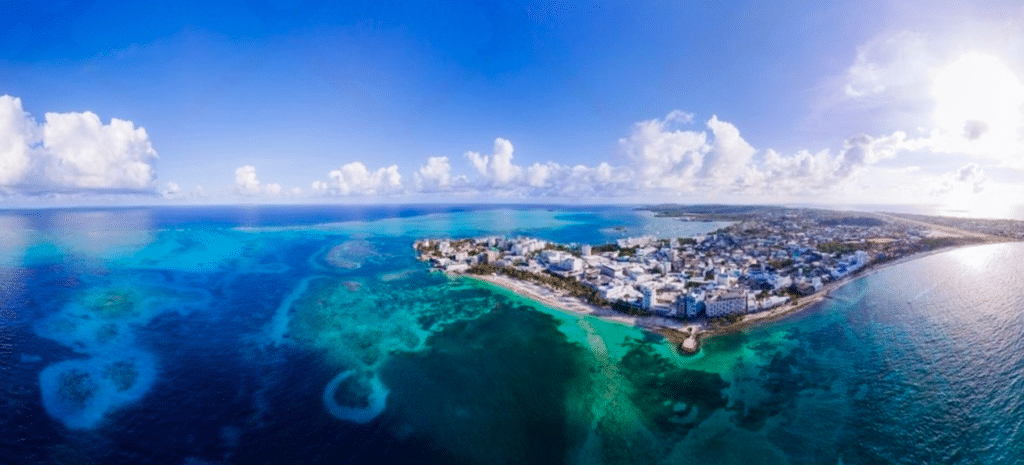
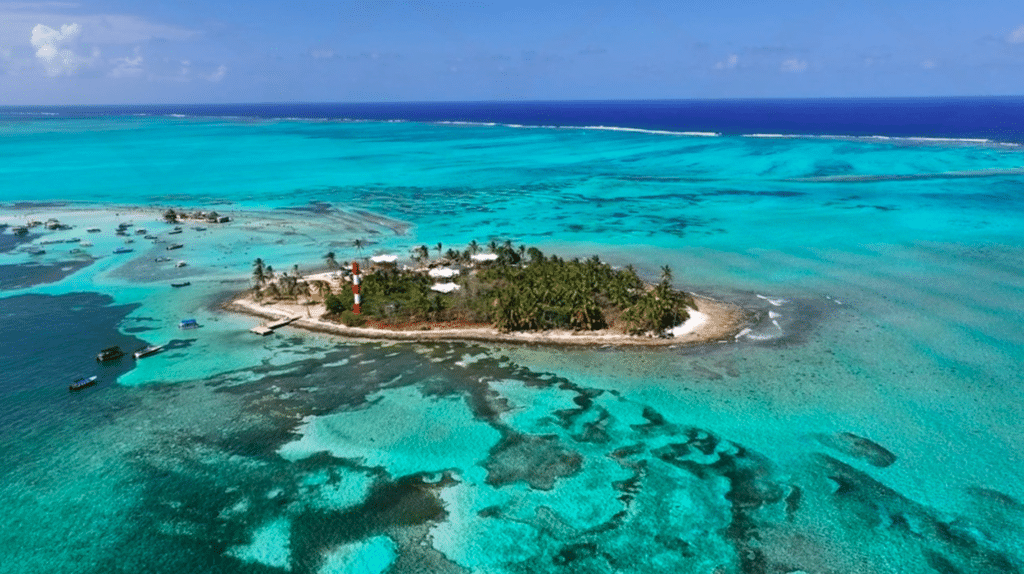
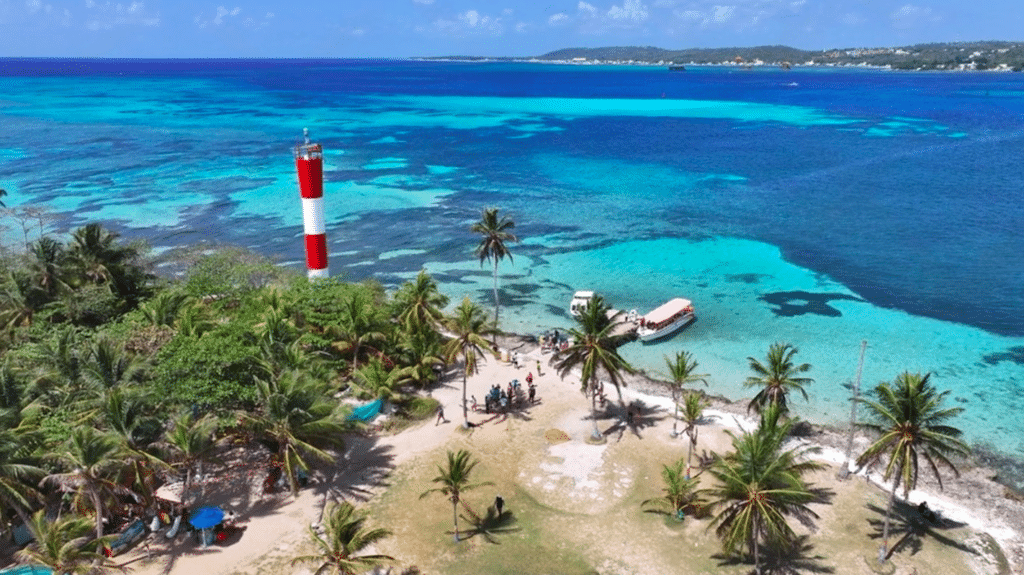
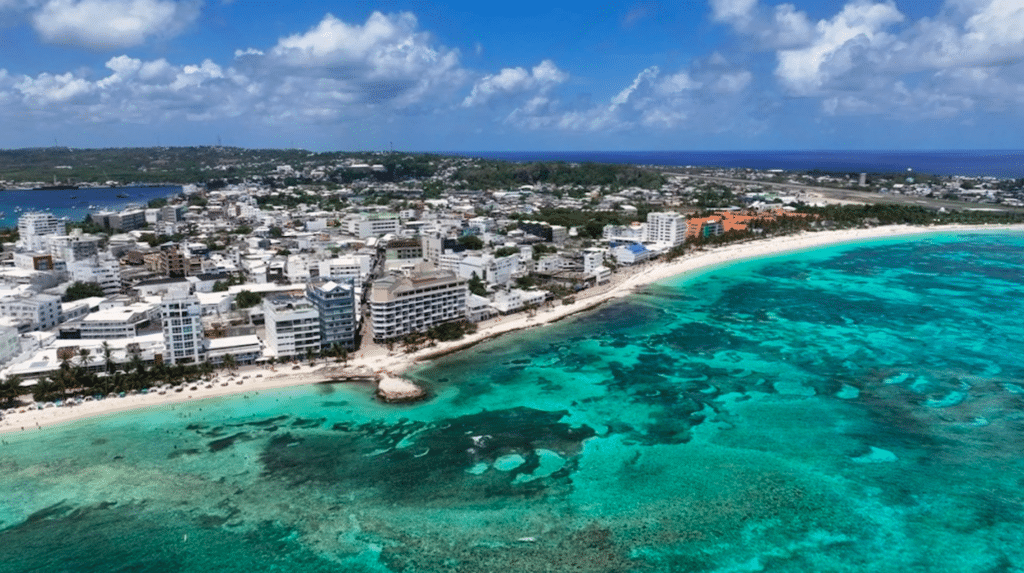
The image most associated with San AndrĂ©s remains that of the “sea of seven colors”. This expression refers to the variations in blue and turquoise visible around the island, linked to the depth of the water, the sandy seabed and the coral reefs. The phenomenon is particularly visible from the east coast and high points along the coastline. The coral reef that partially surrounds the island protects certain areas and supports significant marine biodiversity. The archipelago of San AndrĂ©s, Providencia and Santa Catalina is part of the Seaflower Biosphere Reserve, recognized by UNESCO for its ecological richness.

This close relationship with the sea underpins all aspects of island life: artisanal fishing, maritime transport, nautical activities and seaside tourism.

San Andrés
San Andrés

An accessible, organized region

The main urban center of San AndrĂ©s is built around the port and shopping area. Hotels, shops and services are concentrated along the northern coastline. Residential areas and quieter zones are spread out to the south and inland. The Gustavo Rojas Pinilla international airport provides regular flights to BogotĂ¡, MedellĂ­n, Panama and other regional destinations. This accessibility partly explains the island’s constant tourist numbers.

Despite all this traffic, San Andrés has kept its organization simple: one main road circles the island, making it possible to cover the whole area in just a few hours. This configuration makes it easy to get around and provides a clear overview of the territory.

San Andrés

An economy largely driven by tourism

Tourism is the main economic engine of San Andrés. Hotels, restaurants, nautical activities and duty-free shops structure the local economy. The island benefits from the status of a commercial free zone, which also attracts visitors who come to shop. However, fishing and public services continue to play an important role in the local economy. The cohabitation of tourism and daily life is clearly visible, particularly in the residential areas and markets.

San Andrés

Between frequentation and preservation

The popularity of San AndrĂ©s raises the question of the balance between tourist numbers and the protection of natural resources. Local and national authorities have introduced measures to preserve coral reefs and regulate certain tourist flows. The archipelago’s inclusion in the Seaflower Biosphere Reserve is part of this approach.

For visitors, this translates into a destination that’s alive and kicking, but still easy to understand. The island is more than just a seaside resort: it remains an inhabited territory, with its own rhythms and constraints.

San Andrés
San Andrés

A unique island Caribbean

Highlight San Andrés is to present an island that exemplifies Caribbean diversity. A Colombian territory but with an Afro-Caribbean culture, a tourist destination but an active island space, it combines several dimensions rarely found together in such a small area. For travelers, it offers a clear framework: a compact island, an omnipresent sea and a strong cultural identity. It provides a solid entry point for understanding the Western Caribbean and its interactions between geography, history and tourism.

San Andrés is a Colombian island in the western Caribbean Sea, close to Nicaragua.

It is renowned for its seven-colored sea, coral reefs and membership of the Seaflower Biosphere Reserve.

The island is accessible by air from BogotĂ¡, MedellĂ­n, Panama and several Caribbean cities.

Leave a Reply

Your email address will not be published. Required fields are marked *

More articles from RK

Marcus Garvey
HISTORY & HERITAGE
Tolotra

Jamaica – Marcus Garvey, Jamaican hero of international renown

Marcus Garvey remains one of the most influential figures to emerge from the Caribbean. Born in Jamaica at the end of the 19th century, he transformed a local experience into a political and cultural project of international scope. At a time when black populations faced deeply rooted systems of exclusion, Marcus Garvey proposed a structured vision based on dignity, organization and autonomy. Recognized today as a national hero in Jamaica, he is much more than a historical symbol. His story helps us understand how the Caribbean helped shape major intellectual and political movements on a global scale. His name continues to circulate in contemporary debates on identity, memory and the development of societies born out of colonial history. From Jamaican origins to the formation of a committed conscience He was born on August 17, 1887 in St. Ann’s Bay, Jamaica, into a modest family. Very early on, he developed a

Read More »
BlueSeas Festival
EVENT MANAGEMENT
Tolotra

BlueSeas Festival: in Curaçao, Pietermaai becomes the epicenter of Caribbean blues in 2026

From April 2 to 4, 2026, Curaçao hosts another edition of the BlueSeas Festival a musical event that is gradually establishing itself as one of the most unique cultural events in the Caribbean. Free, open and rooted in the urban space, the festival goes far beyond simple musical programming to become a genuine territorial experience. Right from the opening night, Thursday April 2 at Kura Hulanda Village, the mood is set: the blues settle into a heritage setting, before taking full possession of the Pietermaai district on April 3 and 4. This two-stage format structures an immersive experience in which music, architecture and local life are seamlessly interwoven. A free festival that transforms the city into an open-air stage The BlueSeas Festival is based on the principle of offering free concerts in public spaces. This choice is not insignificant. It widens access to live music, while creating direct interaction between

Read More »
Le vodou : HaĂ¯ti au cÅ“ur d’une candidature patrimoniale majeure avec le BĂ©nin
COOPERATION
Tolotra

Vodou: Haiti at the heart of a major heritage bid with Benin

The vodou is entering a new phase in its international history. The joint candidacy of Haiti and Benin for inscription on the Representative List of the Intangible Cultural Heritage of Humanity places centuries of memory, transmission and creation at the heart of a global heritage debate. The deadline set by UNESCO for applications to be examined in 2027, and submitted before March 31, 2026, places this initiative within a precise and structured institutional calendar, but the stakes go far beyond the administrative procedure. For the Caribbean, and Haiti in particular, this candidacy is no mere cultural formality. It’s about recognizing a living heritage, often misunderstood, sometimes caricatured, but deeply rooted in the country’s social, artistic and spiritual history. Vodou is not a fixed folklore; it is a cultural matrix, a way of organizing the link between generations, communities and the sacred. To place it within an international heritage dynamic is

Read More »

conTACT RK

we'd love to have your feedback on your experience so far

Join The List

Join our Richès Karayib community!  Sign up for our newsletter.

Want To Maximize Your Business Presence On Riches Karayib?

Complete the form to start the application