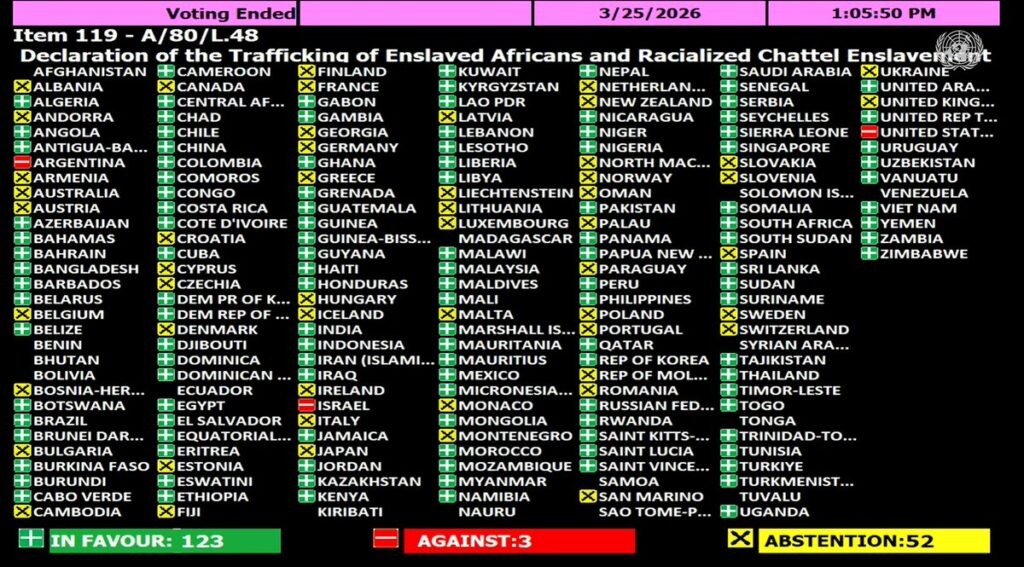
On March 25, 2026, the UN General Assembly adopted a resolution that marks a milestone in the international recognition of the history of slavery. The text qualifies the transatlantic African slave trade and racialized chattel slavery as the most serious crime against humanity. The text, sponsored by Ghana, was adopted by 123 votes in favor, with 3 against and 52 abstentions. Opponents included the USA, Argentina and Israel, while several European countries, including the UK, chose to abstain. Behind this strong wording is more than just a symbolic gesture. For the Caribbean, this decision is part of a historical and political continuity, echoing decades of work, demands and struggles for fairer recognition of this memory.
Recognition that redefines the international debate
By classifying slavery as a major crime against humanity, the UN has crossed a threshold rarely reached by international bodies. This recognition does not create an immediate legal obligation for States, but it profoundly alters the framework of global debate. It introduces a more explicit reading of history, in which the transatlantic slave trade is no longer merely evoked as a past tragedy, but as a crime whose consequences continue into the present.
This evolution in international discourse is not insignificant. It comes at a time when issues relating to colonial legacies, structural discrimination and historical inequalities are taking on increasing importance in public debate. By taking a clear stance, the UN is helping to legitimize the analyses long put forward by Caribbean researchers, institutions and cultural players, who stress that the history of slavery cannot be dissociated from contemporary realities.
The Caribbean, at the heart of history and current issues
For the Caribbean territories, this decision is more than just a historical observation. It has a direct bearing on their very construction. The transatlantic slave trade and the slave system have shaped the region’s economies, societies, languages and cultures. Plantations, land structures, social hierarchies and even some of today’s economic dynamics have their roots in this period.
Recognition by the UN thus confirms a reality that the Caribbean has never ceased to bear: that of a founding history, the effects of which are still visible. It also repositioned the region in the global narrative, not as a peripheral space, but as a central territory in the understanding of the great historical transformations linked to slavery and colonization.
This international recognition also offers a strategic opportunity. It strengthens the capacity of Caribbean territories to influence global discussions on memory, justice and reparations. It gives added legitimacy to the steps already taken by certain regional institutions, which have been working for several years to structure concrete proposals on these issues.


Reparations and memorial justice: a new dynamic
One of the most important effects of this resolution concerns the issue of reparations. By classifying slavery as a major crime against humanity, the UN opens the way to more structured discussions on forms of restorative justice. This includes avenues such as official apologies, the restitution of cultural property, the funding of educational programs and public policies aimed at correcting the inequalities inherited from this history.
In the Caribbean, these issues are not new. They are part of a long-standing process, driven in particular by regional initiatives seeking recognition of the lasting consequences of slavery. The UN decision does not create a binding framework, but it changes the balance of power by giving international support to these claims.
It can also encourage better structuring of remembrance policies. In many regions, the transmission of the history of slavery remains uneven and sometimes fragmented, despite the fact that it is central to understanding today’s societies. UN recognition can serve as a lever to strengthen educational programs, support research and enhance the value of places of remembrance.

Recognition that also reveals tensions
The vote on this resolution highlights persistent differences within the international community. While a large majority of States supported the text, certain oppositions and abstentions show that the issue remains sensitive. The reservations expressed relate in particular to the political and historical implications of this qualification, as well as to the consequences it could have in terms of reparations.
These tensions are a reminder that there is no absolute consensus on the recognition of slavery as a major crime. It remains a subject of debate, where diplomatic stakes, historical responsibilities and economic considerations are intertwined. For the Caribbean, this situation confirms that the battle for full recognition of this history is still ongoing.
Rethinking the Caribbean narrative on a global scale
Beyond the political stakes, this decision offers an opportunity to redefine the way the Caribbean is told internationally. All too often reduced to a simplified tourist or cultural image, the region has a complex history marked by violence, resistance and reconstruction.
The UN’s position puts this history back at the center of the global narrative. It invites us to consider the Caribbean not only as a space of memory, but also as a place of intellectual and political production. The region’s reflections on slavery, colonization and their consequences continue to inform contemporary debates far beyond its borders.
For a medium like RichèsKarayib, this news underlines the importance of offering a demanding, contextualized reading of the Caribbean territories. It reminds us that the region’s culture, history and economic issues are deeply intertwined, and must be approached in their entirety.

Turning recognition into leverage
The real impact of this resolution will depend on the actions that follow. International recognition is a step forward, but it is not enough on its own to bring about concrete change. For the Caribbean, the challenge now is to transform this decision into a lever for action, by strengthening cooperation, structuring public policies and consolidating research and transmission initiatives.
The UN has set an important milestone by classifying the transatlantic slave trade and slavery as a major crime against humanity. For the Caribbean territories, this recognition represents an opportunity to advance essential debates linked to their history and development. It opens up a new way of thinking about international relations, by fully integrating the legacies of the past into the construction of the present and the future.

The UN decision adopted on March 25, 2026 recognizes the transatlantic slave trade and slavery as the most serious crime against humanity. It aims to affirm the historical gravity of these events, and to encourage international discussions on remembrance, justice and reparations.
No, this UN resolution is not legally binding. It does not impose direct obligations, but it does have a strong political and symbolic impact that can influence international discussions and public policy.
The Caribbean has been deeply marked by the transatlantic slave trade and slavery. This recognition by the UN validates a historical reading that has long been held in the region, and can support initiatives linked to remembrance, education and reparations.