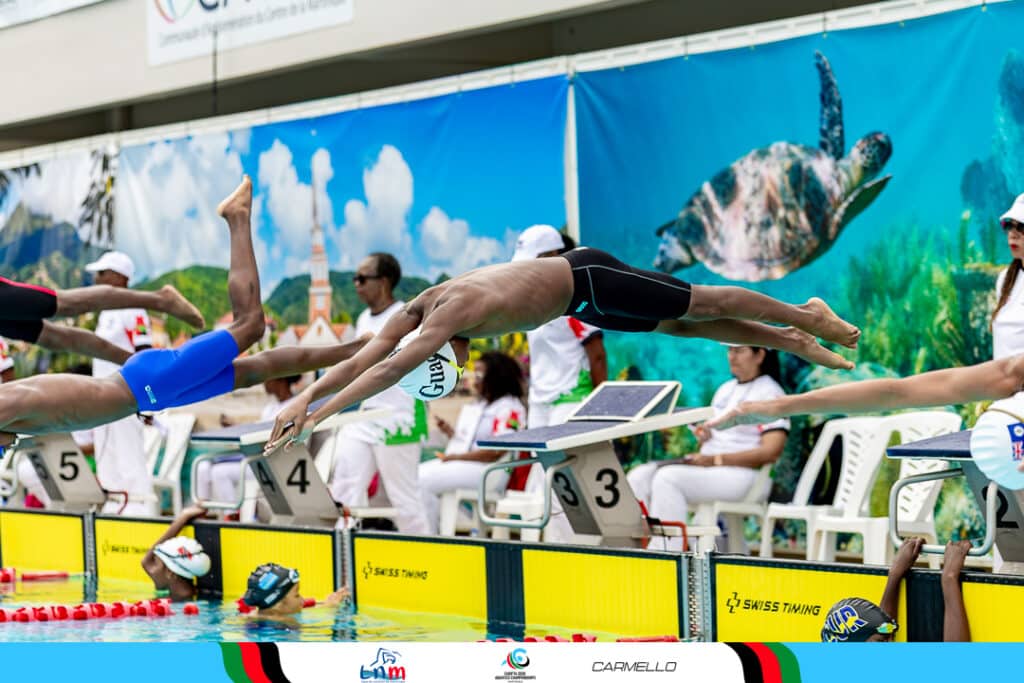
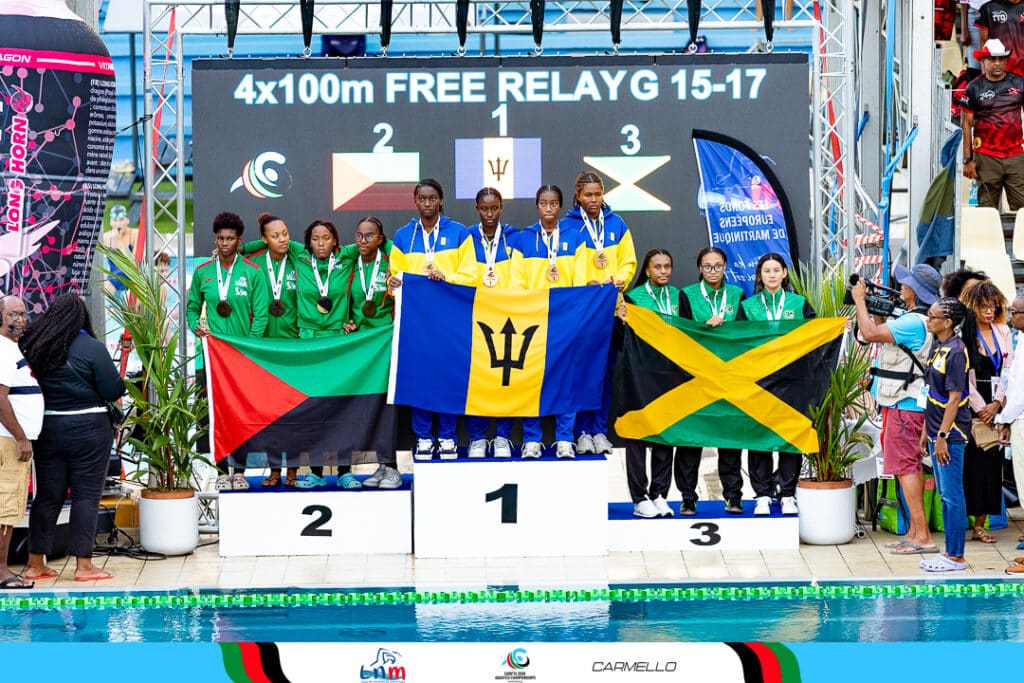
After two days of competition in Fort-de-France, CARIFTA Aquatics 2026 already confirms the region’s strongest output in junior swimming: density, minimal gaps in the overall standings and several swimmers capable of turning an evening on its head. The Bahamas are in first place overall, but Jamaica is still in touch, while Trinidad & Tobago is relying on a very strong men’s base to stay in the race. Behind this trio, Barbados, the Cayman Islands and Martinique continue to advance in a championship where every final, every relay and every point counts.
First day kicks off tight duel
On the first day of the CARIFTA Aquatics 2026, Saturday, April 4, 2026, the Bahamas took the lead in the combined standings with 196 points, ahead of Jamaica with 191 points.a gap of just five units. Trinidad & Tobago followed with 152 points, just ahead of Barbados at 150, then the Cayman Islands at 145. Martinique, buoyed by a solid start at home, was already in sixth place with 114 points. This hierarchy reflected a clear trend: nothing was decided yet, neither for the title nor for the podium.
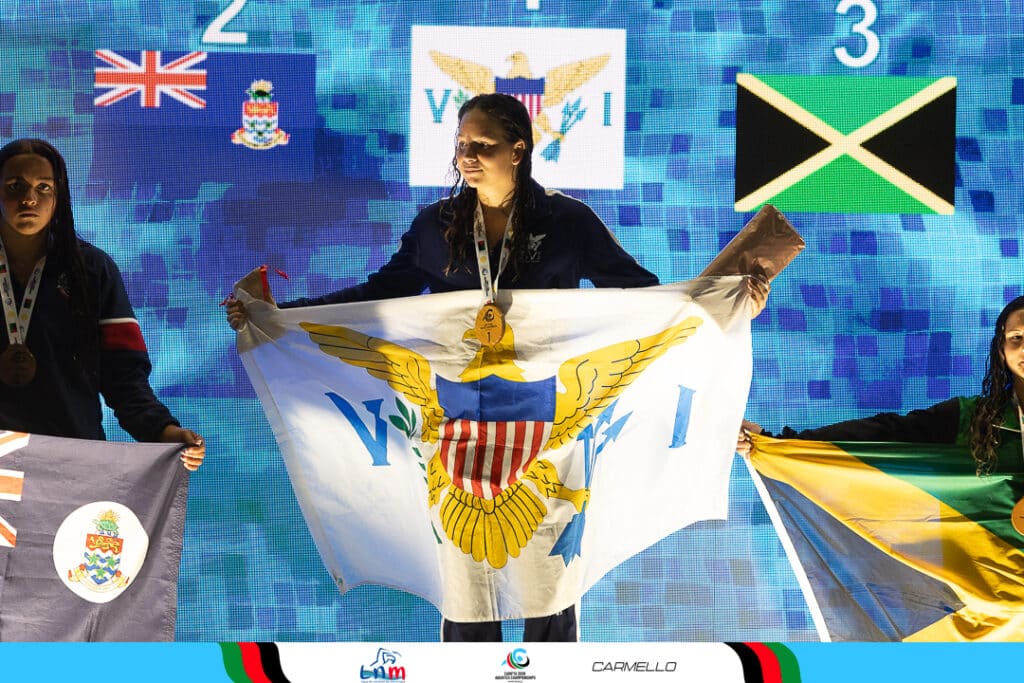
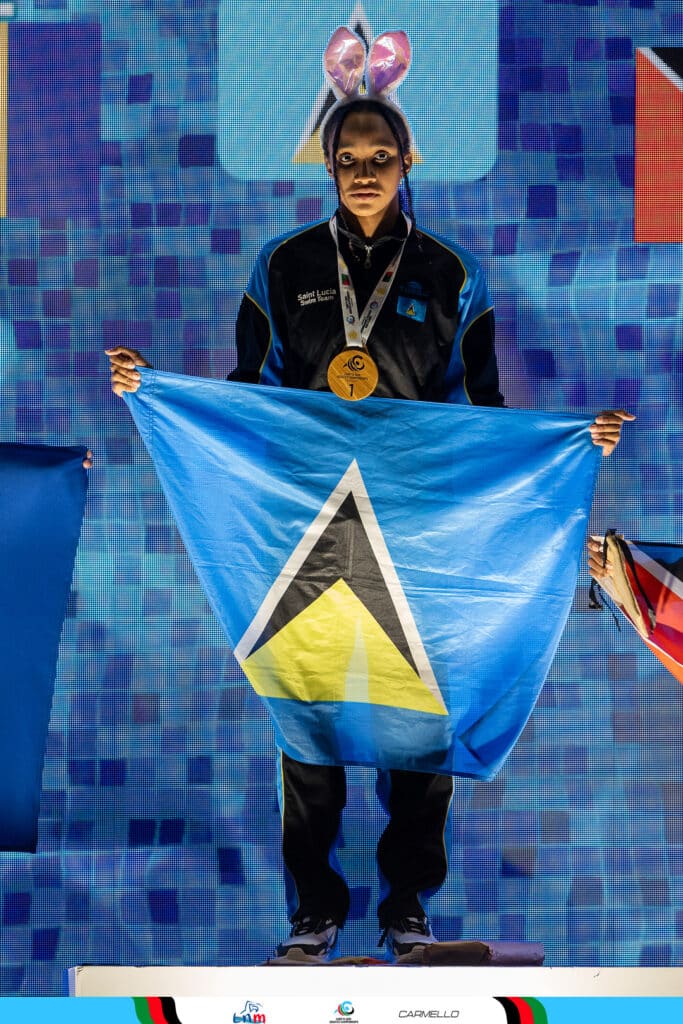
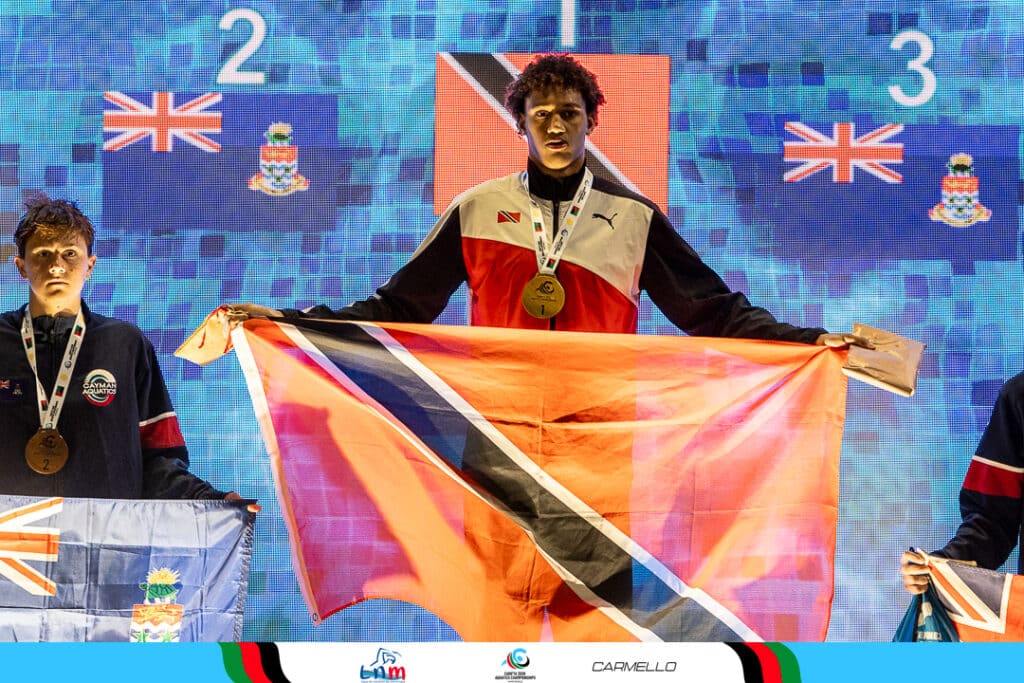
On this first day, several names stood out. Liam Carrington, for Trinidad & Tobago, excelled in the 50 m freestyle and also took a podium in the 100 m butterfly. The men’s 100 m butterfly was won by Christian Jérôme, representing Haiti. On the girls’ side, Heidi Stoute for Barbados and Reagan Uszenski for the US Virgin Islands stood out, while Sapphire Parks, for Saint Lucia, had a particularly outstanding day, with three races contested, two victories and a third place.
Martinique holds its own in front of its home crowd
In this first review of the CARIFTA Aquatics 2026, Martinique didn’t just benefit from the basin advantage. Several results immediately weighed on the rankings: Jade Bering won gold in the 200 m breaststroke, Malia Soroman took bronze in the 100 m butterfly, Lucas Patron silver in the 200 m breaststroke and Lucas Wato bronze in the 50 m backstroke. In such a tight competition, these medals enabled the Martinique squad to stay in touch with the extended leading group.
The second day of CARIFTA Aquatics 2026 confirmed the pressure at the top
The second day of the CARIFTA Aquatics 2026On Sunday, April 5, 2026, the positions became clearer, but the gap did not really widen. After 56 events, the Bahamas retained first place overall with 386.5 points. Jamaica follows with 375 points, then Trinidad & Tobago with 357 points. Barbados remains fourth with 318 points, the Cayman Islands fifth with 282.5 points, and Martinique sixth with 211.5 points.
The detailed rankings also show a balanced battle by gender. Jamaica leads in the girls’ category with 189 points, ahead of the Bahamas at 186, while Trinidad & Tobago dominates in the boys’ category with 208 points, ahead of the Bahamas at 200.5 and Jamaica at 186. This second day was not one of absolute domination by a single territory. On the contrary, several nations shared the podiums, confirming the very homogeneous level of this edition of CARIFTA Aquatics 2026.
Christon Joseph, Liam Carrington and Reagan Uszenski set the pace
The evening of Sunday April 5 established Christon Joseph as one of the great faces of this early competition. The 14-year-old Bahamian won the boys’ 13-14 200 m freestyle in 2:00.27, then the 50 m butterfly in 26.07, before also winning the 400 m medley in 5:03.73. He then took part in the Bahamian victory in the boys’ 13-14 4 x 100 m medley, winning in 4:12.92. Few swimmers have weighed so much in a single session.
In the 15-17 age category, Liam Carrington confirmed his status. The Trinidadian won the 200 m freestyle in 1:50.99, followed by the 100 m backstroke in 54.93, two performances that reinforced Trinidad & Tobago’s lead in the men’s rankings. He has already established himself as one of the most memorable names of the first two days.
Reagan Uszenski, for the U.S. Virgin Islands, also had a top second day. She won the 200 m freestyle 13-14 in 2:09.35, the 50 m butterfly in 28.67, then the 100 m backstroke in 1:06.97. Her name keeps cropping up among the best performances of this early championship, proof of a rare consistency at this level.
Relays that already count
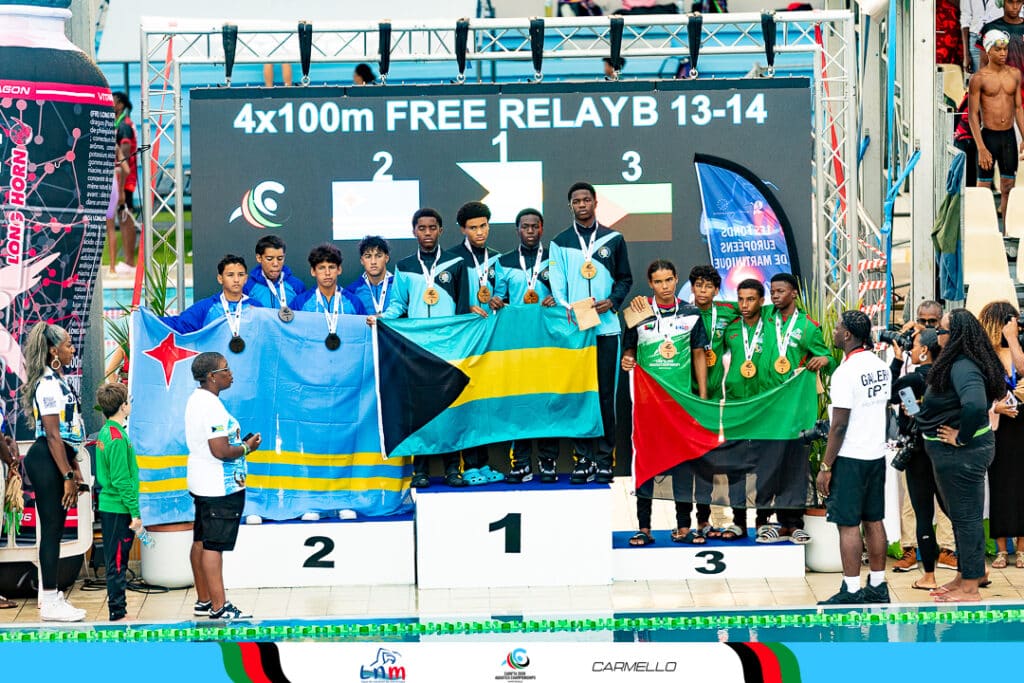
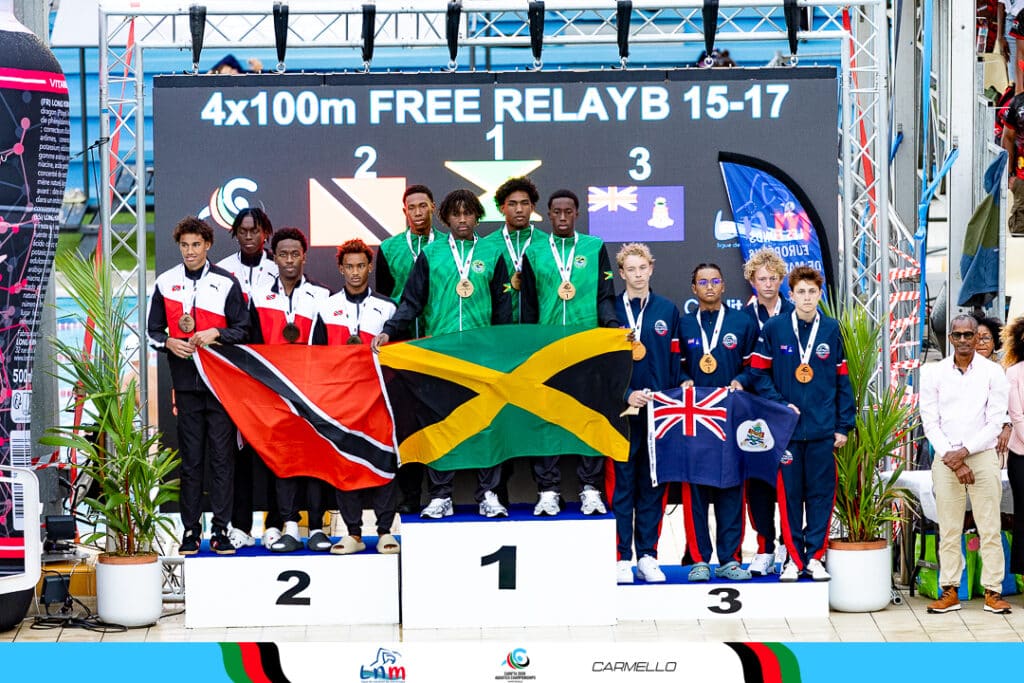
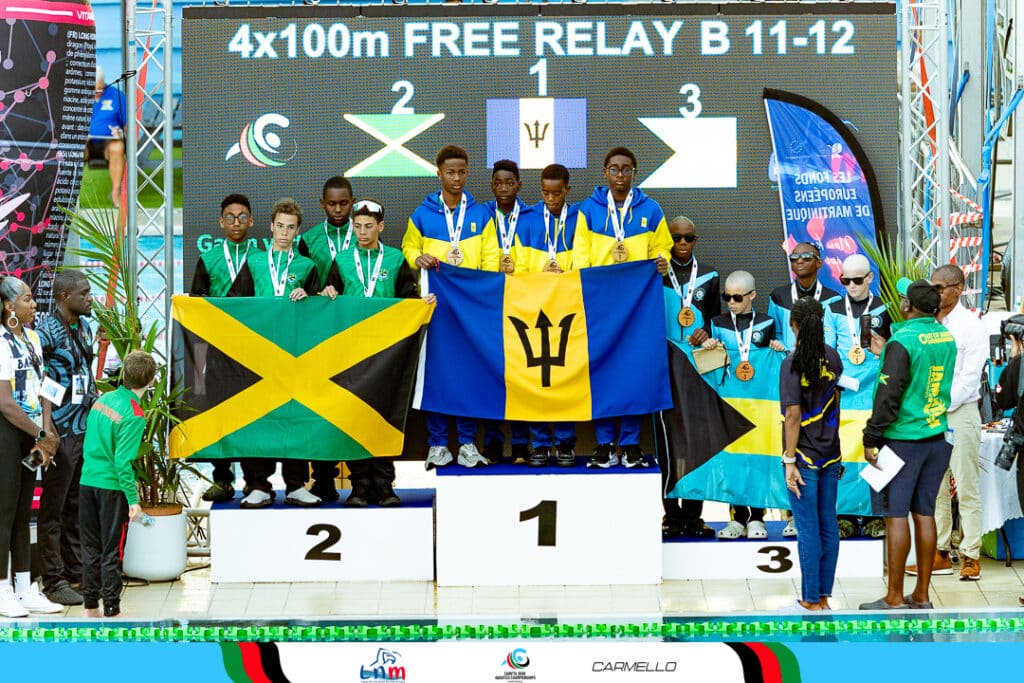
The relays also redistributed vital points on this second day. The Bahamas won the girls 11-12 4 x 100 m medley in 4:56.41 and the boys 13-14 4 x 100 m medley in 4:12.92. Barbados won the boys 11-12 age group in 4:44.41, Jamaica the girls 13-14 age group in 4:43.08, Bermuda the girls 15-17 age group in 4:33.17, while Trinidad & Tobago finished strongly with gold in the boys 15-17 age group. In such a tightly-packed championship, these relays are never secondary: they have a direct impact on the overall ranking.
Competition still wide open
On the evening of Sunday April 5, 2026, CARIFTA Aquatics 2026 remains wide open. The Bahamas have the advantage, Jamaica refuses to give in, Trinidad & Tobago is asserting itself, and Martinique remains firmly established in the top third of the standings. The competition continues in Fort-de-France until April 8, 2026, with artistic swimming starting on Monday April 6.
After two days, one thing is already clear: CARIFTA Aquatics 2026 is not just a succession of results. It’s also confirmation that Caribbean junior swimming relies on a structured, ambitious up-and-coming generation capable of raising the level of the championship race after race.
After two days of competition, the Bahamas occupy first place in the combined ranking with 386.5 points. Jamaica follows close behind with 375 points, while Trinidad & Tobago completes the provisional podium with 357 points.
CARIFTA Aquatics 2026 takes place from April 4 to 8, 2026 in Fort-de-France, Martinique. The first two days, April 4 and 5, have already revealed the first trends in the rankings.
A number of swimmers made their mark at the start of the competition, including Christon Joseph (Bahamas), Liam Carrington (Trinidad & Tobago) and Reagan Uszenski (US Virgin Islands), all of whom scored multiple individual victories.
Martinique is in sixth place in the combined ranking after two days, with 211.5 points. The local team relies on several podium finishes to remain competitive with the region’s big nations.
Relays play a key role in the overall standings, as they allow a significant number of points to be scored in a single race. On the second day, several nations consolidated their positions thanks to their collective performances.