Dushi, in Papiamento, can mean sweet, good, pleasant, tasty or darling. In the ABC islands of Aruba, Bonaire and Curaçao, this word circulates between the street, the kitchen, music and intimacy. It’s a Caribbean way of recognizing what feels good.
A word heard in everyday life
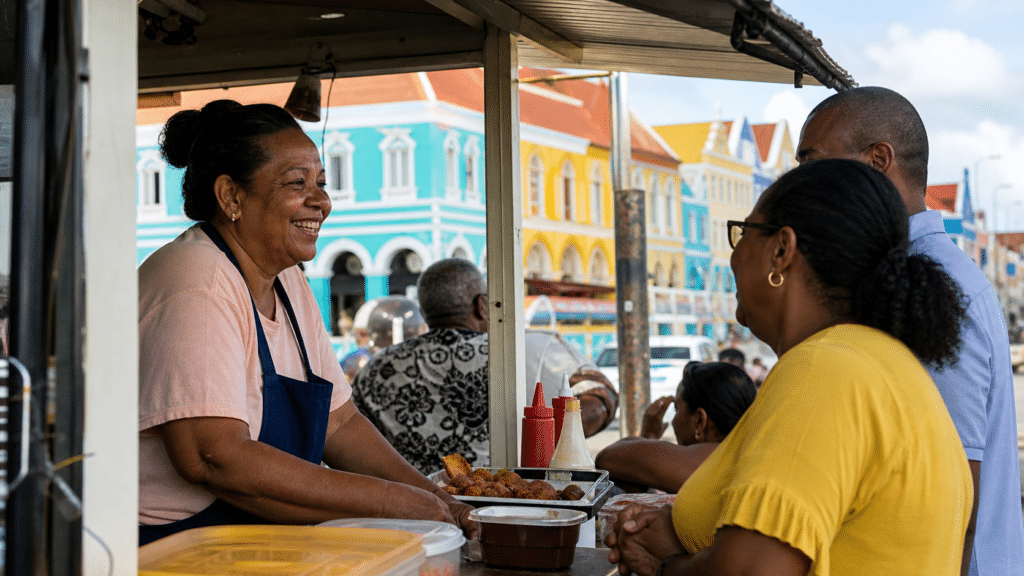
If you step off the plane in Aruba, Bonaire or Curaçao, you’ll soon hear it. On a sign, in a conversation, on a T-shirt, at a snack bar, at the market, in a song. A shop assistant may talk about a dushi cake. A mother may call her child dushi. A friend may say that an evening was dushi, not because it was spectacular, but because it left a good warmth in the memory.

Translation is not enough
Translation helps, but it’s never quite enough. Dushi comes close to “soft”, “sweet”, “good”, “delicious”, “lovable”, “darling”. Yet none of these words really covers all her territory. The same word can describe a beloved person, a successful dish, a pleasant moment, a familiar landscape or a way of being. Its strength lies precisely in this flexibility. The word doesn’t classify. It connects.
In everyday speech, the word doesn’t always have the same intensity. It can be tender, familial, greedy, friendly or simply positive. That’s why it’s important to understand it within the sentence, depending on the tone, the connection and the situation.
Papiamento or papiamentu: a language of passages
In the ABC islands, the language also carries this history of passages. We generally write Papiamento in Aruba, and Papiamentu in Curaçao and Bonaire. This spelling difference does not erase a common base. It is a reminder that the language was built in societies that were close, but never identical.
Linguists describe Papiamento as a Creole with an Ibero-Romance base, marked by Portuguese, Spanish and Dutch, with other contributions from Caribbean and Atlantic circulations. Its history began in Curaçao. The work of linguist Bart Jacobs places the emergence of Papiamentu in the second half of the 17th century, following the capture of Curaçao by the Dutch West India Company in 1634. The result is not a museum language. It’s a language of family, commerce, song, cooking and school.

Important official recognition
Papiamento’s institutional status also reflects its cultural significance. In Aruba, it has been recognized as an official language alongside Dutch since 2003. In Curaçao, Papiamentu is an official language alongside Dutch and English. On Bonaire, in the Caribbean Netherlands, Papiamento is also recognized in public life, notably in education, administrative dealings and the judicial system.
What the word says about the ABC islands
Dushi becomes more than just a pretty word. It condenses a way of talking about the world without separating the emotional from the concrete. A coffee can taste good. A person can be dear. A song can strike a chord. The word doesn’t have to choose between heart, body and palate.
Other islands have their own words of tenderness. In Martinique and Guadeloupe, “doudou” can refer to a loved one. In Caribbean English, “sweet” can mean pleasure, taste, enjoyment. But Dushi, in the ABC islands, retains a particular amplitude. It moves from sentiment to food, from person to place, from intimate detail to collective identity.


An intimate word becomes a collective symbol
In Aruba, this dimension is visible right down to the national anthem Aruba Dushi Tera, adopted with the flag on March 18, 1976. Here, the word is not just an affectionate adjective. It qualifies the land itself. It transforms the island into a beloved presence. That’s why we must avoid reducing the word to a tourist slogan. Before it was printed on objects, it was already circulating in people’s voices.
Perhaps that’s where its uniqueness lies. Dushi doesn’t try to impress. He recognizes what’s important: a simple meal, a special person, an island that’s sweetly named. And next week, RK Words changes horizons: heading for Trinidad, with “lime”, a verb that describes the Caribbean art of spending time together without a precise agenda.
Dushi can mean sweet, good, tasty, pleasant or cherished, depending on the context. In the ABC Islands, the word can refer to a loved one, a successful dish, a touching song or a pleasant moment.
Dushi is mainly used in Aruba, Bonaire and Curaçao, the three ABC islands. The word belongs to Papiamento or Papiamentu, a Creole language spoken in this Dutch-speaking part of the Caribbean.
Dushi is more than just a translation. It expresses an emotional relationship with daily life, food, people and land. In Aruba, it even appears in the national anthem Aruba Dushi Tera, where it describes the island as a beloved land.