
This year, the Caribbean Sustainable Tourism Awards 2026 spotlighted four of the region’s territories: Belize, Guyana, Jamaica and Turks and Caicos Islands. In San Pedro, Belize, the Caribbean Tourism Organization honored initiatives that give a concrete face to sustainable tourism in the Caribbean. Behind the trophies of the Caribbean Sustainable Tourism Awards 2026, the same question arises: what does tourism leave behind for the people, ecosystems and heritage it promotes?
In San Pedro, the Caribbean tourism industry faces up to its responsibilities
The awards ceremony was held during the CTO Sustainable Tourism Conference, organized in Belize with the Belize Ministry of Tourism, Youth, Sports & Diaspora Relations and the Belize Tourism Board. The event brought together regional leaders, industry players and international partners to discuss a topic that has become central to the Caribbean: building a tourism industry capable of creating value without weakening the territories.
This edition of the Caribbean Sustainable Tourism Awards 2026 not only rewards good practices. It draws a map of Caribbean responses to current challenges: protecting natural environments, supporting communities, preserving culture, better resisting climate shocks and moving towards tourism models that repair as much as they welcome.
Belize: Turneffe Flats, a complete model of sustainable tourism
The main prize, the Excellence in Sustainable Tourism Award, went to Turneffe Flats, Belize. The establishment was singled out for its comprehensive and measurable approach, combining environmental management, community involvement and innovation. This choice is symbolic. As well as hosting the conference, Belize is also one of the Caribbean territories where the relationship between tourism, the sea, reefs and local communities is particularly sensitive. In this context, Turneffe Flats represents a simple idea: a high-level tourism experience can also carry a long-term responsibility.
Guyana: Toka Village, when community isn't just a backdrop
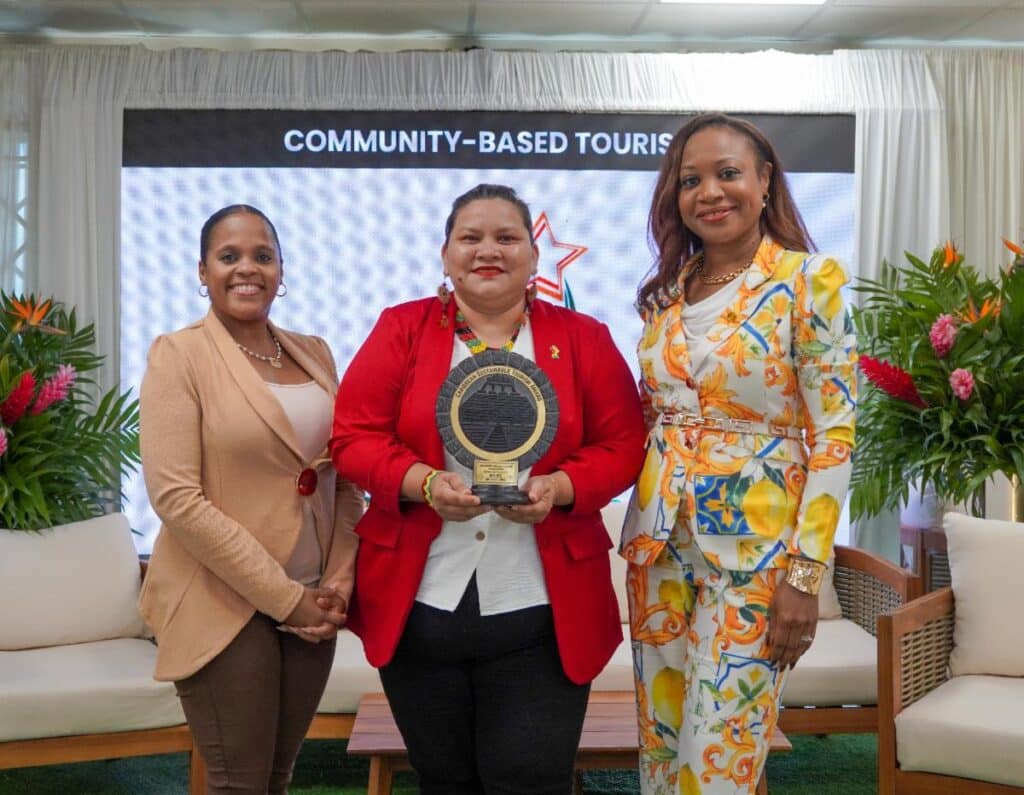
The Community-Based Tourism Award was presented to Guyana Inni Lodge – Toka Village. Here, the challenge is not just to welcome visitors. The model put forward places local residents at the heart of tourism development, with social and economic spin-offs for the community. This is one of the most important aspects of the Caribbean Sustainable Tourism Awards 2026. In a region often told through its beaches, landscapes and hotels, community tourism reminds us that the locals are not an afterthought. They are the custodians of the knowledge, stories and customs that give real depth to travel.
Jamaica: REDI II, resilience as a prerequisite for tourism
The Jamaica Social Investment Fund, through the REDI II program, received the Destination Stewardship and Resilience Award at the Caribbean Sustainable Tourism Awards 2026. The program is recognized for its contribution to tourism resilience and disaster risk management in tourism-dependent communities. This distinction speaks directly to the Caribbean. In territories exposed to hurricanes, flooding, coastal erosion and economic tensions, sustainable tourism can no longer be limited to reducing its impact. It must also help communities to anticipate, resist and recover. Jamaica is singled out here for an approach that links tourism, local safety and adaptability.

Turks and Caicos: regenerative tourism on the horizon
The Regenerative Tourism Award was presented to the Turks and Caicos Islands National Trust. The organization was commended for initiatives related to ecosystem restoration, cultural preservation and community engagement. The term “regenerative” marks an important evolution. It’s no longer just about limiting damage. It’s about producing positive effects: restoring environments, strengthening heritages, involving communities and making destinations stronger after the passage of visitors. In these islands, where landscapes and history are at the heart of appeal, this approach provides a clear direction.

Four prizes, one lesson
The Caribbean Sustainable Tourism Awards 2026 showcase a Caribbean that no longer wants to be measured by visitor numbers alone. The awards highlight what tourism builds, protects and transmits. And that’s where the added value of this news item lies: it’s less about a ceremony than a change of perspective. The CTO has also announced that the winners will be included in its database of best practices in sustainable and regenerative tourism. This pooling of best practices could help other regions to draw inspiration from already-recognized experiences. A key question remains: will these examples become admired exceptions or models capable of transforming Caribbean tourism more widely?
The Caribbean Sustainable Tourism Awards 2026 recognized initiatives from Belize, Guyana, Jamaica and Turks and Caicos Islands, at the conference held in San Pedro, Belize.
They promote tourism models that do more than just attract visitors. They also promote ecosystem protection, community involvement, resilience and heritage preservation.
Sustainable tourism aims to reduce the negative impacts of travel. Regenerative tourism goes further: it seeks to produce positive effects on natural environments, local communities and heritages.