Keshi yena, the cheese that turned leftovers into a source of pride for Curaçao

Keshi yena, plat national de Curaçao servi avec riz et bananes plantain

In Curaçao, keshi yena is a dish served on special occasions: a Gouda or Edam cheese that has been hollowed out and stuffed with meat, olives, and raisins. The very act of preparing this dish carries the memory of a colonial system in which items deemed worthless were discarded. What slave kitchens made of these leftovers continues to grace the island’s festive tables today.

A dish to make as a family

Many Curaçaoan families save keshi yena for Sunday meals or major celebrations, when the house is full of guests and they need a dish that can feed everyone. It takes time to prepare: you have to carefully hollow out a whole ball of cheese without piercing the rind, then fill it with a simmered meat stuffing before baking it in the oven until the cheese melts from the inside. This tradition, passed down from kitchen to kitchen, reveals a history far older than the recipe itself.

Keshi Yena, a Dutch cheese that has become a Curaçao specialty

In Papiamento, the Creole language of Curaçao, “keshi yena ” literally means “stuffed cheese.” The word “keshi” comes from the Dutch word “kaas,” which means “cheese.” This is no linguistic coincidence, Curaçao was long a trading post of the Dutch West India Company, and Gouda or Edam cheese—imported in round wheels from the Netherlands—was among the foods consumed by Dutch settlers on the island. The dish’s name bears a direct trace of this colonial trade, even before one considers what lies inside the wheel of cheese.

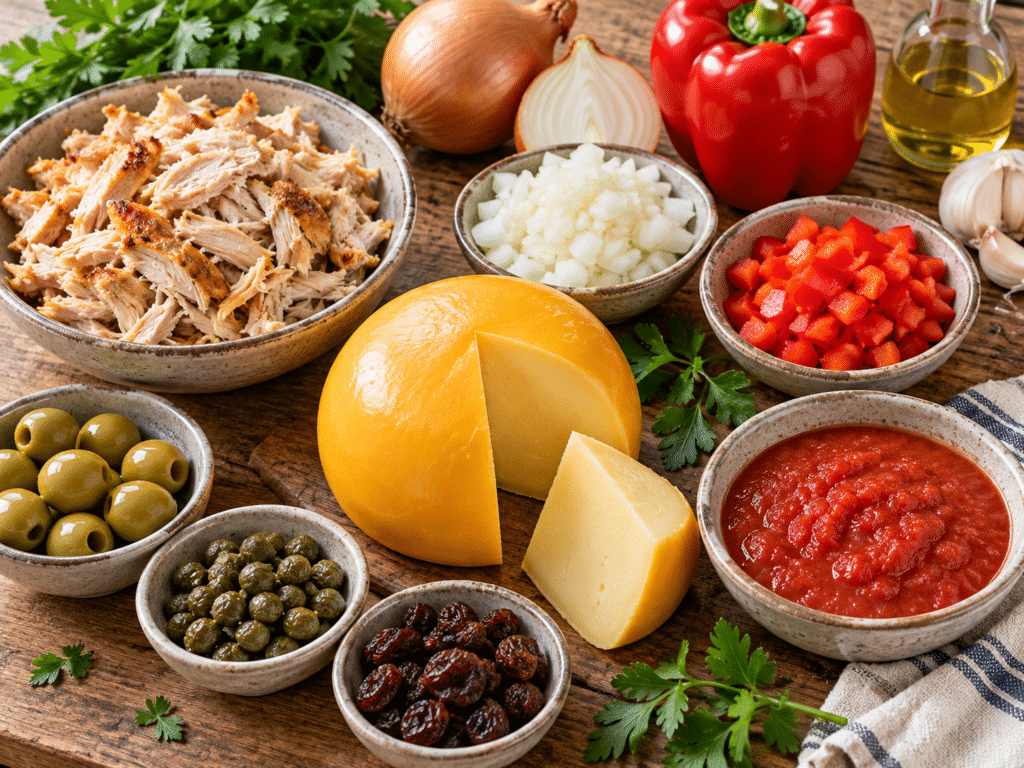
Ingrédients du keshi yena : fromage, viande, olives et raisins secs
Ingrédients traditionnels utilisés pour préparer le keshi yena, plat national de Curaçao : fromage, viande épicée, olives, câpres et raisins secs.
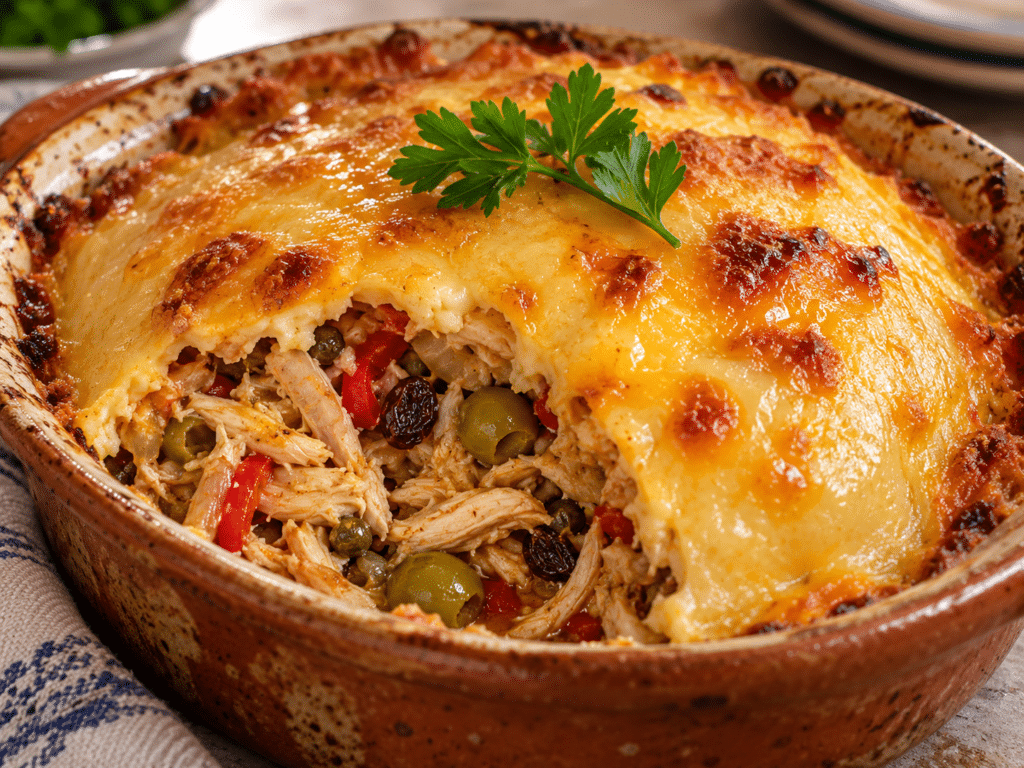
Keshi yena, fromage farci cuit au four, coupé pour révéler sa farce
Le keshi yena tout juste sorti du four, sa croûte fondante cédant sous la fourchette pour révéler la farce généreuse.

The story of an act born of compulsion

According to the story passed down in Curaçao, the keshi yena originated in the kitchens of the plantations, where enslaved people prepared meals for their colonial masters. Once the insides of the Gouda and Edam cheese wheels had been eaten, they left behind a shell of rind that the colonists considered worthless. According to this story, rather than throwing it away, the cooks filled it with leftover meat, vegetables, and spices from the table, then baked it again.

To date, no dated institutional source has made it possible to confirm exactly when this tradition began, but the story has been consistently passed down from one generation of Curaçaoans to the next, to the point that it shapes the way the island itself recounts the origins of this dish.

Curaçao, a hub of Dutch trade

This story takes on its full meaning when viewed within the context of the island’s history. Starting in the seventeenth century, Curaçao played a central role in the Atlantic trade organized by the Netherlands, including the trade in enslaved Africans, who passed through the island before being sent on to other colonies. Willemstad, the capital, still retains its mercantile architecture today, with its colorful facades inherited from Dutch trade.

Keshi yena emerged from this forced encounter between dairy products from Northern Europe and an African workforce that had asked for nothing to do with this trade, yet transformed what was once waste into a dish. Curaçao, already chronicled by Richès Karayib through the Tula revolt, still bears the traces of this Dutch colonial history today.

A dish that Curaçao shares with Aruba

Keshi yena isn’t limited to Curaçao. The neighboring island of Aruba, which shares a similar Dutch colonial history with Curaçao, also claims this stuffed cheese as its own national dish. Both islands follow the same basic recipe, with slight variations from household to household, and neither is willing to yield to the other. Rather than a rivalry, this shared tradition speaks to the Dutch-speaking region of the Caribbean—a common act of cultural appropriation, born out of a shared colonial context, adopted and claimed as their own identity by two distinct territories.

Keshi yena servi à l'assiette avec riz et accompagnements
Le keshi yena servi à l'assiette, avec du riz et des accompagnements, tel qu'on le retrouve sur les tables de fête à Curaçao et à Aruba.

From the Kitchen of Necessity to the Festive Table

Today’s keshi yena bears little resemblance to a dish born of necessity. Over time, the filling has become more elaborate, featuring simmered chicken or beef, raisins, olives, and sometimes prunes, creating a sweet-and-savory balance that sets the dish apart from any other meat pie in the region. Some cooks still bake it in a whole wheel of cheese, just as they did in the old days, while others, short on time, make do with a baking dish or ramekin lined with slices of cheese. The result is unmistakable: a flaky crust that crumbles under the fork to reveal a generous filling.

What the Keshi Yena Continues to Bring Together

Keshi yena no longer belongs to anyone in particular—neither to the colonists whose name it bears, nor to the cooks who invented it out of necessity. Today it belongs to the dining tables of Curaçao and Aruba, where it continues to bring families together around a tradition inherited in spite of itself. It remains to be seen how many Curaçaoan households continue to hollow out an entire melon rather than taking the shortcut of using a ramekin—and what that says about the way an island chooses to remember. Curaçao, already chronicled by Richès Karayib through The Career of Curaçaoan Artist David Paulus, continues to bring to life an identity that is expressed through both art and cuisine.

Keshi yena is a Gouda or Edam cheese that has been hollowed out and stuffed with stewed meat, olives, and raisins; it is considered a national dish in Curaçao and Aruba.

The name comes from Papiamento, the Creole language of Curaçao; “keshi” means “cheese,” borrowed from the Dutch word “kaas,” and “yena” means “stuffed.”

According to a story passed down in Curaçao, the dish originated in plantation kitchens, when enslaved people reused the cheese rinds discarded by Dutch colonists to fill them with leftover meat.

Leave a Reply

Your email address will not be published. Required fields are marked *

More articles from RK

Keshi yena, plat national de Curaçao servi avec riz et bananes plantain
CULINARY ART
Tolotra

Keshi yena, the cheese that turned leftovers into a source of pride for Curaçao

In Curaçao, keshi yena is a dish served on special occasions: a Gouda or Edam cheese that has been hollowed out and stuffed with meat, olives, and raisins. The very act of preparing this dish carries the memory of a colonial system in which items deemed worthless were discarded. What slave kitchens made of these leftovers continues to grace the island’s festive tables today. A dish to make as a family Many Curaçaoan families save keshi yena for Sunday meals or major celebrations, when the house is full of guests and they need a dish that can feed everyone. It takes time to prepare: you have to carefully hollow out a whole ball of cheese without piercing the rind, then fill it with a simmered meat stuffing before baking it in the oven until the cheese melts from the inside. This tradition, passed down from kitchen to kitchen, reveals a

Read More »
Joheirry Mola, institutrice dominicaine sacrée Miss Monde 2026, lors de son couronnement à Nha Trang, au Vietnam
NEWS
Tolotra

Joheirry Mola, the schoolteacher crowned Miss World after 44 years

In a classroom in the Distrito Nacional in Santo Domingo, she taught Spanish and social studies to elementary school students. On the stage in Nha Trang, Vietnam, Joheirry Mola was crowned Miss World 2026, bringing the crown back to the Dominican Republic 44 years after the country’s first victory, achieved by Mariasela Álvarez in 1982. This is the story of a teacher who made her classroom and a global pageant one and the same cause. Joheirry Mola, a schoolteacher from the National District Joheirry Mola Domínguez is 24 years old and comes from the Distrito Nacional, the institutional heart of Santo Domingo, which she had already represented in the national pageant that led her to Miss World. A graduate of the Ibero-American University (Unibe) with a degree in business administration, she teaches Spanish and social studies to elementary school students. She is also a correspondent for the show “Ventana a

Read More »
HISTORY & HERITAGE
Tolotra

“Dèyè mòn, gen mòn,” the proverb that inspired Paul Farmer

In Haiti’s Central Plateau, a mountain trail leads to Morne Michel, one of the most remote villages served by Zanmi Lasante, the health organization co-founded by American physician and anthropologist Paul Farmer. It is by taking this path, amid ridges that seem to go on forever, that writer Tracy Kidder comes to understand why an old Creole saying so aptly describes this place: “Dèyè mòn, gen mòn.” Behind the mountain, there is another mountain. Kidder would use this as the title of a book that would introduce Haiti to millions of readers around the world, far beyond the Caribbean. What does “Dèyè mòn, gen mòn” mean? “Dèyè mòn, gen mòn” literally translates to “beyond the mountains, more mountains.” The true meaning of the proverb goes beyond a simple geographical observation: in life, once one problem is overcome, another almost always arises. It’s a way of saying that life is a

Read More »

conTACT RK

we'd love to have your feedback on your experience so far

Join The List

Join our Richès Karayib community!  Sign up for our newsletter.

Want To Maximize Your Business Presence On Riches Karayib?

Complete the form to start the application