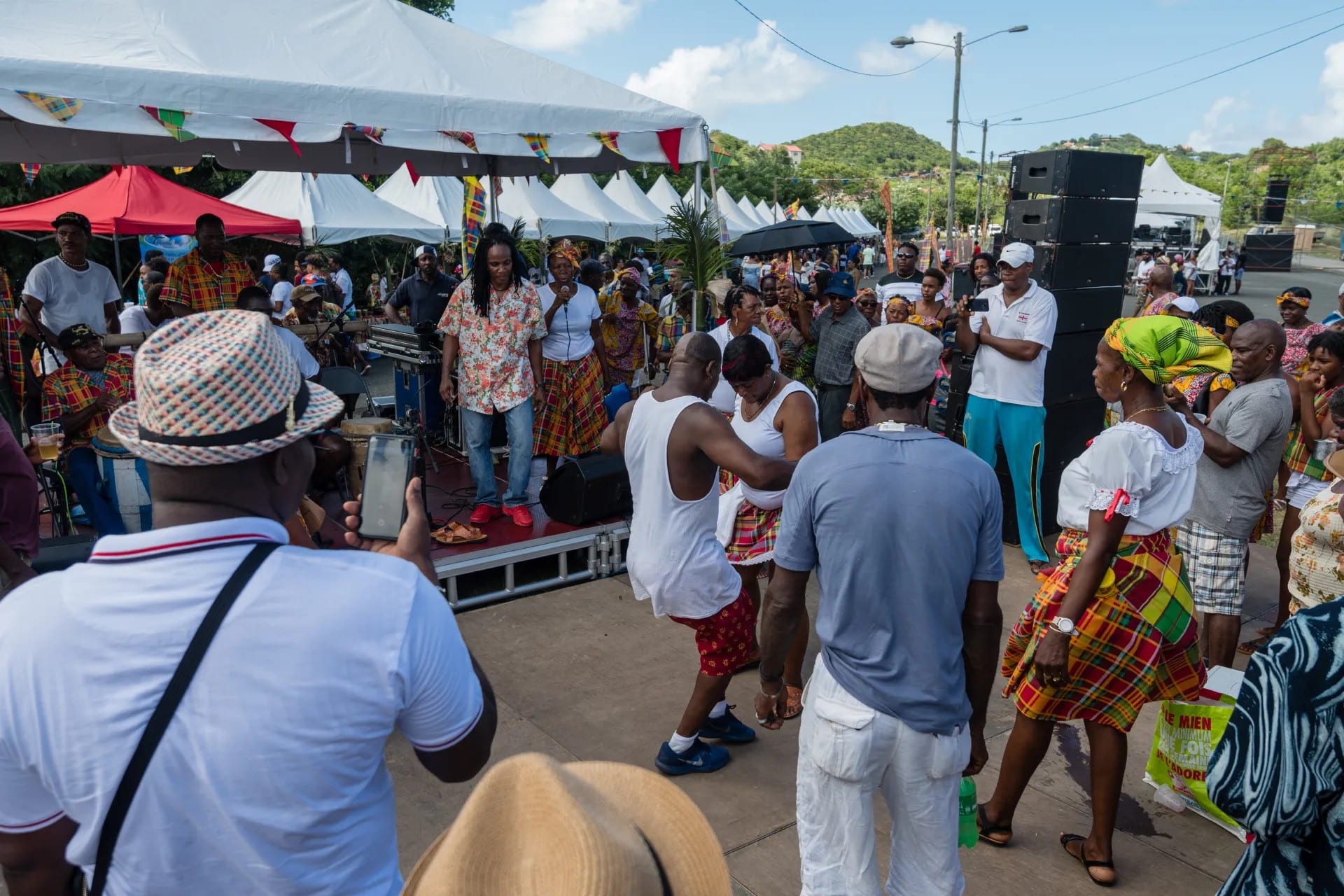
“Dera Gai” translates to “burying the rooster.” However, in Aruba on June 24, the live rooster has disappeared from the ritual. A gourd has taken its place, and it is this gourd that blindfolded participants try to strike, to the rhythm of a band. This Saint John’s Day celebration illustrates how an island preserves an ancient name while changing the ritual that accompanies it.
What does “Dera Gai” mean in Papiamento?
Papiamento is one of the official languages of Aruba and is also spoken in Curaçao and Bonaire. The expression “Dera Gai” literally means “to bury the rooster.” It is sometimes written as “Dera Gay,” a spelling that also appears in the island’s official cultural documents. The name describes the most spectacular part of the festival—the one that made it famous. It says nothing about the music, the dances, or the fireworks, which nevertheless make up the bulk of the day. Translating the title, therefore, is not enough to understand “Dera Gai.”

June 24 in Aruba, St. John's Day
“Dera Gai” takes place on June 24, the feast day of St. John the Baptist, known as “Dia di San Juan” in Papiamento. It is a harvest festival tied to the Christian calendar. Fires are lit all over the island, and the eve of the festival was traditionally marked by bonfires. Folk dance groups perform in colorful costumes. Women often wear yellow, the color of the kibrahacha, a local tree that blooms at this time of year. The dances are accompanied by the violin, guitar, wiri, and tambú.

This dual significance explains the ambiguity of the ritual. According to some interpretations, the sacrificed rooster symbolized the beheading of Saint John the Baptist. According to others, the ritual was an offering to the earth in preparation for the coming season. The “Dera Gai” incorporates both interpretations without ever settling on one.

From the buried rooster to the gourd: a ritual that has changed
According to descriptions of the ancient ritual, a live rooster was buried up to its neck. A blindfolded participant had three attempts to strike it with a stick. The action was violent, and each person interpreted it in their own way. Today, the live rooster no longer appears. A gourd has replaced the animal, and some folk groups use a plastic rooster to mimic the scene. The participant remains blindfolded, moves forward to the sound of the music, and strikes. The game remains, but the violence has disappeared.

Music plays a central role in this ceremony. A group of musicians performs a tune named after the ritual, the “Dera Gai,” while the participant searches for his target blindfolded. The ritual thus takes the form of a collective experience, in which the music is just as important as the action itself.

Origins That Are Still Debated
There is no consensus on the origin of “Dera Gai.” One theory points to Central America, where clergy are said to have replaced a pagan harvest festival with the feast of St. John. Others are undecided between a European origin and a Native American origin. Another interpretation links the rooster to Saint Peter, who denied Christ before the rooster crowed. This interpretation places the ritual on June 29 rather than June 24. All these theories remain hypotheses, and none allows us to say with certainty where the ritual comes from.
A "Dera Gai" unique to Aruba
St. John’s Day is celebrated on several islands in the Netherlands Antilles. “Dera Gai,” with its rooster, its name, and its music, is, however, associated with Aruba, with no exact documented equivalent elsewhere. It serves as a symbol of the island’s identity. It is often described as a reinvented tradition—that is, one that has been revived, transformed, and passed down by cultural groups from one generation to the next. This in no way diminishes its value. On the contrary, it shows that a ritual survives when it is open to change.

The name, however, has remained unchanged. It refers to “burying” in a ritual where nothing is actually buried anymore. This gap between the word and the thing makes the expression so evocative, because it preserves the memory of a gesture that the festival has left behind. On the next June 24, the calabash will once again be struck before an audience that has come to dance. But what are we really conveying when the central gesture disappears—the gesture itself, or what it used to mean?
Frequently Asked Questions
“Dera Gai” means “bury the rooster” in Papiamento. It is the name of a St. John’s Day festival celebrated in Aruba on June 24, whose ancient ritual involved striking a rooster that had been buried up to its neck.
No, the live rooster no longer appears in the current ritual. A gourd replaces the animal, and some folk groups use a plastic rooster to reenact the scene.
The origin of Dera Gai remains a matter of debate. Several theories exist, including a Central American origin, a European or Native American origin, or a connection to Saint Peter, but none has been definitively established.