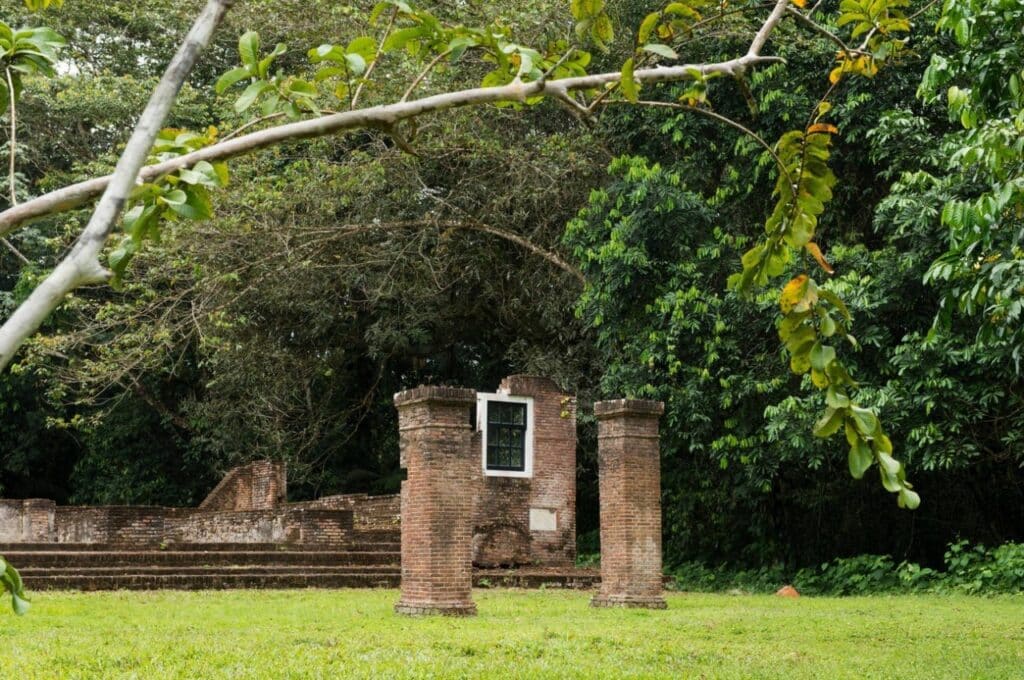
In Suriname, walls made of bricks imported from Europe rest beneath the trees along the banks of the Suriname River. This is Jodensavanne, a Jewish village that had 575 inhabitants around 1700 and judged its own members. Designated a UNESCO World Heritage Site in 2023, it also tells the stories of those less often discussed: enslaved people, Indigenous peoples, and prisoners of a 1942 camp.
In 1685, a synagogue built with bricks brought from Europe was inaugurated in the middle of the Surinamese forest. It is called Beraha VeSalom, “Blessing and Peace.” Its ruins are located in Jodensavanne, in the Para district, about 50 kilometers from Paramaribo. UNESCO describes it as the oldest synagogue of architectural significance in the Americas.
Jodensavanne, a Jewish village with unique privileges
It all began in the 1650s at Cassipora Creek, where Sephardic Jews founded their first community. In 1664, about 200 more arrived from Cayenne under the leadership of David Cohen Nassy. The following year, the English administration granted them religious freedom, a court, a school, and a militia. The Dutch would maintain these privileges. UNESCO refers to it as a “state within a state.”

In the 1680s, the inhabitants moved about two kilometers down the river and founded Jodensavanne. By 1700, 575 Jews were living there, in the heart of what UNESCO describes as the world’s largest Jewish agricultural region. Surrounding the village, more than 40 plantations produced mainly sugar.
This success was built on slavery. People of African descent who had been enslaved eventually came to make up as much as 90% of the population. The village was also located on Indigenous territory and was subject to attacks by maroons—people who had escaped slavery. In 1690, the revolt at Immanuel Machado’s plantation—where Machado was killed by enslaved people in revolt—prompted the governor to entrust the suppression of the uprising to the Jewish militia.
What the Graves of Jodensavanne Tell Us
Two Jewish cemeteries remain. At Cassipora Creek, 216 headstones date from 1666 to 1873. At Jodensavanne, 462 headstones date from 1685 to 1873, marking approximately 900 burials. Nearly half of the deceased had only a wooden marker, which has since disappeared. Most of the stones are believed to have come from Amsterdam and were engraved before the voyage.
The epitaphs are written in Hebrew, Portuguese, Spanish, Dutch, and Aramaic. Cassipora is home to two prism-shaped stelae, reserved for rabbis and community leaders. Other stones bear symbols, such as two hands with spread fingers for a Cohen, a descendant of the Temple priests, or a jug for a Levite. A short distance away, another cemetery had long been forgotten. Nengre Berpe has 135 graves marked by wooden markers. The oldest identifiable ones date from 1860, and the most recent from 1959. Archives indicate that the site was in use before 1794 by both free people and enslaved individuals.
1942: A camp is named after the village
Jodensavanne has a different, much more recent history. In 1942, nearly 150 men deported from the Dutch East Indies were interned in a camp named after the village. Only about half of them belonged to the Dutch Nazi party, the NSB. They remained there until July 1946. According to eyewitness accounts, the guards ordered them to tend to the Jewish graves and clear away the ruins of the synagogue, and even to dig up skeletons in search of jewelry.
Four prisoners refused. They escaped on November 4, 1942, and were recaptured. Two of them, L. K. A. Raedt van Oldenbarnevelt and L. A. J. Van Poelje, were shot without trial on the night of November 6–7 at Fort Zeelandia in Paramaribo. The 1949 investigation found that their hands had been handcuffed behind their backs.
A UNESCO Site Worth Protecting
Jewish privileges were abolished by order of the Crown on April 2, 1825. A fire ravaged the village in 1832. The last service was held in 1865. The synagogue’s roof collapsed in 1873, and the forest reclaimed the site. In September 2023, UNESCO inscribed the site on the World Heritage List under criterion (iii). Today, the Jodensavanne Foundation, established in 1971, manages the site in partnership with the nearby Indigenous village of Redi Doti, under an agreement signed in 2008. Ten percent of ticket sales go to a local foundation.
The work is not yet complete. In 2025, the World Heritage Committee noted that the planned protected forest area could not be established because the land is not owned by the state. It also calls for research into how Jews and people of African descent lived together in Jodensavanne. What will this research reveal, and who will step forward to lead it?
Frequently Asked Questions About Jodensavanne
Jodensavanne is located in Suriname, in the Para District, on the banks of the Suriname River, about 50 kilometers from Paramaribo. The site includes the ruins of the Beraha VeSalom synagogue, which was inaugurated in 1685, and several cemeteries.
Because it bears witness to a Jewish community that enjoyed extensive privileges from the 17th to the 19th century within a slave-owning society. The World Heritage Committee inscribed it in September 2023 under criterion (iii), along with the Cassipora Creek Cemetery.
Nearly 150 men deported from the Dutch East Indies were interned there from 1942 to July 1946. Only about half of them were members of the NSB. Two prisoners were shot without trial at Fort Zeelandia in November 1942.