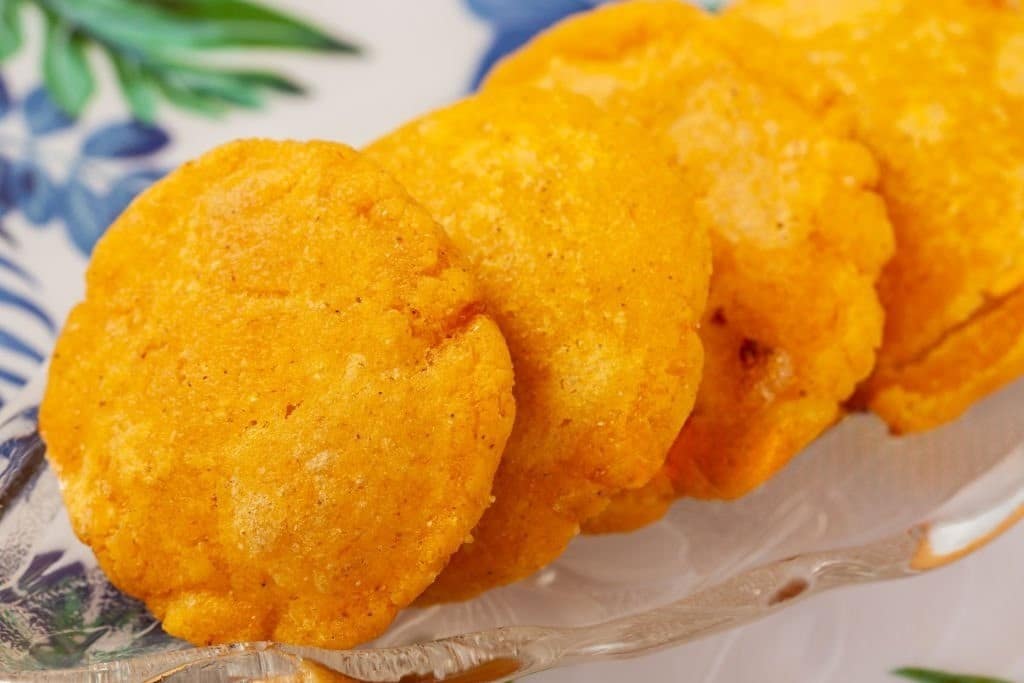
Golden on the outside, soft on the inside, the arepa de huevo hides a whole egg inside a fried corn flatbread. This specialty from Colombia’s Caribbean coast has found a special place in Luruaco: that of an everyday dish that has become a local tradition, a popular celebration, and part of the cultural heritage.
At first glance, it looks like a corn flatbread. But when you cut into it, you’ll find an egg that has cooked inside. That’s what makes the arepa de huevo so special—a dish whose success depends on a precise technique: letting the dough puff up in oil, gently opening it, and then frying it again after slipping an egg inside. In Luruaco, in Colombia’s Atlántico department, this technique has been passed down for generations. Served hot, it combines a crispy exterior, a tender interior, and a whole egg nestled in the center.
A specialty of Colombia's Caribbean coast
The arepa de huevo isn’t exclusive to Luruaco. It’s part of a broader culinary tradition found, in particular, in Cartagena and other areas along Colombia’s Caribbean coast. In Cartagena, it’s also known as an empanada con huevo. The name may vary, but the concept remains the same: a fried corn-based wrapper enclosing an egg.
Its exact origin is unknown. Several stories circulate about how this dish came to be in Luruaco. Some mention Pabla Melgarejo, while others cite a tradition that came from Cartagena. These accounts are part of local lore, but they do not allow us to attribute the invention of the dish to a single person. What makes Luruaco unique lies elsewhere: in the place this arepa has gradually come to occupy in the life of the community.
Why has Luruaco become the go-to place for arepa de huevo?
One road has contributed to its reputation: La Cordialidad, the highway that connects Barranquilla in Cartagena, brought a steady flow of travelers. Nearby, particularly in the area of Cuatro Esquinas, vendors offered fried foods prepared on the spot. The arepa de huevo could be eaten quickly during a stop before continuing the journey. Gradually, the specialty spread beyond family circles: sold by the roadside and prepared in homes, it became associated with the name Luruaco. This success does not prove that the recipe originated there. It does, however, explain why the town has become one of its most famous locations.
How do you make an arepa de huevo?
The traditional recipe calls for yellow corn, water, salt, oil, and eggs. The corn is cooked, ground, and then kneaded into a soft dough. A small portion is flattened into a disc and dropped into hot oil. During this initial frying, the flatbread puffs up and forms a pocket. This puffing is essential: if the flatbread stayed flat, it would be impossible to insert the egg without risking tearing it.

What follows requires skill. The cook removes the arepa, cuts a slit in the side, and slides a raw egg inside without tearing the dough. She seals the slit—sometimes with a bit of dough—and then returns the arepa to the oil. This second frying cooks the egg and gives the outside its golden color. Other versions may include meat or shrimp. But to understand the dish, the egg version best illustrates this particular technique: a flatbread that must first be puffed up before it can be filled.

A dish passed down through the generations and celebrated
In Luruaco, making arepa de huevo is also a matter of passing down family traditions. Cooks, often called matronas, learned the techniques from their elders before passing them on themselves. The sale of these flatbreads has also provided a source of income for families in the town. Since 1988, a festival has been dedicated to this specialty. Its 37th edition, held in June 2026, brought together 70 cooks and resulted in the sale of 52,000 arepas, according to the report released after the event. In 2013, the Luruaco tradition was recognized as part of the intangible cultural heritage of the Atlántico department; a preservation plan was subsequently approved in 2016.
The arepa de huevo, then, doesn’t need to be presented as a Luruaco invention to have a unique history. What matters is what the community has made of it: a distinctive dish, a craft that has been preserved, and a tradition that new generations can still keep alive.
Frequently asked questions
The arepa de huevo is a traditional specialty of Colombia’s Caribbean coast, also found in Cartagena and Luruaco. Its exact origin is unknown. Luruaco is particularly well known for its expertise and tradition of selling this flatbread.
Shape the yellow corn dough into a flat cake, then fry it until it puffs up. Next, cut it open to add a raw egg, close it up, and fry it a second time until the egg is cooked.
Its roadside sales at La Cordialidad, its transmission by local cooks, and its festival—founded in 1988—have deeply linked it to the town. The local tradition has been recognized as part of the cultural heritage of Atlántico Department.