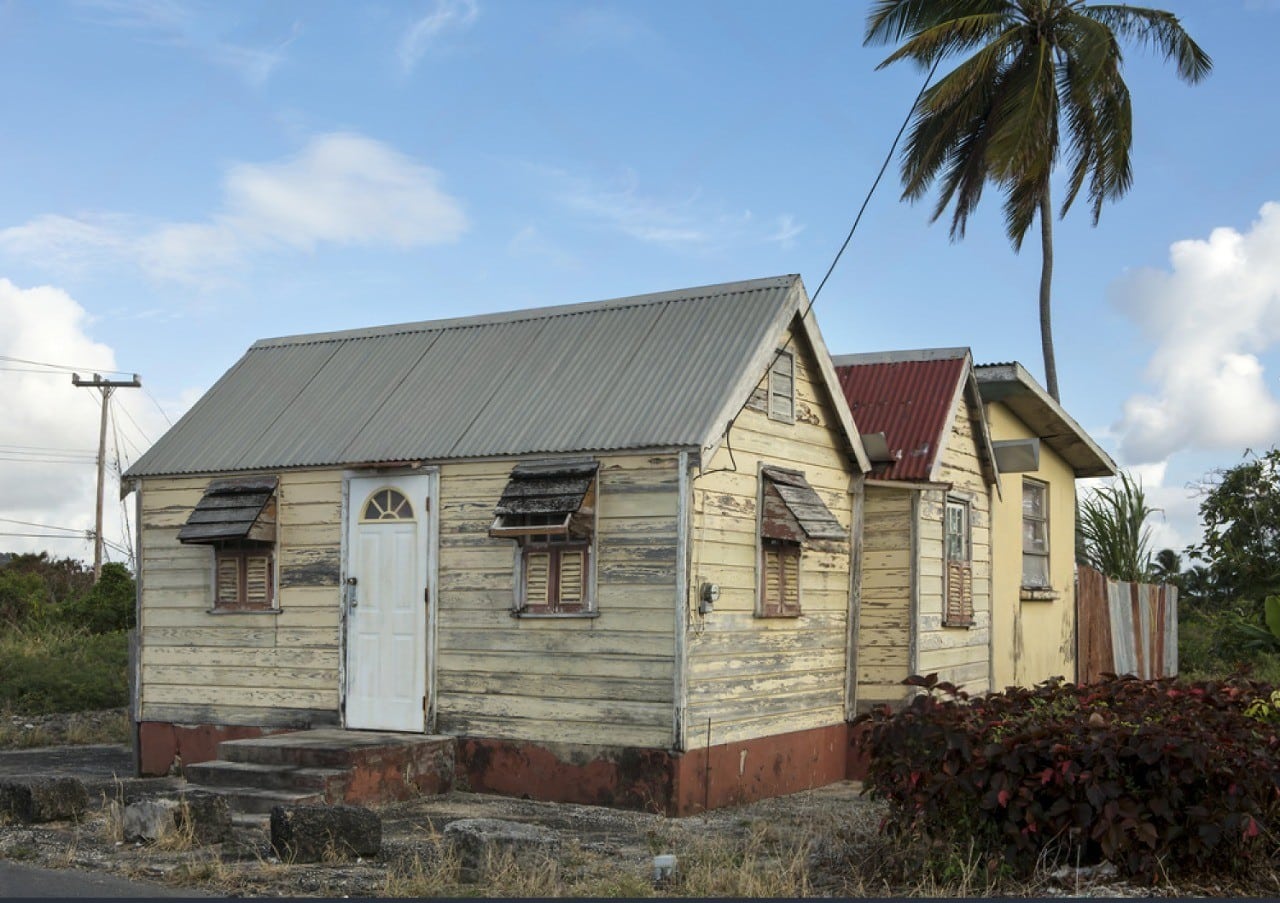

At first glance, they catch the eye with their wooden facades, their colors, and their simple proportions. Yet Barbados’ chattel houses are not merely an architectural signature. Their form reflects a specific social reality: for a long time, some residents could own their homes without owning the land on which they stood. A chattel house therefore had to be movable.
Chattel House: A Home Designed for Traveling
To understand this unique aspect, we must look back to the post-emancipation period. In Barbados, the emancipation of enslaved people was completed in 1838. However, the island’s land structure remained deeply shaped by the sugar economy. As early as the 17th century, the expansion of sugarcane cultivation had led to the concentration of land in the hands of large plantations.
After emancipation, many workers still lived on land belonging to the plantations. They could build a home and own it, without owning the plot of land itself. If the land had to be vacated, the house had to be able to move with them. It is this situation that gives this type of dwelling its full meaning. In English, “chattel” refers to movable property—a possession that can be moved. These wooden houses were therefore designed to be dismantled, transported, and then reassembled elsewhere. The house belonged to them. The land, not necessarily.
Architecture Closely Tied to Lifestyle
This mobility was no minor detail. It determined how the houses were built. Chattel houses were wooden structures set on blocks rather than permanently anchored to the ground. This system made it possible to move the dwelling when a change in land conditions required it. The house could also evolve along with the household. Early models might have been relatively simple, but new sections could be added as the family grew or as their financial means increased. The dwelling was therefore not necessarily designed as a permanent structure: it could expand along with its occupants.
This construction method partly explains the appearance we associate today with the Chattel House. But above all, it reminds us of one thing: its form was a response to very practical constraints. Behind the wood and decorative elements lay a way of coping with limited access to the ground.
Owning a home without owning the land
Owning one’s own home could provide a form of material autonomy. But this ownership had an obvious limitation: while the dwelling belonged to its occupant, the land could remain in the hands of a landowner or a plantation. This distinction between the house and the land provides a better understanding of post-emancipation Barbados. The end of slavery changed people’s status, but the land structures inherited from the plantation economy did not disappear with it.
The Chattel House embodies this contradiction even in its construction: sturdy enough to serve as a home, yet mobile enough not to be permanently tied to a specific plot of land. In other words, the house’s mobility reveals the persistence of a problem that is far less mobile: that of access to land.
This is what gives these dwellings a significance that goes far beyond their aesthetics. What we now view as a recognizable architectural style is also the physical manifestation of a specific social organization.
When the Chattel House Becomes a Historic Landmark
Over time, these houses have become a distinctive feature of Barbados’ architectural heritage. In Tyrol Cot, in the parish of St. Michael, a heritage village dedicated to chattel houses was established as these structures were rapidly disappearing from the landscape in the 1980s and 1990s. It features replicas of seven houses selected for their architectural characteristics, as well as a house from the 1920s that has been converted into a museum.
The reversal is striking: a home designed to be left behind is now preserved precisely because people no longer want to see it disappear. But preserving one of these houses solely for its charm or its colors would be like preserving only the facade of its history. For behind these structures lie issues of ownership, labor, and access to land. They also show how families adapted their living spaces to a situation they did not fully control.
What These Houses Still Tell Us
Today, Chattel House offers a new perspective on Barbados’s landscape. Its value lies not only in the wood, the proportions, or the ornamentation. Above all, it stems from what its architecture still allows us to understand: a family could own, expand, and live in a house while still having to keep it ready to be removed from the land on which it stood.
Perhaps that is where the true power of this architecture lies: a house once intended to be moved has become a fixture in Barbados’ collective memory. And when we protect a Chattel house, what are we really trying to preserve: an architectural style or the social history embedded in its walls?
A Chattel house is a traditional wooden house from Barbados, historically designed to be dismantled and moved. It belonged to its occupant, even when the land on which it stood did not belong to him or her.
After emancipation, many workers lived on land they did not own. The Chattel house was therefore built in such a way that it could be moved if the family had to leave the plot.
The Chattel House tells a story that goes far beyond architecture. It bears witness to people’s relationships with the land, work, and property in post-emancipation Barbados. Today, it has become a recognizable part of Barbados’ architectural heritage.