A few meters below the surface, silhouettes slowly come into view. Children are holding hands. A man sits at his typewriter. In Grenada, art doesn’t just occupy the seabed—it transforms along with it. Further on, carnival figures seem to be moving through the water. Visitors don’t just discover submerged sculptures; they enter a landscape that currents, corals, and time continue to shape.
In 2006, artist Jason deCaires Taylor installed what would come to be widely recognized as the world’s first underwater sculpture park in Molinere Bay. Now located within the Molinere-Beauséjour Marine Protected Area, the site lies at a depth of between five and eight meters. It can therefore be viewed while scuba diving, snorkeling, or from a glass-bottom boat. Nearly twenty years later, the artist sums up the project’s origins in a single sentence: “Grenada is the seed that started it all.”
A museum that the sea is constantly reshaping
In a traditional museum, works of art are protected from moisture, salt, and the passage of time. Here, everything works the other way around. The sculptures were designed to support marine life. The pH-neutral cement and stainless steel provide a surface on which organisms can gradually attach themselves.
In Grenada, a work of art is therefore never completely finished. Seaweed alters its colors. Sponges cover certain shapes. Fish swim among the figures. The waves, currents, and light constantly change the way the whole piece is perceived. The museum becomes an artificial reef, but also a collective creation in which the ocean acts as a second sculptor.
The idea was born in a vulnerable area. Molinere Bay had suffered significant damage during Hurricane Ivan in 2004. The installation of artificial structures provided new habitats for marine life. The park also attracts some divers and swimmers, which helps reduce visitor traffic to certain nearby natural reefs that are more vulnerable.


Faces That Tell the Story of Grenada
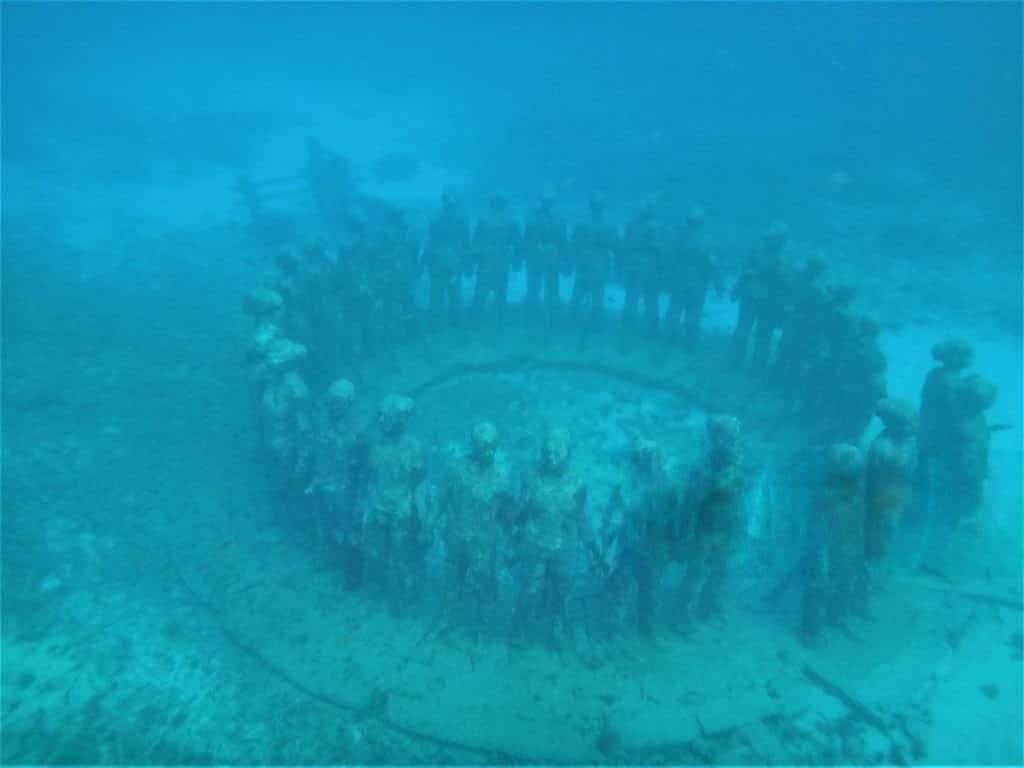
The park isn’t just about the environment. It also tells stories, showcases people, and highlights aspects directly linked to the region. One of his best-known works, *Vicissitudes*, depicts twenty-six children standing in a circle and holding hands. Set about five meters deep, their bodies blend into their surroundings, symbolizing adaptation and the cycle of life. Other works incorporate fragments of memory. The Lost Correspondent shows a man sitting in front of a typewriter, surrounded by articles that evoke a period in Grenadian history. Enlarged reproductions of petroglyphs, meanwhile, serve as a reminder of the traces left by the island’s earliest inhabitants.

This cultural aspect grew even stronger in 2023. The park welcomed The Coral Carnival, a series inspired by Spicemas, the carnival in Grenada. Created in collaboration with local artists, twenty-five sculptures depict several iconic figures from the masquerades, including the Jab Jab, the Short Knee, and the Vieux Corps. For the first time in Taylor’s underwater work, natural pigments were used to add color to the figures.


From Carnival to the Living Reef
Underwater, however, these costumes will not remain the same. Their appearance will change as marine organisms colonize them. This is precisely what gives the project its power. Local culture is not confined to a static image. It interacts with a living environment. The carnival characters mingle with the fish, while marine textures gradually replace the colors applied by the artists.
In this way, Grenade tells the story of its region without separating art, history, and the sea. The park is at once an attraction, an educational space, and a work of art in constant transformation. It also serves as a reminder that a destination can make a name for itself in ways other than by building more and more structures along its coastline.
Since 2006, the Molinere Museum has not sought to resist the passage of time. On the contrary, it makes room for time within its creative process. Each new layer of coral alters its silhouette. Every fish that takes shelter there adds an unexpected movement. What if Grenada’s greatest uniqueness were precisely that it has created a museum where no two visits can ever be exactly the same?


The Grenada Underwater Museum is located in Molinere Bay, within the Molinere-Beauséjour Marine Protected Area, on the island’s west coast.
Established in 2006, it is widely recognized as the world’s first underwater sculpture park. The sculptures gradually evolve as they come into contact with corals, seaweed, and marine life.
The site can be explored while scuba diving, snorkeling, or from certain glass-bottom boats. The sculptures are located at a shallow depth.