
Jazz an ba Tol’: “La Wond’ des Bassistes”, 2nd edition at Jardin de Monique

Jazz an ba Tol’

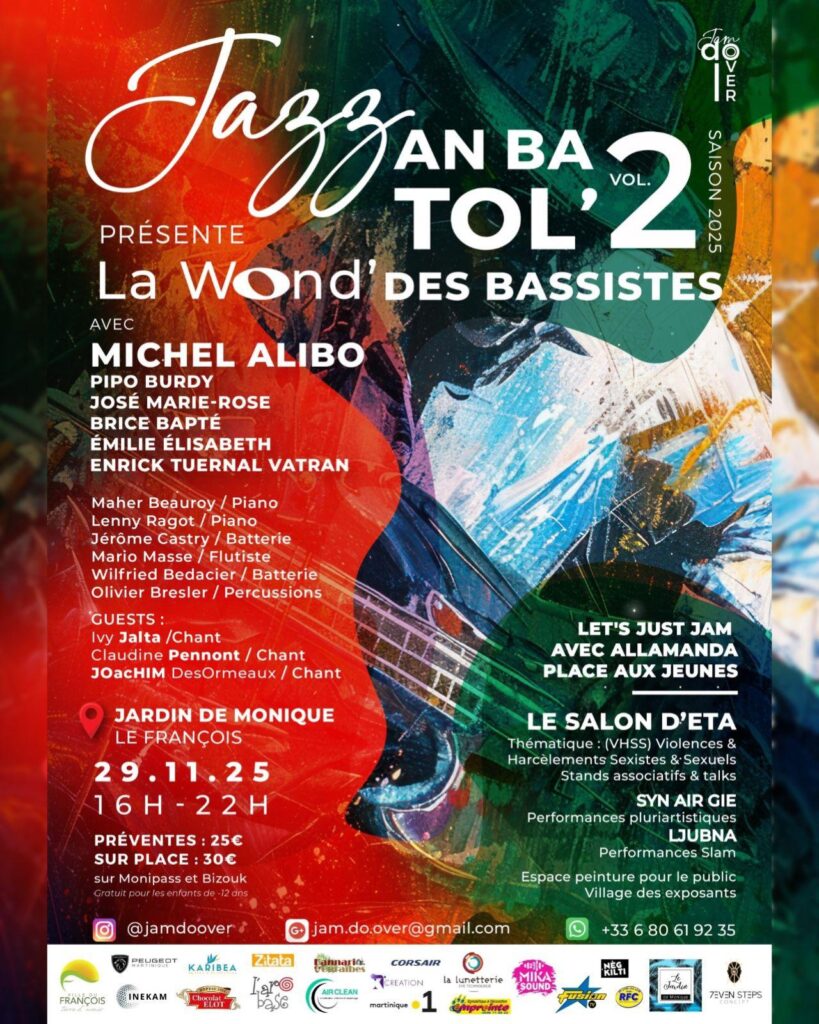
On Saturday, November 29, 2025, Jardin de Monique in Le François played host to the 2ᵉ edition of Jazz an ba Tol’, focusing on “La Wond’ des Bassistes”. The venue was packed throughout the afternoon, with families, young musicians, music scene regulars and residents of the François area coming to see the energy the event brings to the area. The event remained on the same course as the rest of the season: combining music, transmission and commitment to sexual and gender-based violence and harassment (SGBV).

Music, flavors and shared moments

From the outset, the atmosphere blended naturally into the garden setting. As is often the case at Jazz an ba Tol’, people moved between the stage, the dance areas, the live arts stands and the food courts. The music ranged from Afro-Caribbean jazz to improvisations and revisited covers.

Stalls offered crêpes, paninis, pâtés… but it was the fish soup that really stood out. Many people crossed the garden with bowl in hand, explaining that it “tore everything apart”, a culinary detail that also contributed to the singularity of the event.

The event remained multidisciplinary: contemporary dance, collective fresco, body painting, slam performances, exchanges with the associations present. The jam opened the stage to those who wanted to try, share and learn, in keeping with the Jazz an ba Tol’ philosophy.

Jazz an ba Tol’
Jazz an ba Tol’
Jazz an ba Tol’

La Wond' des Bassistes: a tribute to the depth of rhythm

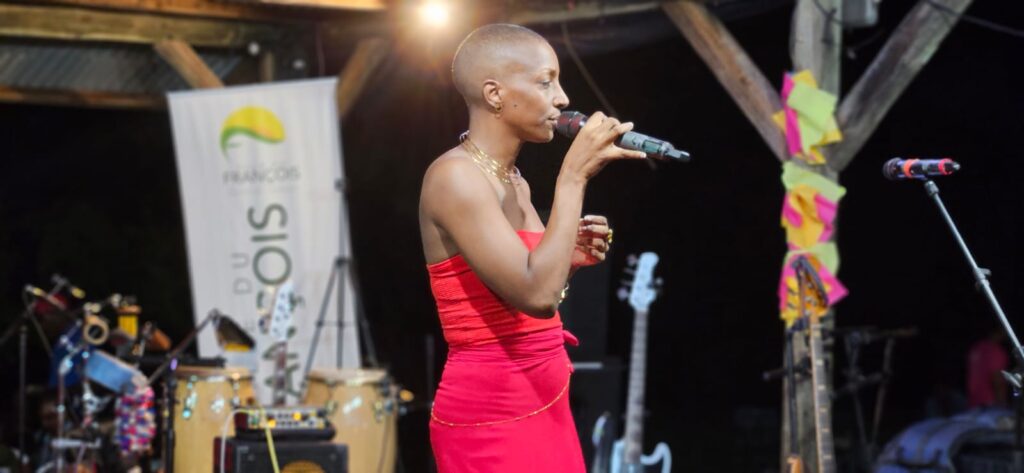
The main stage was home to the featured bassists: Michel Alibo, Pipo Burdy, José Marie-Rose, Brice Bapté, Emilie Elisabeth and Enrick Tuernal Vatran. Alongside them, the resident musicians formed a solid base, and the voices of Ivy Jalta, Claudine Pennont and Joachim DesOrmeaux gave the evening a resonance deeply rooted in Caribbean heritage. The bass was no longer a shadow instrument: it became the heart of a musical narrative carried by the event.

Jazz an ba Tol’
Jazz an ba Tol’
Jazz an ba Tol’

Michel Alibo: a career shaped by the world and focused on transmission

A bassist from Martinique with an international career, Michel Alibo talked about his roots, his travels and his demanding relationship with musical sincerity. He evoked freedom, improvisation and the refusal to play for mere convenience. At Jardin de Monique, his presence reflected a strong desire for transmission, particularly visible during exchanges with the young musicians of Allamanda. In this 2ᵉ edition of Jazz an ba Tol’, his role went beyond simple performance: he built a framework where others could take risks, explore, open up their playing.

Jazz an ba Tol’

Allamanda: five young artists, five points of view

Jazz an ba Tol’

Emilie Elisabeth – a message to women

Emilie, bassist-guitarist with Allamanda and member of La Wond’ des Bassistes, stressed the importance of women finding an artistic practice that helps them to blossom and free themselves from the tensions of everyday life. Her message rang true in the context of this edition, where Jazz an ba Tol’ was working to create spaces of expression and recognition for all generations.

Sarah Sabin – versatility as freedom

At 18, Sarah was alternating between piano and bass. She saw the Jardin de Monique stage as a concrete learning space: testing, finding one’s place, listening to others, confronting a real audience. Her words reflected a generation moving forward with several musical tools at once, perfectly in tune with the open-minded spirit of Jazz an ba Tol’.

Jazz an ba Tol’

Lisa Manikon – an open vision of music

Lisa Manikon, Allamanda’s lead vocalist, emphasized the group’s spirit: a band under construction, refusing to accept musical boundaries.

His vision emphasized research, audacity and the desire to create a space where the five artists can assert their own sound, a spirit very much in tune with what Jazz an ba Tol’ stands for.

Jazz an ba Tol’
Jazz an ba Tol’

Jade Francisque – musical continuity between islands

Jade Francisque, also lead vocalist with Allamanda, emphasized the musical relationship between Martinique and Guadeloupe, citing Soft as a natural reference.

She spoke of a Caribbean dialogue, of the pleasure of playing “the music of our homeland” while bringing a modernity to it.

His perspective was in line with the idea of a wider musical territory, dear to Jazz an ba Tol’.

Oriane Pamphile – asserting the place of young musicians

Oriane Pamphile, percussionist and drummer with Allamanda, saw this stage as an essential springboard.

She explained that the group has only been in existence for a year, and that this performance, only their second, reinforced their desire to move forward: to progress, to show themselves, to fully exist in the Caribbean music scene.

She made one thing clear: young girls are not just singers: they are musicians.


For her, playing on this stage, alongside experienced bassists and committed artists, was a way of asserting the presence of women in instrumental practices that are still all too often invisible.

Jazz an ba Tol’
Jazz an ba Tol’
Jazz an ba Tol’

Salon de Eta and VHSS: when culture opens the floor

The Salon de Eta brought together associations, speakers and the general public to discuss VHSS, with a “talks” area, discussions, workshops and performances. Plastic arts, dance and a collective fresco were used to tackle the subject in a different, less heavy-handed way, in a dynamic of citizen participation. This approach was in line with Jazz an ba Tol”s overall project: to inform, raise awareness and bring people together, while leaving plenty of room for emotion.

https://www.youtube.com/watch?v=yZfSk2utkas
Jazz an ba Tol’
Jazz an ba Tol’
Jazz an ba Tol’

An edition that confirms the project's identity

This 2ᵉ edition showed what makes Jazz an ba Tol’ so strong: putting the spotlight on established musicians like Michel Alibo, offering a place to a new generation of artists, women and men, anchoring the event in a lively venue like Monique’s Garden and tackling a social issue through artistic creation.

On November 29, 2025, the bass told the story of Martinique in a different way: through transmission, dialogue and those moments when a garden becomes, for the space of an evening, musical and human territory.

FAQ

Jazz an ba Tol’ is a cultural event in Martinique that highlights musical creation, artistic transmission and multidisciplinary expression. Each edition showcases local and international artists while tackling a societal theme, such as sexual and gender-based violence and harassment (SGBV) in 2025.

La Wond’ des Bassistes brought together a number of Caribbean bassists, including Michel Alibo, Pipo Burdy, José Marie-Rose, Brice Bapté, Emilie Elisabeth and Enrick Tuernal Vatran. The stage was also buoyed by a solid resident band and the young female musicians of the Allamanda group, who made their mark on this 2ᵉ edition.

In addition to the music, the event features a village of exhibitors, dance performances, body painting, a collective fresco, discussion forums and a Salon de Eta dedicated to raising awareness. Jazz an ba Tol’ combines artistic creation and civic reflection, in a setting open to all.

Leave a Reply

Your email address will not be published. Required fields are marked *

More articles from RK

Affiche officielle du documentaire Women of Dominica
FILM & VIDEO
Tolotra

Dominique – Women of Dominica: The documentary that brings together ten women ahead of its premiere in Miami

“Women of Dominica” brings together ten women from different generations around a shared narrative: the Creole heritage of Dominica. The documentary, directed by environmental scientist-turned-filmmaker Farrah La Ronde-Hutchison, will have its U.S. premiere on September 5 in Miami, ahead of a wider release scheduled for 2027. Among the voices featured is that of Ophelia Marie, a historic figure in Dominican music. A story of passing down traditions, between a mother and her daughter The Women of Dominica project has its roots in a family story. In 2019, Farrah La Ronde-Hutchison’s mother received the Golden Drum, a Dominican award dedicated to the preservation of traditional Creole attire. She had carried this responsibility for more than thirty-five years, passing down to her daughter the techniques and fabrics of a garment that few in younger generations still know how to tie today. It was this tradition passed down from mother to daughter that

Read More »
Femme jamaïcaine sur une véranda au crépuscule face à un duppy dans la cour
HISTORY & HERITAGE
Tolotra

“Duppy know who fi frighten”—why does this proverb protect the weak?

“Duppy know who fi frighten”: this Jamaican saying resonates from childhood onward, long before we fully understand its meaning. In Jamaica, at dusk, a scene plays out across generations. Children are called back inside before night swallows the garden. There’s no need to argue the point—outside, the duppies lurk, those spirits that didn’t follow the dead to the end of their journey. A man from Old Harbour, now in his eighties, told researchers in 2021 how these stories shaped his childhood evenings—not so much to terrify as to keep the children close to home. From this inherited fear arose a saying that is still heard today throughout the island: “Duppy know who fi frighten”—the duppy knows who to frighten. What does “Duppy know who fi frighten” mean? The Jamaican Patwah online dictionary illustrates the expression with a typical phrase, “Him cyaa try mi, duppy know who fi frighten,” which could

Read More »
gwoka
HISTORY & HERITAGE
Tolotra

Gwoka, the Guadeloupean drum that UNESCO has enshrined in history

In Pointe-à-Pitre, a bronze statue depicts a seated man with a ka drum between his legs. It pays tribute to Vélo, one of the greatest masters of gwoka, the Guadeloupean music that emerged from the resistance to slavery. Since 2014, UNESCO has designated it as a World Heritage Site. A Tambouyé Turned into a Statue Marcel Lollia, known as Vélo, was born on December 7, 1931, and died on June 5, 1984. He trained several generations of ka players—a drum carved from a tree trunk and covered with a stretched skin. He also inspired Akiyo, a cultural movement advocating for identity founded in 1979, which brought gwoka out of the small circles where it was still surviving. On June 5, 2004, twenty years after his death, a statue by sculptor Jacky Poullier was unveiled in Pointe-à-Pitre, modeled after an earlier Guadeloupean portrait dedicated to another of the island’s great figures.

Read More »

conTACT RK

we'd love to have your feedback on your experience so far

Join The List

Join our Richès Karayib community!  Sign up for our newsletter.

Want To Maximize Your Business Presence On Riches Karayib?

Complete the form to start the application