
Omara Portuondo, 96, Voice of Filin, Up for a Latin Grammy

Smiling portrait of Omara Portuondo in an orange and yellow headscarf, surrounded by archive photographs of her career on an orange background

Omara Portuondo, born in Havana in 1930, turned 96 on October 29, 2026. Her album Eternamente Omara has been nominated for the 2026 Latin Grammys, which will be held on November 12 in Las Vegas. It all began in 1945, when a teenage girl stepped in to replace a dancer at the Tropicana.

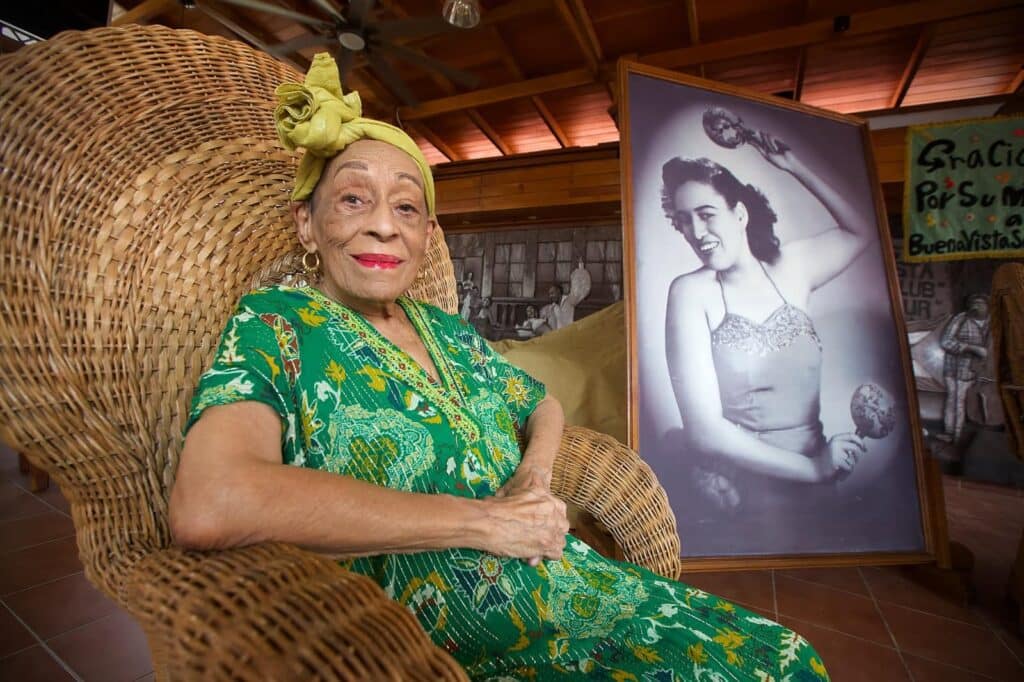
Omara Portuondo, wearing a green headscarf, sits in a wicker armchair in front of a large portrait of her as a young woman
Surrounded by photographs of her career. © Omara Portuondo

In 1945, Omara Portuondo replaced a dancer at the Tropicana

One evening in 1945, a dancer was missing from the Tropicana cabaret in Havana. Omara Portuondo was fifteen years old. Her sister was already dancing at the cabaret. She was shy and embarrassed to show her legs. Her mother insisted, assuring her that one day, thanks to her art, she would represent her country all over the world. The teenager stepped onto the stage. The stand-in for the evening had just made her debut, and she would soon be singing.

Cayo Hueso, a Baseball-Playing Father and a Spanish Mother

Omara Portuondo Peláez was born on October 29, 1930, in Cayo Hueso, a neighborhood in Havana. Her father, Bartolo Portuondo, was an Afro-Cuban baseball player. Her mother came from a wealthy Spanish family. Their relationship was frowned upon, and when they met on the street, they had to pretend not to know each other. At home, however, everything was different. Her parents sang duets. They couldn’t afford a record player, so the little girl learned the melodies by listening to them.

Filin, the Cuarteto d’Aida and the Split in Miami

In the 1940s, Omara Portuondo switched from dancing to singing. She joined Loquibambia, a filin group (the word comes from the English “feeling”), alongside the blind pianist Frank Emilio Flynn. This current of Cuban song is nourished by jazz. She was nicknamed “la novia del filin,” the fiancée of filin. In 1952, the Cuarteto d’Aida was formed around pianist Aida Diestro. Omara sang in the group alongside her sister, Elena Burke, and Moraima Secada. Chico O’Farrill wrote the arrangements. The quartet toured the United States and Europe beginning in 1957. At the Tropicana, the young woman sang on stage with Nat King Cole.

Four singers in long ruffled tulle gowns pose on stage in a black-and-white archive photograph
The Cuarteto d’Aida, archive photograph. © Omara Portuondo

In the early 1960s, the quartet was performing in Miami when the crisis between Cuba and the United States broke out. Her sister remained in Florida. Omara returned to Cuba. In 1967, she launched her solo career and went on tour with the Aragón Orchestra throughout Western and Eastern Europe. Dancer Carlos Acosta describes her as a legend in Cuba.

Buena Vista Social Club, a duet with Compay Segundo in 1996

In 1996, at Egrem Studios in Havana, Omara Portuondo recorded her own album in the same building as the musicians brought together by Ry Cooder. She was asked to sing “Veinte años” with Compay Segundo. At first, she was surprised by the idea of a love duet with him. The Buena Vista Social Club soon took her to major venues. In Wim Wenders’ film, Ibrahim Ferrer wipes a tear from his face during “Silencio.” Carnegie Hall in New York welcomed her in 1997. In 2000, Buena Vista Social Club Presents Omara Portuondo was released.

The accolades and honors continue. In 2019, the Latin Recording Academy presented Omara Portuondo with its Award for Musical Excellence. In 2020, she recorded Mariposas during the pandemic. In 2022, on her 92nd birthday, she performed at Carnegie Hall with Natalia Lafourcade. In 2023, her album Vida won the Latin Grammy for Best Traditional Tropical Album.

Omara Portuondo, in a red cap, holds the Latin Grammy trophy for Best Traditional Tropical Album 2023 for the album Vida
The 2023 Latin Grammy for the album Vida. © Omara Portuondo

Eternamente Omara, an Album Nominated for the 2026 Latin Grammys

Today, Omara Portuondo sings on Eternamente Omara, produced by pianist Roberto Fonseca and recorded at Ojalá Studios in Havana. She says the idea came about during a tour with Fonseca’s band. Guest artists began joining the project in 2024. Silvio Rodríguez sings “Demasiado,” Nathy Peluso sings “Quizás, quizás, quizás,” Pablo López sings “Noche de ronda,” and Angélique Kidjo sings “Guantanamera.” The album is nominated in the same category, alongside Gilberto Santa Rosa, Los Tri-O, Leoni Torres, and Dayhan Díaz.

Omara Portuondo, in a green headband, sits in a wooden armchair holding the vinyl of the album Eternamente Omara
The vinyl of the album Eternamente Omara. © Omara Portuondo

On November 12 in Las Vegas, one question remains unanswered

The ceremony, broadcast live on Univision, will take place on Thursday, November 12, 2026, at the MGM Grand Garden Arena in Las Vegas. On Facebook, Omara Portuondo wrote that if the album won, she would feel deeply satisfied. She also confides: “In these complicated times, we don’t know where we will be.” She affirms that she has never abandoned her people—the ones who recognize her. She also thanks the original musicians of the Buena Vista Social Club. More than eighty years after her first night at the Tropicana, the singer from Cayo Hueso still has her sights set on the stage. One question remains: Whose voice will carry on this filin repertoire after her?

Omara Portuondo, seated in a white armchair, sings into a microphone on stage in a golden gown and matching headscarf
In concert, seated on stage. © Omara Portuondo

Frequently Asked Questions About Omara Portuondo

Omara Portuondo is 96 years old. She was born on October 29, 1930, in Cayo Hueso, a neighborhood in Havana, Cuba.

Her album Eternamente Omara has been nominated in the Best Traditional Tropical Album category. The album was produced by Roberto Fonseca.

The ceremony will take place on Thursday, November 12, 2026, at the MGM Grand Garden Arena in Las Vegas, United States.

Filin, derived from the English word “feeling,” is a genre of Cuban music influenced by jazz. Omara Portuondo is known as “la novia del filin.”

Leave a Reply

Your email address will not be published. Required fields are marked *

More articles from RK

caribbean cinema
FILM & VIDEO
Tolotra

S10/10 – Stories of Caribbean Cinema, from Freda to Zion. Texts by Guillaume Robillard. Ciclic, 2026.

Ten episodes and more than sixty years of cinema. Since Cumbite in 1964, the series “Stories of Caribbean Cinema” has covered Cuba, Jamaica, Trinidad and Tobago, Guadeloupe, Martinique, Curaçao, Haiti, the Dominican Republic, and Antigua and Barbuda. For this final installment, Guillaume Robillard takes us to Haiti with Freda by Gessica Généus, and then to Guadeloupe with Zion by Nelson Foix. You are now watching the tenth and final episode of the series. The previous nine episodes are still available on Richès Karayib, so you can revisit the series from the beginning. 2021: HAITI – FREDA, BY GESSICA GÉNÉUS Female filmmakers are rare in Caribbean cinema. In addition to those already mentioned in this timeline, we can mention the Afro-Cuban Sara Gómez from Cuba, known for her docudrama In a way (In a certain way), released in 1977, was the very first film directed by a woman in this country,

Read More »

conTACT RK

we'd love to have your feedback on your experience so far

Join The List

Join our Richès Karayib community!  Sign up for our newsletter.

Want To Maximize Your Business Presence On Riches Karayib?

Complete the form to start the application