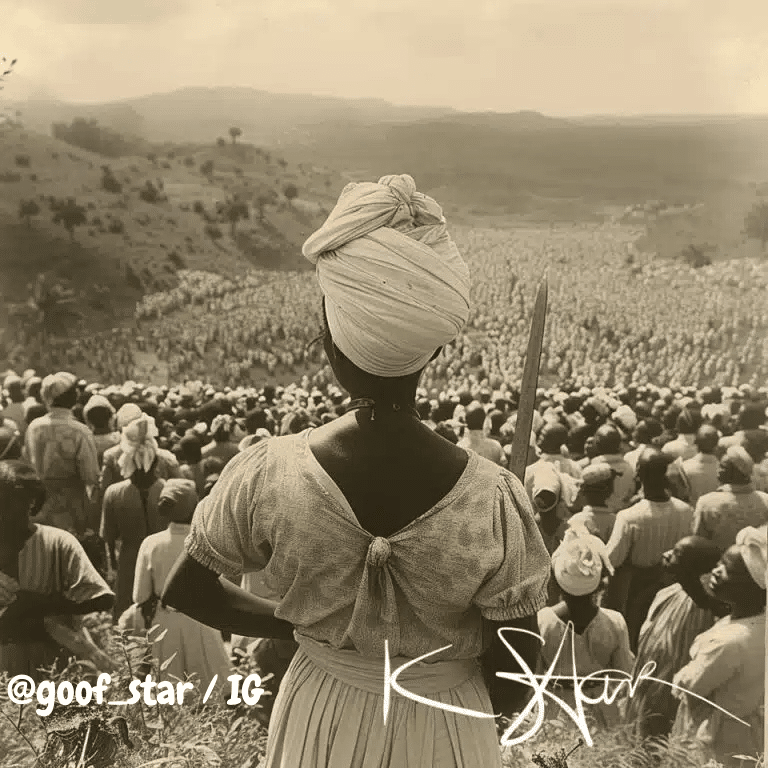
Queen Nanny is one of the most powerful figures in Caribbean history. Leader of the Windward Maroons in the XVIIIᵉ century, she embodies resistance to slavery, military strategy and the place of women in anti-colonial struggles. Born in West Africa, probably in an Akan community in the Asante region, she was deported to Jamaica as a captive before joining the mountains and the Maroon communities.
Her trajectory makes her a contemporary reference for decolonial movements, black feminisms and the defense of Afro-descendant cultures.
From African roots to Jamaican marronage
Maroon oral traditions indicate that Queen Nanny was born towards the end of the XVIIᵉ century in Akan territory. Captured in local conflicts and then sold in the transatlantic slave trade, she arrived in Jamaica with several of her brothers.
She soon managed to escape to the Blue Mountains, where groups of runaway slaves were already living in autonomous communities. This geographical refuge became the place where she developed her role as guide, advisor, spiritual and military leader.
Nanny Town: a space of freedom built to last
Along with her brother Quao, she helps lead the Windward Maroons. The community is structured around a fortified village called Nanny Town, built on an inaccessible ridge.
A strategic location in the heart of the mountains
Nanny Town overlooks a river and controls several natural access points. Observation posts monitor the approaches, food reserves are concealed, and escape routes make it possible to evade British offensives.
It’s not just a military camp: Queen Nanny is helping to organize a society capable of surviving, cultivating, protecting its members and maintaining lasting autonomy.

A war leader who revolutionizes guerrilla warfare
From the 1720s onwards, clashes between the Maroons and the British intensified. Colonial power sought to destroy these communities, which were weakening the slave economy.
Mountain tactics
She implemented strategies based on mobility, surprise and knowledge of the terrain. Ambushes, rapid attacks and retreats into the forest contrasted with the heavy-handed tactics of the British army. Thanks to these methods, the Windward Maroons freed many slaves from the plantations, boosting their numbers while undermining the planters.
Abeng and secret communication
The abeng, a horn used as a signalling instrument, transmits coded messages across ravines and ridges. Ritual drums and songs reinforce cohesion. This cultural and military mastery shows how Queen Nanny links identity and resistance strategy.
Community leadership and the spiritual dimension
She is not just a strategist: she also organizes daily life and nurtures resistance beyond the battlefield.
A self-sufficient economy to resist
Under his guidance, the Maroons cultivate cassava, yams and corn, raise livestock and store food. This self-sufficiency enables them to survive repeated sieges and destruction. Queen Nanny oversees security, the distribution of resources and the protection of new arrivals.
The spiritual role in the cohesion of the Maroons
Maroon stories associate Queen Nanny with the Obeah, an Afro-Caribbean belief system. Stories of supernatural powers, whether symbolic or mythical, reflect the importance of spirituality in maintaining courage and unity in an asymmetrical struggle against a colonial power.

Treaty, survival and political continuity
The British attacked Nanny Town on several occasions, including a major campaign in 1734 that forced the Maroons to retreat. Queen Nanny and her followers rebuilt further away, continuing the resistance.
The treaty of 1740: a partial but structuring victory
The colonial authorities, unable to crush the resistance, opted for negotiation. In 1740, a treaty granted the Windward Maroons a 500-acre territory in Portland parish and recognized their internal autonomy. Queen Nanny, according to several traditions, was cautious about this agreement, considering that freedom should not depend on slave power. Nevertheless, this recognition laid the foundations for the political continuity of communities like Moore Town.
A living legacy
She died around 1755. Her influence lives on in the stories, rituals and cultural practices of Maroon descendants.
A Jamaican national heroine
In 1975, the Jamaican government officially awarded her the title of National Hero, the only woman among the national heroes.
His effigy appears on the Jamaican 500-dollar bill, a daily reminder of his place in history.
An inspirational figure beyond Jamaica
Today, she is cited in movements for social justice and decolonization. Her leadership, strategy and community vision make her a benchmark comparable to Harriet Tubman or Toussaint Louverture.
A story that continues to resonate
Queen Nanny symbolizes a freedom forged collectively, rooted in a territory and in an African memory reinvented in the Caribbean. From the Blue Mountains to Moore Town, her legacy is a reminder that organized communities, guided by a determined figure, can have a lasting influence on the course of history. She remains one of the major voices of Jamaican resistance and a pillar of Caribbean memory.
FAQ
She was the leader of the Windward Maroons in 18thᵉ century Jamaica. Born in West Africa, she became a central figure in the resistance to slavery.
She developed a guerrilla strategy adapted to the Blue Mountains, enabling the Maroons to ambush, free slaves and stand up to British forces.
Nanny Town was a Maroon fortress located in the mountains. This strategic location served as a refuge, political center and military base.