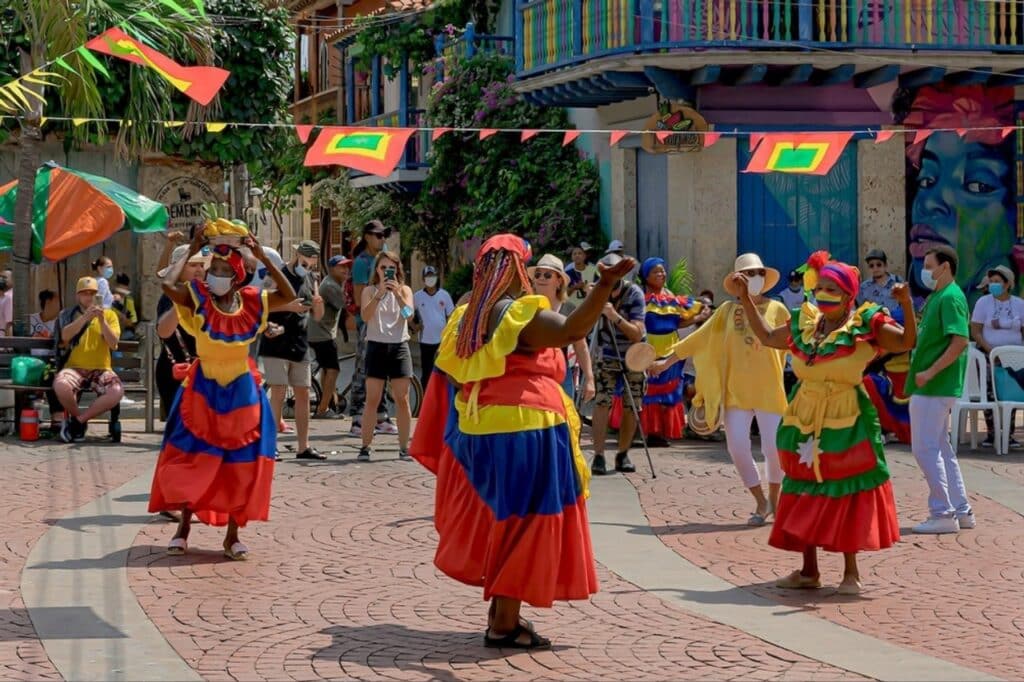

San Basilio de Palenque: Freedom Transformed into a Living Culture

San Basilio de Palenque

In San Basilio de Palenque, in the department of Bolívar in northern Colombia, the memory of freedom is still spoken, sung, taught, and organized as part of daily life. UNESCO presents San Basilio as one of the first free African villages in the Americas and as a major site commemorating the resistance to slavery.

San Basilio de Palenque

A freedom that shaped a region

San Basilio de Palenque grew out of the history of the palenques—communities established by people who had fled slavery. In the 17th century, these settlements served as refuges and allowed their inhabitants to rebuild their lives outside the slave system. San Basilio is the historic palenque that has endured to this day, developing a particularly unique cultural space.

At the heart of this thesis is the figure of Benkos Biohó, a cimarron —a term referring to those who fled slavery—and a key figure in the anti-slavery struggle, as well as one of the founders of the Palenque of San Miguel Arcángel, the predecessor of present-day San Basilio. In the main square, his statue commemorates this history: a broken chain in his hand, which has become a symbol of hard-won freedom. But to reduce San Basilio to this resistance alone would be to miss the point. The true uniqueness of the place lies in what this freedom has made it possible to build and pass on.

Palenquero, a language born of history

One of the most remarkable legacies is the Palenquera language, the only Creole language in the Americas that combines a Spanish lexical base with grammatical features derived from Bantu languages. This fact changes our perspective on San Basilio de Palenque. A history of forced displacement and resistance has also given rise to a distinct language, which has become a marker of belonging and continuity.

Yet this language had to be defended. Teresa Cassiani Herrera, a former teacher from San Basilio, spoke about the role ofethnoeducation—an educational approach rooted in the community’s history and knowledge—played a key role. She explains that it helped people understand that Palenquero was not “bad Spanish,” but a distinct language. According to the Palenquero historian Alfonso Cassiani, in the 1980s, the language was not yet being written down in the community as it is today through dictionaries, booklets, and stories. Passing on the language is therefore also a process of reclaiming how the community sees itself.

San Basilio de Palenque

The Ma-Kuagro: Growing Up as Part of a Community

Palenque culture is not passed down solely through words or music. It is also based on specific forms of social organization. Among these are the ma-kuagro, age groups that play an important role in community life. UNESCO and the Colombian Ministry of Culture describe them as spaces based on rights, duties, and strong solidarity among their members.

This structure helps us understand that in San Basilio, cultural heritage is not limited to objects, monuments, or performances. It also exists in the relationships between people, in shared responsibilities, and in the way the community comes together. Social practices, medical and religious knowledge, as well as oral and musical traditions, are an integral part of the recognized cultural landscape surrounding San Basilio de Palenque.

San Basilio de Palenque

A heritage that refuses to stand still

In 2005, UNESCO designated the Palenque de San Basilio cultural area as a “Masterpiece of the Oral and Intangible Heritage of Humanity.” In 2008, it was added to the Representative List of the Intangible Cultural Heritage of Humanity. The following year, Colombia approved a Special Safeguarding Plan focused in particular on the transmission of knowledge, identity, memory, territory, and community autonomy. But preservation does not mean freezing things in time.

This is perhaps where San Basilio de Palenque has a particularly powerful story to tell. Historian Alfonso Cassiani describes a culture capable of engaging with its time and adapting to grow stronger. Kombilesa Mí’s rap, educational materials in the Palenque language, and community radio initiatives thus carry on ancient practices through contemporary means. Culture remains alive because it continues to be used.

San Basilio de Palenque

San Basilio de Palenque: From Freedom to Transmission

San Basilio de Palenque thus has an extraordinary history, but its significance lies not only in its past. Its uniqueness stems from the continuity between a struggle for freedom and the cultural forms that are its heirs today. A language continues to be spoken. Children learn rhythms and stories. Groups pass on an identity through music. Community structures maintain bonds of solidarity.

Several centuries after the palenques were founded, the question may no longer be simply how their inhabitants won their freedom. It is also about understanding how a community transforms that freedom into something that each new generation can receive, reinvent, and pass on in turn.

San Basilio de Palenque is known as one of the first free African villages in the Americas. Located in the department of Bolívar, Colombia, it is also distinguished by its Palenquera language, musical traditions, community organization, and the transmission of its cultural heritage.

The Palenquera language is a creole spoken in San Basilio de Palenque. It combines a Spanish lexical base with grammatical features derived from Bantu languages. Today, it is one of the most distinctive markers of the community’s identity and cultural heritage.

The San Basilio de Palenque Cultural Area has been inscribed on the Representative List of the Intangible Cultural Heritage of Humanity since 2008. This recognition specifically concerns its oral and musical traditions, its language, its social practices, its knowledge, and its forms of community organization.

Leave a Reply

Your email address will not be published. Required fields are marked *

More articles from RK

Bonaire salt marshes: pink ponds and white salt mountains in the south of the island
HISTORY & HERITAGE
Tolotra

Bonaire: 3,700 hectares of salt marshes conceal a history of slavery

At the southern tip of Bonaire, a Dutch-speaking island in the Caribbean, the salt marshes stretch out in pink and white basins across nearly 3,700 hectares—thirteen percent of the island’s total area. This postcard view, photographed every year by thousands of visitors from the coastal road, hides a history dating back more than five centuries, the story of salt that shaped Bonaire’s economy and, for two hundred years, the lives of hundreds of enslaved people. Along EEG Boulevard, which runs along the southern coast of Bonaire, mountains of white salt come into view kilometers before you reach them. Each contains about 10,000 metric tons of salt that is 99.6% pure, piled nearly 15 meters high, with up to 200,000 metric tons stored at any given time. Their whiteness, so intense that you need to keep sunglasses handy, stands in stark contrast to the pink of the neighboring pools. The salt

Read More »
Journées européennes du patrimoine 2026
EVENT MANAGEMENT
Tolotra

European Heritage Days 2026: Martinique Opens Its Archives.

On September 15, at 5 p.m., the conference room of Martinique’s Cultural Affairs Department is already packed. Journalists, cultural leaders, organizations, artists, and heritage professionals have gathered to find out what the 43rd edition has in store. With just four days to go before the 2026 European Heritage Days , scheduled for September 19 and 20, this press conference already feels like a journey across Martinique—from its Creole huts to its lighthouses, from Saint-Pierre to the monuments we sometimes pass by without really noticing them. European Heritage Days 2026: A Lively Conference Johan-Hilel Hamel, Martinique’s director of cultural affairs, opened the meeting without putting on airs. He even warned that the evening would not be a long monologue. The conversation quickly began to flow. A representative from Les Trois-Îlets speaks, followed by Xavier Nicolas from the Directorate of the Sea, Philippe Villard from the Heritage Foundation, Florence Le Gal from

Read More »
caribbean cinema
FILM & VIDEO
Tolotra

S3/10 – Stories of Caribbean Cinema: Two Perspectives on the Year 1980. Texts by Guillaume Robillard. Ciclic, 2026.

With this third episode, *Stories of Caribbean Cinema* moves into the 1980s. The first two installments covered Cuba, Jamaica, Trinidad and Tobago, and Guadeloupe, from the 1960s through the emergence of Caribbean cinema. This time, two films made in the same year take radically different directions. In Jamaica, *Children of Babylon* explores romantic, sexual, and racial relationships with unusual freedom. In Guadeloupe, *Live Free or Die* draws on several centuries of history centered on the legacy of Commander Ignace. This article is the third installment in a series of ten. Two installments have already been published, and seven more will follow in this chronology of Caribbean cinema. 1980: JAMAICA – “CHILDREN OF BABYLON”, BY LENNIE LITTLE-WHITE This film is unique in Jamaican cinema and, more broadly, in Caribbean cinema as a whole. Far from the social deprivation of Kingston’s ghettos, in a villa in the countryside (complete with a swimming

Read More »

conTACT RK

we'd love to have your feedback on your experience so far

Join The List

Join our Richès Karayib community!  Sign up for our newsletter.

Want To Maximize Your Business Presence On Riches Karayib?

Complete the form to start the application