The Series Stories of Caribbean Cinema continues its journey through several decades of filmmaking in the region. Following a first episode that began in the 1960s—from Cuba to the emergence of Jamaican cinema with *The Harder They Come*—this second installment takes us to Trinidad and Tobago, Cuba, and then Guadeloupe.
Amid social conflicts, the legacy of slavery, and political demands, three films demonstrate how Caribbean cinema took on history and power dynamics from the very beginning. This article is the second installment in a series of ten. The first installment is already available on Richès Karayib, and eight more episodes will continue this chronology through 2025.
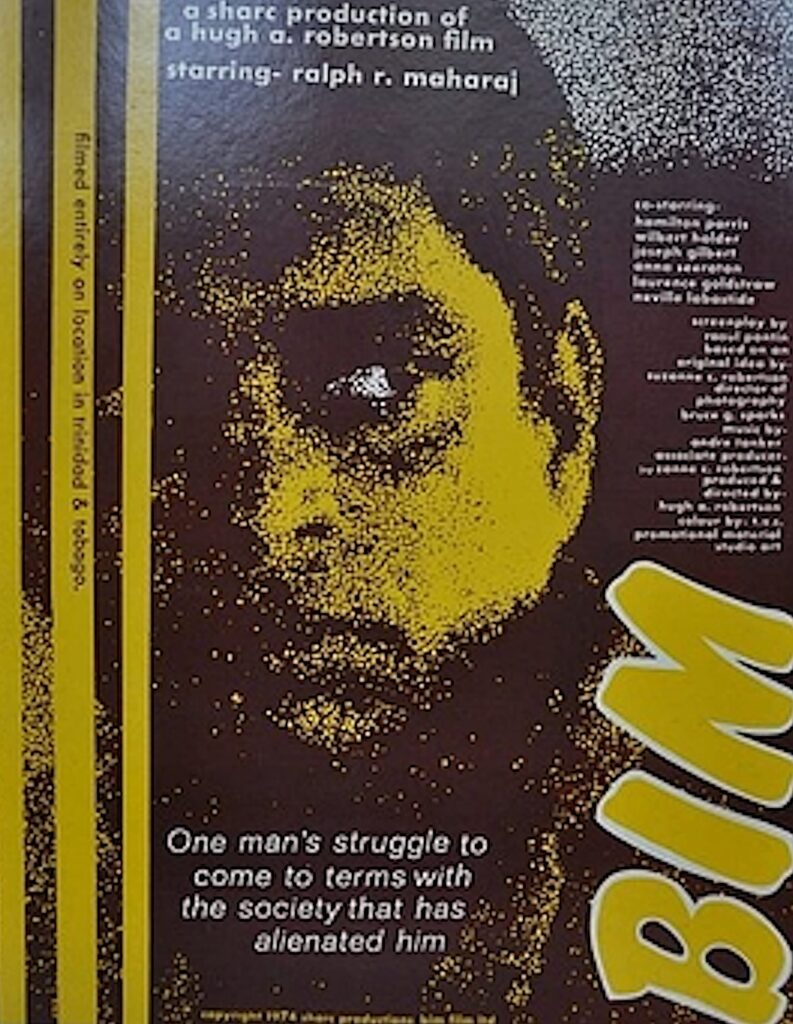
1974: TRINIDAD AND TOBAGO – BIM, BY HUGH A. ROBERTSON
Hugh A. Robertson has had an unconventional career path among Caribbean filmmakers. A New Yorker born to Jamaican parents, he got his start in the film industry at a very young age and held various positions, including that of editor on films such as the famous *Macadam Cowboy* (John Schlesinger, 1969), starring Dustin Hoffman and John Voight, and one of the classics of Blackploitation, *Shaft: The Red Nights of Harlem* (Gordon Parks, 1971), starring Richard Roundtree.
For his first film, he was nominated for an Oscar for Best Film Editing (a first for a Black person) and won the BAFTA that same year. After directing a few television projects and the feature film *Melinda* (1972)—a “Black Film,” as the poster put it—he moved to Trinidad and Tobago with his wife and children, where he directed Bim and then *Obeah* (1987), his second film, which was released upon the director’s death. Bim, modeled after the classic plot of a gangster movie, follows the life of a Trinidadian of Indian descent who, after enduring years of bullying from childhood onward, becomes a crime boss who eventually enters politics.
What stands out in this film is the direct nature of the interethnic conflicts, particularly between people of African and Indian descent (each group accounting for about 40 percent of the island’s population), ranging from the school setting to the political arena (where the white minority seems to be “pulling the strings”) and extending into marital life. Certain sequences have a strong ethnographic dimension: for example, the film opens with a traditional Hindu wedding.
While the latter is predominantly urban, much like *The Harder They Come* (Perry Henzell, 1972), Trinidad and Jamaica—which have major historic cities, Port-of-Spain and Kingston, respectively— work in the sugarcane fields—the historical foundation of most Caribbean societies—is highlighted in a plot set during the colonial era, amid the fervent independence movements of the 1950s and 1960s.
The strong political consciousness of this film echoes certain Trinidadian films that preceded it, such as *The Right and the Wrong* (1970) by Indian director Harbance Kumar, which depicts a revolt on a plantation at an unspecified time. Furthermore, Bim stands out for its energy and Ralph Maharaj’s impressive performance in the lead role. Given Robertson’s standing in the U.S. film industry, it’s not unreasonable to think that Brian De Palma might have seen his film, given Al Pacino’s brilliantly over-the-top performance in Scarface (1983) is so strongly reminiscent of Bim on several occasions.
1976: CUBA - THE LAST SUPPER (LA ÚLTIMA CENA), BY TOMÁS GUTIÉRREZ ALEA
This classic is a must-see film about the portrayal of slavery in the Caribbean, just as *Twelve Years a Slave* is for the southern United States, *Twelve Years a Slave* (Steve McQueen, 2013). Inspired by the novel *El Ingenio* (*The Plantation*) by Manuel Moreno Fraginals (which itself is based on true events), the plot of La Última Cena takes place on a slave plantation in Cuba in the 18th century, during Holy Week.
A wealthy landowner, a devout Catholic nobleman, decides to reenact the Last Supper around a lavishly set table, in the presence of twelve of his slaves. The group eats and drinks to their hearts’ content. The next day, the foreman wakes the slaves to send them to work in the sugarcane fields. A revolt breaks out…
In a film industry that, at first, rarely addressed the “Black Question” (to borrow the title of a book by the Trinidadian intellectual C.L.R. James), this film confronts the history of slavery—a reality shared by the vast majority of Caribbean countries—through a visual and auditory portrayal of rare precision regarding the “racialized” hierarchy specific to plantations: white and Black bodies do not occupy the same space (both literally and figuratively) nor do they have the same right to speak.
The banquet sequence (the famous reenactment of the Last Supper), which lasts nearly 45 minutes, displays great mastery both in terms of theater (dialogue and the actors’ performances) and cinema (technical editing, in which changes in camera angles reflect the power dynamics between characters). As for the final third of the film, it is one of the most beautifully staged depictions—through both camera movements and the framing of bodies and landscapes—of a slave revolt followed by a mass escape (the slaves’ flight from the plantation) ever made. A true masterpiece!

1979: GUADELOUPE - "COCO LA FLEUR," DIRECTED BY CHRISTIAN LARA
This film by the most prolific director from the French Antilles—who achieved the remarkable feat of directing nearly 25 films (even if it was sometimes under challenging technical conditions)—heralds the arrival of Antillean cinema. Two years earlier, in Martinique, the feature film *Dérives ou la femme-jardin* (1977), directed by Jean-Paul Césaire—one of the sons of the poet, politician, and champion of Négritude, Aimé Césaire—had not been given the chance for a commercial theatrical release.
Loosely based onAn Island in the Sun by Robert Rossen (1957), starring the famous Harry Belafonte, *Coco la Fleur, Candidate* is a political comedy that follows the journey of Coco, a so-called “apolitical” candidate controlled by technocrats from the prefecture, who decides during the campaign to take an interest in the future of his “country.” The demand—at the very least—for autonomy for Guadeloupe and Martinique is directly raised by the lead protagonist of this emerging cinema, who repeatedly takes on the role of the traditional Creole storyteller, a central figure in this body of films.
Furthermore, this film makes extensive use of the Creole language. It was a resounding success, drawing more than 100,000 viewers in Guadeloupe and Martinique, according to various sources, and remained in the lineup at the Louxor cinema in Paris for several years. An effective blend of lightheartedness and political activism that the director would brilliantly revisit in his third film, *Mamito* (1980), another classic of this cinematic tradition, whose main character is a Creole mother (a single mother raising her children on her own).
Played by the indispensable Lucrèce Saintol (who also plays Coco’s mother), who clearly illustrates the “feminocentricity” of Caribbean cinema—namely, the nearly systematic presence of strong women (fanm doubout) in this cinema. This significant presence of women was foreshadowed in *Dérives ou la femme-jardin*, a film loosely based on the short story Alléluia pour une femme-jardin by Haitian author René Depestre, featuring its enigmatic protagonist Isa.

About the Author
Guillaume Robillard holds a Ph.D. in film studies; he is a professor and researcher, a documentary filmmaker, and a specialist in Caribbean cinema and artistic production. He is the author of two books: *Conquest of Space and Time: Caribbean Cinema (Éditions Jannink, “Hypothèses d’Art,” 2023) and Decolonial Cinema: Characters in Caribbean Cinema (Presses Universitaires des Antilles, “Arts et Esthétique,” 2024).