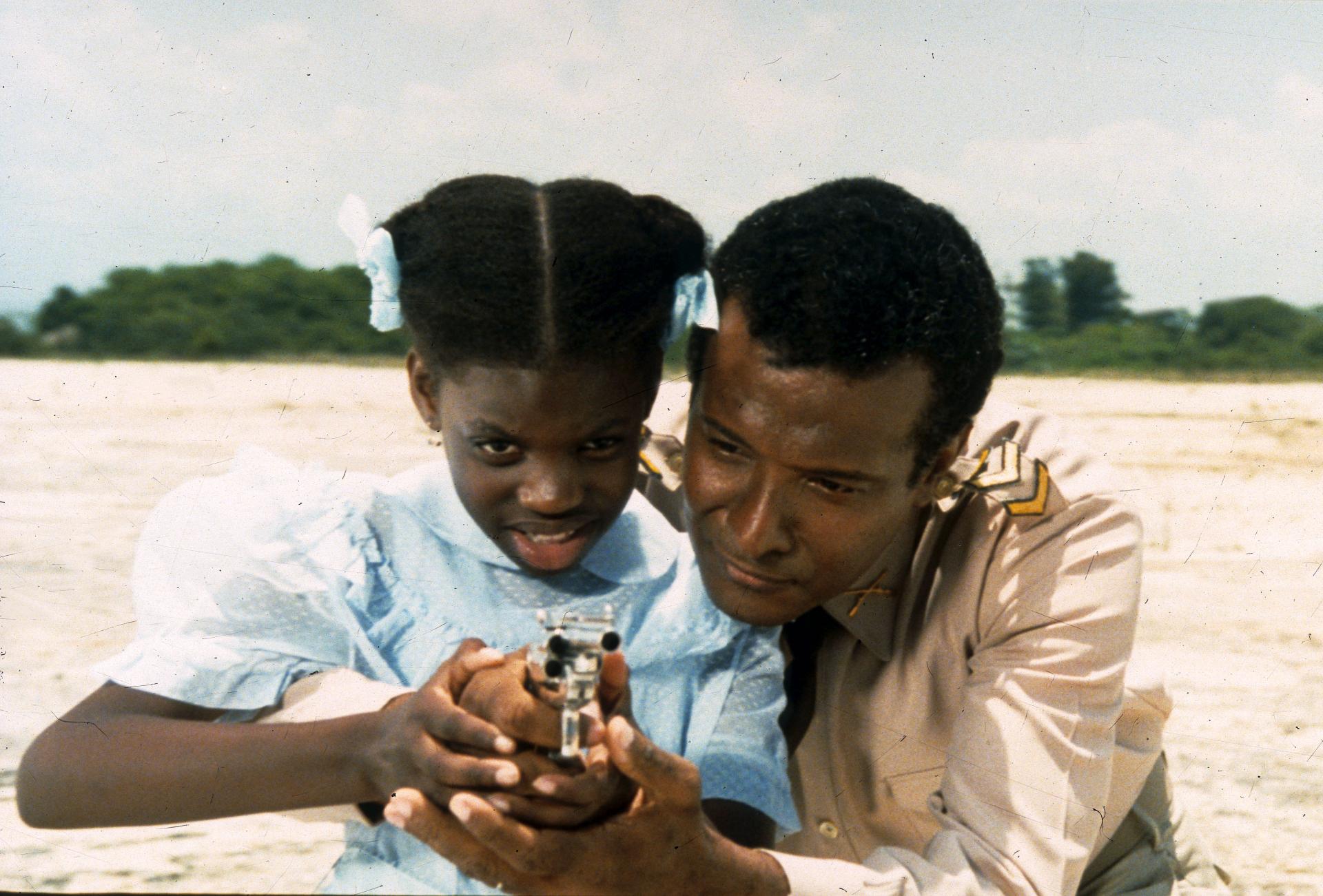
With this first episode, Richès Karayib launches a ten-part series dedicated to the history of Caribbean cinema, based on the work of Guillaume Robillard, a Ph.D. in film, professor and researcher, documentary filmmaker, and specialist in Caribbean cinema and artistic production. From Cuba to Jamaica, from Martinique to Curaçao, this chronology spans more than sixty years of filmmaking in the Caribbean.
This first installment takes us back to the 1960s and early 1970s, first to Cuba and then to Jamaica, where several films began to lay the groundwork for cinematic traditions deeply rooted in the social, cultural, and political realities of their respective regions. This article is the first in a series of ten, available on Richès Karayib.
Thus, the history of Caribbean cinema did not begin until the 1960s, even though films had been shot in the Caribbean since the early 20th century—notably two short films by the Lumière brothers in Martinique in 1902. In fact, it is common to make a clear distinction between films shot in the Caribbean and films made by filmmakers from the various islands of this archipelago.
As for productions from Jamaica, Trinidad and Tobago, and the Dominican Republic, they have shown a certain consistency punctuated by pleasant surprises, while in Haiti, a semi-professional production scene was long prolific and enjoyed a large audience.
On the other hand, a few smaller countries produce films only sporadically (Saint Lucia, Grenada) or rarely (Barbados, Puerto Rico) produce films whose themes overlap with those of other regional cinemas, reflecting a shared “Caribbean spirit” despite the evident diversity of these productions.
As for “Caribbean cinema” specifically from Guadeloupe and Martinique it now comprises some forty films, most of whose plots are set on these two islands. Finally, it should be noted that this timeline focuses on the insular Caribbean, and thus does not include films from the mainland, such as those from French Guiana or Mexico. It’s worth noting that most Caribbean films are available on free or paid streaming platforms for everyone to enjoy.
1964: CUBA - "Cumbite", by Tomás Gutiérrez Alea
The third feature film by the renowned Cuban director Tomás Gutiérrez Alea, one of the co-founders of the ICAIC (Instituto Cubano del Arte y la Industria Cinematográficos), the renowned Cuban film school that has trained generations of Latin American professionals, is an adaptation of one of the classics of Haitian literature, “Gouverneurs de la rosée” by Jacques Roumain. After leaving for the island of Cuba, where he worked in the sugarcane fields, the protagonist, Manuel, returns to his small rural village in Haiti, which is suffering from a drought.
The hero then sets out in search of water and finds a hidden spring. He will only succeed in the mission he has set for himself, a mission that will cost him his life without his beloved Annaïse and his mother Délira. Thanks to them, the villagers come to realize the need to come together as a community through “coumbite,” a Creole word meaning collective work based on mutual aid, and bring water to the village. Addressing the issue of rampant deforestation, which has left a deep mark on Haitian history, the book has a strong ecological dimension that is generously reflected in its film adaptation.
A worthy heir to Italian neorealism (the director studied film in Italy), this film oscillates between grand visual classicism (composition of light and framing, photogenic portraits, fluid editing) and cinéma du réel, particularly in a striking voodoo sequence (an African religion still practiced in Haiti) that rivals the famous documentary “Divine Horsemen” by the Russian filmmaker Maya Deren (shot between 1947 and 1951), which is considered a seminal work on the subject. Last but not least, “Cumbite” is one of the very first and exceptionally beautiful adaptations of a work from Caribbean literature.
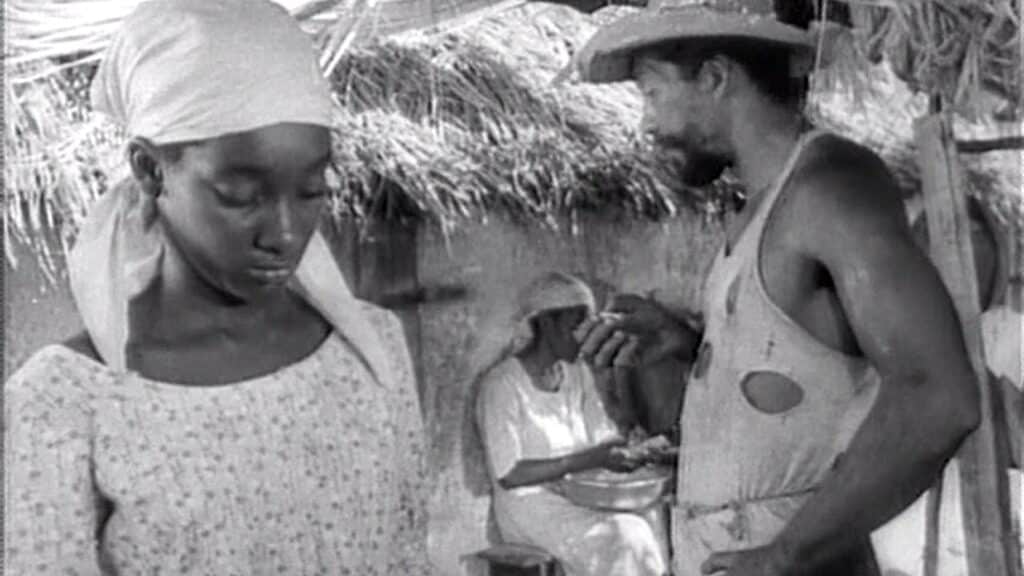
1966: CUBA – THE DEATH OF A BUREAUCRAT (LA MUERTE DE UN BUROCRATA), BY TOMÁS GUTIÉRREZ ALEA
At the very beginning of the film, we witness the funeral of a man who is buried with his worker’s ID card to honor his commitment to the working class. However, this card turns out to be an essential document for his widow if she is to receive a pension. Needing to recover this precious item but unable to have the body exhumed, a nephew of the deceased goes so far as to illegally dig up his uncle’s grave, triggering a cascade of administrative dead ends…
This film, influenced by 1960s Italian comedy, captivates with its formal freedom (including the use of photographs and time-lapse editing, among other techniques), which is rare in Caribbean cinema. Furthermore, it exhibits strong intertextuality with a group of filmmakers, credited in the opening credits (typed on a typewriter onto a piece of official paperwork, in keeping with the film’s subject matter): a montage of various archival footage to depict the life of the deceased (echoing *Citizen Kane* by Orson Welles), and stop-motion animation featuring a “human shredder” machine (a nod to Modern Times by Charlie Chaplin), and a dream sequence referencing *Un Chien Andalou* by Luis Buñuel, etc.
This interplay of references, a sign of a deep knowledge of cinema, does not, however, make it a European or American film. Indeed, deeply rooted in Cuban society, the plot explores how a regime (in this case, Fidel Castro’s) can itself become an “absurd” bureaucracy despite its stated intention to do away with bureaucracy (“Muerte a la burocracia,” as stated several times in the film).
Furthermore, the Native American heritage of the protagonist, who faces the wrath of the administration, the majority of whose representatives are of European descent, may subtly suggest a “racialized” Cuban social hierarchy. This critical examination of the limitations of a regime or, more broadly, of the exercise of power is continued in the equally famous *Memoirs of Underdevelopment* (1968), the director’s next film, which takes a more overtly political stance and was honored with a screening at Cannes Classics in 2016.

1972: JAMAICA – "THE HARDER THEY COME", BY PERRY HENZELL
This film marks the beginning of Jamaican cinema and would establish a “formula” that has since been widely emulated: a focus on Jamaican music primarily reggae, whose international fame is well established as seen through the journey of the young singer Ivan (played by the famous Jimmy Cliff) in search of a producer, but also of Jamaican Creole (a mixed form of English with a distinctive accent and phrasing) as a Caribbean “linguistic anchor,” and, finally, the figure of the rebellious hero standing up against a “system” deemed unjust or repressive.
The potential of the urban landscape (in this case, Kingston) is also highlighted: the film’s opening features some of the most beautiful images capturing the city’s energy at that time, paired with stunning portraits. Furthermore, the “baroque” and “fragmented” architecture of the impoverished neighborhoods is given extensive screen time. Against the backdrop of religion’s heavy influence, a love story unfolds, marked by flirtation and a bit of nudity.
Confrontations with law enforcement, particularly through gunfights and prison scenes, are also featured, including a notable sequence of physical punishment. All of these elements with the exception of the figure of the rebel (or resistance fighter), were virtually absent from French Caribbean cinema (for example) for nearly thirty years, with a few exceptions. While being chased by a police officer on a motorcycle, the protagonist shoots at the officer as an act of defiance against the established order: a multi-stage chase ensues, ending in the mangrove swamps and culminating on a beach where he attempts to reach Cuba (an island considered revolutionary) by boarding a boat.
On the city’s walls, you can see graffiti that says things like ” I was here but I disappeared ” (“I was here but I disappeared”), all of which evoke the image of a maroon (a slave fleeing the plantation) “modern” maroon who stands in opposition to a society where the wealthy (producers, for example) and those in authority (police commissioners) are subtly mixed-race or white, while the impoverished Black population yearns for comfort (“ You can get it if you really want it; you’ll succeed in the end / “You can have it if you really want it; you’ll finally succeed,” says a song from the movie as Ivan drives down a golf course in a stolen luxury car: a “racialized” social hierarchy that strangely echoes the colonial past.

About the author:
Guillaume Robillard holds a Ph.D. in film studies; he is a professor and researcher, a documentary filmmaker, and a specialist in Caribbean cinema and artistic production. He is the author of two books: *Conquest of Space and Time: Caribbean Cinema (Éditions Jannink, “Hypothèses d’Art,” 2023) and Decolonial Cinema: Characters in Caribbean Cinema (Presses Universitaires des Antilles, “Arts et Esthétique,” 2024).