Ten episodes and more than sixty years of cinema. Since Cumbite in 1964, the series “Stories of Caribbean Cinema” has covered Cuba, Jamaica, Trinidad and Tobago, Guadeloupe, Martinique, Curaçao, Haiti, the Dominican Republic, and Antigua and Barbuda.
For this final installment, Guillaume Robillard takes us to Haiti with Freda by Gessica Généus, and then to Guadeloupe with Zion by Nelson Foix. You are now watching the tenth and final episode of the series. The previous nine episodes are still available on Richès Karayib, so you can revisit the series from the beginning.
2021: HAITI – FREDA, BY GESSICA GÉNÉUS
Female filmmakers are rare in Caribbean cinema. In addition to those already mentioned in this timeline, we can mention the Afro-Cuban Sara Gómez from Cuba, known for her docudrama In a way (In a certain way), released in 1977, was the very first film directed by a woman in this country, shortly before the director’s death. Still aligned with the Cuban regime, the famous epic films Lucía (1968) and Cecilia (1982) by Humberto Solás feature female protagonists through whom the island’s history is explored.
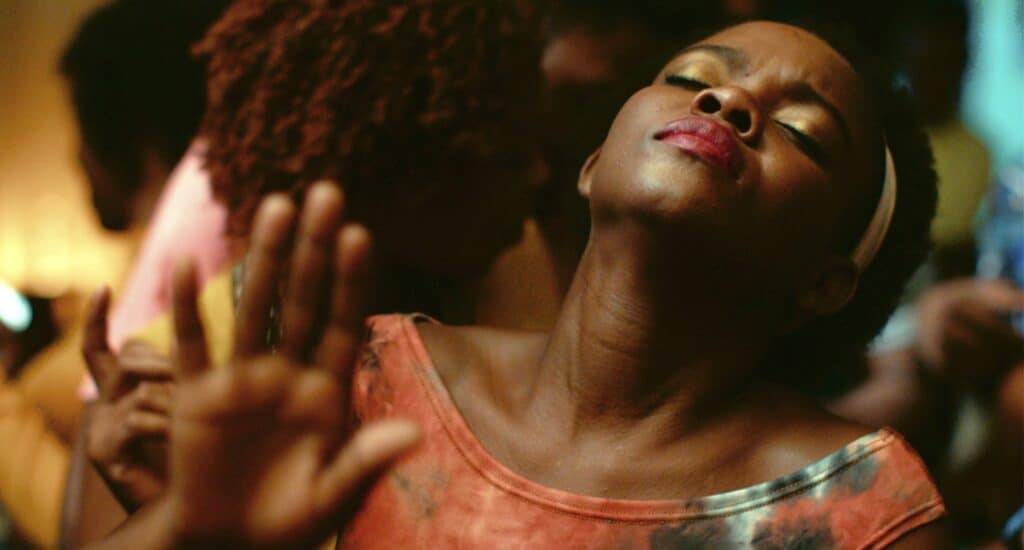
In Haiti, Gessica Généus, known for her roles in several Haitian films such as *Moloch Tropical* (Raoul Peck, 2009) and Les Amours d’un zombi (Arnold Antonin, 2010), and, more recently, *Kidnapping Inc.* (Bruno Mourral, 2024), makes a strong impression with her debut film, *Freda*, which was selected for the “Un Certain Regard” section at the 2021 Cannes Film Festival.
With sensitivity, it follows the story of Freda (whose first name subtly echoes that of the famous Mexican feminist painter Frida Kahlo), a young woman who lives with her mother and sister in the back of the modest street shop they own, while she studies anthropology at the university.
This film deserves credit for showing us the real Port-au-Prince today, even though it is very difficult to film there for obvious security reasons. Indeed, it effectively alternates between, on the one hand, political discussions among students, social protests (through candid documentary footage) and gunfire in the streets, and, on the other, moments of relaxation, laughter, and enjoyment (dancing in the streets or at nightclubs)—all despite the hardships of a country where many citizens are wondering whether or not they should leave.
As for those who remain, Freda’s highly sought-after mixed-race sister (brilliantly portrayed by Nehemie Bastien) hastily marries a senator while her mother watches, without saying a word, the self-serving game of seduction her daughter is playing, moving from one man to the next, with her family’s social advancement seemingly her sole objective.
AAmid domestic violence, the risk of rape, and abandoned pregnant women, the precarious plight of women in Haiti is portrayed with restraint through an impeccable cast and a camera that captures their raw emotions with delicate sensitivity. More recently, with *The Last Meal* (2024), a stunning film about the Duvalier dictatorship (1957–1986) that has won numerous international awards, Haitian-Quebecois director Maryse Legagneur has joined the ranks of talented female filmmakers from the world’s first Black republic.
2025: GUADELOUPE – ZION, BY NELSON FOIX
The release of Magma, a film by French director Cyprien Vial heavily inspired by the 1976 eruption of La Soufrière, which raised fears that the capital city of Basse-Terre (Guadeloupe) would be destroyed, followed by two films directed by Guadeloupeans, namely Fanon (Jean-Claude Barny), about the famous anti-colonialist intellectual during his time in Algeria, and *Zion*, in less than a month, succeeded in drawing the attention of the French media (Le Monde, Libération, etc.) to the potential of Caribbean cinema and, more broadly, of films dealing with the French overseas territories.
Indeed, audiences beyond the Caribbean and its diaspora turned out in force: nearly 50,000, 250,000, and 500,000 admissions, respectively. In particular, by focusing on the social deprivation of the “ghetto” and the reality faced by some Caribbean youth—amid drug deals, motorcycle rides, and daily drug use— Zion strongly opposes a “postcard-style” portrayal of the Caribbean.
In this way, it continues a process of deconstructing an exoticized view (an “outsider’s perspective”) of these islands, a process that began with the very first feature film in this cinematic tradition *Coco la Fleur*, a film (Christian Lara, 1979), which was already heavily focused on social deprivation and the daily hardships of the population, and which has been a defining feature of this film industry for over thirty years.
As for its urban character, it follows directly in the footsteps of Nèg Maron (2005) by Jean-Claude Barny, with the necessary adaptation of the conventions to a new generation. It also marks the widespread return of the Creole language in a feature-length fiction film: a choice characteristic of Caribbean cinema in the 1970s and 1980s and, following a decline in the use of this language during the 1990s and 2010s (with the exception of a few films such as Nèg Maron), a trend that has been evident in virtually all of the short films of the past decade.
One last point: as we follow the story of young Chris (played by the surprising Sloan Descombes), a resourceful delinquent with little respect for women (with the exception of his neighbor, convincingly portrayed by Axelle Delisle), who finds himself literally with a baby on his hands—left anonymously on his doorstep— Caribbean cinema is asserting more strongly than ever the right for fathers to be present in societies where the majority of families remain single-parent households—a trend initiated and sustained in this cinema since the early 2000s.
This film, with its infectious energy and set against the backdrop of social upheaval during Carnival, is supported by strong direction, production, and casting, and has established among a wide audience the distinctive qualities of Caribbean cinema that have been patiently developed over several decades.

About the Author
Guillaume Robillard holds a Ph.D. in film studies; he is a professor and researcher, a documentary filmmaker, and a specialist in Caribbean cinema and artistic production. He is the author of two books: *Conquest of Space and Time: Caribbean Cinema (Éditions Jannink, “Hypothèses d’Art,” 2023) and Decolonial Cinema: Characters in Caribbean Cinema (Presses Universitaires des Antilles, “Arts et Esthétique,” 2024).