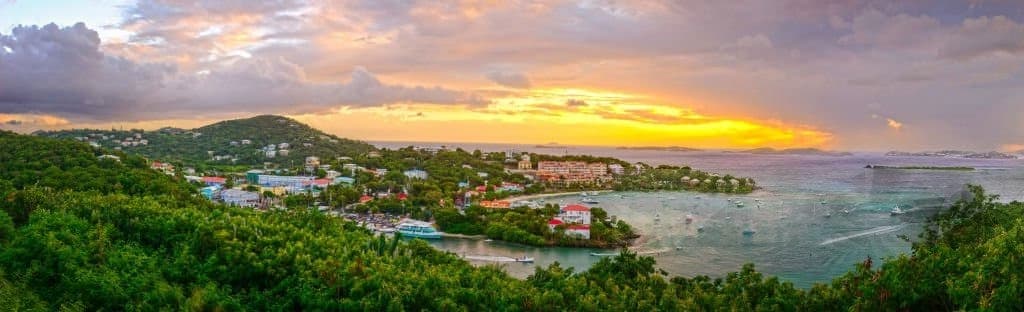
In the U.S. Virgin Islands, Saint John occupies a singular place. More discreet than St. Thomas, less urbanized, it was built around a simple principle: preserve your land. Today, almost 60% of the island is part of the Virgin Islands National Park, directly shaping its landscape, economy and organization.
For travelers, Saint John represents a legible destination: a compact island, accessible beaches, a structuring national park and local life concentrated around a main center, Cruz Bay. This configuration makes it possible to quickly understand the territory, without dispersion or saturation.
A large-scale protected island
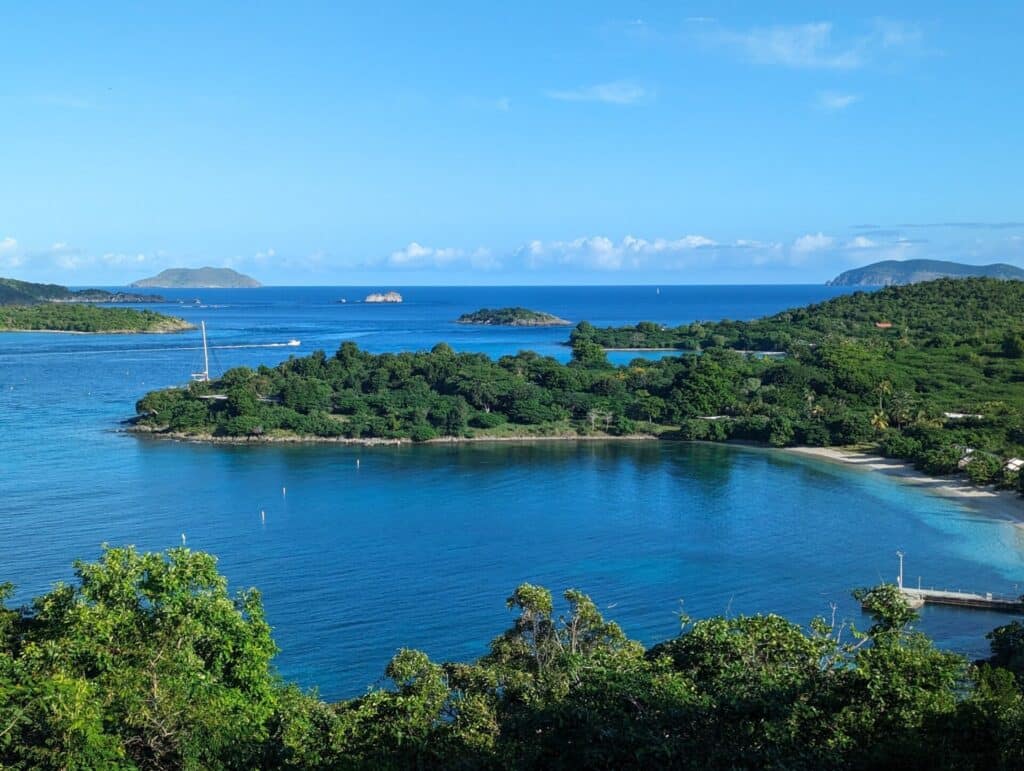
Virgin Islands National Park was created in 1956 thanks to a major land donation. Since then, it has covered most of Saint John’s land territory, as well as protected marine areas. This configuration limits real estate development and maintains large areas of unspoiled nature. Tropical dry forests, hills, mangroves and coral reefs make up most of the landscape. Roads are few and far between, and inhabited areas are concentrated mainly around Cruz Bay and Coral Bay. This territorial organization gives the island an airy character, without excessive urban continuity, which reinforces the feeling of space for visitors.
The national park also offers signposted trails through old plantations, viewpoints and forested areas. For travelers interested in history and nature, these trails offer a complete overview of the territory. The island can be explored both on foot and by sea.
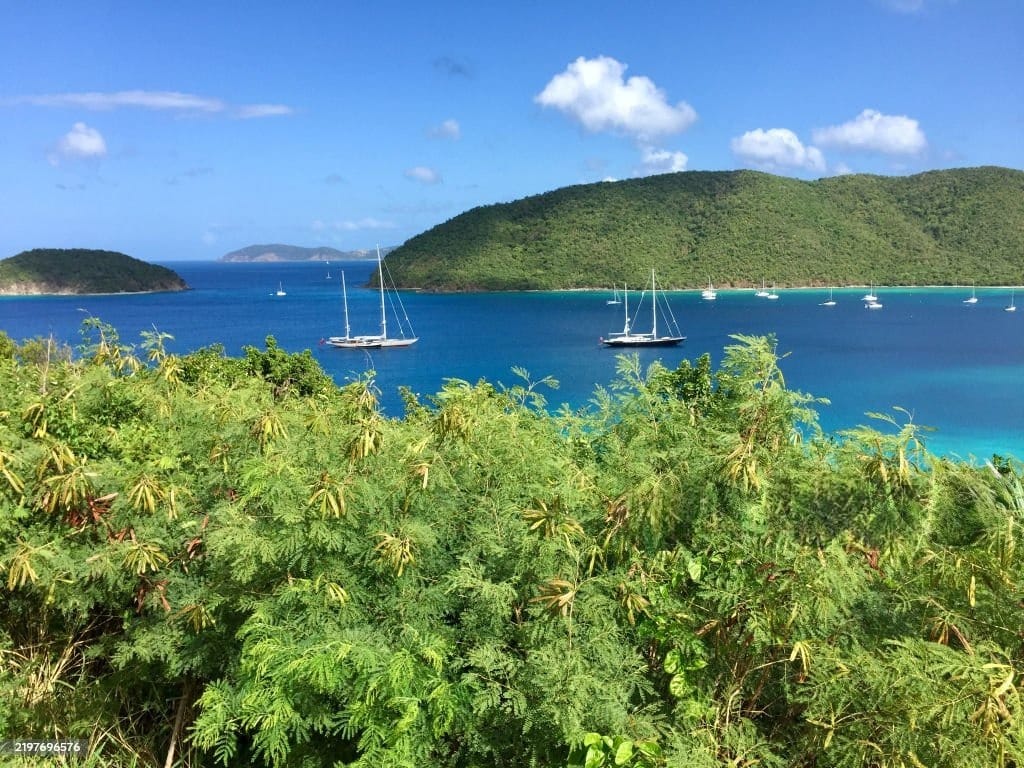
Saint John is renowned for its clear beaches bordered by reef-protected waters. Trunk Bay, Cinnamon Bay and Maho Bay are among the best-known sites. What they all have in common is that they are part of the national park and benefit from strict environmental protection. Access is provided, but construction remains limited. The aim is to keep visitor numbers under control and preserve marine ecosystems. This approach reinforces the image of an island focused on quality rather than tourist density.
Some of the less-frequented beaches also reveal a different facet of the coastline. They are a reminder that the island retains many open spaces, free from intensive occupation. This availability contributes to the balance between visitors and residents.
Before becoming an American territory in 1917, Saint John was part of the Danish West Indies. The island has preserved traces of this period, notably through the ruins of sugar plantations scattered throughout the national park. These remains are a reminder of the colonial economy based on sugar cane and forced labor. Today, they are historical landmarks accessible to visitors, often linked by footpaths. History isn’t just to be found in museums: it’s inscribed in the landscape, stone walls and ancient farm tracks.
A controlled tourism economy
Tourism is Saint John’s main economic driver. Unlike other Caribbean destinations, the island has no international airport. Access is by ferry from St. Thomas, which naturally limits visitor flows and encourages a gradual arrival of visitors. This logistical constraint contributes to the balance of the region. Stays are generally longer, encouraging more attentive discovery. The accommodation offer is based on medium-sized hotels, villas and private rentals, rather than large complexes. This organization maintains a human scale.
Simple organization for travellers
The center of Cruz Bay is home to shops, restaurants and services. Coral Bay, further east, is more residential and less busy. Travel is mainly by car, as the roads are hilly and narrow. This configuration encourages you to take it easy and explore the island gradually. To reach Saint John, you must first land in Saint-Thomas, then take a twenty-minute ferry ride. This maritime transition marks your entry into a different territory, where the sea remains omnipresent.
Highlighting Saint John means presenting an island where land protection structures all development. The predominant presence of the national park limits urbanization, controls access to beaches and preserves landforms. For travelers, the island offers a clear combination of protected nature, accessible beaches, visible historical heritage and sufficient infrastructure. Saint John doesn’t seek to multiply its attractions; it offers a stable, organized and sustainable territory turned towards the sea. This coherence gives the island a special value in the contemporary Caribbean, where land management is becoming a central issue for the future of island tourism.
You’ll need to fly into St. Thomas, then take the ferry to Saint John in about twenty minutes.
The U.S. Virgin Islands assert their cultural and tourist uniqueness
At Seatrade Cruise Global 2025 in Miami, the US Virgin Islands (USVI) highlighted what makes them unique in the Caribbean: a unique cultural heritage, stemming from a Danish history that is still very much alive, combined with an ambitious, sustainable cruise strategy.
Through the voice of Alani Henneman, Deputy Commissioner of the US Virgin Islands Department of Tourism, the archipelago affirms its desire to combine tourism growth with the preservation of its plural identity.
Three islands, three experiences, authentic hospitality
Tourism, the territory’s leading industry, relies heavily on cruises. With 1.8 million cruise passengers this year and a forecast of 1.9 million next year, the USVI has confirmed its strategic position on Caribbean itineraries.
Cruising is a year-round activity, with a slight low season in summer. Efforts made during the pandemic to improve port infrastructures are now bearing fruit: better traffic flow, better flow management, and an upscale customer experience.
Comprising St. Thomas, St. John and St. Croix, the US Virgin Islands offer a diversity that is rare in the Caribbean. Each island boasts its own unique atmosphere:
Saint-Thomas, vibrant and dynamic,
Saint-John, unspoilt and wild,
Saint-Croix, steeped in culture and history.
🎯 Alani Henneman’s stated aim: to make the USVI not just a stopover, but a real gateway to discover the richness of the region.
Saint-Thomas
Saint John
Saint-Croix
Turning a stopover into a cultural immersion
For Alani Henneman, the major challenge now lies in transforming the cruise experience.
” We have a strong cultural identity that we want to share: the quadrille, Danish architecture, our music and traditions. That’s what we want visitors to experience. “she explains.
The development of new themed excursions and the improvement of the hotel offer are at the heart of the strategy. The ambition is clear: to encourage cruise passengers to extend their stay, by offering them authentic and memorable experiences.
🎯 If she could grant a wish, Alani Henneman would like to see the creation of new hotels, to turn even more passing visitors into long-term tourists.
USVI, between living roots and the future of tourism
At Seatrade Cruise Global 2025, the US Virgin Islands reaffirmed that it is possible to combine historical heritage, modern tourism and a warm welcome. By capitalizing on the uniqueness of their history and the diversity of their islands, they are charting an ambitious course: to make every cruise a true voyage to the heart of an authentic, proudly preserved Caribbean identity.