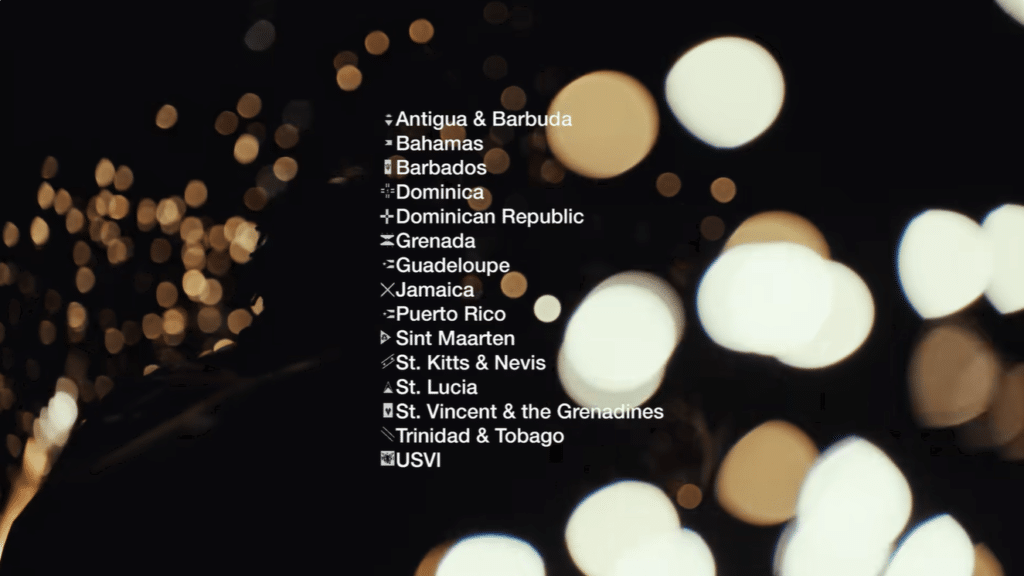
IShowSpeed Caribbean Tour opens a rare window on the Caribbean. The announcement was broadcast on April 20 on the American creator’s networks, with a live broadcast scheduled for April 25, 2026. The published list mentions fifteen destinations: Antigua and Barbuda, the Bahamas, Barbados, Dominica, the Dominican Republic, Grenada, Guadeloupe, Jamaica, Puerto Rico, Sint Maarten, Saint Kitts and Nevis, Saint Lucia, Saint Vincent and the Grenadines, Trinidad and Tobago and the US Virgin Islands. In the space of a few hours, this tour placed the region in an unusual position of global visibility.
IShowSpeed Caribbean Tour deserves attention for one simple reason: IShowSpeed gathers a gigantic audience. The Associated Press recalls that it surpassed 50 million subscribers on YouTube during its African tour in January 2026. At this scale, every move becomes a live event, picked up by other accounts and transformed into short sequences that circulate quickly. When an entire itinerary is devoted to the Caribbean, the territories, accents, landscapes and everyday customs enter the field of vision of an international audience.
The Caribbean as a whole
The first strength of the IShowSpeed Caribbean Tour lies in the overall picture it produces. The list combines independent states and territories, English-, French-, Spanish- and Dutch-speaking areas. This juxtaposition reminds us that the Caribbean is a multiple region, crossed by different languages and heritages, while retaining deep links.
This regional reading corresponds to a historical reality. Human, musical, commercial, religious and family circulations have existed for centuries from one island to another. Borders have shaped distinct administrations and statuses. They have never erased exchanges. In a single announcement, the Caribbean appears as a legible space for millions of people who often perceive it in a fragmented way.
Visibility through the codes of the present
The format counts almost as much as the list of destinations. IShowSpeed is all about live action, improvisation, immediate reaction and massive sharing. Its audience follows less a program than a presence. This way of filming changes the nature of the exhibition. The viewer watches streets, beaches, markets, journeys, encounters and crowd scenes as they happen.
For the Caribbean, this exhibition has a special significance. Many of the region’s territories suffer from uneven visibility in the major media circuits. The best-known benefit from a well-established image. Others remain absent from global narratives, or reduced to a few clichés. The IShowSpeed Caribbean Tour can therefore play a useful role: showing a diversity of places and atmospheres to a young public that is building its vision of the world through platforms.
An opportunity for cultural and media players
IShowSpeed Caribbean Tour is also of interest to artists, organizers, local media and creators based in the region. A tour of this scale can highlight a dancer, a musician, a culinary tradition, an urban setting, a popular event or a local personality. It can also create connections between territories that rarely communicate at this speed.
However, the added value of IShowSpeed Caribbean Tour will depend on how these moments are accompanied. A viral image attracts attention for a few hours. Serious editorial work extends this interest. It provides reference points, recalls history, clarifies political and cultural contexts, and helps us understand what we’re seeing. This is an opportunity for the Caribbean to tell the story of its plurality with greater mastery.
A visible symbolic impact
It would be premature to announce any quantified tourist effects or immediate economic spin-offs. However, one thing is clear: the Caribbean is gaining a global presence in one of today’s most popular formats.
This is where IShowSpeed Caribbean Tour really comes into its own. IShowSpeed Caribbean Tour brings together in a single movement territories that are often commented on separately. It reminds us that the region possesses a cultural, visual and social force capable of capturing attention on a grand scale. For audiences unfamiliar with the area, it can open a first door. For those who are already familiar with it, it confirms that the Caribbean remains a major hotbed of creation, circulation and energy in the contemporary world.
IShowSpeed Caribbean Tour is a tour announced by American creator IShowSpeed across several Caribbean territories. Beyond the announcement itself, this tour is attracting attention for its media scope and the visibility it can offer the region as a whole.
IShowSpeed Caribbean Tour is attracting a lot of interest because IShowSpeed is one of the most followed creators in the world. When he travels, his videos, live broadcasts and excerpts shared on the networks quickly reach an international audience, giving this tour a much wider reach than a series of stopovers.
IShowSpeed Caribbean Tour is important because it shows the Caribbean as a visible, vibrant and connected regional space. The tour links several territories in a single narrative and reminds us that the region possesses a cultural, linguistic and social richness capable of attracting attention on a large scale.
Yes, IShowSpeed Caribbean Tour can have a real cultural impact. This type of tour can highlight local landscapes, sounds, accents, lifestyles, artists and moods. It can also encourage a new way of looking at the Caribbean, particularly among a younger audience who follow world news via digital platforms.
It’s still too early to accurately measure the impact of the IShowSpeed Caribbean Tour on tourism. On the other hand, this tour can already raise the profile of the Caribbean and feed the curiosity of a global audience. This media exposure can then benefit the territories if it is intelligently relayed by cultural, tourism and media players.
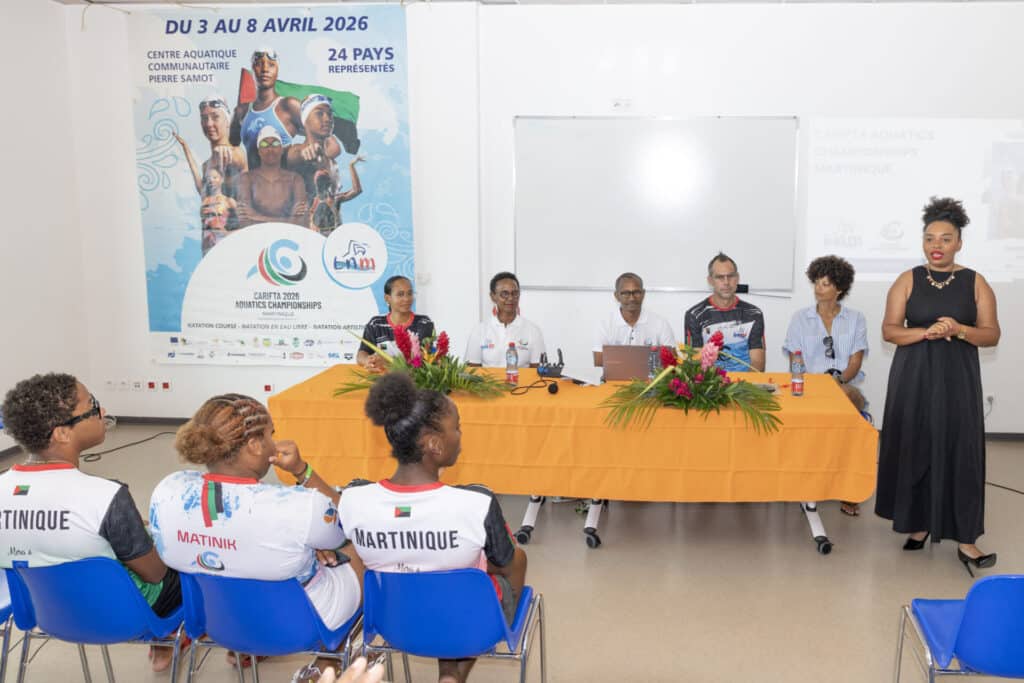
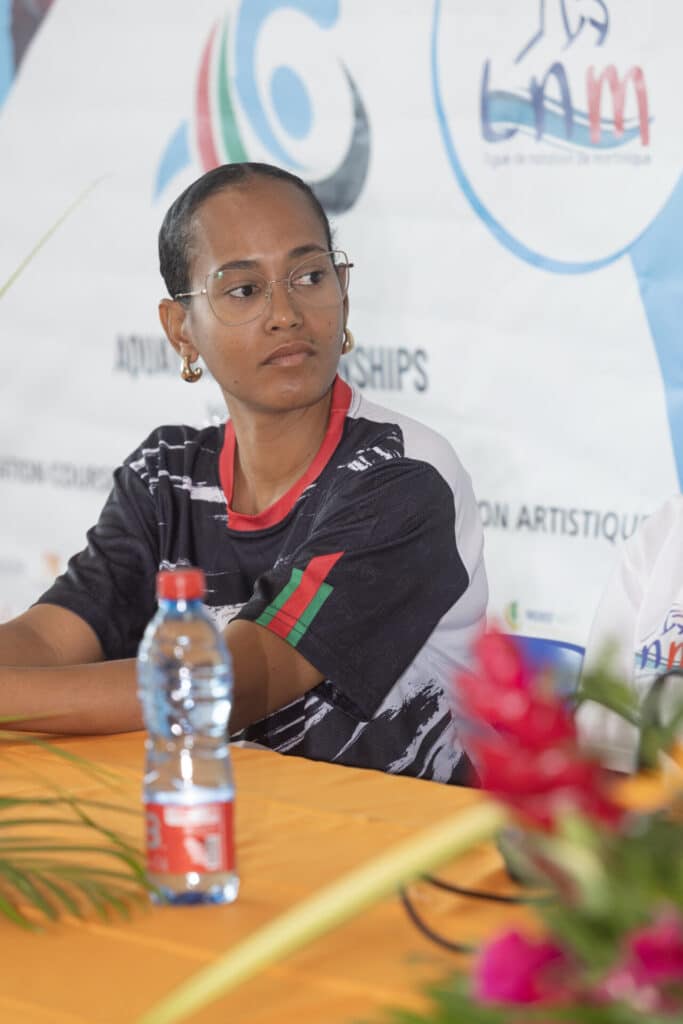
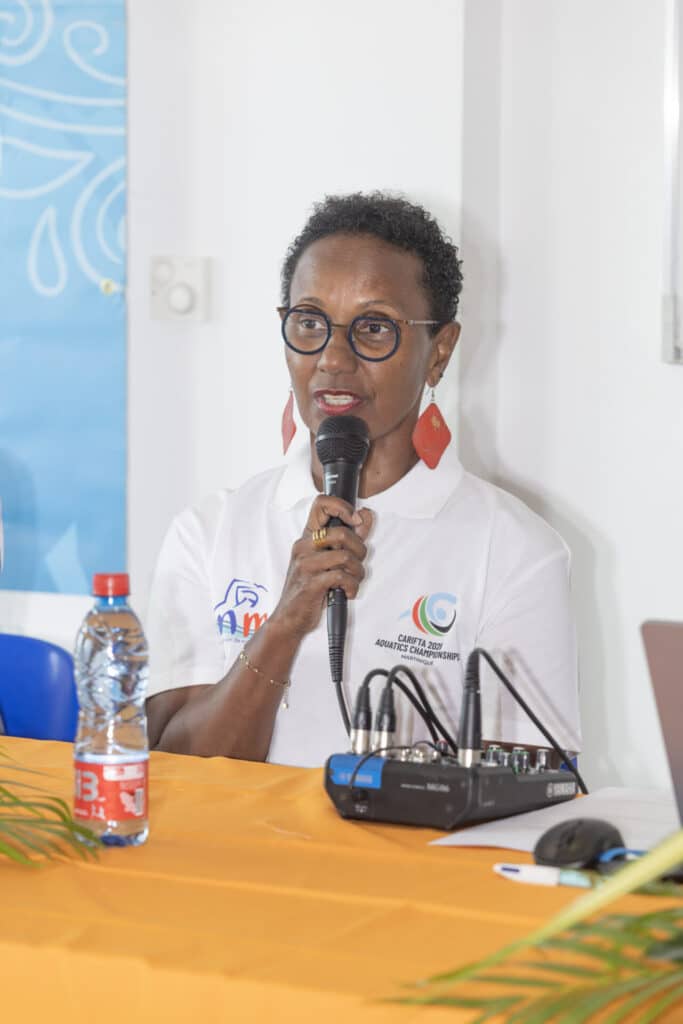
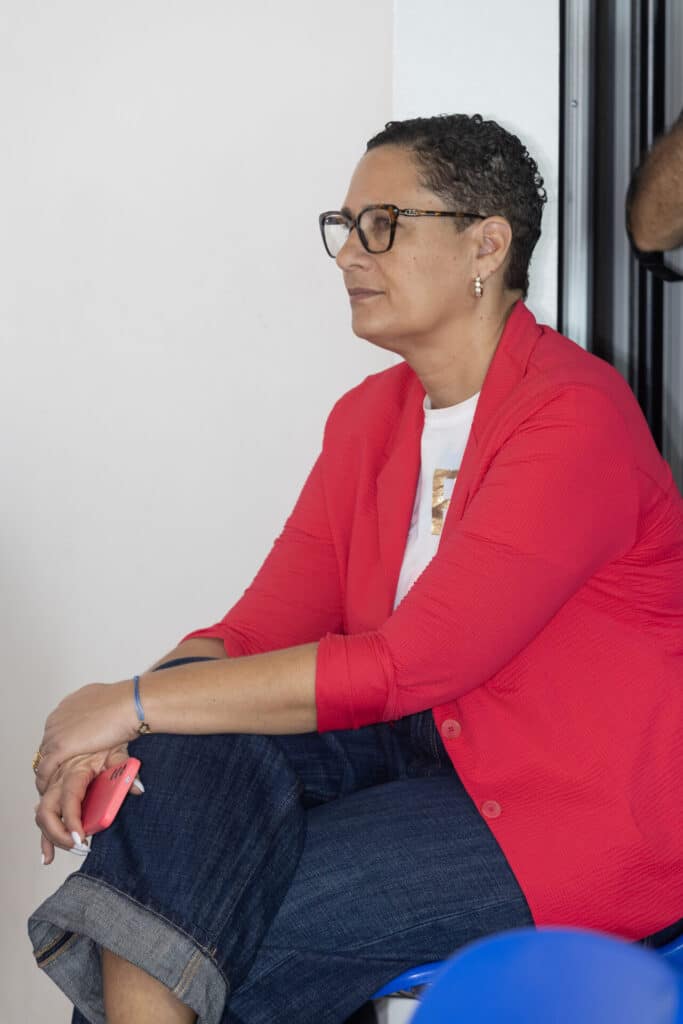
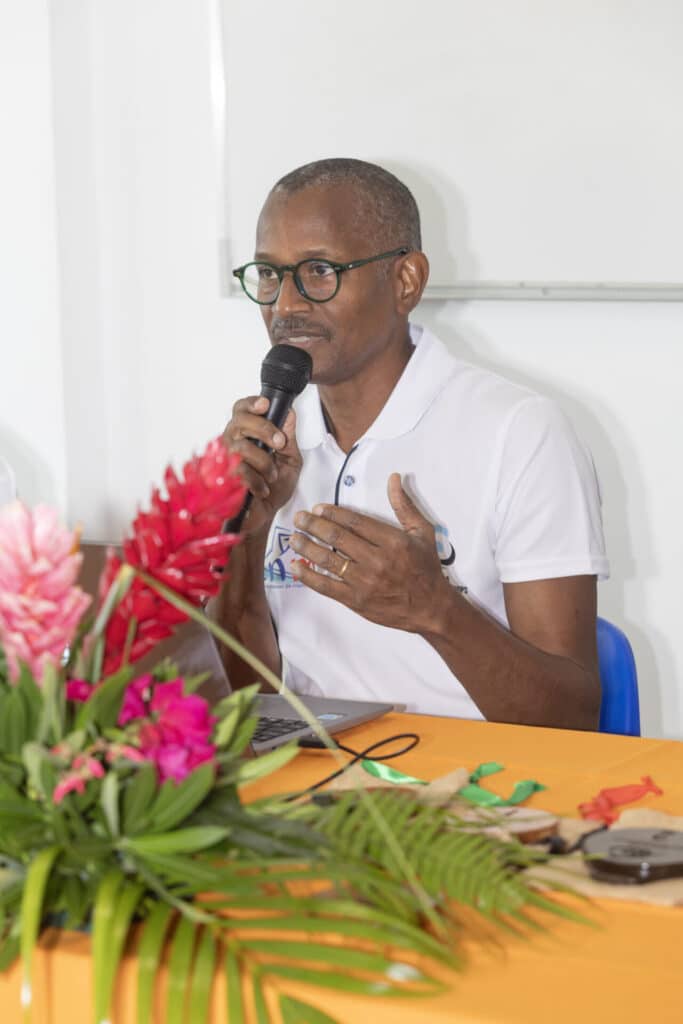
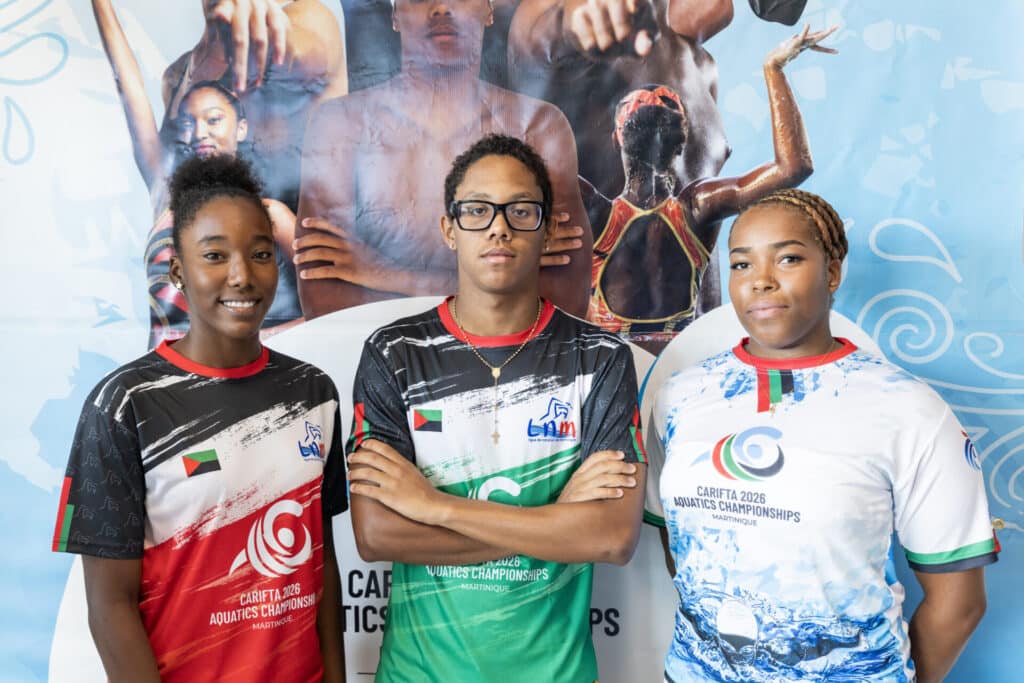
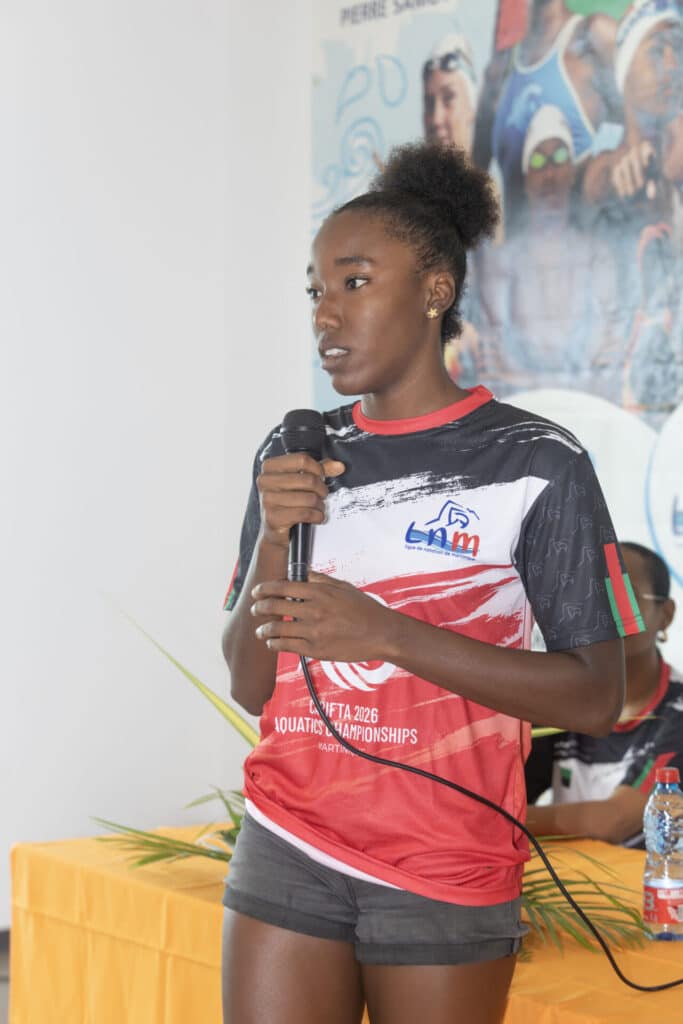
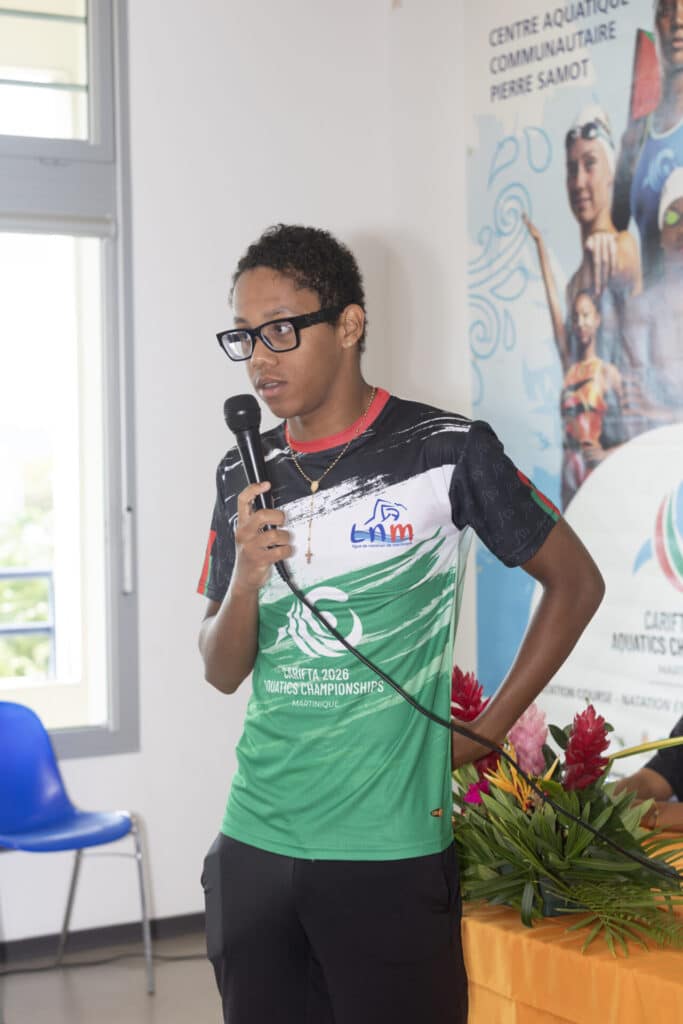
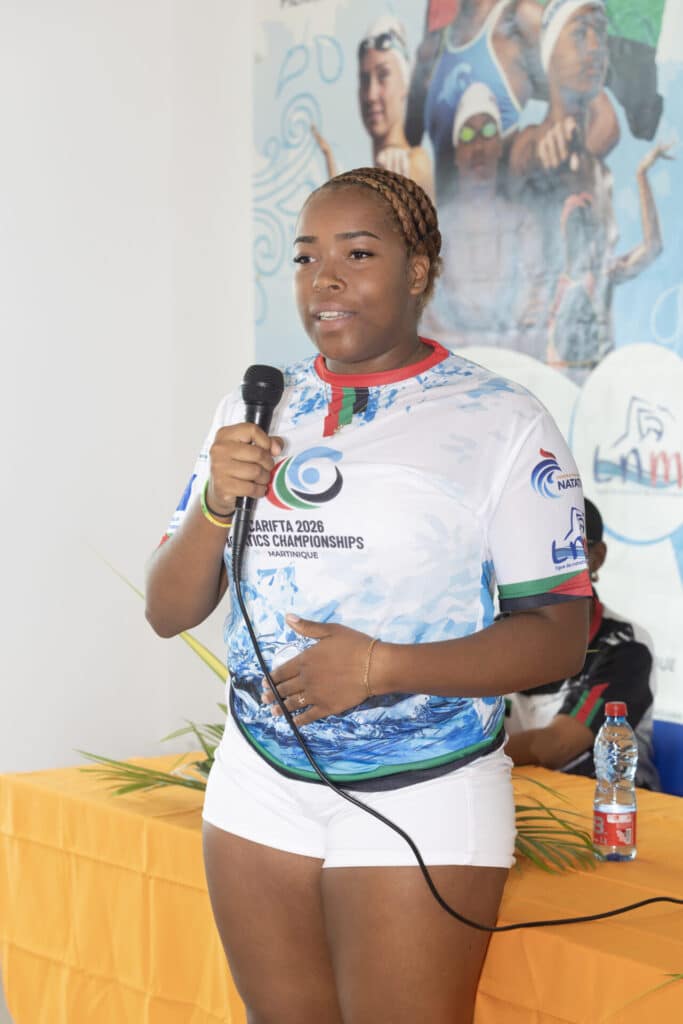
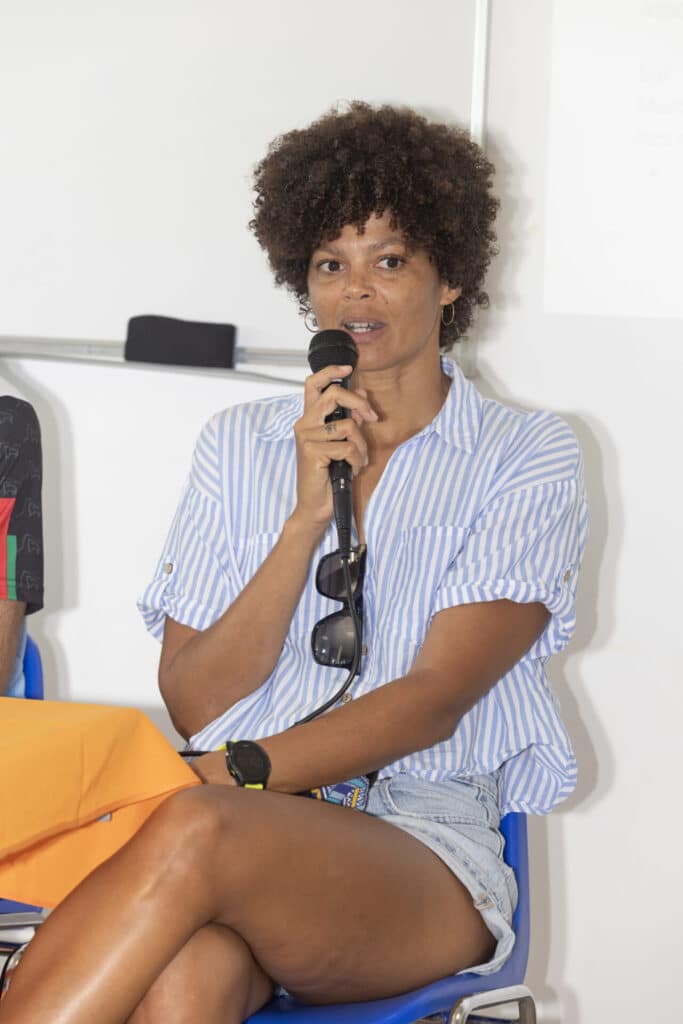
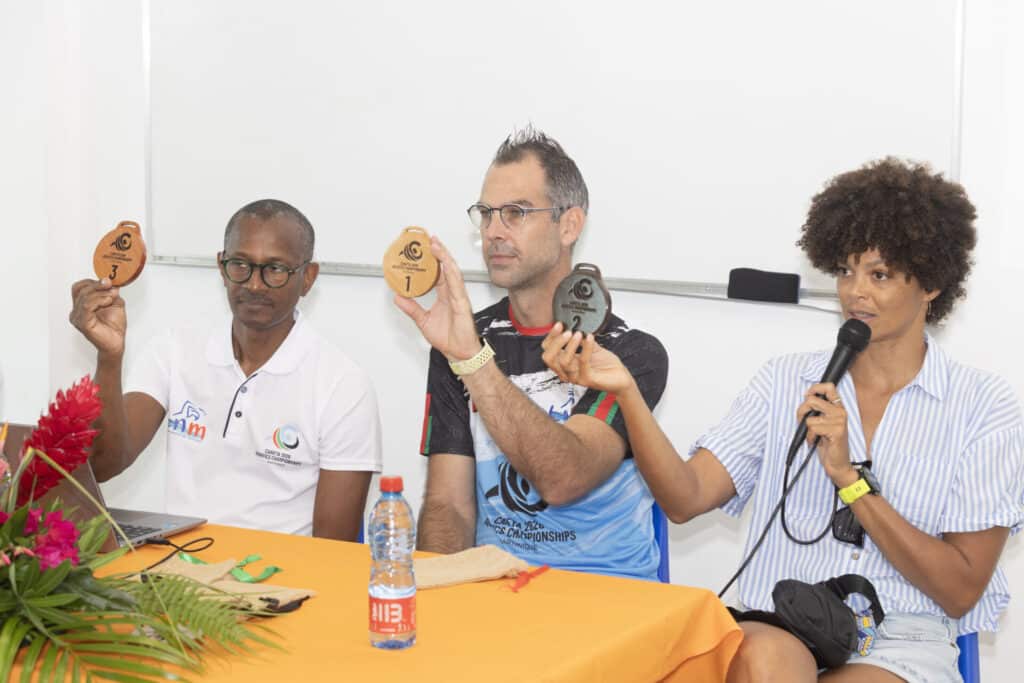
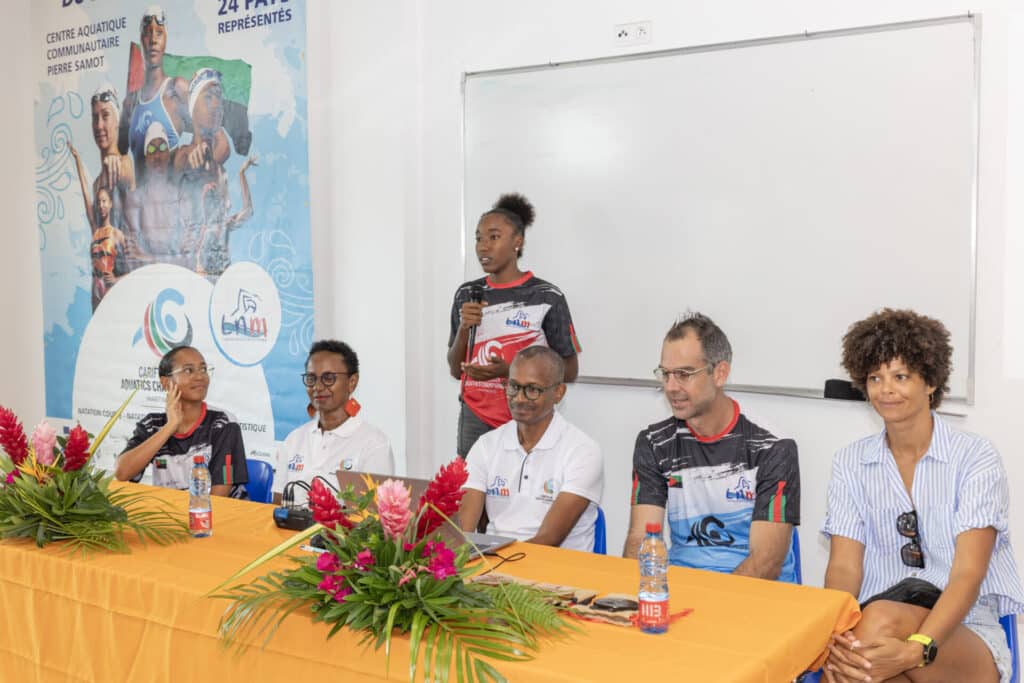
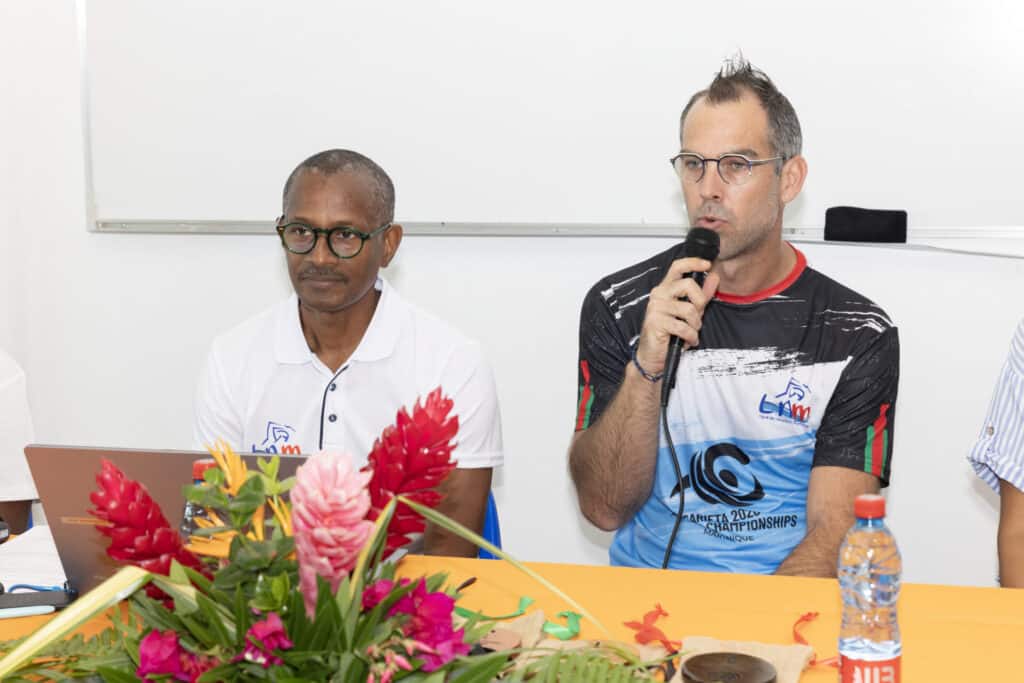
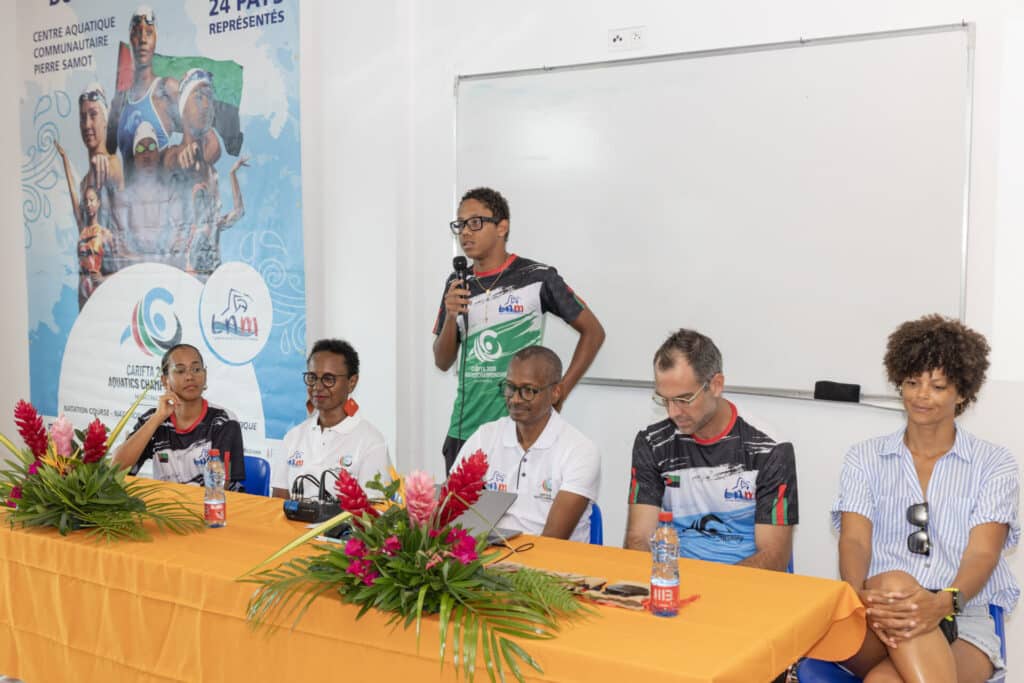
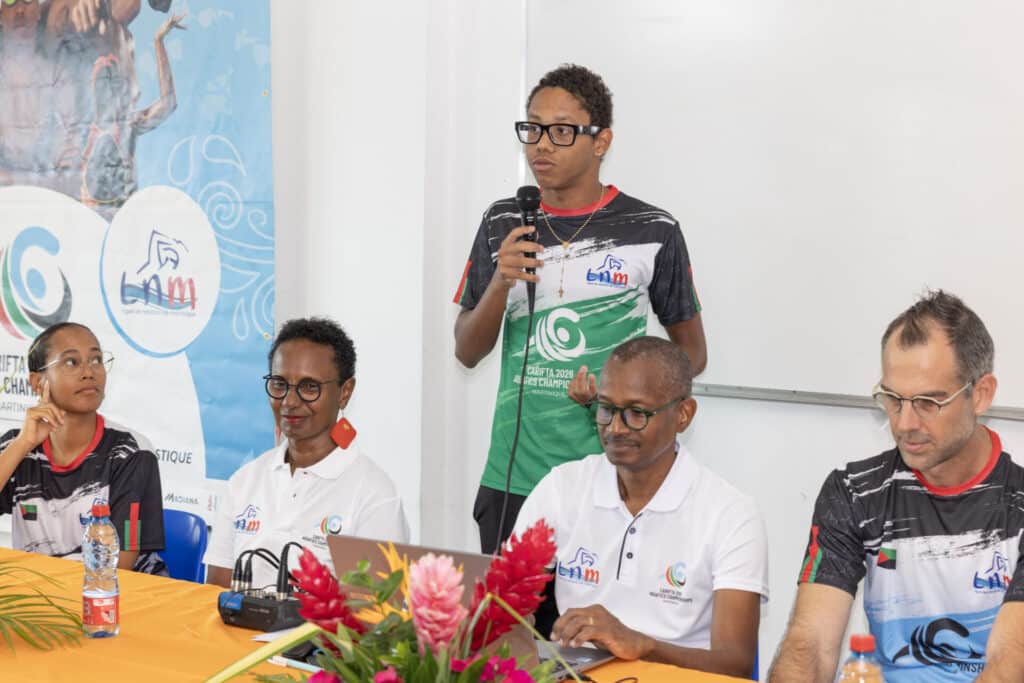
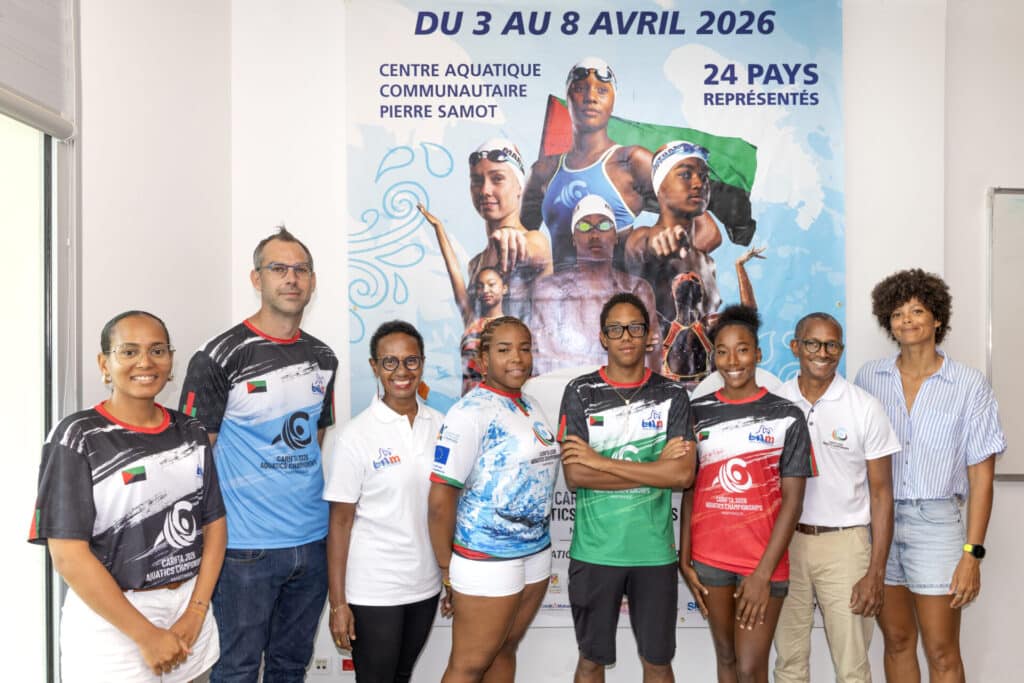
On Saturday March 28, at the Centre Aquatique Pierre Samot in Le Lamentin, the CARIFTA Aquatics Championships 2026 press conference was more than just an information meeting. Over the course of an hour and a half, organizers, athletes and partners presented much more than just the sporting program: from April 3 to 8, Martinique will host the 39th edition of the Caribbean’s leading junior aquatic event, ten years after the first edition was so memorable. Twenty-four nations. Three disciplines. A home territory that knows it.
A bid driven by collective memory
In 2024, at the Caribbean Aquatics Association Congress held in the Bahamas, two bids were put forward to host the 2026 CARIFTA Aquatics Championships: Saint Lucia and Martinique. The vote was clear-cut: some thirty votes for Martinique, ten for Saint Lucia.
Behind this result is a story. The 2016 edition, the first ever to be held on home soil, left its mark on the minds of all those who were there: coaches, delegation leaders, officials. In 2024, when it came time to vote, many still remembered that week.
"It was a beautiful edition, and one that will always be remembered."
The other factor was more concrete: Sainte-Lucie did not yet have its own pool. Martinique, on the other hand, can count on the Centre Aquatique Pierre Samot in Le Lamentin, with its ten-lane Olympic pool, 800-seat grandstand and 25-meter warm-up pool. One of the best facilities in the Caribbean.
The organization also emphasized its capacity to welcome delegations from outside the basin, with several accommodation solutions mobilized in the south of the island, supplemented by other structures if necessary. This logistical aspect, rarely secondary in this type of event, reinforced the credibility of Martinique’s bid.
Three disciplines, 24 nations, a demanding format
The CARIFTA Aquatics Championships 2026 will bring together 24 countries: 21 English-speaking Caribbean nations, plus Martinique, Guadeloupe and Guyana. The swimming races will take place over four days: heats in the morning, finals in the afternoon, from Saturday April 5 to Tuesday April 8. Artistic swimming gets underway on Monday during the lunch break, with solos followed by technical events. The duets and teams round off the program on Wednesday morning. On the same Wednesday, the open water event takes place over five kilometers in the Anses d’Arlets.
Competitors: Benjamins (11-12 years), Minimes (13-14 years), Cadets (15-17 years) do not enter as individuals. They are national selections, with the best swimmers from each territory. To enter the Martinique selection, swimmers must satisfy a time grid established over the previous two seasons, which only selects swimmers capable of reaching the finals.
In the minds of the organizers, selection is based on a simple logic: to score points, you have to enter the final, and to enter the final, you have to be among the top eight times in the morning heats. In other words, the swimmers selected are supposed to have a level that enables them to play a real role in the competition, and not just participate.
The Martinique delegation at the CARIFTA Aquatics Championships 2026 has 61 swimmers: 36 in racing, 12 in open water, five of whom also race, and 18 in artistic swimming. The team is led by five captains: Jean-Naël Zozime and Maxime Auguste-Charlery for boys’ racing (15-17 age group), Cyrielle Manin and Sayanne Guivissa for girls’ racing, and Nohemy Marajo for artistic swimming.
Water as starting point and destination
When asked how he got started, Jean-Naël Zozime, captain of the boys’ selection, answers straightforwardly: “I was introduced to swimming so that I wouldn’t drown. Cyrielle Manin, captain of the girls’ selection, tells much the same story: she almost drowned as a child, and that’s what led her to learn to swim.
These two testimonies, heard just a few minutes apart, say something important about this territory. Two young Martiniquans, initially frightened by the sea, who are now representing their island against twenty-three Caribbean nations. This is more than just a sporting achievement.
"Swimming is a tough sport. You can't expect it to be easy, but with a lot of perseverance, anyone can do it."
— Jean-Naël Zozime
Nohemy Marajo, artistic swimming captain, has been practicing for ten years a discipline that the public still knows little about. She explains it concretely: learning choreographies on dry land, rehearsing them in the water, controlling your breathing under the surface while your legs draw figures above. It’s a sport that’s as technically demanding as it is physically demanding, and has as much to do with ballet as it does with endurance.
"You have to know how to endure, how to save every last breath to finish the choreography."
— Nohemy Marajo
The conference of the CARIFTA Aquatics Championships 2026 also pointed out that artistic swimming is still a confidential discipline in the Caribbean, due to the infrastructure it requires and the level of preparation required. It requires three-dimensional work and very thorough technical preparation, as well as the support of outside professionals, particularly in dance and gymnastic preparation. For the supervisors, the challenge of CARIFTA is twofold: to support those who are already practising and to encourage new vocations.
What the coaching team observes in these youngsters is a constant: they train, take their exams, compete at weekends, and do it all over again. “Generally, swimmers perform well in their studies too, because they’ve worked on this rigor on a daily basis.” What you learn in the pool also applies elsewhere, and the organizers insist on this daily requirement: it’s not enough to qualify, you have to be able to show up on the day, in a sport where regularity and discipline count as much as talent.
Medals from the hands of the island
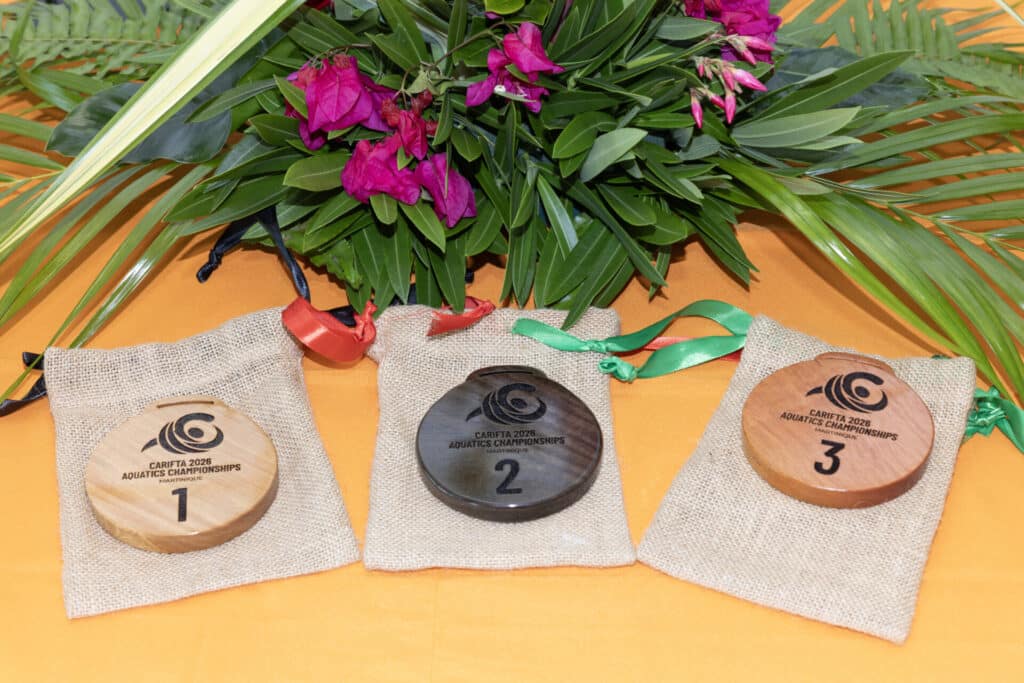
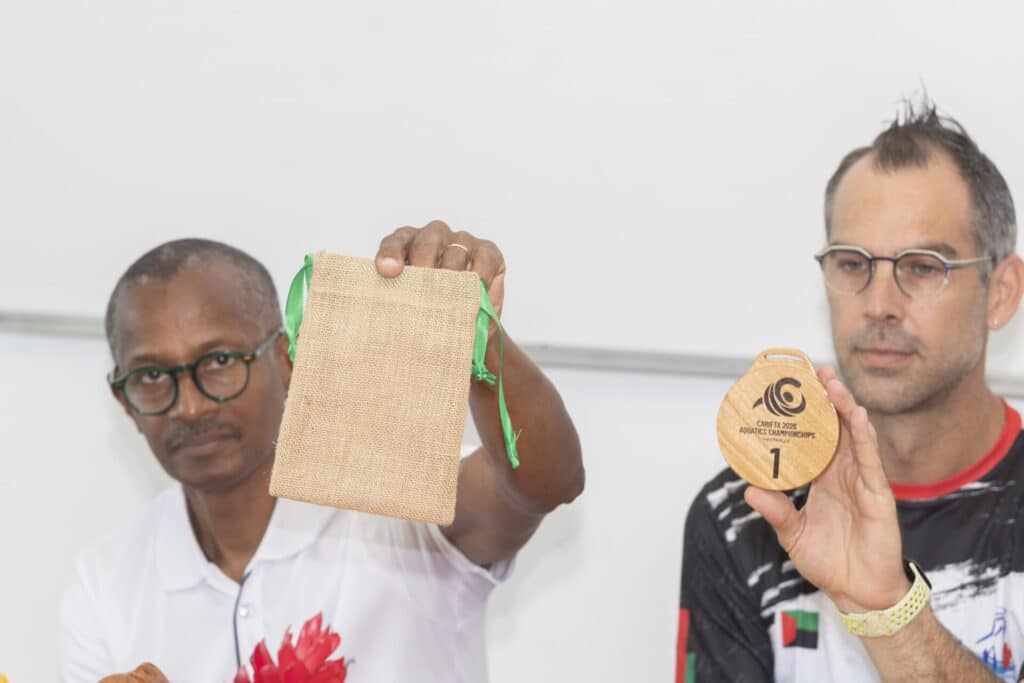
The way an event rewards its champions often says a lot about what it stands for. At the CARIFTA Aquatics Championships 2026, the medals were made in Martinique from noble woods: pearwood for gold, mao bleu for silver, mao ghani for bronze. A craftsman from the Nord-Atlantique region produced them, Joseph Galliard signed the engravings, and a local seamstress made the pouches in the three colors of the Martinican flag.
The initiative was spearheaded by the event’s godmother, Coralie Balmy, a former top-level swimmer who had taken part in the CARIFTA four times in her career. An eco-responsible and identity-affirming initiative, hailed as a first on the Caribbean scale.
Every Caribbean athlete who reaches the podium at the CARIFTA Aquatics Championships 2026 will leave with a piece of Martinique, a unique medal made by local craftsmen, unlike any other.
The conference also specified that trophies would accompany these awards, and that the medals had yet to receive their lanyards before the competition opened. Here too, the aim is clear: to make each award a sporting, local and symbolic object.
A week that mobilizes the whole territory
The CARIFTA Aquatics Championships 2026 won’t just be played out in the pools. Between 1,500 and 1,800 people are arriving in Martinique: swimmers, staff and families spread out over several hotels in the south of the island. Every day, around 150 volunteers ensure the smooth running of the event: former swimmers, parents, locals who sometimes have no direct connection with swimming, but who wanted to get involved.
Among them, the officials play a decisive role: some 26 officials from the Caribbean will reinforce the Martinique officials, bringing the number of people around the pool to around fifty for each morning and afternoon meeting. In addition, there will be first-aid attendants, reception teams, people in charge of awards, delegation escorts and areas open to the public.
Welcoming delegations to the CARIFTA Aquatics Championships 2026 was also thought through in detail. They all had to arrive on April 2, at different times of the day, sometimes very early in the morning, sometimes late at night. In conjunction with the transport company and SAMAC, a precise plan was drawn up at the airport to ensure smooth exits, transfers to buses and settling into accommodation, with particular attention paid to meals depending on the time of arrival.
The opening ceremony of the CARIFTA Aquatics Championships 2026, on Friday April 3 at the Georges Gratiant stadium, is free and open to all: 2,800 seats to fill. The group “Nou Pa Sav” will accompany the parade of delegations. On Saturday, April 4, Les Hommes d’Argile will be on hand as the delegations arrive on site, offering a strong cultural backdrop intended as a symbolic first encounter with Martinican identity. Throughout the week, Martinican cultural groups will be on hand to ensure that visitors leave with a living image of the region, not just competition results.
The CARIFTA Aquatics Championships 2026 ceremony is scheduled to take place from 4 to 6 p.m., and will be broadcast on a giant screen, as well as relayed by media partners and via YouTube for wider distribution in the Caribbean. The ambition is clear: to make Martinique the center of the Caribbean for the duration of the event.
In addition to sport, the organizers of the CARIFTA Aquatics Championships 2026 also have an economic and cultural objective. Bringing in up to 1,800 people means filling accommodation, generating consumption, encouraging car rentals and putting the hotel and restaurant sectors to work. It’s also a way of showcasing Martinique’s culture, notably through the entertainment planned for the opening ceremony and the arrival of the delegations.
The open water event at Anses d’Arlets also serves as a reminder that the sea is a living, fragile environment that deserves protection. The association’s representative at the conference sums up its mission simply: “learn to swim to discover the seas and protect them.”
This educational dimension goes beyond drowning prevention. It also touches on the appropriation of water by the people of Martinique, the discovery of the discipline by the youngest and the broader desire to reinforce the region’s aquatic culture in the long term.
An assertive island
A phrase uttered at the end of the conference sums up the general mood: “We’re ready, and we’ll make the CARIFTA Aquatics Championships 2026 a collective success and a great source of pride for our region.”
What the delegations take away with them on the evening of April 8 is more than just a ranking. It’s an image of Martinique, a territory that knows how to welcome, organize and assert its identity. For six days, the whole Caribbean will be there. It’s up to Martinique to show what it can do.
But the organizers of the CARIFTA Aquatics Championships 2026 also want to leave their mark after the event. The Ligue de Natation de Martinique ended the 2024-2025 season with some 2,540 members, around ten affiliated clubs and, generally speaking, 7 to 8 clubs involved in competition. With this in mind, the CARIFTAs are not intended as a parenthesis, but rather as a possible catalyst to encourage vocations, boost membership and establish swimming as a permanent fixture on the Martinique sports scene.
The organizers of the CARIFTA Aquatics Championships 2026 have also chosen not to reproduce the large village of 2016. In 2026, the activities surrounding the competition are to be more focused, with one day in particular being highlighted, in order to concentrate energy and attendance rather than scattering the highlights.
The CARIFTA Aquatics Championships 2026 is the 39th edition of the Caribbean’s leading junior aquatic event, held in Martinique from April 3 to 8. Twenty-four nations are taking part in racing, artistic and open water swimming, in categories ranging from 11 to 17 years of age.
The swimming race and artistic swimming events take place at the Centre Aquatique Pierre Samot in Le Lamentin. The 5-kilometer open water event takes place in Anses d’Arlets on Wednesday April 8.
Tickets are available on cariftamartinique2026.com and on the Ligue de Natation de Martinique social networks. Prices: €10 in the morning, €20 in the afternoon for adults, 4-day pass at €125. The opening ceremony at the Georges Gratiant stadium is free of charge.
Twenty-four countries are taking part: 21 English-speaking Caribbean nations, plus Martinique, Guadeloupe and Guyana.
The Martinique squad is led by five captains: Jean-Naël Zozime and Maxime Auguste-Charlery for boys’ racing, Cyrielle Manin and Sayanne Guivissa for girls’ racing, and Nohemy Marajo for artistic swimming.
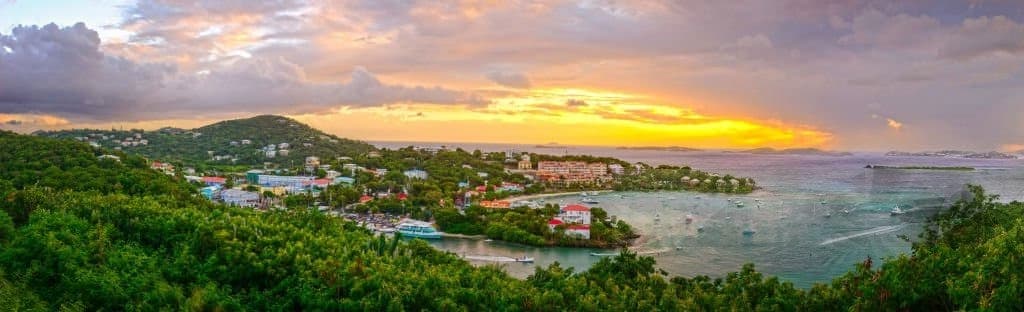
In the U.S. Virgin Islands, Saint John occupies a singular place. More discreet than St. Thomas, less urbanized, it was built around a simple principle: preserve your land. Today, almost 60% of the island is part of the Virgin Islands National Park, directly shaping its landscape, economy and organization.
For travelers, Saint John represents a legible destination: a compact island, accessible beaches, a structuring national park and local life concentrated around a main center, Cruz Bay. This configuration makes it possible to quickly understand the territory, without dispersion or saturation.
A large-scale protected island
Virgin Islands National Park was created in 1956 thanks to a major land donation. Since then, it has covered most of Saint John’s land territory, as well as protected marine areas. This configuration limits real estate development and maintains large areas of unspoiled nature. Tropical dry forests, hills, mangroves and coral reefs make up most of the landscape. Roads are few and far between, and inhabited areas are concentrated mainly around Cruz Bay and Coral Bay. This territorial organization gives the island an airy character, without excessive urban continuity, which reinforces the feeling of space for visitors.
The national park also offers signposted trails through old plantations, viewpoints and forested areas. For travelers interested in history and nature, these trails offer a complete overview of the territory. The island can be explored both on foot and by sea.
Accessible but unspoilt beaches
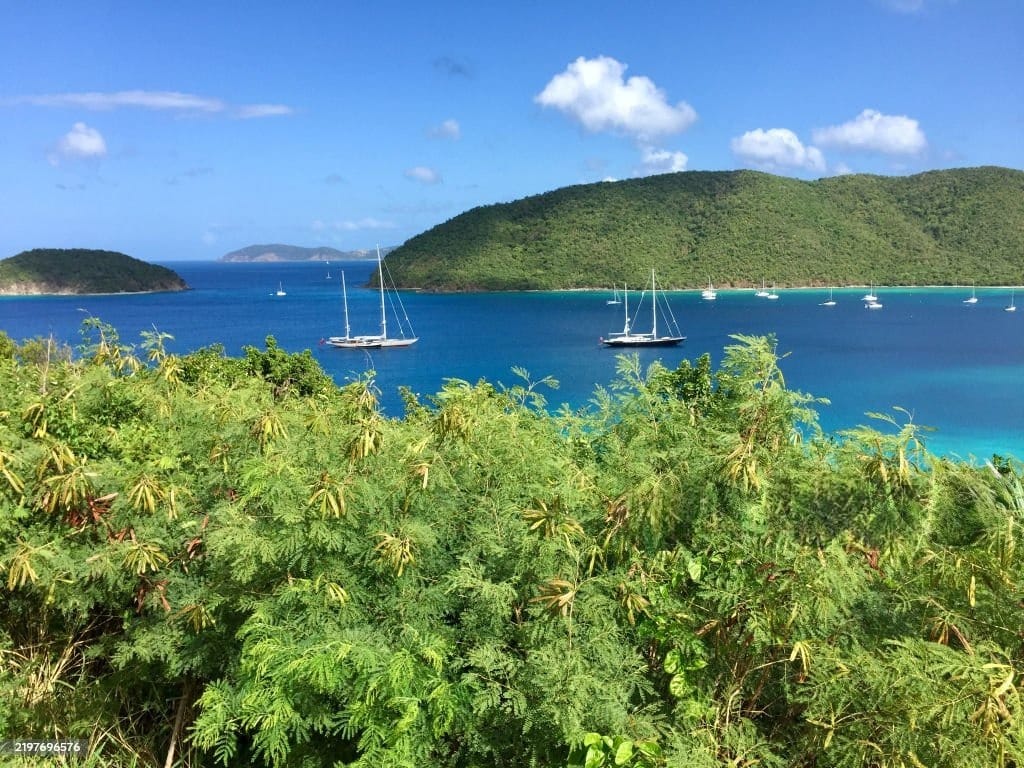
Saint John is renowned for its clear beaches bordered by reef-protected waters. Trunk Bay, Cinnamon Bay and Maho Bay are among the best-known sites. What they all have in common is that they are part of the national park and benefit from strict environmental protection. Access is provided, but construction remains limited. The aim is to keep visitor numbers under control and preserve marine ecosystems. This approach reinforces the image of an island focused on quality rather than tourist density.
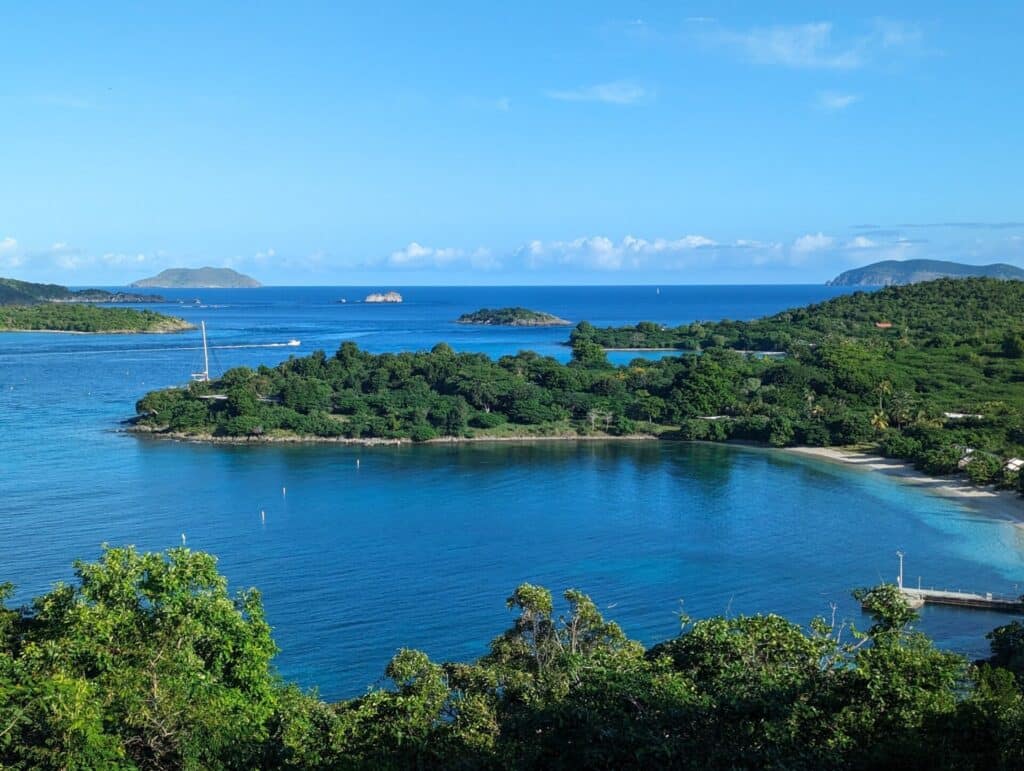
Some of the less-frequented beaches also reveal a different facet of the coastline. They are a reminder that the island retains many open spaces, free from intensive occupation. This availability contributes to the balance between visitors and residents.
A history visible in the landscape
Before becoming an American territory in 1917, Saint John was part of the Danish West Indies. The island has preserved traces of this period, notably through the ruins of sugar plantations scattered throughout the national park. These remains are a reminder of the colonial economy based on sugar cane and forced labor. Today, they are historical landmarks accessible to visitors, often linked by footpaths. History isn’t just to be found in museums: it’s inscribed in the landscape, stone walls and ancient farm tracks.
A controlled tourism economy
Tourism is Saint John’s main economic driver. Unlike other Caribbean destinations, the island has no international airport. Access is by ferry from St. Thomas, which naturally limits visitor flows and encourages a gradual arrival of visitors. This logistical constraint contributes to the balance of the region. Stays are generally longer, encouraging more attentive discovery. The accommodation offer is based on medium-sized hotels, villas and private rentals, rather than large complexes. This organization maintains a human scale.
Simple organization for travellers
The center of Cruz Bay is home to shops, restaurants and services. Coral Bay, further east, is more residential and less busy. Travel is mainly by car, as the roads are hilly and narrow. This configuration encourages you to take it easy and explore the island gradually. To reach Saint John, you must first land in Saint-Thomas, then take a twenty-minute ferry ride. This maritime transition marks your entry into a different territory, where the sea remains omnipresent.
A coherent Caribbean destination
Highlighting Saint John means presenting an island where land protection structures all development. The predominant presence of the national park limits urbanization, controls access to beaches and preserves landforms. For travelers, the island offers a clear combination of protected nature, accessible beaches, visible historical heritage and sufficient infrastructure. Saint John doesn’t seek to multiply its attractions; it offers a stable, organized and sustainable territory turned towards the sea. This coherence gives the island a special value in the contemporary Caribbean, where land management is becoming a central issue for the future of island tourism.
Saint John is part of the U.S. Virgin Islands in the eastern Caribbean, east of Puerto Rico and close to St. Thomas.
The island is famous for the Virgin Islands National Park, which protects around 60% of its territory, as well as for its beaches and coral reefs.
You’ll need to fly into St. Thomas, then take the ferry to Saint John in about twenty minutes.
The U.S. Virgin Islands assert their cultural and tourist uniqueness
At Seatrade Cruise Global 2025 in Miami, the US Virgin Islands (USVI) highlighted what makes them unique in the Caribbean:
a unique cultural heritage, stemming from a Danish history that is still very much alive, combined with an ambitious, sustainable cruise strategy.
Through the voice of Alani Henneman, Deputy Commissioner of the US Virgin Islands Department of Tourism, the archipelago affirms its desire to combine tourism growth with the preservation of its plural identity.
Three islands, three experiences, authentic hospitality
Tourism, the territory’s leading industry, relies heavily on cruises.
With 1.8 million cruise passengers this year and a forecast of 1.9 million next year, the USVI has confirmed its strategic position on Caribbean itineraries.
Cruising is a year-round activity, with a slight low season in summer.
Efforts made during the pandemic to improve port infrastructures are now bearing fruit: better traffic flow, better flow management, and an upscale customer experience.
Comprising St. Thomas, St. John and St. Croix, the US Virgin Islands offer a diversity that is rare in the Caribbean.
Each island boasts its own unique atmosphere:
Saint-Thomas, vibrant and dynamic,
Saint-John, unspoilt and wild,
Saint-Croix, steeped in culture and history.
🎯 Alani Henneman’s stated aim: to make the USVI not just a stopover, but a real gateway to discover the richness of the region.
Turning a stopover into a cultural immersion
For Alani Henneman, the major challenge now lies in transforming the cruise experience.
” We have a strong cultural identity that we want to share: the quadrille, Danish architecture, our music and traditions. That’s what we want visitors to experience. “she explains.
The development of new themed excursions and the improvement of the hotel offer are at the heart of the strategy.
The ambition is clear: to encourage cruise passengers to extend their stay, by offering them authentic and memorable experiences.
🎯 If she could grant a wish, Alani Henneman would like to see the creation of new hotels, to turn even more passing visitors into long-term tourists.
USVI, between living roots and the future of tourism
At Seatrade Cruise Global 2025, the US Virgin Islands reaffirmed that it is possible to combine historical heritage, modern tourism and a warm welcome.
By capitalizing on the uniqueness of their history and the diversity of their islands, they are charting an ambitious course:
to make every cruise a true voyage to the heart of an authentic, proudly preserved Caribbean identity.