In St. Vincent and the Grenadines, the Garifuna language could leave the circle of commemorative speeches and enter the classroom more clearly. At the 13th International Garifuna Conference, Prime Minister Dr Godwin Friday called for the language to be taught as an essential subject. The announcement touches a deep nerve: that of an Afro-Aboriginal memory long displaced, but never extinguished.
A highly symbolic political statement
The choice of location and subject is not insignificant. In Saint-Vincent and the Grenadines, to speak of the Garifuna language is to return to one of the founding territories of this history. This people, born of African and indigenous Caribbean encounters, carries a memory of resistance, exile and transmission that extends far beyond the borders of the city.
By placing the school at the center of his appeal, Dr. Godwin Friday isn’t just talking about a program to be added. He refers to education as a space where a language can once again become alive, useful, understood and proudly spoken. It’s a major difference between honoring a heritage once a year and giving it a regular place in children’s education.
A language that keeps more than words
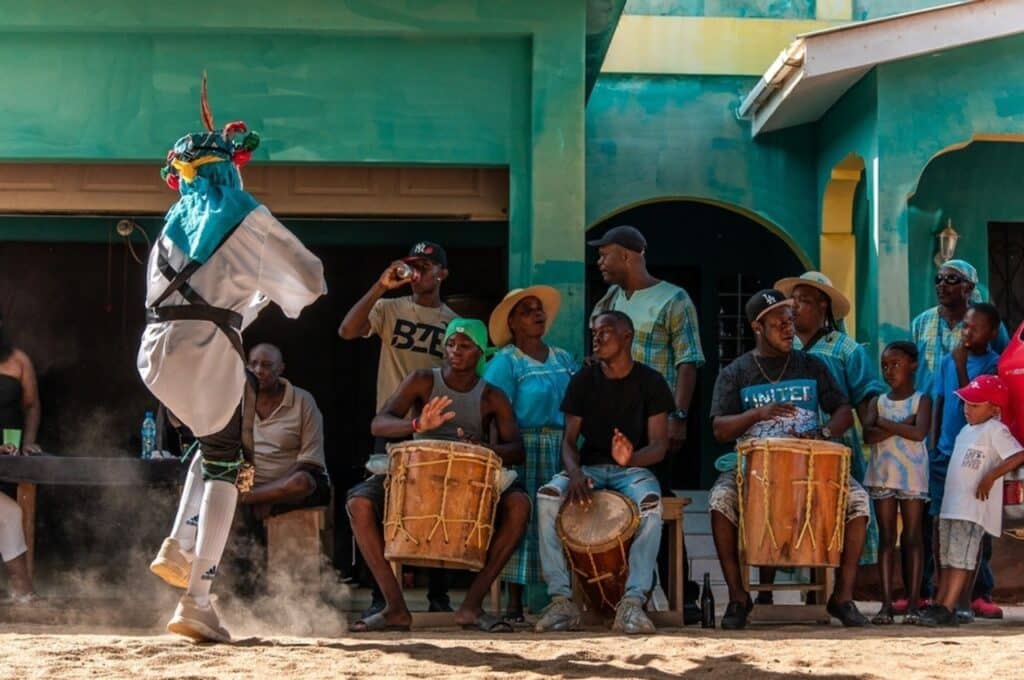
The Garifuna language is not just a vocabulary to be protected. A language preserves ways of naming the sea, the land, kinship, plants, everyday gestures and stories passed down through the family. When it recedes, a whole memory system becomes less audible. This is why school can play a decisive role. A child learning the Garifuna language doesn’t just learn new words. They can also reconnect with a song, a place name, a family history, an ancient practice. Transmission then becomes more concrete, less dependent on a few specialists or one-off events.
For students, this approach can also turn pride into knowledge, by linking public ceremonies to family realities, local archives and the voices of elders who still keep the language alive today.
Worldwide recognition, but a future to build
UNESCO recognizes the Garifuna language, dance and music as Intangible Cultural Heritage of Humanity. The organization also points out that the Garifuna language belongs to the Arawakian group and has survived centuries of discrimination and linguistic domination. This international recognition gives special significance to the debate in Saint Vincent and the Grenadines.
But heritage listing is not enough to save a language. It can attract attention, support research and reinforce pride. It does not replace teachers, textbooks, teaching hours, adapted methods or opportunities to speak the language outside the classroom. The survival of the Garifuna language will therefore depend on concrete, long-term decisions.
From Saint Vincent to the Garifuna diaspora
This possible school turning point also resonates beyond the Vincentian archipelago. Garifuna communities can be found in Belize, Honduras, Guatemala and Nicaragua. In these territories, language, music and traditions continue to convey a strong identity, often weakened by migration, economic pressures and the domination of more powerful languages.
If Saint Vincent and the Grenadines moves forward on this front, it will send out an important signal. The country would no longer speak of the Garifuna language only as a historical heritage. It would treat it as a cultural skill to be passed on to new generations. This nuance changes everything: it moves memory from the museum to the classroom.
The challenge starts now
Caution is still called for. The Prime Minister’s call does not yet mean that a complete reform has already been implemented in all schools. The real test will come with the practical choices: which levels will be covered, who will train the teachers, what media will be used, what place will be given to speakers and memory keepers? These questions will determine the real strength of the project. A language cannot be repaired with a slogan. It is reinstated through use, patience and respect for the communities that use it.
If the Garifuna language becomes a permanent fixture in schools, Saint Vincent and the Grenadines will not only be teaching children a language. The country will give children a key to understanding an essential part of their history. And in this key, the whole Caribbean could recognize a common question: what remains of a people when its language is no longer transmitted?
The Garifuna language could be taught in the schools of Saint Vincent and the Grenadines to reinforce the transmission of an Afro-Aboriginal heritage linked to the country’s history. The issue is not just linguistic: it also concerns memory, identity and the role of the younger generations in preserving a culture that has long been under threat. By entering the classroom, this language could become a concrete tool of knowledge, pride and cultural continuity.
We must remain cautious: at this stage, we cannot claim that the Garifuna language is already compulsory in all schools in Saint Vincent and the Grenadines. What we are hearing today is a strong political call for it to be taught as an essential subject. For such a measure to become effective, concrete decisions will be needed: official curriculum, teacher training, teaching aids, timetable for implementation and a place for Garifuna speakers.
The Garifuna are a people of African and indigenous Caribbean heritage, with a history strongly linked to Saint Vincent and the Grenadines and several Central American territories. The Garifuna language is one of the major expressions of this identity. It carries stories, songs, place names, family knowledge and a collective memory. That’s why teaching it in schools would have a wider scope than simply learning the language: it would contribute to the transmission of an entire culture.