The port of Saint Barthélemy is currently the focus of much attention. Faced with growing saturation, the local authority has launched an expansion project, essential to guaranteeing the smooth flow of trade and the island’s prosperity. Here are the issues, challenges and future of this essential infrastructure.
The port of Saint Barthelemy : the island's backbone
An irreplaceable economic role
The port of Saint Barthélemy is more than just a quay where ships dock. It is the logistical heart of the island, through which cement, vehicles, foodstuffs, fuel and various parcels pass every day. For Saint Barthelemy, where almost everything is imported, the port is synonymous with economic survival and social stability. Without it, business and daily life would come to a standstill.
An ever-increasing variety of goods flows
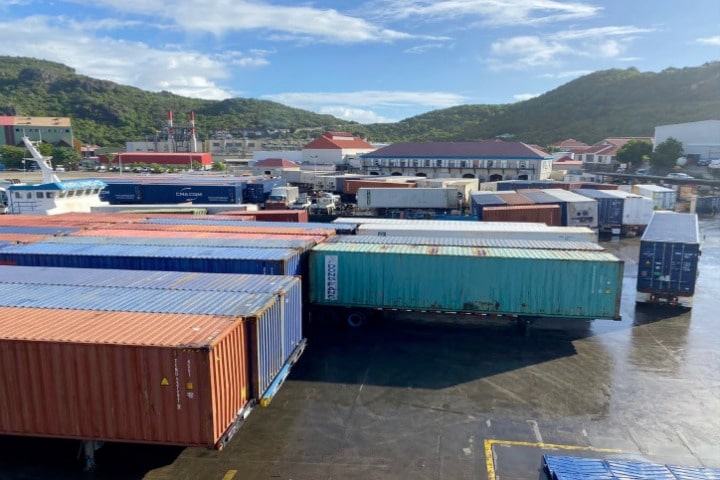
Every year, the port of Saint Barthélemy sees an impressive variety of goods pass through its doors. Containers of fresh produce, building materials, cars, fuel and even equipment for luxury hotels and villas pass through its quays. This diversity of flows underlines the port’s strategic importance for the entire community.

Saturation threatens logistical balance
Unprecedented traffic growth
For the past ten years, traffic at the port of Saint Barthelemy has been growing steadily. After Hurricane Irma and the economic recovery, the island saw a doubling in the number of containers imported. In 2023, nearly 8,500 containers and over 7 million liters of fuel were unloaded. This exponential growth is putting a strain on existing infrastructures.
Practical consequences in everyday life
Lack of space leads to major difficulties. Maneuvering areas are narrow, containers, barges and tankers are difficult to accommodate, and operations are sometimes confused. On some days, it’s almost impossible to simultaneously manage the unloading of a tanker and the arrival of general cargo, which slows down the supply of goods to the island and creates tensions among professionals in the sector.
A necessary expansion project
An investment of 10 million euros
Faced with this saturation point, the local authorities have decided to invest 10 million euros to expand the port of Saint Barthélemy. The project, entirely financed locally, aims to create 2,200 m² of additional quay space, representing an increase of more than 20% in operational surface area. The work, which will take five months to complete, is expected to improve traffic flow and operational safety.
Planning for the future
The expansion is not just about adding space. It also involves reorganizing flows, separating unloading areas, creating dedicated spaces for refrigerated containers and reinforcing security around sensitive installations, such as the drinking water production plant. The inner dock will be filled in to provide a new storage and handling area to meet the island’s growing needs.
The challenges of port management in Saint Barthelemy
Coexistence of different types of traffic
One of the main challenges remains the simultaneous management of different types of traffic. Containers, fuel, unloading barges: each activity has its own constraints. Expansion must be accompanied by more rigorous organization to avoid conflicts of use and guarantee the safety of all those involved.
Regulate to avoid further saturation
Expanding the port also means running the risk of further traffic growth. To avoid further saturation, the local authority is considering modulating the port tax according to the length of stay of goods, in order to encourage regular rotation and limit quay congestion. This regulation will be essential to maintain the port’s efficiency over the long term.

The port of Saint Barthelemy, a pillar of public finances
Quay dues: a major resource
A 5% wharfage charge is levied on all goods unloaded. This tax, which replaces VAT on the island, brings in almost 23 million euros a year for the local authority, making the port the second-largest source of public revenue after property transfer taxes. This simple, effective tax system enables the island to finance its infrastructure without resorting to debt.
A direct impact on island life
Revenues generated by the port account for almost a quarter of the community’s budget. They are used to finance investment in schools, health, roads and safety. The smooth running of the port therefore determines not only the supply of goods to the island, but also the quality of life of its inhabitants and the community’s ability to invest in the future.
Expanding the port is much more than a simple infrastructure project. It’s a concrete response to current saturation and a gamble on the island’s economic future. Thanks to this investment, the port of Saint Barthelemy will be able to continue playing its role as the backbone of the island’s supply, security and prosperity for years to come.