Lake Enriquillo: About 40 meters below sea level, a Caribbean giant

Lake Enriquillo

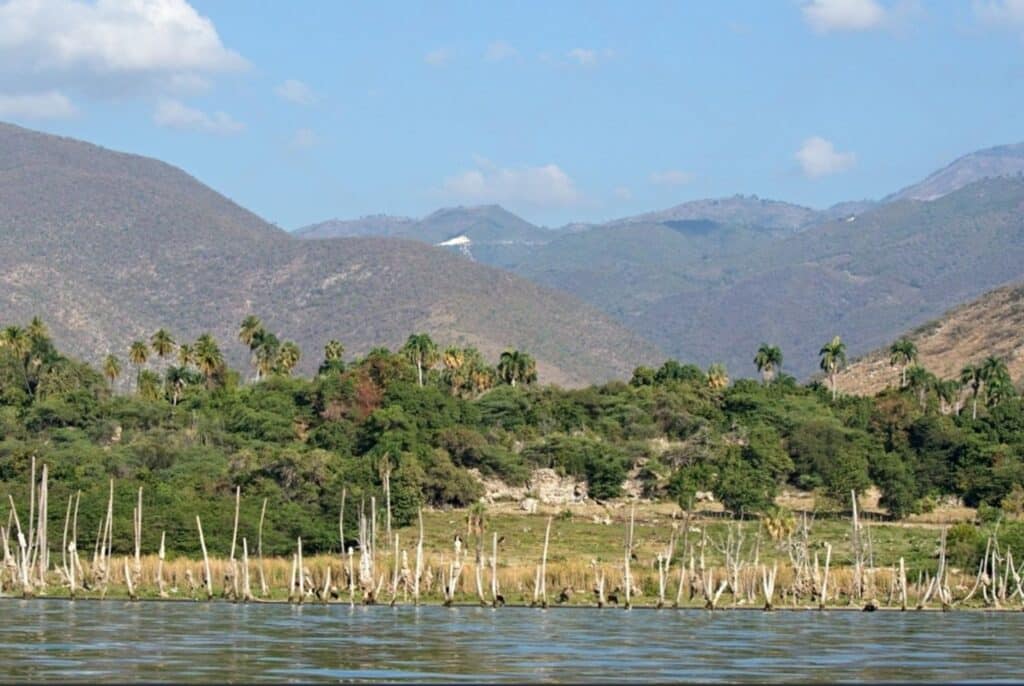
In the southwestern part of the Dominican Republic, the landscape seems to defy geography. Lake Enriquillo, said to be the largest lake in the Caribbean, lies in a depression whose surface is 40 meters below sea level. It is a vast saltwater lake with no outlet to the ocean, home to American crocodiles and iguanas. Behind this very concrete scene lies a much broader question: how did such a unique lake come to be here, and what does it reveal about the territory that surrounds it?

Lake Enriquillo, a lake with no outlet to the sea

One of the keys lies in the very shape of the basin. The United States Geological Survey (USGS), a government research agency specializing in Earth sciences, describes Lake Enriquillo and the neighboring Lake Azuéi in Haiti as two salt lakes located in the Hispaniola rift valley. Both occupy a closed basin: their waters have no natural outlet to the sea.

This lack of an outlet changes everything. The lake’s water level depends heavily on rainfall, runoff, and evaporation. When water enters the basin, it is not drained into the ocean. Evaporation therefore plays a major role in the system’s balance, while salts remain concentrated in the water. This is one of the reasons why USGS researchers classify the lake as hypersaline.

The landscape is therefore never completely static. Landsat images analyzed by the USGS show dramatic changes over the decades. Between 2002 and 2016, a sharp rise in water levels submerged farmland and displaced thousands of families. In Lake Enriquillo, this geographical reality is also evident in the daily lives of the riverside communities.

Lago Enriquillo

A Shelter for Reptiles

Another unique feature of Lake Enriquillo can be seen along the water’s edge. The Dominican Republic’s population of American crocodiles is confined to this geographical area. In this dry, salty landscape, the presence of this large reptile gives the lake a particularly strong ecological identity.

Iguanas are also part of the scenery. Two species are found in this region, including Ricord’s iguana, a species with a very limited range on Hispaniola. Isla Cabritos, one of the recommended stops in the national park, is an iconic spot for observing this wildlife and understanding the site’s biological richness.

This biodiversity also explains the level of protection afforded to the territory. Lake Enriquillo has been listed since 2002 as a Wetland of International Importance under the Ramsar Convention. The lake is also part of the Jaragua-Bahoruco-Enriquillo Biosphere Reserve, designated in the Dominican Republic in 2002 and, since 2017, integrated into a transboundary biosphere reserve with La Selle, in Haiti, under the auspices of UNESCO.

Lago Enriquillo
Lago Enriquillo
Lago Enriquillo
Lago Enriquillo

When Lake Enriquillo Also Tells Us About the Climate

The lake is also of interest to scientists for a less obvious reason: its sediments preserve information about the climate of the past. In 2019, the USGS team retrieved several sediment cores from the lake, some of which were about five meters long. Their goal was to reconstruct the history of precipitation and droughts in the Caribbean during the recent Holocene.

Lake Enriquillo is thus more than just a geographical curiosity. Its sediment layers, fluctuating water level, and salinity form a natural archive that allows scientists to study the balance between rainfall and evaporation. What we see on the surface today can therefore help researchers better understand climate variations that have occurred over thousands of years.

Lago Enriquillo
Lago Enriquillo

About 40 meters that change the way you see things

What ultimately makes Lake Enriquillo so memorable is an apparent contradiction: the largest lake in the Caribbean is located in one of the driest regions of the Dominican Republic, below sea level, yet it is home to remarkable wildlife and preserves part of the Caribbean’s climate history in its depths.

The figure of about 40 meters catches the eye. But above all, it opens a door to a region where geology, climate, biodiversity, and human lives remain intimately intertwined. What if some of the Caribbean’s most fascinating destinations were precisely those whose landscapes first force us to rethink what we thought we knew?

Lake Enriquillo is located in the southwestern part of the Dominican Republic. It lies in a closed basin and is about 40 meters below sea level.

Lake Enriquillo has no natural outlet to the sea. The water that flows into the lake evaporates, leaving the salts concentrated, which explains its hypersaline nature.

Lake Enriquillo is said to be the largest lake in the Caribbean. Located below sea level, it is home to American crocodiles and iguanas, among other species, and its sediments preserve evidence of the region’s past climate.

Leave a Reply

Your email address will not be published. Required fields are marked *

More articles from RK

María Elena Llorente recevant un hommage floral, Ballet Nacional de Cuba
DANCE
Tolotra

María Elena Llorente: 50 Years of Ballet in the Service of Cuba

In May 1977, a Cuban dancer took the stage in New York with the Alvin Ailey Dance Theater. In the audience that evening, actor Harry Belafonte watched the performance and would later describe the evening as a significant historical event. This dancer’s name was María Elena Llorente, prima ballerina and ballet mistress of the Ballet Nacional de Cuba. Her career spans fifty years of dance, spent almost entirely with a single company—the one founded by Alicia Alonso in Havana—on an island where, over the decades, classical ballet has become as much a source of national pride as it is an art form. María Elena Llorente, of the Sociedad Pro-Arte at the National Academy It all began at the Sociedad Pro-Arte Musical, a school in Havana where young Cuban women learned the basics of classical ballet even before the official founding of the national ballet company. María Elena Llorente then continued

Read More »
Two men greeting each other with "Asere, qué bolá" in Havana
HISTORY & HERITAGE
Tolotra

“Asere, ¿qué bolá?”, the street greeting Obama dared to use in Cuba

“Asere, ¿qué bolá?”, this Cuban street greeting, was already in common use in Havana’s working-class neighborhoods long before a U.S. president adopted it as well. On Saturday, March 19, 2016, on the eve of the first presidential trip to the island in nearly nine decades, Barack Obama appeared in a Cuban TV sketch alongside Pánfilo, a comedic character well known to viewers on the island, and delivered a “qué bolá” that no one expected to hear from a U.S. head of state. The next day, upon setting foot in Havana, he did it again on Twitter: “¿Que bolá Cuba? Just touched down here.” In just a few hours, two words of Havana slang had bridged the gap between the street and the world of diplomacy. What does “Asere, ¿qué bolá?” mean? Taken literally, “asere” doesn’t really translate, and “qué bolá”—which comes from “bola,” meaning “ball”—doesn’t convey anything more literal than

Read More »
View of Fortaleza Ozama and its Torre del Homenaje tower, in Santo Domingo
HISTORY & HERITAGE
Tolotra

Fortaleza Ozama, the 1502 fortress where a nation was born

In Santo Domingo, on the banks of the Ozama River, the Fortaleza Ozama has weathered more than five centuries of Dominican history without ever falling into the hands of an attacker. It held the father of Dominican independence captive, served as a political prison under the Trujillo dictatorship, and withstood tank fire during the 1965 civil war. Now a UNESCO World Heritage Site, the oldest European-built fortress still standing in the Americas continues to preserve, almost intact, the memory of a nation. An arrival in chains, August 27, 1844 On August 22, 1844, Juan Pablo Duarte was arrested in Puerto Plata. Five days later, on August 27, he entered the Fortaleza Ozama in Santo Domingo. The government led by Pedro Santana had just declared him a traitor to the nation. Duarte, who had planned and led the young Dominican Republic to independence, was imprisoned in the dungeons of the Torre

Read More »

conTACT RK

we'd love to have your feedback on your experience so far

Join The List

Join our Richès Karayib community!  Sign up for our newsletter.

Want To Maximize Your Business Presence On Riches Karayib?

Complete the form to start the application