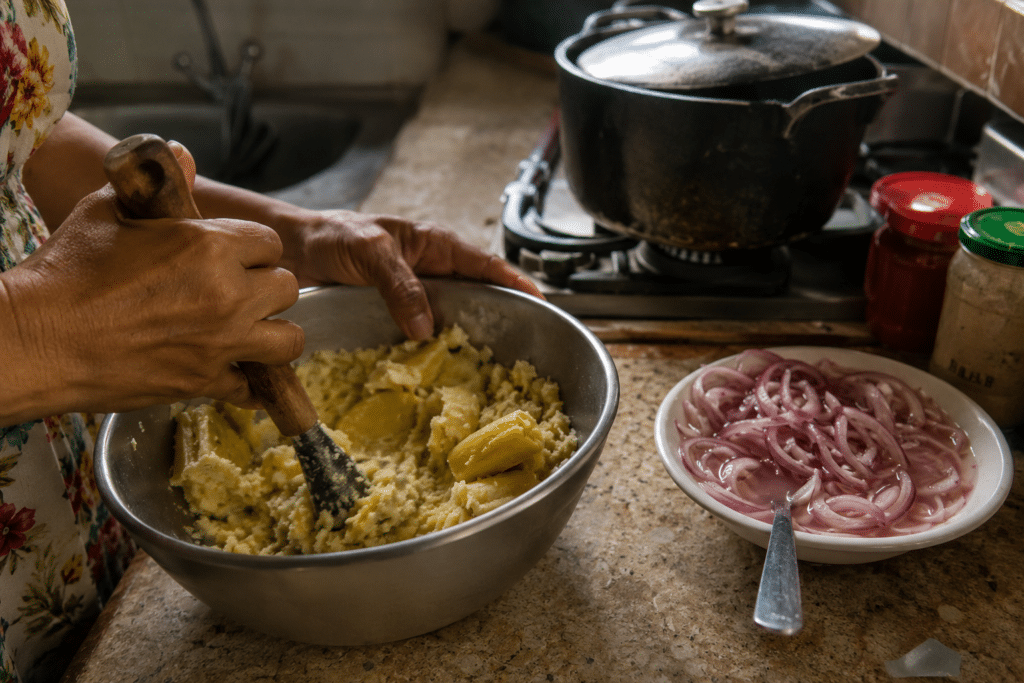
At daybreak, in many neighborhoods of Santo Domingo, kitchens come to life with a simple task: mashing green plantains after they’ve been cooked. This purée is often topped with red onions marinated in vinegar, Dominican salami, fried cheese, and eggs. This iconic breakfast dish has a short name: mangú. Behind this familiar word lie Dominican culinary history, African heritage, and an etymology that is still debated.
A Word for an Everyday Dish
Mangú refers first and foremost to a dish made from green plantains that are boiled and then mashed into a smooth purée. Depending on the family, cooking water, butter, or oil may be added to adjust the texture. Red onions, often sautéed with vinegar, add a tangy note that contrasts with the sweetness of the plantains.

The dish is often served with “los tres golpes,” literally “the three bites”: fried Dominican salami, queso de freír, and fried eggs. This combination has become one of the most recognizable symbols of the Dominican breakfast. While it does not hold official status as a national dish, it plays a major role in the country’s eating habits and in how it presents its cuisine to the world.

African Roots on Your Plate
The origins of mangú are generally traced back to African traditions of boiled, pounded, or mashed starchy foods. These culinary practices crossed the Atlantic with enslaved Africans and later evolved according to the available ingredients and local customs.
In the Caribbean and Latin America, several dishes also feature mashed plantains. Puerto Rican mofongo is most often made with fried and mashed plantains. In Cuba, fufú de plátano is prepared differently. In Colombia, cayeye is generally made with cooked green plantains, while the Ecuadorian bolón often combines plantains with various toppings. These recipes are not identical, and their names do not necessarily share the same origin. However, they reflect culinary influences linked to the African history of the Americas.

An Etymology That Remains Open
The exact origin of the word “mangú” remains unclear. One commonly cited theory links it to “mangusi,” which is said to be a term originating from the Congo Basin. However, this theory is not supported by linguistic evidence that is clear enough to be considered a certainty.
Another story goes that an American soldier, during the occupation of the Dominican Republic that began in 1916, tasted the dish and exclaimed, “Man, good! ” The Dominicans then supposedly transformed this phrase into “mangú.” The story is popular, but the chronology contradicts it. The word was already attested in 1899 in a text by Francisco Ortea devoted to linguistic usages observed in the country.
This evidence alone is not enough to resolve the entire etymology. It does, however, show that the term did not originate during the American occupation. Rather than choosing between two tenuous accounts, it is more rigorous to acknowledge that the word’s origin remains open to interpretation. The dish may have African roots without its name being automatically linked to a specific African language.
From the Homeland to the Diaspora
Today, mangú is enjoyed far beyond just breakfast. It can be served at various times of the day and remains a staple in Dominican restaurants throughout the diaspora, particularly in New York, Miami, and Madrid. In the United States, home to more than two million people of Dominican descent, this dish retains strong sentimental value. While its texture, toppings, and presentation vary from family to family, its presence serves as an immediately recognizable point of connection across generations, both in the Dominican Republic and in communities around the world.

For many, a plate of mangú evokes home cooking, a Sunday morning, or a shared meal. The word doesn’t encapsulate the entire Dominican Republic, but it captures an intimate part of it: the traditions passed down, the adapted flavors, and the stories we continue to explore.
Next week, RK Words will cross another sea. We’re heading to Jamaica to explore “bashment,” a word from Jamaican patois associated with partying, dancehall, and a whole new way of taking the stage.

Mangú is a Dominican dish made from green plantains that are boiled and then mashed into a smooth purée. It is often served with red onions dressed in vinegar. Although it is commonly associated with breakfast, it can also be eaten at other times of the day. Mangú holds an iconic place in home cooking and in the culinary identity of the Dominican Republic.
The exact origin of the word “mangú” remains uncertain. One theory links it to a term supposedly originating in the Congo Basin, but this theory lacks solid linguistic evidence. Another account claims that the word comes from the English expression “Man, good! ,” which was used during the American occupation of the Dominican Republic. This version is contradicted by a written record of the word dating back to 1899, before the occupation began in 1916.
“Los tres golpes,” or “the three accompaniments,” refers to the three side dishes traditionally served with mangú: fried Dominican salami, the cheese used for frying called queso de freír and fried eggs. This combination makes up one of the most recognizable breakfasts in the Dominican Republic. Depending on the family or restaurant, the dish may also include red onions or avocado.