


World Steelpan Day: In Trinidad, Young People March Alongside the Pioneers

Journée mondiale du steelpan

This Tuesday, August 11, Trinidad and Tobago celebrates World Steelpan Day with a program built around a powerful idea: connecting those who shaped the movement with the generation that must now carry it forward. In Port of Spain, performances by youth orchestras, the Ancestral Walk, and a closing concert come together to create a day where memory does not stand still. It flows, is played out, and is passed on.

In Port of Spain, a day designed to symbolize a passing of the torch

Pan Trinbago has chosen “Rhythm and Rise: Youth. Discipline. Culture. Community.” as the theme for the 2026 edition. This choice is no coincidence. For this World Steelpan Day, the organization is clearly placing youth at the center of the program, while paying tribute to the movement’s pioneers. The celebration begins at the Massy Trinidad All Stars Steel Orchestra’s panyard, featuring youth ensembles from various regions of the country.

This approach immediately gives the event a different meaning. It is not just about celebrating an instrument that has become one of Trinidad and Tobago’s most recognizable cultural symbols. It is also about showing how a legacy continues to live on when it is entrusted to new hands.

The Ancestral Walk: At the Heart of the Tradition

At 1:30 p.m., the Ancestral Walk winds through the streets of Port of Spain in tribute to the pioneers of the steelpan movement. The walk then proceeds to the bp Renegades Steel Orchestra’s panyard, where a new showcase dedicated to young pannists is announced. This is likely the most powerful gesture of this World Steelpan Day. The elders are not honored in a segment separate from the rest of the program. Their legacy is directly linked to those who play today. The march thus becomes a symbolic bridge between generations: recognizing those who paved the way, then giving a voice to those who will continue along that path.

World Steelpan Day
@Pan Trinbago
World Steelpan Day
@Pan Trinbago

Youth in the Spotlight

The rest of the day follows this same theme. At 5:30 p.m., Queen’s Park Savannah will host a concert featuring several youth steel orchestras from across the country. Pan Trinbago is presenting this event as a tribute to the past, present, and future of the steelpan.

On World Steelpan Day, young people are not relegated to the sidelines of an official ceremony. They take center stage at the performances, the panyards, and the closing event. The message goes beyond the musical performance. It serves as a reminder that passing on a culture also depends on spaces where young people can learn, rehearse, play together, and find their place in a community.

World Steelpan Day

Global recognition, rooted in Trinidad and Tobago

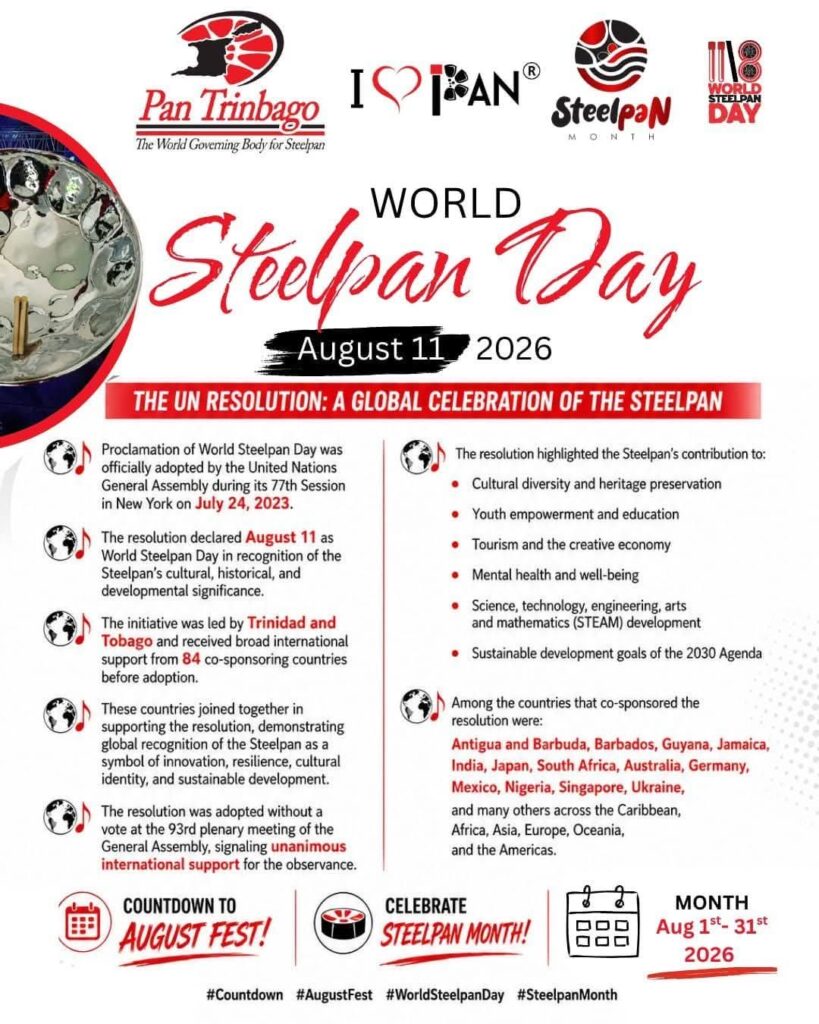
Since 2023, August 11 has been recognized by the United Nations General Assembly as World Steelpan Day. The resolution highlights, in particular, the cultural and historical significance of the instrument, which originated in Trinidad and Tobago, as well as its potential contribution to sustainable development, inclusive communities, and youth empowerment. This recognition gives the steelpan international visibility. But the celebration held in Port of Spain reminds us of something essential: global recognition is no substitute for local roots. The steelpan continues to be passed down through steelbands, panyards, families, and communities that keep this tradition alive on a daily basis.

In 2026, the World Steelpan Day thus demonstrates that international recognition truly comes into its own when it flows back to the region, its communities, its traditions, and those who carry them forward.

World Steelpan Day

Bringing Heritage to Life, Beyond Celebration

World Steelpan Day can thus be seen as more than just a commemorative date. In Port of Spain, it takes the form of a dialogue between memory and the future. The pioneers are honored, young people take the stage, and the audience joins in.

The real challenge, however, begins after the concerts. A global day of celebration may honor a cultural heritage, but it does not guarantee its transmission. That depends on the musicians, educators, steelbands, and venues that enable new generations to practice. So on this August 11, Trinidad and Tobago reminds us of a simple truth: for the steelpan to continue to resonate tomorrow, we must make room today for those who will write its next chapter.

World Steelpan Day is celebrated every August 11. Recognized by the United Nations General Assembly since 2023, it highlights the cultural and historical significance of the steelpan, an instrument native to Trinidad and Tobago.

In 2026, the celebrations in Port of Spain will focus on intergenerational transmission. The program includes performances by youth steel orchestras, an Ancestral Walk honoring the pioneers, and a concert at Queen’s Park Savannah.

The 2026 theme, “Rhythm and Rise: Youth. Discipline. Culture. Community.”, puts youth at the center. The goal is to show that the steelpan tradition is passed on through the new generations who are learning, practicing, and evolving this cultural heritage.

Leave a Reply

Your email address will not be published. Required fields are marked *

More articles from RK

Journée mondiale du steelpan
EVENT MANAGEMENT
Tolotra

World Steelpan Day: In Trinidad, Young People March Alongside the Pioneers

This Tuesday, August 11, Trinidad and Tobago celebrates World Steelpan Day with a program built around a powerful idea: connecting those who shaped the movement with the generation that must now carry it forward. In Port of Spain, performances by youth orchestras, the Ancestral Walk, and a closing concert come together to create a day where memory does not stand still. It flows, is played out, and is passed on. In Port of Spain, a day designed to symbolize a passing of the torch Pan Trinbago has chosen “Rhythm and Rise: Youth. Discipline. Culture. Community.” as the theme for the 2026 edition. This choice is no coincidence. For this World Steelpan Day, the organization is clearly placing youth at the center of the program, while paying tribute to the movement’s pioneers. The celebration begins at the Massy Trinidad All Stars Steel Orchestra’s panyard, featuring youth ensembles from various regions of

Read More »
Well mudda sick
HISTORY & HERITAGE
Tolotra

“Well mudda sick!”: But what do these three words really mean?

In the Bahamas, three words are enough to express surprise even before you realize what just happened. Good news breaks, a plan falls through, something exceeds expectations: “Well mudda sick!” might pop up in conversation. Taken literally, the meaning is confusing. In Bahamian usage, however, the expression is much simpler than it seems. Three words that don’t really translate word for word “Well mudda sick!” literally translates to “Well, my mother is sick.” But that’s not what a Bahamian means when they use it. Instead, the expression functions more like an exclamation: “Wow!”, “Oh my!”, “Unbelievable!”, or even “My God!”, depending on the situation and tone. It is precisely this discrepancy that makes it interesting. Someone who knows every single English word can understand the sentence on paper and yet completely miss its meaning in conversation. Here, it’s not just the words that matter. Context, speed, and intonation play a

Read More »
Chattel house
HISTORY & HERITAGE
Tolotra

Chattel House: The Hidden Social History Behind Barbados’ Houses

At first glance, they catch the eye with their wooden facades, their colors, and their simple proportions. Yet Barbados’ chattel houses are not merely an architectural signature. Their form reflects a specific social reality: for a long time, some residents could own their homes without owning the land on which they stood. A chattel house therefore had to be movable. Chattel House: A Home Designed for Traveling To understand this unique aspect, we must look back to the post-emancipation period. In Barbados, the emancipation of enslaved people was completed in 1838. However, the island’s land structure remained deeply shaped by the sugar economy. As early as the 17th century, the expansion of sugarcane cultivation had led to the concentration of land in the hands of large plantations. After emancipation, many workers still lived on land belonging to the plantations. They could build a home and own it, without owning the

Read More »

conTACT RK

we'd love to have your feedback on your experience so far

Join The List

Join our Richès Karayib community!  Sign up for our newsletter.

Want To Maximize Your Business Presence On Riches Karayib?

Complete the form to start the application