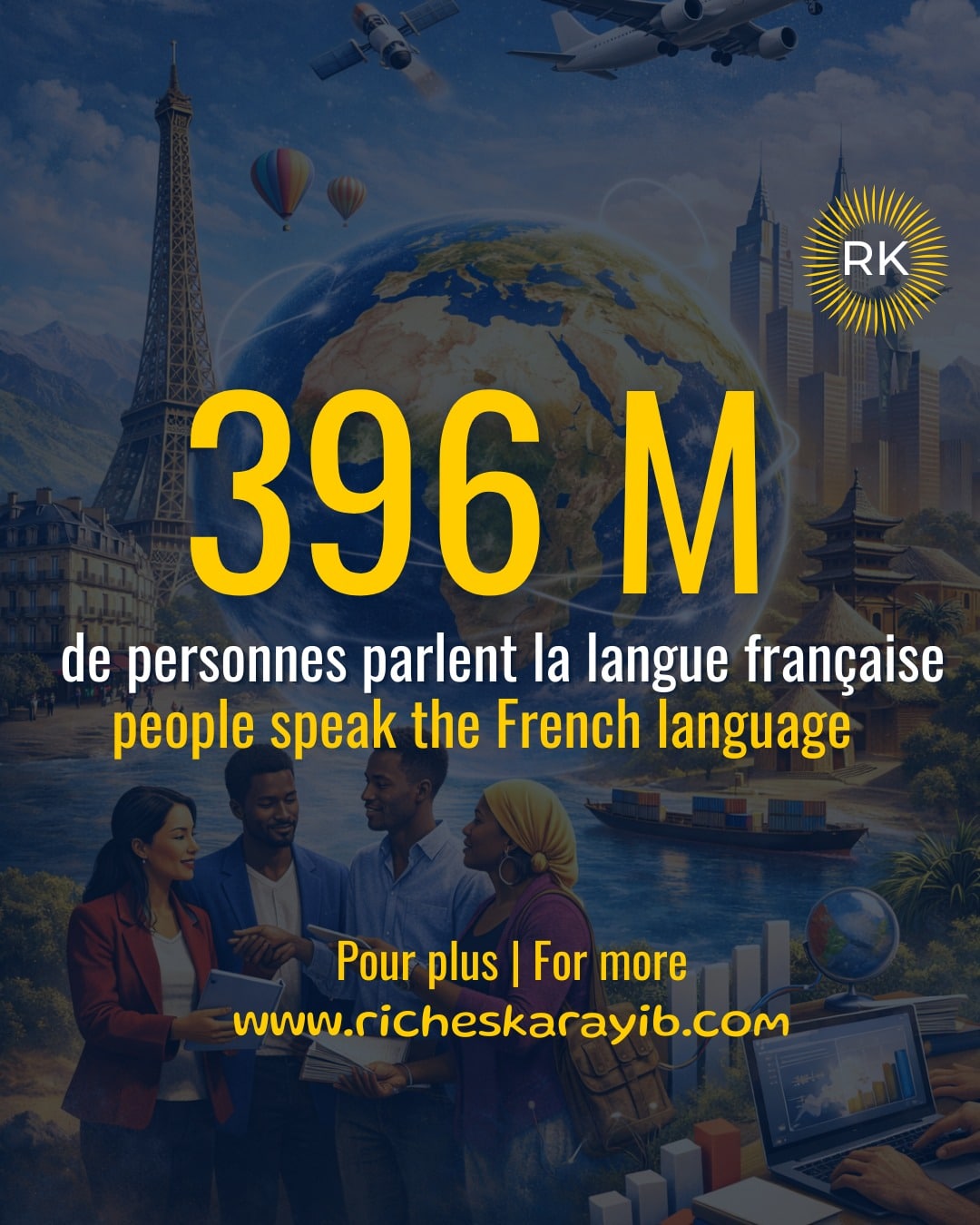
The Organisation internationale de la Francophonie has published a figure that reshuffles the deck in the global language debate: 396 million people now speak French. With this total, the French language in the world rises from 5th to 4th position behind English, Mandarin and Spanish, but ahead of standard Arabic. This is more than just an announcement. It marks a fundamental change in the place of French on the international stage, and confirms that the language continues to make headway in strategic areas such as education, economic exchanges, digital technology and cultural mobility.
Global progress changes the narrative around French
For years, French has often been portrayed as a language of great influence, but weakened in the face of global competition. The OIF’s 2026 report introduces an important corrective. The French language in the world is not only holding its own: it is gaining ground in terms of the number of speakers and international visibility. Moving up to 4th place in the world ranking not only gives it strong symbolic weight, but also political, educational and economic weight. A language that rises in the world rankings is not simply a language handed down by heritage; it’s a language that continues to be learned, used, relayed and invested in.
French should not be analyzed solely as an institutional or diplomatic language. It remains a language of concrete circulation, spoken, taught, worked on and adapted to very different contexts. The French language in the world today is driven by demographic and social realities that go far beyond the European framework, and this is precisely what the 2026 report highlights.

396 million speakers: what this figure really means
The figure of 396 million must be read with care. It refers to a linguistic community spread over the five continents and not a homogeneous block. This means that French continues to exist in a wide variety of contexts: as a mother tongue for some, as a language of instruction for others, and as an administrative, professional, cultural or communication language in multilingual societies. This diversity is at the heart of the French language in the world as it really exists in 2026.
This fact also has a strong editorial impact. It reminds us that we can no longer speak of French as a language confined to a single territory or a single national history. French circulates in very different spaces, with multiple uses and its own dynamics. It is this plurality that is its strength today. So the figure of 396 million doesn’t just tell of an increase; it tells of the geographical, social and cultural scope of a global language.

Africa, the decisive center of gravity for the French language worldwide
One of the key findings of the 2026 report is the importance of the African continent. The OIF states that 65% of French speakers live in Africa. This proportion alone is enough to shift the focus. The future of French is no longer being played out primarily in the areas where it has long concentrated its institutional prestige; it is now being played out in young, numerous, urban, creative African societies, with profound educational and economic issues at stake.
This reality forces us to rethink old ideas. Talking about french language around the world without acknowledging the central role of Africa would be to miss the main point of the report. The growth of the French language today depends not only on powerful demographic dynamics, but also on the ability of African education systems, media, cultural industries and French-speaking economies to maintain and expand the use of French. The report’s focus on Africa is not a footnote; it is a structuring element.
A language that's also moving forward through schools, digital technology and business
The 2026 report points out that French is the 2nd most widely-learned foreign language in the world, with almost 170 million learners, confirming its importance in education systems and its appeal well beyond the French-speaking world… It is also listed as 4th most popular language on the Internet and 3rd language of business and economics. These factors give substance to the figure of 396 million: they show that the growth of the French language is based not only on demographics, but also on learning, digital uses and the professional value of the language.
This data is extremely important today. A world language doesn’t just exist through its past or its official status. It also exists through its ability to remain visible in search engines, digital content, educational networks, platforms, commercial exchanges and working environments. The report therefore suggests a more comprehensive reading: the The French language continues to be of practical use around the world, which helps to explain its resilience and progress.
2050: why do IOF projections already count today?
The report’s other strong point is its projection for the coming decades. The IOF estimates that, on current trends, French could be spoken by 590 million people in 2050 including 9 out of 10 in Africa. This is not a mechanical certainty, but a projection based on observed dynamics. It highlights a central issue: the future progress of French will depend less on symbolic rhetoric than on policies for education, training, transmission and access to content.
In other words, the future of the French language in the world is more than just a flattering ranking. It depends on very concrete decisions: quality of teaching, presence of French in career paths, adaptation to digital uses, cultural and media production, the place of the language in student and economic mobility. The 2026 report therefore gives a positive signal, but this signal remains linked to conditions of consolidation.

What the 396 million figure really says
TheOIF ‘s 2026 report not only delivers an impressive total. It redraws the mental map of contemporary Francophonie. 396 million people speak French; the language is moving up the world rankings; its African roots are strengthening; and its weight in learning, the digital world and the economy remains significant. Taken together, these elements provide a more accurate picture of the French in the world: an international language, diverse, in transformation, and still capable of widening its scope.
For a media outlet, a cultural player, an educational institution or a company, this observation has a clear consequence: French should not be seen as a language of retreat, but as a language of the future, provided it is considered in all its geographical and social diversity. This is where the real interest of the 2026 report lies: behind the number lies a reshaping of the global linguistic landscape.
According to the report The French language in the world 2026 published by the Organisation internationale de la Francophonie, 396 million people around the world now speak French. This is an important figure, as it shows that the French language retains real international weight and continues to make inroads into the global linguistic landscape. It is not just a language inherited from a shared history between several countries, but one that is still transmitted, learned and used in very different educational, economic, administrative and cultural contexts.
According to the OIF, French is now the 4th most widely spoken language in the world, behind English, Chinese and Spanish, and ahead of standard Arabic. This change in rank is significant, as it reflects a concrete evolution in the place of French on a global scale. This ranking reinforces the idea that French remains a major international language, present in many fields, and that it should no longer be considered as a purely institutional or heritage language.
The growth of the French language can be explained by a number of complementary factors. Firstly, the language benefits from a strong demographic dynamic in several French-speaking countries, particularly in Africa, where the majority of French speakers now live. Secondly, French continues to play an important role in education, international cooperation and certain economic sectors. The OIF also points out that French remains the 2nd most widely-learned foreign language, with almost 170 million learners, showing that it continues to attract people far beyond the territories where it is an official language.